Roofing Software: Estimating & Quoting Tools for Contractors
Top Lead Estimating and Quoting Software for Roofing Contractors: A Comprehensive 2026 Market Analysis

The 2026 Macroeconomic Landscape of Exterior Contracting
The residential and commercial roofing sector has entered a period of profound technological maturation. Market data from the fourth quarter of 2025 indicates a highly optimistic outlook for the 2026 fiscal year, with 75% of exterior contractors forecasting revenue increases and 74% projecting higher overall profit margins. However, this optimism is counterbalanced by severe operational pressures. Rising labor and overhead costs are identified by 39% of contracting firms as the primary existential threat to their business, closely followed by chronic skilled labor shortages, cited by 34% of the industry. To combat these margin-eroding forces, roofing operations are aggressively pivoting toward efficiency optimization, with 60% of companies prioritizing labor cost reduction and 45% focusing on material cost containment.
These macroeconomic realities have fundamentally altered the software procurement strategies of modern roofing enterprises. Historically, the industry experienced a phase characterized by the prioritization of affordable, rudimentary Customer Relationship Management (CRM) tools. This approach resulted in a fragmented “Frankenstein stack,” wherein contractors stitched together disparate applications for aerial measurements, estimating, project management, and accounting. In 2026, this paradigm is collapsing under the weight of its own administrative overhead. Contemporary survey data reveals that 47% of exterior contractors now prioritize a robust, integrated suite of production features over base affordability, which is prioritized by a mere 6% of the market. The industry is moving decisively toward full workflow orchestration, demanding centralized platforms that seamlessly bridge the gap between initial lead capture, precision estimating, and final production.
The Foundational Layer: Aerial Measurement and Data Acquisition
The accuracy of any roofing estimate is entirely dependent on the precision of the underlying geometric data. The era of estimators manually scaling roofs with tape measures is rapidly concluding, replaced by sophisticated remote measurement technologies. However, the methodology and cost structure of acquiring this data vary significantly across the software landscape.
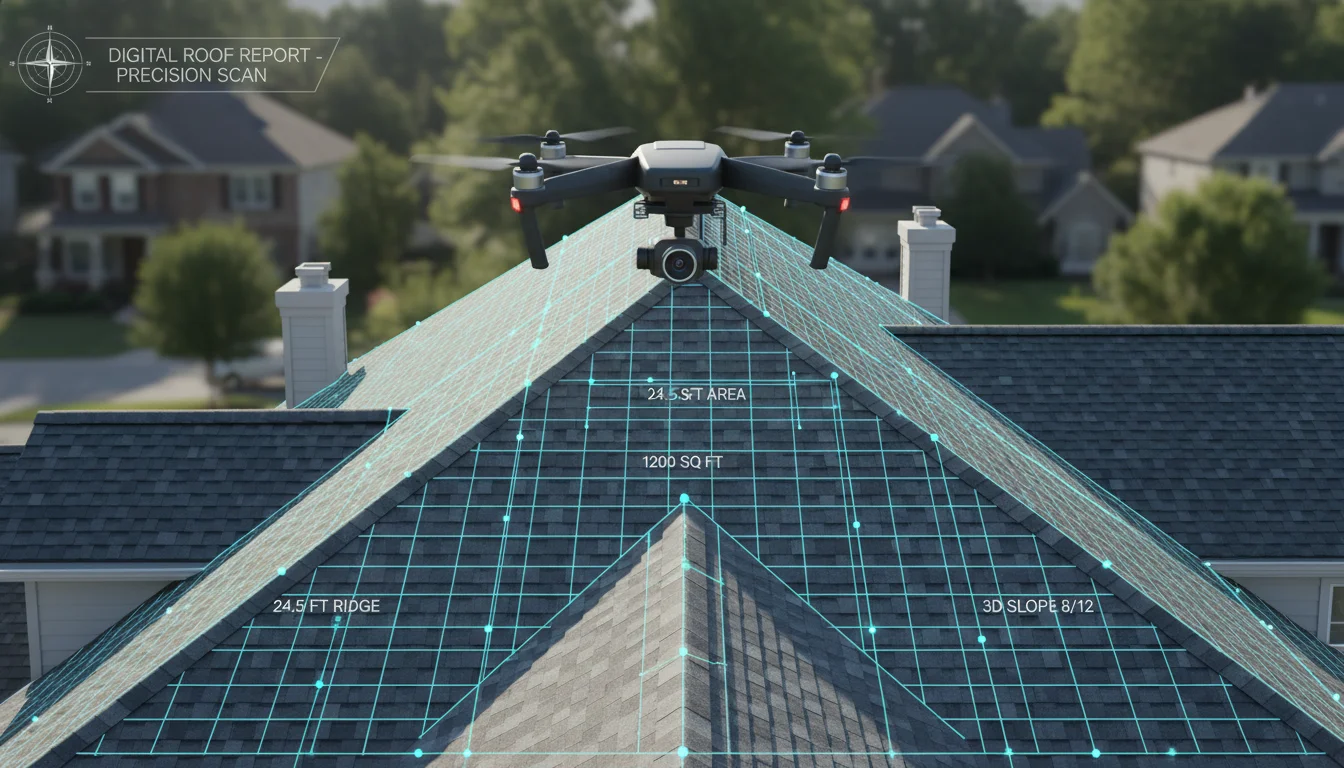
High-Resolution Aerial and LiDAR Technologies
EagleView remains the industry standard for uncompromising geometric accuracy, highly favored in insurance restoration workflows. Utilizing proprietary arrays of high-resolution aerial imagery captured by specialized aircraft and drones, EagleView reports boast a confirmed accuracy rate of 98.77% across complex rooflines, with roof area measurements averaging a marginal difference of merely 5.61 square feet. This level of precision eliminates the requirement for site visits or user-submitted photographs. However, this accuracy carries a premium variable cost, with base roof reports typically starting around $40 and exterior wall reports scaling up to $75.
Airplane-Derived Imagery and the Canopy Problem
A pervasive challenge with satellite-derived measurement tools is seasonal tree canopy coverage, which obscures roof facets and compromises measurement integrity during spring and summer months. Platforms like iRoofing bypass this limitation through proprietary technologies such as Clearoof. Clearoof utilizes high-resolution imagery captured by low-flying airplanes rather than satellites, deliberately capturing imagery during late fall and winter to eliminate foliage obstruction. Available in over 90% of geographic areas, this technology allows contractors to perform highly accurate do-it-yourself (DIY) measurements within ten minutes.
Satellite and Mobile Sketching Integration
Platforms like Roofr provide instant satellite-derived measurements integrated directly into the CRM workflow. Roofr promises report delivery in as little as two hours, providing architectural roof plans encompassing facets, pitch, eaves, valleys, and hips. Conversely, tools like RoofSnap cater to fast-moving field representatives by providing mobile on-roof measurement capabilities, enabling users to trace lines over high-accuracy aerial imaging provided by Nearmap, assisted by patent-pending artificial intelligence to identify pitch and differentiate line types.
| Measurement Platform | Core Technology | Accuracy / Precision Metrics | Primary Use Case | Reported Pricing |
|---|---|---|---|---|
| EagleView | Aircraft/Drone Aerial Imagery | 98.77% linear accuracy | Insurance claims, high-precision replacements | ~$40 - $75 per report |
| iRoofing (Clearoof) | Seasonal Airplane Imagery | 99% professional-grade accuracy | Retail roofing, DIY measurements | Included in $129-$149/mo subscription |
| Roofr | Satellite / Drone Uploads | High accuracy, fast turnaround | Integrated CRM workflow, rapid quoting | $13 - $19 per report |
| RoofSnap | Nearmap Aerial / AI Assist | High accuracy AI-assisted tracing | In-field mobile sketching | Subscription-based |
Algorithmic Waste Calculation and Material Optimization
Following the acquisition of accurate roof measurements, the critical next phase is calculating material requirements. A persistent vulnerability in traditional estimating is the reliance on the outdated “10 percent rule,” wherein estimators uniformly add 10% to 15% to the total square footage to account for shingle waste, overlaps, and installation errors.
This generalized methodology introduces severe financial risks. Under-ordering halts project momentum, resulting in costly delays, while over-ordering erodes net profit margins and incurs unnecessary disposal fees for unused pallets of shingles or underlayment. Advanced estimating software rectifies this through algorithmic waste calculators. Applications such as OneClick Code calculate tailored waste percentages derived from the specific geometry of the roof, factoring in the frequency of hips, valleys, dormers, and the specific installation requirements of architectural versus 3-tab shingles. By integrating precise waste factors directly into the estimating engine, roofing operations can meticulously optimize material purchase orders, protecting profit margins at the granular level.
The Mechanics of the Modern Estimating Engine
The transition from static spreadsheet estimates to dynamic software engines represents the most significant operational upgrade for exterior contractors. Modern estimating modules are sophisticated financial calculators that integrate live supplier data, dynamic labor tracking, and profit margin logic.
Spec-Based Estimate Templates (SBET)
Enterprise-grade platforms, particularly ServiceTitan, deploy Spec-Based Estimate Templates (SBET) to automate the translation of raw field data into finalized proposals. The mechanism relies on digital forms completed by field representatives. When an estimator inputs specific variables—such as attic square footage, roof pitch, and linear feet of eaves—the SBET automatically links these fields to a centralized Pricebook. The software subsequently performs algorithmic quantity calculations, automatically determining the precise number of intake vents, exhaust vents, and bundles of shingles required without manual intervention.
Configurable Material Architecture
Managing material databases for roofing is notoriously complex due to the sheer volume of product variants. A single line of architectural shingles may feature twenty distinct color options. To prevent database bloat, advanced platforms utilize configurable material architectures. Instead of creating separate database services for each color combination, the software utilizes a generic material container (e.g., “CertainTeed Landmark”). When generating the estimate, the software allows the customer or sales representative to select the specific color variant. The system automatically adjusts the pricing based on the selected variant and updates the material order, seamlessly integrating with supplier catalogs such as SRS Distribution, ABC Supply, and QXO without requiring redundant manual setup.
Dynamic Baseline Tracking and Labor Placeholders
The efficacy of an estimate is ultimately validated by the actual production costs. Production-focused systems like BuilderPrime bridge this gap through dynamic baseline tracking. During the estimating phase, the software allows contractors to assign “labor placeholders” within the project templates—such as a generic “Crew Lead” or “Install Tech”—assigned a specific hourly rate or per-square payout.
Upon contract execution, the initial estimate establishes a financial baseline. As production commences, the project manager replaces the placeholders with actual personnel and logs the actual hours worked. If a subcontractor requires ten hours of labor for a subtask originally estimated at eight hours, the software’s grid view immediately highlights the financial variance against the baseline. This real-time visibility into the delta between estimated and actual costs prevents margin bleed and informs the adjustment of future estimating templates.
Margin-Based vs. Markup-Based Pricing
Financial sophistication is a key differentiator among estimating tools.
While entry-level software often utilizes basic markup calculations (adding a flat percentage to the total cost), platforms engineered for complex operations, such as AccuLynx, allow estimators to build quotes based on targeted gross profit margins. This ensures that the final price accurately reflects the desired profitability after factoring in variable overhead, labor burdens, and material fluctuations, providing tighter financial control over the enterprise.
Digital Proposals and the Psychology of Quoting
In the highly competitive retail roofing market, the presentation of the estimate is as critical as the mathematical accuracy of the costs. Software platforms have engineered their proposal modules to leverage consumer psychology, maximizing close rates and increasing average ticket values.

The Good / Better / Best Architecture
Industry analytics reveal that 97% of consumers experience hesitation when presented with a single pricing option, leading to delayed decision-making and reduced conversion rates. Consequently, quoting software has standardized the “Good, Better, Best” proposal framework. Platforms such as Roofr, Leap, and AccuLynx enable sales representatives to generate multi-tiered proposals simultaneously.
Within a platform like Roofr, estimators can toggle features to display specific line-item details, set profitability types (margin or markup), and allow customers to select multiple options prior to executing a digital signature. This side-by-side presentation shifts the consumer’s psychological framing from “Should I purchase this roof?” to “Which tier of this roof should I purchase?”, naturally facilitating upselling to premium architectural shingles or extended warranty packages.
Presentation and Sales Enablement
As discussed by industry experts during Roofr Masterclass sessions, a raw numerical estimate is insufficient in 2026; proposals must function as comprehensive sales presentations. Software platforms facilitate this by allowing the integration of personalized cover photos, detailed “About Us” narratives, and automated inclusion of digital product brochures and warranty documentation directly into the PDF or web-based proposal.
Furthermore, sales enablement platforms like Leap are engineered specifically for the point-of-sale environment. Operating seamlessly on mobile devices, Leap allows representatives to navigate visual presentations, overcome objections, and present dynamic contracts in the homeowner’s living room.
Integrated Point-of-Sale Financing
The inclusion of financing options is a critical driver of revenue. Integrated software architecture allows platforms to embed consumer financing applications directly into the digital proposal.
Integrations with financial institutions such as GreenSky (via Leap) or Wisetack (via Jobber) allow homeowners to apply for credit, receive approval, and select monthly payment terms concurrently with signing the digital contract. This removes friction from the purchasing process and empowers homeowners to opt for higher-tier roofing systems by amortizing the cost over time.
Financial Architecture and Total Cost of Ownership (TCO)
A systemic failure in software procurement occurs when roofing operations evaluate platforms solely based on advertised entry-level pricing. The SaaS (Software as a Service) ecosystem in the construction vertical utilizes highly complex, multi-layered monetization strategies. Accurately modeling the Total Cost of Ownership (TCO) over a three-to-five-year horizon is imperative to prevent budget overruns.
The Per-User Licensing Paradigm
The most prevalent monetization model is per-user licensing. Platforms such as AccuLynx and JobNimbus mandate a base platform fee, supplemented by individual licensing costs for every active user. This model scales aggressively with organizational growth. An analysis of the JobNimbus pricing structure reveals granular role-based pricing: Administrator seats incur a $75 monthly fee, sales and office staff are billed at $55 per user, field technicians at $30, and subcontractors at $20. Consequently, a rapidly expanding roofing company faces compounding software liabilities with every new hire, which often disincentivizes the onboarding of field crews, thereby creating data silos.
AccuLynx operates similarly, with premium per-user fees reportedly ranging from $60 to $120 per user, causing monthly software expenditures to easily exceed $1,200 for a medium-sized team.
Enterprise Per-Technician Models and Implementation Tariffs
Enterprise service management systems like ServiceTitan utilize a distinct per-technician licensing model. The software fee is calculated based on the number of revenue-generating field technicians, typically ranging from $245 to $500 per technician, per month, depending on the selected tier.
While office staff seats may be included without additional charges, the absolute cost remains exceptionally high. Furthermore, adopting an enterprise system requires a substantial capital expenditure for initial setup. Implementation and onboarding fees for ServiceTitan routinely range from $5,000 to $50,000, reflecting the intense customization required to configure the platform for complex, multi-trade operations.
The Flat-Rate Rebellion
In stark contrast to per-user models, platforms like Projul have engineered their financial architecture around flat-rate pricing. Projul charges a single annual fee—starting at $4,788 for its Core tier and $7,188 for the Core+ tier—which grants access to an unlimited number of users.
This model provides absolute predictability in operating expenses and encourages full-company adoption from the executive suite down to the newest subcontractor.
Hidden Fees: Usage Tariffs and Payment Processing
Beyond licensing, contractors must meticulously audit secondary usage fees.
- Measurement Tariffs: Platforms prioritizing integrated aerial measurements often monetize report generation. Roofr charges a variable fee of $13 to $19 per roof measurement report, depending on the user’s subscription status. For high-volume operations performing dozens of estimates weekly, these usage fees can aggregate to thousands of dollars annually, prompting some contractors to migrate toward platforms offering unlimited measurements within a flat subscription.
- Communication Modules: Essential tools such as two-way SMS communication are frequently sequestered behind add-on paywalls. For instance, the JobNimbus “Engage” texting module requires supplemental monthly fees ranging from $49 for basic access to $249 for premium capabilities.
- Payment Processing: As CRMs transition into payment facilitators, processing tariffs become a critical variable. JobNimbus Payments levies a 3.2% fee plus $0.29 per credit card transaction. On a standard $15,000 roof replacement, this equates to $480 in processing fees.
In response to this margin erosion, platforms like Roofr have introduced automated “Platform Fees,” an automated compliance mechanism that shifts the 2.8% credit card processing fee directly to the consumer on the final invoice, thereby preserving the contractor’s net profit.
| Software Platform | Licensing Architecture | Base/Tier Monthly Cost | Per-User Add-on Cost | Hidden / Add-on Cost Considerations |
|---|---|---|---|---|
| ServiceTitan | Per-Field Technician | N/A (Min Spend ~$1,500) | ~$245 - $500 / tech | $5,000 - $50,000 Implementation Fee |
| AccuLynx | Per-User License | Custom (Base ~$250) | ~$60 - $120 / user | New features often require add-on fees |
| JobNimbus | Base + Role-Based | $225 - $550+ | $20 - $75 / user | Texting ($49-$249/mo), CC Fees (3.2%) |
| Roofr | Seat-Tiered | $99 - $349/mo | $0 (within tier limits) | $13 - $19 per aerial measurement report |
| Projul | Flat-Rate (Unlimited) | $0 (Billed Annually) | $0 | High upfront annual payment ($4,788+) |
Field Operations, Mobile Architecture, and Technician Adoption
The most sophisticated algorithmic estimating engine provides zero return on investment if the field crew refuses to utilize the software. User adoption at the site level is heavily dependent on the mobile architecture, offline reliability, and the user interface (UX) designed for workers operating in high-friction environments—often involving direct sunlight, heavy work gloves, and absent cellular connectivity.
The Native Application Imperative
For heavy production management, fully native mobile applications deployed via iOS and Android are generally superior. Recognizing that field technicians utilize the mobile app at nearly double the rate of the desktop version, ServiceTitan recently undertook a massive overhaul to rebuild its Field Mobile App as a purely native experience, moving away from its legacy tablet-first view.
This architectural shift to native code, augmented by “Atlas AI,” allows for robust offline data caching and real-time syncing that has resulted in a 99.99% crash-free rate.
Similarly, JobNimbus relies on a highly rated (4.8 stars) native application to connect the field to the office.
The JobNimbus app facilitates vital field workflows such as offline data access, in-app photo annotation (allowing technicians to highlight roof damage directly on images), and specialized portals for subcontractors. This subcontractor access allows external crews to view job details, complete assigned tasks, and upload documentation without gaining visibility into the roofing company’s sensitive financial data or broad customer lists.
Progressive Web Applications (PWA)
A divergent approach to mobile deployment is the utilization of browser-based mobile experiences, or Progressive Web Apps.
Roofr recently refreshed its mobile interface to deliver an app-like experience directly through the smartphone’s web browser, entirely bypassing the Apple App Store and Google Play Store. This ensures that the software is perpetually updated without requiring manual downloads and maintains absolute parity with the desktop experience. However, browser-dependent systems can experience latency or functionality degradation in remote areas where cellular networks are unavailable, a frequent occurrence in residential contracting.
UX Simplification and Permissions
Software bloat is a primary catalyst for field abandonment. Applications that require excessive navigation to complete fundamental tasks are routinely rejected by laborers. Projul actively combats this through strict permission-based UI rendering. While a project manager accessing Projul will view comprehensive budgets, schedules, and client communications, a field laborer logging into the same application will exclusively view their daily task list and the geolocation-fenced time clock. By restricting views and utilizing oversized interactive elements designed for users wearing work gloves, the platform dramatically reduces the learning curve and prevents sensitive financial data from circulating on the job site.
Comprehensive Platform Evaluations
To facilitate strategic procurement, the following section provides a granular analysis of the dominant software platforms in the 2026 exterior contracting market, assessing their core competencies, estimating mechanics, and operational limitations.
AccuLynx: The Production-Driven Enterprise Standard
AccuLynx operates as a comprehensive, all-in-one roofing management platform explicitly designed for production-driven operations. It serves as a unified command center, synchronizing field and office data in real time.
Core Competencies: AccuLynx possesses one of the most exhaustive native feature sets available, heavily mitigating the need for third-party software. Its paramount advantage lies in its deep, direct API integrations with elite industry suppliers, including ABC Supply, SRS Distribution, and QXO. This connectivity allows estimators to pull live material pricing and directly execute purchase orders from within the estimating module. Furthermore, its “Smart(er) Docs” capability dynamically pulls data from multiple estimates to rapidly generate Good/Better/Best pricing tiers. The software calculates estimates based on targeted gross profit margins rather than simplistic markup models, providing superior financial control. Its integration via “AppConnections” with lead-generation tools like Roofle automates the transition from online quote requests directly into the CRM pipeline without manual data entry.
Limitations: The platform demands a significant financial commitment. The per-user pricing architecture severely penalizes organizational growth, and users frequently note that emergent features are sequestered behind additional paywalls. The user interface, while robust, enforces a rigid workflow methodology; while stages can be customized, they must adhere to the unalterable structure of the preset dashboard, limiting flexibility for companies with unorthodox operational models.
ServiceTitan: The Multi-Trade Behemoth
ServiceTitan is the undisputed apex predator of the broader field service management industry, engineered to handle the immense complexities of rapidly scaling, multi-location, and multi-trade businesses (e.g., combining roofing, HVAC, siding, and plumbing).
Core Competencies: The platform’s architectural scale is unmatched. It features highly advanced real-time job costing flyouts that track profitability with granular precision. Its estimating engine relies on highly sophisticated Spec-Based Estimate Templates that automate quantity calculations derived from field forms. The platform dominates in operational visibility, offering enterprise-grade roll-up reporting across distinct business units, integrated point-of-sale financing, and AI-driven automation capabilities.
Limitations: ServiceTitan’s barrier to entry is formidable. Implementation requires intensive consultation, with setup fees spanning $5,000 to $50,000, often necessitating a temporary pause in operations to facilitate complex data migration and training. The recurring per-technician licensing fees ($245 to $500 monthly) render it economically inviable for standard residential roofing firms that do not require multi-trade enterprise capabilities.
JobNimbus: The Agile Workflow Orchestrator
JobNimbus bridges the divide between lightweight CRM tools and heavy production software, acting as a highly customizable project management hub.
Core Competencies: Unrivaled flexibility is the platform’s defining characteristic. Utilizing highly customizable Kanban boards, JobNimbus allows contractors to map distinct sales stages and automation rules to exactly match their physical workflows. A company can run completely independent pipelines for retail replacements, storm damage restorations, and commercial repairs within the same system. It provides a superior 4.8-star native mobile application equipped with photo annotation and dedicated subcontractor access.
Limitations: While the core functionality is robust, the platform relies heavily on an aggressive add-on monetization model. Base subscription costs are augmented by role-based user fees, and essential capabilities like two-way SMS communication and advanced estimating often require supplemental payments or integrations with third-party tools (like SumoQuote).
Roofr: The Sales-First Quoting Engine
Transitioning from a dedicated aerial measurement provider to a broader platform, Roofr is explicitly optimized for speed-to-lead and conversion at the top of the sales funnel.
Core Competencies: Roofr is unparalleled in rapid estimate generation. Its Instant Estimator widget can be embedded directly onto a contractor’s website, capturing homeowner data and instantly delivering a geographically accurate, customized quote based on the contractor’s internal pricing algorithms. It seamlessly links its high-accuracy satellite measurement reports into beautifully designed, digital Good/Better/Best proposals that feature integrated material ordering and e-signatures. The seat-based pricing model offers relief from the micro-transactions of per-user licensing.
Limitations: Roofr’s profound focus on the sales cycle leaves its production management and deep job costing features less mature than enterprise competitors. Furthermore, the reliance on per-report measurement fees ($13 to $19) can create substantial variable overhead for high-volume estimating teams.
BuilderPrime: The Unified Production Sync
BuilderPrime functions as a holistic CRM and production management hybrid, purpose-built for residential home improvement and roofing.
Core Competencies: The platform is engineered to eliminate the friction between the sales team and the production crew. Its integrated Price Book automatically synthesizes material and labor costs to rapidly build accurate estimates. The software excels in post-sale execution, utilizing labor placeholders to establish project baselines, subsequently tracking actual worker hours and material consumption to provide rigorous variance reporting and defend profit margins.
Limitations: The sheer depth of the production and financial tracking tools introduces a notable learning curve during initial deployment. User feedback indicates that while the desktop platform is exceptionally powerful, the mobile application experience occasionally lags and lacks absolute feature parity with the primary interface.
Projul: The Flat-Rate Generalist
Projul disrupts the traditional SaaS market with an aggressive pricing strategy and a highly intuitive interface tailored for construction generalists.
Core Competencies: The flat-rate, unlimited-user financial model ($4,788 to $7,188 annually) provides absolute cost predictability, allowing companies to scale headcount without penalty. The software offers excellent visual project coordination via Gantt charts and linear timelines. Field adoption is exceptionally high due to the simplified mobile interface, geofenced time tracking, and integrated photo reporting.
Limitations: Because it serves the broader construction industry, Projul lacks the highly specialized, roofing-specific integrations found in AccuLynx or Roofr—such as direct, native connectivity with roofing material distributors (ABC Supply) or specialized aerial measurement suites.
Leap: The Point-of-Sale Closer
Leap operates not as a comprehensive CRM, but as a specialized sales enablement platform engineered for in-home presentations.
Core Competencies: Leap is designed to empower sales representatives to overcome objections and close contracts during the initial site visit. Running flawlessly on mobile devices, it allows reps to build error-free estimates utilizing locked price libraries, present visual options, generate dynamic legal contracts, and capture digital signatures on the spot. Crucially, it embeds point-of-sale financing (e.g., GreenSky), allowing homeowners to secure immediate credit approval, significantly accelerating the sales cycle.
Limitations: Leap is a point solution for sales.
To manage scheduling, production, and long-term job costing, contractors must integrate Leap with a broader operational backend like JobNimbus or BuilderPrime, requiring the maintenance of a multi-software stack.
The Takeoff Specialists: EagleView, iRoofing, and RoofSnap
The foundational requirement of accurate geometric data sustains a market of specialized measurement and takeoff applications.
- EagleView: The undisputed leader in absolute precision, heavily favored for complex commercial projects and insurance restoration claims. While its 98.77% accuracy is unparalleled, the high variable cost of individual reports restricts its utility for routine retail estimates.
- iRoofing: Delivers a highly compelling alternative through its Clearoof technology. By utilizing airplane-derived imagery captured during off-seasons, it circumvents the tree canopy obstructions that plague satellite imagery. A flat-rate subscription ($129-$149 monthly) provides comprehensive DIY measurement tools, an AI visualizer, digital pitchbooks, and an allowance of $75 in HD imagery credits, making it an exceptionally cost-effective tool for independent estimators.
- RoofSnap: Prioritizes in-field speed. It empowers sales representatives to rapidly sketch roof dimensions on mobile devices using aerial imagery, instantly generating pitch calculations and preliminary material takeoffs to facilitate immediate quoting.
Onetrace: The Subcontractor’s Command Center
Onetrace abandons traditional sales-focused CRM pipelines, catering exclusively to the unique operational requirements of roofing subcontractors.
Core Competencies
The platform is a masterclass in site compliance and traceability. It enables production managers to upload complex roof drawings, drop specific pins corresponding to work zones, and mandate the capture of photographic evidence against those pins. By prioritizing workforce planning, GPS tracking, and safety compliance reporting, Onetrace aggressively mitigates the risks of rework and payment disputes that perpetually threaten subcontractor margins.
Jobber and QuoteIQ: The SMB Challengers
- Jobber: An exceptional entry point for small field service businesses transitioning from analog processes. It offers incredibly rapid onboarding, intuitive drag-and-drop scheduling, and automated invoicing with integrated payment processing. However, its generalist nature means it lacks the deep, multi-stage production workflows and material tracking necessary for complex roofing operations.
- QuoteIQ: Positions itself as a direct, cost-effective alternative to Roofr. By offering a flat monthly subscription ($29.99 - $189) that includes unlimited measurements, integrated SMS communication, and mobile applications, QuoteIQ appeals to contractors seeking to eliminate the variable usage fees associated with proprietary aerial reports.
Strategic Matrix and Procurement Conclusions
The selection of estimating and quoting software in 2026 must be dictated by a rigorous analysis of a roofing operation’s specific operational bottlenecks, financial architecture, and primary sales strategy. Procuring the software with the most expansive feature list is a flawed strategy; the objective is to procure the optimal architectural fit.
1. For the Enterprise and Scaling Commercial Operator:
Organizations managing high revenue volumes, multi-trade divisions, or multiple branch locations should deploy ServiceTitan or AccuLynx. The formidable Total Cost of Ownership and arduous implementation phases are entirely justified by the sophisticated job costing algorithms, spec-based estimating templates, and enterprise-grade financial reporting that protect profit margins at scale. AccuLynx remains the superior choice for monolithic roofing operations, while ServiceTitan dominates the multi-trade ecosystem.
2. For the Mid-Market, Process-Driven Contractor:
Companies possessing refined, proprietary operational methodologies that demand software flexibility should deploy JobNimbus or BuilderPrime. JobNimbus provides unmatched workflow customization via its modular Kanban boards, allowing the software to adapt to the company rather than the inverse. BuilderPrime is the optimal solution for operations whose primary vulnerability lies in the handoff from sales to production, offering superior financial baseline tracking and subtask labor management.
3. For the High-Volume Retail Sales Organization:
Contractors whose financial viability relies on speed-to-lead, aggressive in-home close rates, and seamless financing must leverage Roofr or Leap. Roofr provides an elegant, uninterrupted digital journey from web-based lead capture to high-accuracy aerial measurement and multi-tiered proposal generation. Leap functions as the ultimate closing tool, empowering representatives to navigate objections, execute dynamic contracts, and secure financing at the kitchen table.
4. For the Rapidly Growing SMB Seeking Cost Stability:
Small to medium-sized contractors experiencing rapid headcount expansion should strategically consider Projul. The flat-rate, unlimited-user pricing model entirely removes the financial penalty of organizational growth. While lacking some niche supplier integrations, its core scheduling, estimating, and CRM tools, combined with a highly intuitive mobile interface, are thoroughly capable of orchestrating a highly profitable residential roofing enterprise.
The defining characteristic of elite roofing operations in 2026 is the precise alignment of software architecture with physical workflow. By meticulously evaluating the mathematical mechanics of the estimating engine, ensuring uncompromising mobile reliability for field crews, and calculating the true, multi-layered cost of ownership, contractors can transition from reactive, decentralized quoting to orchestrated, data-driven profitability.