Top Accredited Online MBA Programs Without GMAT
The Evolution of Graduate Admissions and the Online MBA Landscape
The landscape of graduate business education has undergone a profound structural and philosophical transformation over the past decade. Historically, the Master of Business Administration (MBA) was inextricably anchored to the rigid requirement of standardized testing, most notably the Graduate Management Admission Test (GMAT) and the Graduate Record Examinations (GRE). However, an increasing number of elite, globally accredited institutions have fundamentally reevaluated their admissions paradigms. This recalibration is driven by a wealth of empirical data and institutional experience indicating that extensive professional tenure, progressive leadership trajectories, and prior quantitative academic performance often serve as far superior predictors of both managerial success and academic readiness than standardized test scores alone.

Concurrently, the perception of the online MBA has shifted dramatically from being viewed as a secondary, alternative credential to operating as a primary engine for senior-level career acceleration. Top-tier business schools now architect digital programs that mirror the extreme rigor, faculty caliber, and comprehensive curriculum of their traditional residential counterparts. For highly experienced mid-career professionals, the opportunity cost of abandoning the workforce for two years to pursue a full-time residential degree is immense, often entailing hundreds of thousands of dollars in foregone income. Thus, the online format—combined with the strategic implementation of GMAT waivers—has democratized access to premier academic networks. Modern online programs are now rigorously evaluated by prospective candidates on their ability to offer asynchronous flexibility alongside synchronous networking, global corporate immersion opportunities, and a highly tangible return on investment (ROI). As the corporate demand for agile, digitally native, and globally minded leaders intensifies, business schools have responded by dropping archaic barriers to entry, focusing instead on the holistic evaluation of a candidate’s real-world impact and strategic potential.
The Global Accreditation Framework: The Anchors of Institutional Legitimacy
When evaluating the legitimacy, market portability, and long-term value of an online MBA, institutional and programmatic accreditation serves as the critical, non-negotiable baseline. Accreditation acts as an independent, rigorous validation of a program’s faculty qualifications, curriculum relevance, financial stability, and post-graduate student outcomes. In the highly competitive global business education ecosystem, three dominant accrediting bodies define the absolute pinnacle of quality. Earning all three is referred to as achieving the “Triple Crown,” a distinction that universally signals uncompromising academic excellence.
The “Triple Crown” of Business Education
Holding the Triple Crown is a rare and highly coveted distinction achieved by less than 1% of business schools globally, ensuring universal degree recognition across North American, European, and emerging international corporate markets.

The Association to Advance Collegiate Schools of Business (AACSB)
The Association to Advance Collegiate Schools of Business (AACSB), headquartered in the United States, is widely considered the gold standard for North American institutions. The AACSB conducts exhaustive evaluations of student learning outcomes, programmatic impact, and faculty research output. The vast majority of top-ranked US online MBAs, including those at Indiana University (Kelley), the University of North Carolina (Kenan-Flagler), the University of Southern California (Marshall), and Pepperdine University, hold this prestigious accreditation. AACSB accreditation is frequently cited by corporate recruiters as a primary filter when reimbursing tuition or considering candidates for executive promotion.
The Association of MBAs (AMBA)
The Association of MBAs (AMBA), based in London, operates with a distinct philosophy. Rather than accrediting the entire business school, AMBA focuses exclusively on postgraduate business programs, particularly the MBA. It places a heavy emphasis on cohort experience and peer-to-peer learning, mandating that programs require students to possess significant post-graduate work experience. This ensures that classroom discussions are rooted in actual corporate practice rather than abstract theory.
The European Quality Improvement System (EQUIS)
The European Quality Improvement System (EQUIS), managed by the European Foundation for Management Development (EFMD), benchmarks institutions against stringent international standards. EQUIS heavily weights a business school’s degree of internationalization, its deep corporate connections, and its integration of ethics and sustainability initiatives within the curriculum. Programs such as Spain’s IE Business School, Mexico’s EGADE Business School, and Portugal’s Porto Business School boast this exclusive Triple Crown status, making their online degrees highly portable across international borders and deeply respected by multinational conglomerates.
Specialized Programmatic Accreditors
Beyond the Triple Crown, candidates may also encounter the Accreditation Council for Business Schools and Programs (ACBSP) and the International Accreditation Council for Business Education (IACBE). The ACBSP is a programmatic accreditor that emphasizes teaching prowess and student outcomes, often utilized by highly effective regional and teaching-focused universities. The IACBE similarly focuses on student success and the alignment of the university’s mission with its business education outputs. While AACSB remains the absolute standard for elite global institutions, ACBSP and IACBE provide vital quality assurance for a broad spectrum of accessible, high-value online MBA programs.
Deconstructing Global Rankings: Methodologies and Institutional Biases
The ranking ecosystem for online MBA programs is highly fragmented, with different publications weighting distinct variables. Understanding these methodological variances is essential for prospective candidates aiming to align their educational choices with their specific career objectives. Rankings are not objective truths; rather, they are the mathematical outputs of specific philosophical methodologies.
The Financial Times (FT) Global Online MBA Rankings
The Financial Times places a predominant emphasis on verifiable career progression, alumni salary data three years post-graduation, Environmental, Social, and Governance (ESG) teaching, and international mobility. In the 2026 rankings, the FT expanded its list to evaluate 20 programs, highlighting the sector’s rapid growth. European schools continued their historic dominance in this index. Spain’s IE Business School secured the #1 global position for the fourth consecutive year, largely due to its immense international diversity and strong post-graduate salary metrics. The United Kingdom captured the next tier, with Imperial College Business School at #2 and Warwick Business School at #3. US institutions perform exceptionally well in the “aims achieved” metric—representing alumni satisfaction—and absolute salary figures within the FT index. USC Marshall (#4), Carnegie Mellon Tepper (#7), and UNC Kenan-Flagler (#8) led the North American contingent.
The QS Global Online MBA Rankings
The QS methodology evaluates business schools through a slightly different lens, focusing on four primary criteria: faculty and teaching, employability, class profile, and the digital class experience. This includes measuring academic reputation, faculty-student ratios, course completion rates, and the proportion of female and international students. In the 2026 QS rankings, Imperial College Business School reclaimed the #1 position globally, overtaking IE Business School, which fell to #2. Warwick Business School maintained its top-tier status at #3. Notably, the Australian Graduate School of Management (AGSM at UNSW) broke into the global elite at #4, representing the absolute pinnacle of online business education in the Asia-Pacific region, followed closely by Indiana University’s Kelley School of Business at #5.
US News & World Report and Poets&Quants (P&Q)
For domestic United States programs, US News & World Report relies heavily on peer assessments from competing deans, faculty credentials, and standardized student inputs. Indiana University (Kelley) perennially dominates this ranking, claiming the #1 spot frequently due to its massive scale, affordable pricing model, and impeccable peer reputation. UNC Kenan-Flagler routinely challenges for the top positions within this domestic framework.
Conversely, Poets&Quants (P&Q) weights its rankings heavily on alumni surveys, focusing on student satisfaction, the perceived rigor of the academic experience, and immediate career outcomes, particularly promotions earned while enrolled. In the 2026 P&Q rankings, Indiana Kelley (#1), the University of Texas at Dallas Jindal (#2), and the University of Michigan Ross (#3) secured the absolute top positions, reflecting their exceptional ability to deliver immediate ROI to their enrolled professionals.
| Ranking Publication | #1 Global / US Program | #2 Global / US Program | #3 Global / US Program | Primary Methodological Focus |
|---|---|---|---|---|
| Financial Times | IE Business School (Spain) | Imperial College (UK) | Warwick Business School (UK) | Post-MBA Salary (PPP), Career Progress, ESG Teaching |
| QS | Imperial College (UK) | IE Business School (Spain) | Warwick Business School (UK) | Employability, Faculty Ratio, Class Profile Diversity |
| U.S. News (US Only) | Indiana University (Kelley) | UNC (Kenan-Flagler) | Carnegie Mellon (Tepper) | Peer Assessment, Faculty Credentials, Academic Rigor |
| Poets&Quants | Indiana University (Kelley) | UT Dallas (Jindal) | Univ. |
- of Michigan (Ross)
- Alumni Satisfaction, Immediate Career ROI, Promotions
The Mechanics of Standardized Test Waivers: A Move Toward Holistic Admissions
The phrase “no GMAT required” encompasses two distinct admissions strategies across the academic tier system: blanket test-optional policies and highly scrutinized formal waiver policies. Rather than lowering academic standards, leading institutions utilize strict, empirical criteria to identify candidates who have already demonstrated advanced quantitative proficiency through real-world commercial application or prior academic rigor.
Standardized Test Alternative Models and Quantitative Proxies
Admissions committees at elite business schools require evidence that a candidate can survive the mathematical rigor of corporate finance, managerial economics, and advanced statistics. When removing the GMAT, they substitute it with alternative proxies for quantitative intelligence.
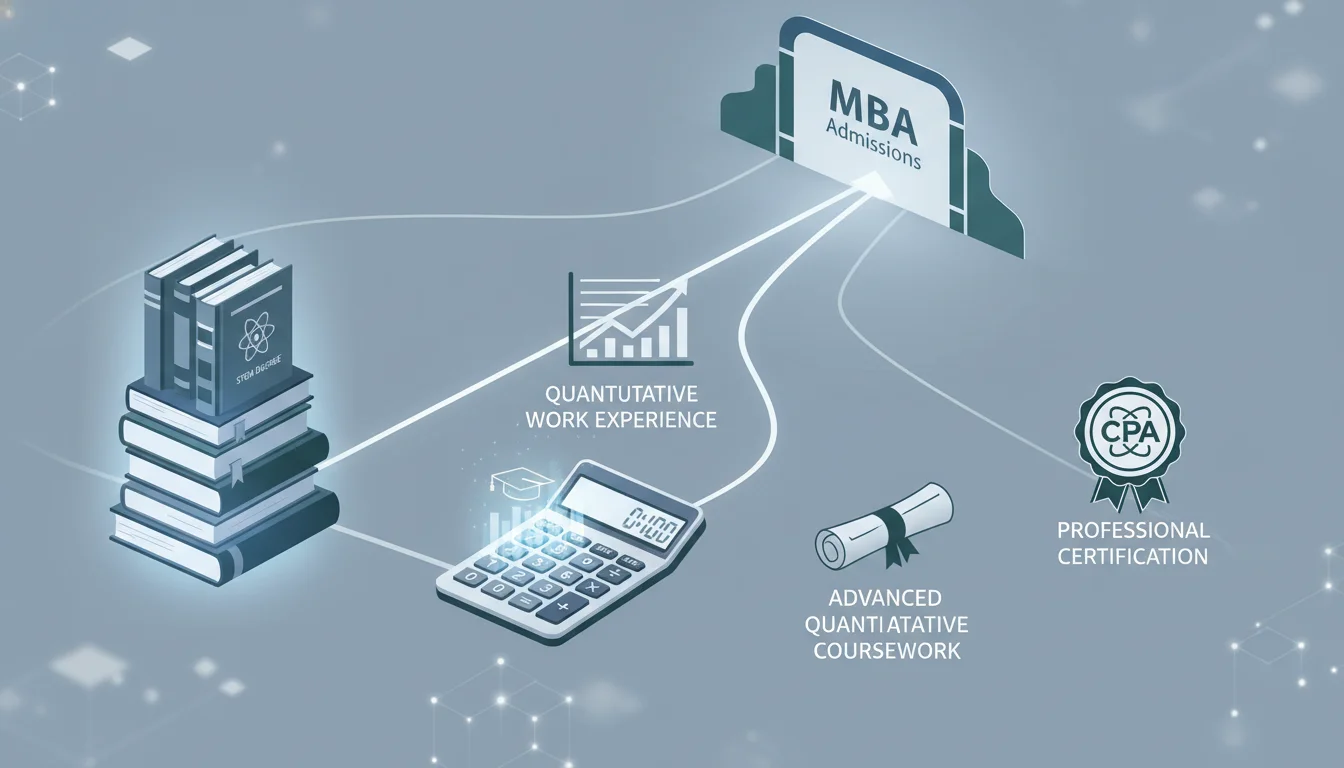
- Quantitative Experience and STEM Degrees: Programs such as UNC Kenan-Flagler and Carnegie Mellon’s Tepper School mandate that waiver applicants possess either a STEM-focused undergraduate or graduate degree—typically requiring a cumulative GPA above 3.0 or 3.2—or a minimum of five years of explicit professional experience in analytical, financial, or highly technical roles. This policy acknowledges that an engineer with a decade of data modeling experience does not need a standardized test to prove numerical competence.
- Professional Certifications: Holding an active Certified Public Accountant (CPA), Chartered Financial Analyst (CFA), or an equivalent international professional certification serves as a direct, irrefutable proxy for the quantitative reasoning tested by the GMAT. Institutions universally accept these as valid criteria for an immediate test waiver.
- Proprietary Assessments and Readiness Courses: In lieu of the GMAT, the University of Michigan (Ross) offers an innovative pathway: a free Quantitative Readiness Course. Applicants must complete this rigorous module and score 80% or higher on the final proctored exam to satisfy the testing requirement, ensuring that the candidate is prepared for the specific mathematical demands of the Ross curriculum. Similarly, Warwick Business School occasionally administers its own proprietary “Warwick Test” following a candidate interview, while IE Business School offers the IE Global Admissions Test to assess entrepreneurial mindset and logical reasoning without relying on third-party standardized exams.
- Terminal Degrees: Candidates holding an MD, JD, or PhD are almost universally granted automatic waivers across the top 50 programs. Admissions committees universally acknowledge the supreme academic discipline, critical thinking, and intellectual stamina required to attain those terminal credentials, rendering a foundational business test redundant.
| Institution | GMAT Policy Structure | Specific Waiver or Alternative Criteria |
|---|---|---|
| UNC Kenan-Flagler | Formal Waiver Request | 5+ years professional experience; or STEM degree (3.2+ GPA); or active CPA/CFA; or Terminal Degree. |
| Michigan Ross | Waiver / Alternative Course | 3.4+ GPA in STEM/Business; or CPA/CFA; or score 80%+ on the Ross Quantitative Readiness Course. |
| Carnegie Mellon Tepper | Formal Waiver Request | STEM/Business degree (3.0+ GPA); or CPA/CFA; documented post-undergrad quantitative work experience. |
| USC Marshall | Fully Test Optional | Completely optional; scores only requested if the candidate explicitly wishes to enhance a weaker undergraduate GPA profile. |
| Imperial College | Rare Merit Waivers | Requires exceptional academic performance and strong quantitative skills; necessitates deep transcript/CV review by the committee. |
| Warwick Business School | Flexible Alternatives | Accepts GMAT Focus (615 avg), traditional GMAT (670 avg), or the internal Warwick Test for highly experienced executives. |
| AGSM (UNSW) | Never Required | No GMAT required for the MBAX; relies entirely on assessing a minimum of two years of professional/managerial experience. |
In-Depth Architectural Analysis of Elite North American Programs
The United States online MBA market is characterized by extreme stratification in pricing, cohort experience levels, and pedagogical delivery mechanisms. Analyzing the precise architecture of these programs reveals how they tailor their offerings to specific professional demographics.
Indiana University (Kelley School of Business)
The Kelley Direct Online MBA is a structural juggernaut in the digital education space, frequently holding the #1 position in domestic indices. Its market dominance is driven by a unique combination of vast scale, technological maturity, and unmatched affordability among elite M7-adjacent tiers. With an estimated total tuition of $94,944, Kelley offers an exceptional value proposition compared to peers charging upwards of $130,000. The program supports a massive online enrollment of over 1,442 students, yet meticulously maintains rigorous student excellence scores and a highly selective 23% acceptance rate. The typical candidate is 31 years old with 9 years of work experience, possessing an average undergraduate GPA of 3.42. The curriculum emphasizes peer support through robust student leadership associations, enabling digital students to build functional networks comparable to residential cohorts. Post-graduate outcomes validate the model, with graduates commanding an average starting salary of $147,249.
University of North Carolina (Kenan-Flagler Business School)
Ranking #2 in US News, UNC Kenan-Flagler has architected an online MBA explicitly tailored for mid-to-senior level professionals. The program, which carries a total tuition cost of $125,589, allows for immense customization; nearly half of the 62-credit curriculum is dedicated to electives across highly relevant concentrations such as Finance, Supply Chain Management, and Information Systems and Business Analytics. A defining feature of the Kenan-Flagler pedagogy is the integration of mandatory in-person summits. These global and domestic immersions fuse the flexibility of self-paced digital coursework with high-impact collaborative networking, ensuring students physically interact with faculty and peers.
University of Southern California (Marshall School of Business)
USC Marshall’s online MBA was constructed from the ground up specifically for the digital medium, consciously avoiding the common pitfall of merely porting residential lectures to a screen via a static camera. Priced between $123,471 and $132,970, the 21-month program heavily emphasizes analytics-driven decision-making, virtual team collaboration, and digital leadership. Marshall operates via synchronous weekly seminars conducted by faculty via webcam, combined with high-production-value asynchronous content. A critical value driver for Marshall is the legendary “Trojan Network,” which yields an 85.7% career aim achievement rate. Recent alumni data indicates significant career pivot success, with graduates transitioning smoothly into elite consulting, technology, and entertainment roles at firms like Amazon, Disney, and McKinsey, achieving an average base salary of $144,442 and a signing bonus averaging $32,524.
Carnegie Mellon University (Tepper School of Business)
For professionals seeking deep quantitative, analytical, and technological training, the Tepper Online Hybrid MBA is unparalleled. Ranked #2 in the US by the Financial Times, this STEM-designated degree costs approximately $149,058 ($769 per unit), positioning it at the absolute premium end of the global market. The program requires live, interactive classes two evenings a week (synchronous), ensuring high engagement and accountability. Because of the intense quantitative nature of the Tepper curriculum, candidates admitted with a GMAT waiver are systematically required to successfully complete a “Calculus Fundamentals” course prior to matriculation to ensure they can handle the academic load. This hybrid model also features “Access Weekends” for in-person networking, allowing students to complete the degree in 32 months, or faster via a 24-month accelerated track. The cohort is highly experienced, with an average of 12 years of work experience and an incredibly selective 19% acceptance rate.
University of Michigan (Ross School of Business)
Michigan Ross, commanding a tuition of $120,000 for in-state and $130,000 for out-of-state students, leads the nation in facilitating internal corporate career advancement. A staggering 75% of Ross online MBA alumni report receiving a promotion either during the program or shortly after completion, a testament to the immediate applicability of the curriculum. The 57-credit curriculum includes the hallmark Multidisciplinary Action Project (MAP), an intensive 14-week real-world consulting engagement that bridges academic theory with corporate reality, forcing students to solve live business challenges for sponsor companies. Ross requires three in-person residencies focusing on leadership, innovation, and transformation, ensuring the cohort bonds deeply despite the primary distance format. Graduates secure an impressive median base salary of $175,000 alongside median signing bonuses of $30,000.
University of Florida (Warrington College of Business)
Florida Warrington presents one of the highest ROI equations in the global market.
With tuition ranging from $49,205 for its 1-year accelerated track to $59,808 for the 2-year track, it is substantially more affordable than its peer institutions in the upper echelon of rankings. The curriculum is highly adaptable and forward-looking, offering unique concentrations in emerging fields such as Artificial Intelligence for Managers. Warrington completely waives the GMAT requirement, prioritizing a candidate’s real-world experience and professional maturity. The strategic geographic expansion of their part-time hybrid model into Miami further connects students directly to Latin American trade routes, massive tech startups, and dominant real estate hubs. The program boasts a 54% acceptance rate and an average starting salary of $112,847, making it a highly efficient vehicle for career acceleration.
Rice University (Jones Graduate School of Business)
Rice Business offers a highly innovative Hybrid MBA alongside its standard online variant (MBA@Rice), priced at $118,476. The program distinguishes itself by combining asynchronous learning with Thursday evening live remote sessions, and critically, a mandatory one-weekend-per-month on-campus immersion in Houston. This 70% in-person, 30% online ratio creates a powerful local network while maintaining executive schedule flexibility. The 54-credit, 22-month curriculum requires participation in a Global Field Experience, sending students abroad to consult on international business problems. Students can deeply customize their degree through ten distinct specializations, including high-demand sectors like Energy, Corporate Finance, Healthcare, and Entrepreneurship.
University of Washington (Foster School of Business)
UW Foster capitalizes immensely on its strategic location in the Pacific Northwest technology hub. With a resident cost of $84,810 and a non-resident cost of $119,148, the program offers tight integration with the Seattle corporate ecosystem, including giants like Amazon and Microsoft. Foster utilizes a highly interactive format, reporting an impressive 85.5% success rate in overall career aim achievement. The school provides unique global options, including a joint Global MBA initiative that allows international students to earn dual degrees while seamlessly taking Foster electives.
Specialized and Niche Premier Programs
Beyond the massive state and private juggernauts, several highly specialized programs offer unique value propositions. Babson College operates an elite part-time online MBA universally recognized as the #1 program globally for Entrepreneurship. Babson utilizes a blended learning model, costing $1,990 per credit ($94,575 total), and does not require the GMAT, allowing founders and corporate intrapreneurs to hone their skills while managing their ventures. North Carolina State University’s Poole College of Management offers extreme value at $57,298 total tuition, delivering an average starting salary of $166,938 for its highly experienced cohort (average age 33), representing a massive, rapid ROI for its graduates. Pepperdine University focuses deeply on values-based leadership and ethical decision-making, offering a 55-unit degree for $109,980 with concentrations in Digital Innovation and Managing Organizational Change.
Elite US Institution Data Summary
-
Michigan (Ross)
- Estimated Total Tuition: $120k - $130k
- Acceptance Rate: N/A
- Average Starting Salary / Base: $175,000 Median Base
- Key Architectural Feature: 14-week MAP Consulting Course
-
Carnegie Mellon (Tepper)
- Estimated Total Tuition: $149,058
- Acceptance Rate: 19%
- Average Starting Salary / Base: $191,841 (PPP)
- Key Architectural Feature: STEM-Designated; Calculus Requirement
-
Indiana (Kelley)
- Estimated Total Tuition: $94,944
- Acceptance Rate: 23%
- Average Starting Salary / Base: $147,249
- Key Architectural Feature: Massive Scale; #1 US News Rank
-
USC (Marshall)
- Estimated Total Tuition: $123k - $133k
- Acceptance Rate: N/A
- Average Starting Salary / Base: $144,442 Base
- Key Architectural Feature: Extensive Trojan Network Coaching
-
UNC (Kenan-Flagler)
- Estimated Total Tuition: $125,589
- Acceptance Rate: N/A
- Average Starting Salary / Base: $211,372 (PPP)
- Key Architectural Feature: Mandatory Global/Domestic Summits
-
Rice (Jones)
- Estimated Total Tuition: $118,476
- Acceptance Rate: N/A
- Average Starting Salary / Base: N/A
- Key Architectural Feature: Hybrid Model; Global Field Exp.
-
Washington (Foster)
- Estimated Total Tuition: $84k - $119k
- Acceptance Rate: 42%
- Average Starting Salary / Base: N/A
- Key Architectural Feature: Deep Seattle Tech Hub Integration
-
Florida (Warrington)
- Estimated Total Tuition: $49k - $59k
- Acceptance Rate: 54%
- Average Starting Salary / Base: $112,847
- Key Architectural Feature: AI Integration; Miami Weekend Track
-
NC State (Poole)
- Estimated Total Tuition: $57,298
- Acceptance Rate: 71%
- Average Starting Salary / Base: $166,938
- Key Architectural Feature: Exceptional Price-to-Salary ROI
Expanding Access: The Affordability and High-Value Tier
For professionals who do not require the elite branding of an M7 or Top-15 institution, a robust ecosystem of highly accredited, affordable online MBAs exists. These programs are designed to check the required human resources boxes for corporate advancement without inducing crippling debt. The University of North Georgia offers a 36-credit, AACSB-accredited online MBA for an astonishingly low $10,440 total program cost, featuring concentrations in Data Analytics and Healthcare Management. Eastern University provides a $9,000 program focusing on ethical leadership, while Missouri State University prices its degree at just $11,544. Larger, well-known state systems also offer immense value; Purdue Global’s program costs approximately $34,944, and the University of Tennessee Knoxville offers its degree for $54,000. Even prestigious private universities like Syracuse offer flexible, GMAT-free online MBAs, though at a higher price point of $108,810. This tier proves that quality business education is rapidly democratizing.
In-Depth Architectural Analysis of Premier International Programs
The international online MBA market operates with distinct characteristics. Programs in Europe and Asia are generally shorter (often 12 to 18 months), intensely globally focused, and often less expensive in absolute terms than their American counterparts. They prioritize cross-border mobility and multinational corporate strategy.
IE Business School (Spain)
As the perennial #1 in the Financial Times rankings, Madrid-based IE Business School has fundamentally redefined digital executive education through its proprietary “Liquid Learning” pedagogical model. Priced at €65,000, the Global Online MBA relies on a highly diverse, cosmopolitan cohort representing over 165 nationalities. The program strictly avoids the traditional GMAT, utilizing its own holistic IE Global Admissions Test to assess an entrepreneurial mindset, behavioral traits, and logical reasoning. Alumni report an average post-MBA salary of $209,202 (PPP adjusted), reflecting massive career mobility across European and global corporate sectors.
Imperial College Business School (UK)
Ranked #1 globally by QS, Imperial College charges £57,000 for its highly flexible 21, 24, or 32-month part-time program. Imperial uniquely leverages its institutional dominance in science and engineering, offering deep, highly technical concentrations in Technology & Analytics, Sustainability & Climate, and Healthcare Management. The ROI timeline for this degree is exceptionally fast; graduates entering high-paying consulting or investment banking roles in the UK typically recover their entire financial investment within 2 to 3 years. Imperial holds the highest FT metric for alumni salary, with graduates earning a staggering average of $228,443 (PPP adjusted) three years post-graduation, with 85% of graduates successfully changing their role within four months.
Warwick Business School (UK)
Warwick offers immense, undeniable value at £43,550 for its Global Online MBA. The program successfully combines recorded “lightboard” asynchronous lectures—bringing presentations dynamically to life—with interactive online forums. The program is ranked #1 globally specifically for career progress by the FT, a testament to the efficacy of its deeply embedded CareersPlus coaching service. Warwick alumni average $216,898 (PPP adjusted) post-graduation, representing a staggering 44% salary increase. Warwick’s pedagogical design explicitly targets time-poor executives; students can dynamically scale their module load from one to two per quarter, allowing them to pause the degree seamlessly if global work demands surge.
AGSM @ UNSW Business School (Australia)
Leading the Asia-Pacific region, AGSM offers the MBAX program at a total cost ranging from AUD $62,280 to $64,080. The program completely waives the GMAT, requiring instead a strict minimum of two years of high-level managerial experience. The MBAX is distinct for its deep thematic specializations, allowing students to graduate with specific credentials in Social Impact, Cyber Security Leadership, Technology, or Policy Leadership. It is widely considered the absolute premier vehicle for corporate advancement in the Australasian market.
EGADE Business School (Mexico)
EGADE is the sole Latin American institution represented in the elite Financial Times Top 20 online global rankings. A Triple Crown accredited school, the EGADE online MBA spans 21 months and focuses intensely on regional Latin American corporate leadership, digital innovation, and global supply chain dynamics. By integrating global network weeks and facilitating dual-degree opportunities with over 60 international universities, EGADE provides Latin American executives with a seamless, highly respected bridge to international markets.
Porto Business School (Portugal)
Porto Business School represents extraordinary hidden value within the European academic ecosystem.
With a total program cost ranging from approximately €14,672 to €30,000, Porto achieved the absolute highest overall student satisfaction score (9.56 out of 10) in the FT alumni survey. The program attracts an incredibly diverse cohort, boasting the highest percentage of female students (47%) among its global ranking peers, and offers a highly personalized structure tailored to individual career goals.
Premier International Institution
| Premier International Institution | Estimated Total Tuition | Program Length | PPP Adjusted Salary | Key Architectural Feature |
|---|---|---|---|---|
| Imperial College (UK) | £57,000 | 21-32 months | $228,443 | STEM integration; fast London finance ROI |
| Warwick (UK) | £43,550 | 24 months | $216,898 | #1 Global Career Progress; lightboard tech |
| IE Business School (Spain) | €65,000 | 18 months | $209,202 | Liquid Learning; Triple Crown accreditation |
| Porto Business School (Portugal) | €14,672 - €30,000 | 11-15 months | N/A | Highest student satisfaction globally (9.56) |
| AGSM UNSW (Australia) | AUD $62,280 | 24 months | N/A | Deep specializations (e.g., Cyber Security) |
| EGADE (Mexico) | N/A | 21 months | N/A | Sole LatAm FT Top 20; vast dual-degree network |
Curriculum Architecture: Pedagogical Delivery and Experiential Learning
The structural design and delivery mechanism of an online MBA dictates its ultimate suitability for a working professional. Institutions deploy varying blends of asynchronous (self-paced) and synchronous (live) methodologies, each carrying distinct psychological, logistical, and pedagogical implications.
The Dichotomy of Asynchronous vs. Synchronous Delivery
Asynchronous models rely heavily on high-production pre-recorded lectures, interactive digital discussion boards, and comprehensive reading materials. This format, heavily utilized by the University of Florida Warrington and large segments of Warwick’s curriculum, offers ultimate, unconstrained timezone flexibility. It heavily favors highly self-directed learners who must integrate their study hours into erratic global travel schedules or demanding, unpredictable executive roles. Students can engage with the material during their commute or late at night without penalty.
Synchronous models, conversely, demand strict, real-time virtual attendance via webcam. USC Marshall and Carnegie Mellon Tepper mandate live classes on specific evenings every week. This architecture intentionally replicates the intense Socratic method of a physical residential classroom, forcing real-time debate, immediate on-the-spot problem-solving, and stronger interpersonal cohort bonding. However, it creates severe logistical friction for international students or those operating across multiple time zones, requiring them to log in at potentially disruptive hours.
Hybridity and Global Corporate Immersions
To bridge the inherent networking gap of remote study, the most elite programs aggressively integrate mandatory physical immersions. UNC Kenan-Flagler requires two in-person domestic or global summits. Rice University mandates a comprehensive Global Field Experience, sending its students to international corporate hubs to consult directly on real-world business challenges. Imperial College and Warwick host intensive residential weeks in London—often utilizing iconic venues like The Shard—allowing digital cohorts to consolidate their virtual relationships through intensive, face-to-face capstone projects.
The Rise of Hyper-Specialized Concentrations
Broad, generalized management curricula have largely given way to hyper-specialized academic tracks designed to make graduates immediately deployable and highly valuable in niche corporate sectors. Imperial College offers specialized tracks in Analytics & Operations, Healthcare, and Sustainability & Climate. Florida Warrington integrates emerging technologies directly into its core, offering mandatory, forward-looking coursework in Artificial Intelligence for Managers. Rice Jones provides ten distinct specializations, allowing students the flexibility to effectively double-major in complex fields like Energy, Entrepreneurship, and Corporate Strategy.
The Shifting Economics of the Online MBA: Financing, Debt, and ROI
Pursuing an elite online MBA requires a massive, calculated capital expenditure. While international programs generally offer significantly lower raw tuition costs, US programs command extreme premium pricing, which is historically offset by higher absolute starting salaries in the lucrative American corporate sector.
The Restructuring of Graduate Debt
A critical, systemic shift in the financing of US graduate business education is imminent. Beginning July 1, 2026, the US federal Graduate PLUS loan program will be entirely eliminated for new borrowers. While the Federal Direct Unsubsidized Loan remains available, it is rigidly capped at $20,500 annually for most full-time and part-time MBA students. This creates a massive funding gap for premium programs costing $120,000 or more.
Consequently, the burden of financing is shifting rapidly to the private student loan market, utilizing lenders like Prodigy Finance and MPower, which often rely on algorithms predicting future earning potential rather than just historical credit scores. Furthermore, this policy change drastically increases the importance of institutional scholarships. To remain competitive and accessible, institutions are bolstering internal aid; Imperial College provides Advisory Board Scholarships up to £51,000 for exceptional candidates demonstrating financial need, while IE Business School channels over €50 million annually through the IE Foundation to support global talent through merit and need-based awards.
Corporate Sponsorship and Employer Subsidies
Employer sponsorship remains a highly vital conduit for financing the degree without incurring personal debt. Many students at programs like Michigan Ross and Rice Jones leverage corporate tuition assistance programs. Because online MBA students remain fully employed, they partner with their employers to fund their professional development, generating an immediate return on investment for the company by applying advanced classroom frameworks directly to their current operational roles the very next day.
Post-Graduate Trajectories: Career Outcomes and Alumni Network Utility
The ultimate, defining metric of an MBA’s efficacy is the tangible career advancement it facilitates. Because online MBA candidates remain fully embedded in the workforce during their studies, the ROI is often realized concurrently with the pursuit of the degree, rather than after a two-year hiatus. The data overwhelmingly indicates two primary, highly lucrative pathways: rapid internal promotion and strategic sector pivoting.
Internal Promotion and Salary Acceleration
The immediate application of strategic, operational, and financial frameworks to a student’s existing job frequently leads to rapid intra-company advancement. At Michigan Ross, an astonishing 67% of online MBA students received a formal promotion while actively enrolled in the coursework, and 75% secured one shortly after completion. Similarly, Warwick Business School graduates experience an average salary increase of 44% three years post-graduation, with absolute PPP-adjusted salaries reaching impressive heights of $216,898. A degree from Howard University yields a $125,000 average salary, representing a massive 66% premium over bachelor-level candidates.
Strategic Sector Pivoting
Despite the part-time, digital nature of the degree, online MBAs successfully facilitate major industry transitions. At Imperial College, 85% of graduates changed their job role within four months of graduation, and 22% completely changed their overarching economic sector. The dominant destination industries for elite online MBA graduates mirror those of residential programs: Consulting, Technology, and Financial Services. For instance, USC Marshall places heavily into elite firms like Amazon, Google, Deloitte, JP Morgan, and McKinsey. Broad data from top-tier institutions, reflected in MIT Sloan’s employment reports, shows massive placement in Consulting (32.3%) and Technology (23.3%), with median signing bonuses frequently reaching $30,000.
The Enduring Power of the Network
The theoretical textbook knowledge imparted by an MBA is essentially commoditized; the true, lasting value of the degree lies in the alumni network it unlocks. Programs intentionally engineer cohort diversity to enhance this network’s utility. IE Business School boasts 90% international students representing 34 distinct nationalities in its online cohort, ensuring that group work and case studies reflect the true friction and complexities of global, cross-border corporate management. USC Marshall aggressively leverages its fiercely loyal and highly active “Trojan Network,” providing lifelong access to global hubs and dedicated career pivot coaching from alumni embedded in top firms. Ultimately, the seamless integration of these digital students into the broader, historical university alumni base ensures they receive the exact same long-term networking premium as their full-time residential peers.
Strategic Synthesis and Future Outlook
The 2025-2026 academic landscape unequivocally confirms that the online MBA has achieved full academic and corporate parity with traditional residential formats. The systematic removal of the GMAT requirement across premier global programs is not indicative of diminished rigor or lowered standards. Rather, it represents a highly logical, evolutionary step toward holistic, experience-based admissions.
By evaluating quantitative readiness through prior STEM degrees, demanding professional certifications like the CFA, and analytical work histories, institutions are purposefully curating cohorts of proven, battle-tested corporate operators rather than mere academic test-takers.
For prospective candidates, the decision matrix must carefully balance pedagogical format, total debt load, and regional network strength. Those seeking extreme quantitative rigor and placement into the technology sector may gravitate toward Carnegie Mellon Tepper’s highly structured synchronous hybrid model. Candidates prioritizing immediate internal promotion and broad organizational leadership might favor the massive scale and action-based learning of Michigan Ross or Indiana Kelley. Meanwhile, global operators looking to transcend geographic boundaries and operate in multinational environments will find unmatched value in the highly international, Triple-Crown accredited cohorts of IE Business School or Imperial College.
As tuition dynamics shift—particularly with the restructuring of US federal graduate loans in 2026 forcing a reliance on private capital—candidates must rigorously calculate their individual payback periods. However, with average salaries routinely breaching the $150,000 to $200,000+ threshold within three years of graduation, the elite accredited online MBA remains one of the highest-yield investments available in the modern professional economy. By blending sophisticated digital delivery mechanisms with high-impact global physical immersions, these programs successfully forge the agile, data-literate, and globally-minded executives required to navigate the severe complexities of the future business landscape.