Quantitative Executive Leadership & Succession Models
Quantitative Evaluation Models for Executive Leadership and Succession Planning

The Macroeconomic and Demographic Imperatives for Data-Driven Succession
The global corporate ecosystem is currently navigating a period of unprecedented demographic transition and macroeconomic volatility, fundamentally altering the calculus of executive succession. Projections for the year 2025 indicate that a record 4.2 million individuals in the United States alone will reach the age of 65, triggering a massive wave of retirements among highly tenured executives and seasoned leaders. This generational shift is occurring against a backdrop of intense corporate restructuring, with private equity and corporate entities executing an estimated 660,000 mergers and acquisitions valued at an aggregate $56 trillion since 2004. Amidst this churn, the fragility of legacy corporate structures is evident; only 12% of the original Fortune 500 companies have managed to maintain their standing over the long term, highlighting the existential threat posed by mismanaged leadership transitions.
Despite these profound systemic pressures, an alarming disparity exists between the recognized strategic importance of executive succession and its actual operational implementation. While recent boardroom surveys indicate that 34% of corporate directors identify Chief Executive Officer (CEO) and C-suite succession planning as their paramount company priority for 2025—ranking significantly ahead of artificial intelligence adoption (27%), workforce planning (26%), and cybersecurity enhancements (25%)—the structural reality remains bleak. Only 19% of modern organizations have established formal, robust succession frameworks, and among those that do, 72% focus their succession planning exclusively on the absolute top tier of executive roles, entirely neglecting the broader management layers critical for downstream operational continuity.
Historically, executive selection and succession have relied heavily on qualitative heuristics, informal apprenticeships, and subjective evaluations driven by insular corporate networks. Academic research underscores the danger of this approach, indicating that when organizational decision-makers rely solely on intuition or subjective “gut feelings,” their probability of accurately identifying a high-performing future leader is roughly 50/50—statistically no better than a coin toss. Such informal processes are highly susceptible to human cognitive biases and often result in inconsistent outcomes, missed opportunities for diverse talent capitalization, and profound organizational vulnerability. Consequently, roughly 70% of organically formed succession plans fail within a two-year window, primarily due to a lack of empirical rigor and an ensuing failure to secure sustained buy-in from senior leadership stakeholders.
To mitigate these systemic risks, organizations and their governing boards are increasingly adopting quantitative evaluation models that leverage predictive analytics, multidimensional psychometric testing, and formalized algorithmic decision matrices. By transitioning from a reactive, qualitative exercise to an anticipatory, data-driven mathematical architecture, organizations can build resilient leadership pipelines that ensure operational continuity and optimize financial returns. Extensive empirical research demonstrates that superior, data-backed succession planning within the C-suite can enhance corporate profitability and investor returns by as much as 25%. This comprehensive report examines the sophisticated quantitative models, psychometric frameworks, and predictive technological infrastructures that define the modern era of executive talent management.
Epistemological Foundations: Quantitative Versus Qualitative Paradigms
Before examining the specific mathematical mechanisms of succession models, it is necessary to establish the epistemological differences between quantitative and qualitative research paradigms as they apply to executive evaluation. Understanding how organizations collect, interpret, and validate human capital data is essential for designing purposeful, defensible leadership pipelines.
The fundamental divergence between quantitative and qualitative methodologies lies in their respective approaches to data collection, scaling, and interpretation. Quantitative research collects numerical data designed to identify broad statistical relationships, calculate probabilities, and enable massive structural generalizations. In the context of executive selection, quantitative data includes psychometric percentiles, revenue generation figures, historical retention rates, and algorithmic competency scores. This approach answers critical organizational questions regarding what is happening within the talent pipeline and to what extent a candidate possesses a required trait.
Conversely, qualitative research gathers descriptive, non-numerical data through unstructured interviews, observational shadowing, and cultural immersion to deeply understand how and why specific individuals think and act within complex organizational contexts. The data output of qualitative assessment primarily takes the form of words, capturing the nuanced, lived experiences of leadership that resist simple numerical encoding.
While qualitative methods provide profound contextual depth, they are inherently difficult to scale across global enterprises and are highly vulnerability to the subjective interpretations of the evaluator. In an era where multinational corporations must evaluate thousands of middle-management candidates for potential executive ascension, the lack of scalability in qualitative assessment presents a critical bottleneck. Therefore, modern succession architectures prioritize quantitative frameworks, utilizing numerical baselines to filter and rank vast candidate pools objectively. Qualitative insights are then selectively integrated during the final stages of the selection process—such as final-round board interviews—to provide context to the quantitative baseline, effectively mitigating the limitations inherent in both methodologies.
Structural Decision Matrices and Weighted Scoring Systems
For board composition, C-suite selection, and enterprise-wide succession planning, decisions involve balancing highly complex, competing variables under strict temporal and regulatory constraints. Weighted scoring models provide a deterministic, objective quantitative framework for prioritizing candidates or strategic workforce options by assigning specific, pre-calibrated numerical weights to predefined selection criteria. This mathematical framework ensures that the most critical organizational requirements exert the greatest proportional influence on the final selection outcome, stripping emotion and subjective bias from the process.
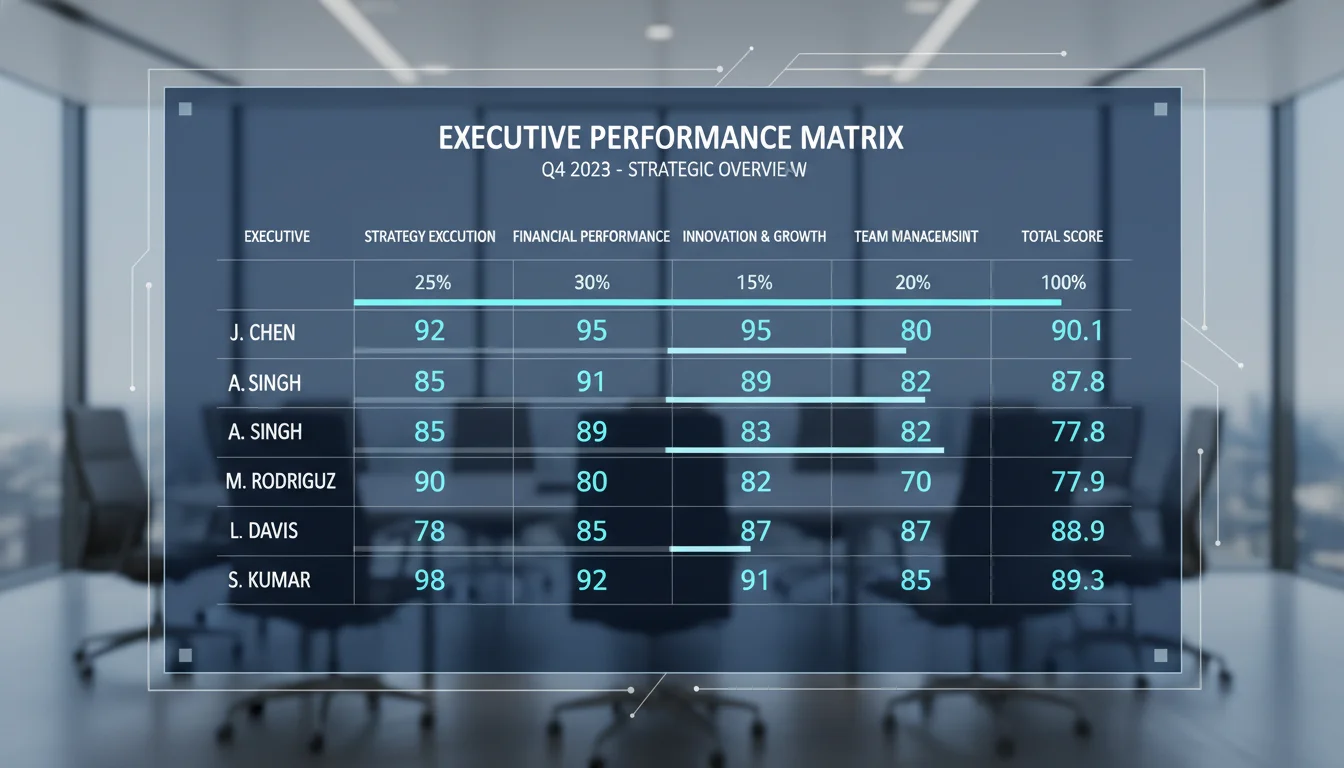
The mathematical formulation for a weighted scoring model can be expressed as a linear combination of evaluated criteria, where the total composite readiness score for an executive candidate is determined by the sum of fractional weights (importance) assigned to specific criteria multiplied by the quantitative rating achieved on those criteria.
- S represents the total composite readiness or suitability score for an executive candidate.
- w represents the fractional weight (importance) assigned to a specific criterion, where the sum of all weights equals 1 (or 100%).
- r represents the quantitative rating (e.g., on a standardized 1-10 or 1-100 scale) the candidate achieves on that specific criterion based on assessments.
This structural equation allows organizational decision-makers to prioritize different operational, financial, and behavioral factors based on their immediate strategic significance within a particular macroeconomic context. Furthermore, advanced variations of this model incorporate penalty functions, mathematically subtracting weighted scores for anticipated operational effort, onboarding friction, or transitional costs, thereby optimizing the likelihood of identifying a high-magnitude organizational success.
- Criteria Identification: Defining the specific attributes, features, or characteristics required for the executive role (e.g., M&A experience, digital transformation capability, crisis management). Strategic Implication: Ensures all candidates are evaluated against a standardized baseline derived directly from organizational strategy, rather than idiosyncratic preferences.
- Weight Assignment: Distributing percentages across the identified criteria to reflect relative importance, ensuring the total equals 100%. Strategic Implication: Mathematically forces boards and search committees to align on strategic priorities prior to evaluating specific personalities.
- Candidate Scoring: Rating each candidate on a numerical scale (e.g., 1 to 5) for every criterion based on psychometric data and interview performance. Strategic Implication: Translates qualitative interview experiences and historical resume data into computable, comparative integers.
- Composite Calculation: Multiplying individual scores by their respective weights and aggregating the results to produce a final ranking. Strategic Implication: Provides a defensible, objective numerical justification for executive promotion or rejection, minimizing legal and compliance risks.
- Data-Driven Validation: Retrospective analysis comparing the predicted score of the hired executive against their actual on-the-job performance metrics. Strategic Implication: Enables continuous optimization of the matrix weights for future selection cycles, creating a self-improving evaluation loop.
In the specific context of board of director succession, Nominating and Governance Committees heavily utilize highly specific board composition matrices to identify and quantify existing skill gaps. These matrices have become increasingly complex due to expanding regulatory and societal demands.
For instance, the impending Women on Boards Directive within the European Union obligates all listed companies to recruit a minimum of 40% female non-executive directors by 2026. Similarly, in the United Kingdom, the Parker Review has established stringent targets for large private companies to appoint at least one board member representing an ethnic minority by December 2027.
To navigate these mandates without compromising fiduciary duties, boards deploy customized skills matrices. A matrix might categorize essential skills into numeric rating scales, low-medium-high (L-M-H) distributions, or competency-based scales, ensuring the board maintains the precise mix of ESG compliance background, cybersecurity oversight, and industry-specific operational expertise required to drive sustainable corporate performance. By rigorously scoring potential recruits against these weighted criteria, the board creates a mathematically sound, legally defensible pathway to compliance that simultaneously optimizes cognitive diversity and governance excellence.
The 9-Box Grid and Enterprise Readiness Indices
As organizations attempt to scale the logic of weighted scoring across thousands of employees, they frequently employ generalized, two-dimensional indices. The 9-box grid, alternatively referred to as the performance-potential matrix or the talent matrix, represents one of the most ubiquitous and enduring foundational tools for talent management and succession planning worldwide.
This visual matrix evaluates individuals along two primary, orthogonal quantitative axes: current performance and future growth potential. To effectively operationalize the 9-box grid and avoid the trap of subjective placement, organizations must establish rigorous, standardized evaluation metrics for both dimensions:

- The Performance Axis: This dimension is typically derived from retrospective, quantitative, and highly verifiable data. Inputs include historical goal attainment percentages, sales target realization, operational efficiency metrics, and formal, calibrated supervisor evaluations. Candidates are generally categorized into low, moderate, or high performance tiers based on their statistical deviation from the organizational mean.
- The Potential Axis: Measuring potential presents a far greater challenge, as it requires a forward-looking, predictive assessment of an individual’s latent capacity to navigate exponential increases in complexity and assume significantly broader leadership responsibilities. This axis is quantified using standardized psychometric assessments, cognitive agility scores, and multidimensional leadership competency evaluations.
Individuals mathematically plotted in the upper-right quadrant of the grid—those exhibiting both exceptional historical performance and massive latent potential—are designated as “Stars” or high-potential (HiPo) candidates. These individuals form the critical core of the succession plan and become the primary targets for accelerated leadership development programs, specialized mentoring, and eventual executive deployment. Conversely, individuals scoring at the absolute bottom of both axes are categorized as underperformers, triggering entirely different human resources interventions, ranging from targeted remediation to managed exit strategies.
While the fundamental geometry of the 9-box grid is relatively simple, its true strategic value emerges during the talent calibration process. The utilization of the tool forces disparate management teams to debate and ultimately align on the precise mathematical thresholds and operational definitions that constitute high, medium, and low performance. This process effectively standardizes the organization’s definition of excellence, creating a level of internal consistency that eradicates regional or departmental grading curves. Furthermore, the populated grid facilitates high-level structural workforce analytics, providing empirical justification for compensation adjustments, resource allocation, and targeted recruitment drives.
Comparative Multi-Domain Readiness Indices
The logic of multi-dimensional readiness indexing is not strictly confined to individual corporate executives; it is increasingly utilized to assess the structural readiness of entire organizational ecosystems. An analog to this is the District Readiness Index (DRI), an evaluation methodology developed to quantify the operational capabilities of public school districts.
The DRI methodology collects 30 specific quantitative and qualitative measures for each target entity. These measures are converted into “indicators” on a standardized two-point scale (Yes = 2 points, Some = 1 point, No = 0 points). These discrete indicator scores are mathematically aggregated to calculate Domain Ratings across five critical operational areas, such as Financial Management, Leadership & Governance, and Work Environment. Depending on the percentage of possible points achieved, the entity is assigned a macro-level readiness designation (e.g., “Strong Foundations”).
When translated to corporate succession planning, this exact methodological framework allows enterprise holding companies or private equity sponsors to quantitatively assess the leadership pipeline health of their various subsidiary units. By applying a standardized point system to domains like “Succession Plan Formalization,” “HiPo Retention,” and “Bench Strength,” parent organizations can mathematically rank the risk profiles of their subsidiaries and allocate talent development capital to the areas exhibiting the weakest foundational governance.
Multidimensional Psychometric Evaluation Architectures
Moving beyond the retrospective performance metrics utilized in basic grids, highly sophisticated succession planning requires deep psychological, behavioral, and cognitive evaluations. Modern psychometric frameworks construct a comprehensive “whole-person” view, capturing both the innate cognitive capacities and the acquired behavioral competencies necessary for executive success in an era of volatility.
Korn Ferry’s Four Dimensions of Leadership (KF4D)
The Korn Ferry Four Dimensions (KF4D) model stands as one of the most empirically validated and widely deployed frameworks in global executive evaluation. The underlying architecture of the KF4D model is underpinned by a massive normative database containing data from over 7 million executive and professional candidate profiles, alongside 2.5 million completed psychometric assessments.
The KF4D framework operationalizes the abstract concept of leadership potential by measuring individuals across four distinct, interacting domains:
- Competencies: The observable skills and explicit behaviors directly linked to operational success in leadership roles (e.g., decision quality, strategic mindset, global perspective, navigating ambiguity). These are highly correlated with immediate job performance and promotion capability.
- Experiences: The cumulative impact of prior roles, diverse organizational assignments, and specific hardship events that build functional readiness and mental schemas for future challenges. This determines the foundational baseline of context an executive brings to new, unstructured problems.
- Traits: The natural, deeply ingrained foundational dispositions and personality characteristics—such as cognitive capacity, social intelligence, and learning agility—that shape spontaneous behavioral tendencies. This dictates an individual’s natural ease or difficulty in acquiring new competencies.
- Drivers: The deep-seated core values, personal motivations, and intrinsic aspirations that dictate an individual’s career engagement, resilience under pressure, and cultural alignment with the firm. This determines the likelihood of long-term retention.
By mathematically mapping an internal candidate’s assessment scores across these four dimensions against empirically derived “Success Profiles,” organizations can calculate the precise mathematical distance between a candidate’s current state and the optimal benchmark for a target executive role. These Success Profiles act as strategic blueprints, defining the exact configuration of traits and mindsets required to execute a specific business strategy. Data indicates that executives whose multidimensional profiles tightly align with these targeted benchmarks are statistically up to 13 times more likely to demonstrate high engagement and superior performance in their roles compared to misaligned peers.
Russell Reynolds’ New Leadership Portrait
Russell Reynolds Associates (RRA) utilizes an advanced, science-backed evaluation framework known as “The New Leadership Portrait,” which explicitly bifurcates executive assessment into baseline readiness and future-focused growth potential.
Current readiness is assessed using RRA’s proprietary Leadership Span Model™. Initiated in 2017, this competency framework evaluates an individual’s capacity to continuously navigate four major dualities required in modern senior leadership.
Rather than possessing a static leadership style, the most effective executives demonstrate the cognitive flexibility to oscillate between seemingly contradictory behaviors—such as acting heroically and decisively during an operational crisis while simultaneously maintaining the vulnerability required to solicit critical feedback, or balancing pragmatic, detail-oriented execution with highly idealistic, long-term strategic vision.
To quantify future growth potential, RRA relies on psychometric data mapped to four specific cognitive and behavioral constructs, which are then evaluated against benchmarks compiled from thousands of successful senior leaders:
- Systems Thinking: The advanced cognitive capacity to operate effectively within deep systemic complexity, recognize non-linear relationships, and manage extreme environmental ambiguity.
- Curiosity and Adaptability: The continuous, intrinsic learning orientation required to evolve alongside rapidly shifting global markets.
- Drive and Resilience: The deep tenacity and overarching ambition necessary to maintain high levels of operational sustainability in high-pressure executive environments.
- Social Intelligence: The ability to remain interpersonally attuned and mindful when managing a vast, diverse range of internal and external stakeholders.
A critical differentiator in the RRA methodology is the structured, quantitative measurement of “Potential Realization”—the manner in which a leader actively applies their latent potential. Recognizing the limitations of traditional personality inventories, RRA developed novel interview rubrics to assess self-knowledge, values, and legacy. RRA’s global data indicates that 90% of C-suite leaders cite deep self-awareness regarding their limitations and potential “derailers” as critical to their role preparation, and 95% point to a crystal-clear sense of core values as vital to their success. Through highly structured, rubric-based interviews, these historically abstract concepts are converted into standardized, comparative data points.
Aon’s Objective Benchmarking and The Multitouch Paradigm
Aon expands upon these multidimensional approaches by heavily utilizing objective, simulation-based talent assessments to differentiate high performance in a current role from true high potential for future, exponentially more complex roles. Aon’s global data analytics—derived from an immense dataset encompassing over 750,000 leadership assessments, 2,000 leadership skill profiles, and input from 2,500 client organizations across 31 countries—reveal the specific skill prevalences required for modern executive transitions.
Their quantitative benchmarking indicates that the most sought-after competencies for the emerging class of executives include driving results (assessed as a primary requirement in 56% of leadership profiles), providing strategic direction (49%), communicating with high impact (47%), coaching subordinates for peak performance (47%), and building complex organizational relationships (44%). Furthermore, Aon’s research indicates a clear demographic shift, with analytical data showing that high-potential individuals are applying for and attaining mid-to-senior leadership roles at significantly younger ages than historical cohorts, necessitating earlier and more aggressive assessment interventions.
To evaluate these critical competencies, Aon deploys a highly integrated suite of technological assessment tools. This includes the ADEPT-15™ behavioral assessment platform, which predicts likely workplace behavior across 15 discrete dimensions, and Situational Judgment Tests embedded directly within immersive job simulations. Furthermore, tools like vidAssess-AI utilize advanced natural language processing to scan an applicant’s spoken words during video interviews, algorithmically scoring their verbal reasoning and communication competencies against a validated personality model. By leveraging these automated, highly structured virtual assessment centers, organizations allow “data to do the heavy lifting,” systematically stripping human bias from the identification of hidden talent.
Similarly, executive search and consulting firms like Heidrick & Struggles advocate for a “multitouch” approach, recognizing that isolated psychometric data points provide an incomplete, potentially skewed picture. Their framework triangulates quantitative data from 360-degree behavioral reviews, standardized online psychometrics, and highly immersive business simulations. 360-degree feedback instruments mathematically aggregate the diverse perceptions of an executive’s superiors, peers, and direct subordinates. For instance, a 360-degree audit might reveal a statistically significant variance between how an executive perceives their own collaborative behavior and how their subordinates experience it, effectively identifying critical blind spots and “core blockers” to effective team dynamics. When this multi-rater feedback is integrated with deep-dive, competency-based behavioral interviews and complex business simulations, organizations generate an independent, highly objective “through line” of data that continuously informs the executive pipeline over multi-year horizons.
Academic Meta-Analyses on Leadership Validity and Styles
The commercial utilization of these psychometric tools is heavily supported—and nuanced—by rigorous academic meta-analyses. A comprehensive meta-analysis conducted by Loy et al. regarding the validity of personality testing revealed a critical divergence based on environmental context: validity coefficients for personality assessments differed significantly between low-stakes employee development scenarios and high-stakes applicant testing environments. This finding highlights a persistent challenge in executive evaluation: candidates competing for highly lucrative C-suite positions (high-stakes) may consciously or subconsciously manipulate self-report psychometric inventories to match the perceived ideal profile, subtly degrading the predictive validity of the assessment compared to its use in purely developmental (low-stakes) contexts. To combat this, the inclusion of multi-rater (360-degree) feedback and behavioral simulations is scientifically required to validate self-reported trait data.
Further meta-analytic research provides crucial insights into the specific leadership styles that maximize organizational health. An expansive meta-analysis examining 12 distinct leadership styles across 137 separate academic articles—comprising a massive aggregate sample size of 45,228 individuals—investigated the relationship between leadership behavior and a follower’s “perceived insider status” (the extent to which an employee feels like a valued, integral part of the organization). The statistical results demonstrated significant positive correlations between perceived insider status and inclusive, transformational, empowering, authentic, servant, humble, and moral leadership styles.
Crucially, the results of relative weight analysis indicated that inclusive leadership exhibited the absolute strongest explanatory power for generating perceived insider status among employees. Conversely, authoritarian leadership demonstrated a significant negative correlation, mathematically degrading organizational cohesion. These massive, aggregated statistical findings provide clear empirical directives for the design of the “Success Profiles” utilized by tools like KF4D; organizations must heavily weight the traits and drivers associated with inclusive leadership to maximize downstream employee engagement and minimize systemic attrition.
The academic validation of specific measurement instruments also continues to advance. Recent research has focused on the cross-cultural validation of tools like the Self-Assessment Leadership Instrument (SALI). A rigorous methodological study validating the Portuguese version of the SALI across 1,590 nursing students demonstrated high internal consistency (Cronbach’s alpha coefficient of 0.95). Factor analysis confirmed construct validity across four distinct leadership dimensions: Critical and Strategic Thinking, Teamwork Skills, Emotional Intelligence, and Communication and Relational Influence. These four factors alone explained 49.39% of the total variance in leadership capability, underscoring the profound impact that just a handful of accurately measured behavioral domains can have on the overall prediction of leadership efficacy.
Predictive Analytics, Feature Engineering, and Machine Learning
The integration of artificial intelligence (AI) and machine learning algorithms has catalyzed a fundamental transition in human resources—from descriptive workforce reporting (analyzing what has already happened) to predictive and prescriptive talent analytics (forecasting future trajectories and recommending optimal interventions). By continuously processing the vast, multi-dimensional datasets generated by Human Resource Information Systems (HRIS), Learning Management Systems (LMS), and performance evaluation platforms, organizations can mathematically forecast leadership success with unprecedented accuracy.
Feature Engineering and the Architecture of Prediction
The mathematical efficacy of any predictive succession model relies fundamentally on the quality of the underlying data and the sophistication of its feature engineering. Feature engineering is the highly technical process of synthesizing raw, disparate human capital data into specific, quantitative indicators that machine learning algorithms can utilize to calculate leadership potential.
Critical engineered features within executive succession models include:
- Promotion Velocity: A calculated temporal metric representing the speed of an employee’s career progression.
This is derived by measuring the time elapsed between sequential advancements, serving as a powerful, objective indicator of profound learning agility and high institutional value.
- Cross-Functional Collaboration Indices: Derived from Organizational Network Analysis (ONA) and the metadata of corporate communication networks, these indices quantify the breadth, depth, and centrality of a candidate’s inter-departmental influence. High scores on these indices are vital for predicting success in enterprise-level executive roles that require breaking down operational silos.
- Leadership Engagement Scores: Aggregated numerical assessments of an individual’s proactive, leadership-oriented behaviors that occur outside their immediate, formalized job description, signaling latent executive drive.
Once the data is preprocessed, cleansed, and standardized to eliminate structural anomalies, organizations deploy various supervised machine learning architectures. These range from fundamental logistic regression models designed for binary classification tasks (e.g., predicting whether a candidate will succeed or fail) to highly complex decision trees, gradient boosting frameworks, and deep neural networks capable of identifying non-linear patterns within massive datasets. These algorithms are trained on historical organizational data where the ultimate leadership transition outcomes are definitively known.
To evaluate the mathematical validity, accuracy, and operational reliability of these predictive models, data scientists utilize standard machine learning performance metrics:
- Precision and Recall: Precision measures the percentage of individuals predicted by the algorithm to be successful executives who actually succeed, actively minimizing the rate of false positives. Recall measures the model’s ability to identify all actual successful executives residing within the dataset, actively minimizing false negatives.
- F1-Score: The harmonic mean of precision and recall. This provides a single, balanced metric for model accuracy, which is especially critical in executive succession datasets where the number of successful executives (the positive class) is naturally minuscule compared to the general employee population.
- ROC-AUC (Receiver Operating Characteristic - Area Under Curve): A vital aggregate metric that quantifies the model’s overall capability to accurately distinguish between high-potential candidates and those at elevated risk of executive derailment.
The output of these algorithms provides human resources executives with specific, highly actionable numerical forecasts: a standardized leadership potential score used to rank candidates, an estimated timeframe forecasting exactly when a candidate will reach full readiness for deployment, and a quantifiable risk probability of the candidate derailing in the new role.
Commercial Application Platforms and Ecosystems
The theoretical models of predictive analytics have been fully operationalized and productized by major Human Capital Management (HCM) software vendors. These platforms establish interconnected digital ecosystems that automate the heavy lifting of talent management.
| HCM Platform | Core Predictive Analytics & Succession Capabilities | Strategic Impact |
|---|---|---|
| Workday | Deploys sophisticated AI algorithms to analyze historical performance and future career aspirations. Features AI-driven turnover prediction to identify flight risks, automated matching of internal talent to emerging capability gaps, and generates dynamic executive workforce scorecards encompassing headcount, growth, and talent readiness. | Shifts HR from reactive replacement to proactive pipeline management. Instead of waiting for turnover spikes, the system flags vulnerabilities before problems escalate, enabling immediate compensation adjustments or targeted succession planning. |
| SAP SuccessFactors | Leverages advanced “Growth Portfolio intelligence” to mathematically calculate role readiness. The system’s 2025 release utilizes OData V4 APIs everywhere to standardize integrations. It provides AI-generated successor recommendations, presenting up to 10 highly ranked candidates per role based on job profiles, competencies, and work history, complete with clear rationales. | Simplifies middleware flows and custom logic by using a unified API pattern. The inclusion of clear AI rationales for successor recommendations directly combats the “black box” problem of machine learning, increasing trust among human planners. |
| PeopleFluent | Provides unified talent profiles integrated with powerful risk analysis modules. Evaluates which top-tier talent presents an immediate flight risk and provides highly customizable visual reporting for succession pipeline health. | Allows organizations to pinpoint previously hidden superstars across global operations and schedule automated, recurring reports to maintain continuous visibility over the succession landscape. |
| Cornerstone OnDemand | Integrates predictive succession planning capabilities directly with Learning Management Systems (LMS). | Creates a closed-loop system by mapping specific executive skill gaps directly to the requisite training interventions required to close them. |
| UKG Pro / ChartHop / Empxtrack | Deploys AI-driven analytics for turnover prediction, provides visual dashboards for workforce dynamics, and enables precise mappings of readiness and performance across complex organizational hierarchies. | Enables HR leaders to visually simulate varying succession scenarios in real-time, mapping the cascading effects of leadership changes across the enterprise matrix. |
Furthermore, the talent acquisition pipeline feeding these internal succession pools is managed by advanced specialized software. Platforms like Gem.com offer comprehensive candidate pipeline management, utilizing customized Service Level Agreements (SLAs) to set strict timeline expectations for candidate follow-up, ensuring that high-value external executive recruits never fall through the cracks during complex hiring cycles. Concurrently, executive search networks like True Platform and Thrive TRM provide global reach and proprietary market-leading software that delivers monthly updates on the executive talent market and quarterly analytical reports connecting specific search trends directly to macroeconomic environmental factors, ensuring internal succession benchmarks remain highly competitive against the external market.
By sharing real-time performance statistics, assessment scores, and structural data through APIs, these interconnected software ecosystems enable continuous scenario simulation. Executives and boards can virtually model the ripple effects of an unexpected CEO departure, utilizing the algorithms to instantly calculate the cascading down-line vacancies and identify the absolute optimal sequence of internal promotions required to maintain operational stability and minimize value destruction.
Integrating Financial and Strategic KPIs into Succession Models
To bridge the historical, often adversarial divide between human resources and corporate finance, advanced evaluation models directly correlate executive succession metrics with core business Key Performance Indicators (KPIs). Succession planning is not merely an exercise in talent optimization; it is fundamentally an exercise in massive organizational risk management and capital optimization. Therefore, the metrics utilized to evaluate the efficacy of a succession architecture must seamlessly speak the language of the board of directors and institutional investors.
Strategic Workforce Metrics
Organizations utilizing robust, data-driven succession architectures track a specific cohort of quantitative workforce variables to measure the health and velocity of their talent systems:
- Internal Promotion Rate: The mathematical ratio of critical leadership roles filled by internal candidates versus external hires. Consistently high internal promotion ratios indicate a highly functional, well-calibrated development pipeline. Furthermore, this metric correlates directly to financial savings by eliminating exorbitant executive search fees, reducing external onboarding time, and mitigating the high failure rates associated with cultural mismatches in external hires.
- Time-to-Fill Key Positions: The strict temporal measurement of the gap between an executive vacancy occurring and the deployment of a fully operational successor. Prolonged vacancies in critical strategic roles severely degrade unit productivity, stall major strategic initiatives, and disrupt market momentum, directly impacting revenue realization.
- Retention of High-Potential (HiPo) Employees: Tracking the specific turnover rate within the top-right quadrant of the 9-box grid. A high attrition rate among identified HiPos represents a catastrophic, systemic failure of the succession architecture and a massive, unrecoverable loss of accrued human capital investment and institutional knowledge.
- Bench Strength and Pipeline Utilization: This combined metric measures the absolute number of designated, “ready-now” successors identified per critical organizational role, crossed with the frequency with which these specifically identified individuals are actually utilized when vacancies occur. High bench strength coupled with low pipeline utilization indicates a critical failure in senior leadership’s trust in the data or the presence of intense political interference in the promotion process.
Financial Value Creation and Private Equity Dynamics
The financial ramifications of effective or defective succession planning are highly quantifiable and acutely monitored by markets.
Institutional investors and venture capitalists do not evaluate financial models based purely on aesthetics; they scrutinize fundamental KPIs such as Customer Acquisition Cost (CAC), Burn Rate, Return on Investment (ROI), and Gross Profit Margins to evaluate the true health of a business model. Research indicates that approximately 42% of startups fail because they misread market demand—a strategic failure directly attributable to executive leadership focusing on vanity metrics rather than critical financial signals like unit economics or payback periods. When leadership transitions are mismanaged, these core financial indicators routinely degrade due to strategic paralysis, loss of key client relationships, or basic execution failures by unprepared successors.
This dynamic is incredibly pronounced within the private equity (PE) sector. Executives operating within PE-backed portfolio companies function under uniquely compressed, high-stakes operational frameworks. Unlike public company executives, who may be evaluated over long horizons based on quarterly earnings sentiment, dividend yields, and long-term brand value, PE portfolio executives operate on aggressive, highly specific 3-to-5-year value creation windows designed to culminate in a highly profitable exit event.
The KPIs utilized to evaluate these portfolio executives—and, critically, their prospective successors—are heavily weighted toward generating immediate EBITDA growth, executing rapid operational efficiency improvements, and demonstrating flawless, direct alignment with the firm’s overarching exit thesis. Within these environments, there is zero tolerance for ambiguity. If a PE firm lacks objective, real-time executive performance metrics and a pre-calibrated, ready-now succession pipeline, they are effectively flying blind. The resulting inability to rapidly course-correct failing leadership risks stalling organizational momentum, degrading vital investor confidence, and ultimately diminishing the enterprise valuation at the point of exit.
Empirical Validation: Case Studies in Structural Succession
The theoretical advantages of data-driven, continuous succession planning are strongly validated by longitudinal, real-world case studies of highly optimized corporate enterprises.
Scaled Architectural Continuity: General Electric and Procter & Gamble
General Electric (GE) provides the historical benchmark for institutionalized, scaled leadership development. By establishing the legendary Crotonville leadership center, GE embedded succession planning into the fundamental operating rhythm and cultural DNA of the enterprise. Crucially, GE did not limit its succession planning exclusively to the apex CEO role. Instead, the organization built robust, role-based pipelines across all critical business units and functional verticals. This democratized approach generated a continuous, scaled output of highly capable executives who shared a standardized leadership vocabulary and profound shared developmental experiences, insulating the company from the shocks of individual departures.
The “Tradition” Case Study: Strategic Alignment via QSPM
The necessity of structured methodology is further demonstrated by a recent strategic research project involving a global organization operating under the pseudonym “Tradition,” which had recently been acquired by private investors. A comprehensive Strengths-Weaknesses-Opportunities-Threats (SWOT) analysis revealed that the most critical, immediate threat facing the newly acquired company was a complete lack of formal executive succession planning, a vulnerability heavily exacerbated by the extreme complexity of the firm’s industry and a dangerous concentration of senior leaders rapidly approaching retirement age.
To systematically address this crisis, researchers utilized a Quantitative Strategic Planning Matrix (QSPM) to objectively evaluate multiple implementation strategies. The QSPM mathematically scores alternative strategies against internal and external success factors. Given the complex dynamics of new ownership and questions regarding organizational autonomy, the QSPM analysis led to the selection of a highly focused “control what can be controlled” strategy for the succession rollout. This case underscores the utility of quantitative matrices not just in selecting specific individuals, but in calculating the optimal strategic deployment of the succession architecture itself within complex governance structures.
Technological Efficacy in Enterprise Applications
The deployment of artificial intelligence and advanced predictive analytics to facilitate these transitions yields rapid, massively quantifiable improvements. Empirical outcome data from major, forward-looking multinational corporations definitively validates the Return on Investment (ROI) of algorithmic succession tools:
- IBM reported a staggering 30% increase in total internal promotions and a corresponding 15% improvement in broader employee retention following the deep integration of AI-driven career pathing and succession analytics into their HR infrastructure.
- Microsoft realized a 30% increase in the retention of its top-tier talent and a 20% enhancement in leadership development throughput utilizing advanced AI architectures to map capabilities.
- Johnson & Johnson successfully reduced the administrative time dedicated to succession planning by 25% while simultaneously increasing internal promotions by 15%, demonstrating that algorithmic automation can drastically streamline backend operations while simultaneously improving downstream human capital outcomes.
These empirical cases collectively underscore that predictive analytics effectively substitute subjective “gut feelings” and highly destructive personal favoritism with empirical, objective performance data, ultimately fostering a more meritocratic, equitable, and diverse leadership pipeline.
Algorithmic Bias, Ethical Constraints, and Systemic Limitations
While advanced quantitative models offer profound operational and financial advantages, they possess inherent epistemological limitations and severe ethical constraints. The academic literature strictly cautions against the blind, unregulated adoption of artificial intelligence in high-stakes executive selection without rigorous, continuous governance.
The Perils of Historical Bias and Data Selection
The foundational, often fatal flaw in many predictive machine learning models is their absolute reliance on historical training datasets. Algorithmic bias emerges spontaneously when models trained on decades of legacy employment records inadvertently internalize and mathematically perpetuate historical, discriminatory patterns. If an organization’s past executive cohorts were demographically homogenous—dominated by a specific gender, ethnicity, or socioeconomic background—a neural network will rapidly and erroneously correlate those specific demographic markers with the abstract concept of “leadership potential”.
This phenomenon, known as data selection bias, can lead to severely skewed, inaccurate evaluations of particular groups. For instance, if certain highly effective behavioral traits generally associated with female leadership styles were historically undervalued in a company’s subjective performance reviews, the algorithm will mathematically inherit and ruthlessly replicate that specific operational blind spot. Consequently, relying purely on automated systems to filter candidates can result in the structural, algorithmic disadvantage of protected groups, generating discriminatory outcomes that directly contravene modern Diversity, Equity, and Inclusion (DEI) mandates and expose the firm to massive legal liability.
The Paradox of Objectivity and Algorithmic Co-Dependency
The implementation of complex mathematical models often induces a dangerous psychological phenomenon termed the “paradox of objectivity.” Because human stakeholders fundamentally—and often incorrectly—assume that computer algorithms are inherently neutral and entirely devoid of human emotion or bias, they apply significantly less critical oversight to the algorithm’s outputs. This blind trust in the machine drastically increases the likelihood of discriminatory outcomes or wildly inaccurate predictions going entirely unnoticed and uncorrected by the very HR professionals tasked with managing the system.
Furthermore, as organizations increasingly rely on AI to guide executive selection, researchers warn of the emerging threat of “algorithmic co-dependency”. Prolonged reliance on AI assistance may fundamentally diminish independent human judgment, degrading the very critical thinking skills that human HR executives require to effectively evaluate the nuanced complexities of leadership potential.
Compounding these issues is the fact that advanced machine learning architectures, particularly deep neural networks, suffer from a profound lack of model interpretability.
They function as highly complex “black boxes,” capable of producing highly accurate predictions regarding a candidate’s likelihood of success without providing any transparent, comprehensible logic for how the decision was derived. In the context of executive promotion—where legal defensibility, ethical transparency, and board-level justification are paramount requirements—the inability to explain exactly why the algorithm favored one candidate over another presents a critical systemic and regulatory risk.
The Moderating Influence of Social Media Signals
Adding another layer of complexity to modern quantitative evaluation is the integration of unstructured external data, particularly social media signals, into the recruitment and evaluation process. An experimental study involving 480 managers and HR specialists demonstrated that the content candidates share on social media profoundly moderates and influences the evaluations of decision-makers.
The findings revealed that negative or unprofessional social media content functions as a massive negative signal that completely overshadows highly positive professional competencies and quantitative experience metrics present on a candidate’s resume. Even for highly qualified candidates boasting exceptional psychometric scores, negative social media presence led evaluators to prioritize perceived “cultural fit” over technical competence, resulting in immediate rejection. Conversely, highly professional social media content acted as a strategic moderator that reinforced the technical signals, significantly boosting hiring intentions. This indicates that quantitative models must increasingly account for external, unstructured reputational data to accurately predict how a candidate will be perceived within the broader organizational culture.
Mitigating these myriad systemic limitations requires a highly sophisticated hybrid approach. Quantitative models must be subjected to continuous, rigorous algorithmic audits to detect and eliminate emergent biases. Human-in-the-loop (HITL) operational architectures must be strictly maintained, ensuring that empirical data mathematically augments, rather than entirely replaces, nuanced human judgment, ethical oversight, and contextual leadership evaluation.
Emerging Frontiers: Continuous Sensing and “Living Intelligence”
The future horizon of executive evaluation is rapidly expanding far beyond periodic, static psychometric testing and retrospective annual performance reviews. Advanced, highly theoretical research operating at the absolute intersection of biotechnology, artificial intelligence, and quantum cognitive science is establishing the groundwork for continuous, real-time leadership assessment paradigms.
The emerging conceptual framework of “Living Intelligence” posits that the deep integration of advanced biometric sensors, dynamic organizational digital twins, and highly autonomous agentic AI systems will fundamentally redefine how human cognitive load, emotional resilience, and decision-making velocity are quantified and measured. Rather than relying on a static, point-in-time 360-degree review or a self-reported personality inventory, future evaluation models may utilize continuous physiological data streams to monitor an executive’s exact biological and cognitive responses to high-stress environmental stimuli in real-time.
Additionally, highly advanced theoretical frameworks drawn directly from quantum consciousness research—such as adaptations of Giulio Tononi’s Integrated Information Theory (IIT)—are currently being explored by researchers to understand and eventually quantify the profound, multidimensional aspects of human intuition, profound empathy, and strategic foresight. Researchers note that unique biological processes, such as metabolism, differentiate true “living intelligence” from artificial intelligence. Theoretical models exploring radical pair mechanisms and their correlation to cognitive function and memory suggest a future where the deepest, most complex elements of human executive capability can be mapped and mathematically modeled.
While currently residing at the extreme bleeding edge of theoretical academic application, these converging technologies suggest a rapidly approaching paradigm shift. In this future state, executive readiness and succession viability will no longer be determined solely by analyzing past career trajectories or historical KPIs. Instead, it will be dictated by a continuously updated, biologically and algorithmically integrated assessment of a leader’s real-time cognitive state, metabolic stress response, and overarching adaptive capacity.
Conclusion
The complex evaluation of executive leadership and the strategic architecture of enterprise succession planning have definitively crossed the rubicon from a highly subjective, network-driven art to a rigorous, empirically driven science. Driven by a massive global demographic transition, trillions of dollars in M&A restructuring, and the hyper-compressed value creation demands of modern capital markets—particularly within private equity ecosystems—organizations can no longer afford the immense strategic risks associated with informal, heuristic-based leadership transitions.
By anchoring their talent management strategies in foundational quantitative matrices—such as the deeply calibrated 9-box grid, comprehensive board composition matrices, and complex weighted scoring models—organizations successfully establish an indispensable baseline of operational objectivity and legal defensibility. Enhancing this critical baseline with multidimensional psychometric evaluations, such as the KF4D or RRA frameworks, ensures a truly holistic, mathematically sound understanding of a leader’s competencies, traits, and behavioral drivers.
The ultimate maturation of this evaluative process, however, lies in the deep integration of predictive machine learning analytics. When seamlessly integrated into powerful HRIS platforms, these sophisticated algorithms transform static historical data into dynamic, actionable foresight. They allow organizations to proactively identify hidden internal talent, accurately predict potentially devastating flight risks, and visually simulate complex structural transitions to protect enterprise value in real-time.
Nevertheless, the deployment of these immensely powerful quantitative models necessitates rigorous, unyielding ethical oversight. The inherent, well-documented risks of insidious algorithmic bias, historical data contamination, the paradox of machine objectivity, and the threat of algorithmic co-dependency require continuous statistical validation and ironclad human-centric governance. Ultimately, the most resilient, high-performing organizations of the future will be those that successfully harmonize the empirical precision and massive scalability of artificial intelligence with the profound contextual nuance, inclusive behavioral traits, and ethical foresight of human leadership, forging an evidence-based succession architecture fully capable of navigating the extreme demands of the 21st-century corporate landscape.