Plumbing Dispatch Software: Evaluation for High-Volume Fleets
Introduction: The Transformation of Field Service Management
The field service management software sector is undergoing a profound operational transformation, catalyzed by an escalating demand for real-time visibility, operational efficiency, and the integration of autonomous artificial intelligence. Market projections from Fortune Business Insights indicate that the global field service management market is expected to more than double by the year 2033. For high-volume plumbing fleets, which operate at a complex intersection of high-stakes emergency response and intricate preventative maintenance, the deployment of sophisticated automated dispatching tools has transitioned from a competitive advantage to a foundational survival requirement. By 2027, industry analysts at Gartner predict that artificial intelligence agents will augment or entirely automate fifty percent of all business decisions in this sector, fundamentally altering how human dispatchers and field technicians interact with scheduling algorithms.
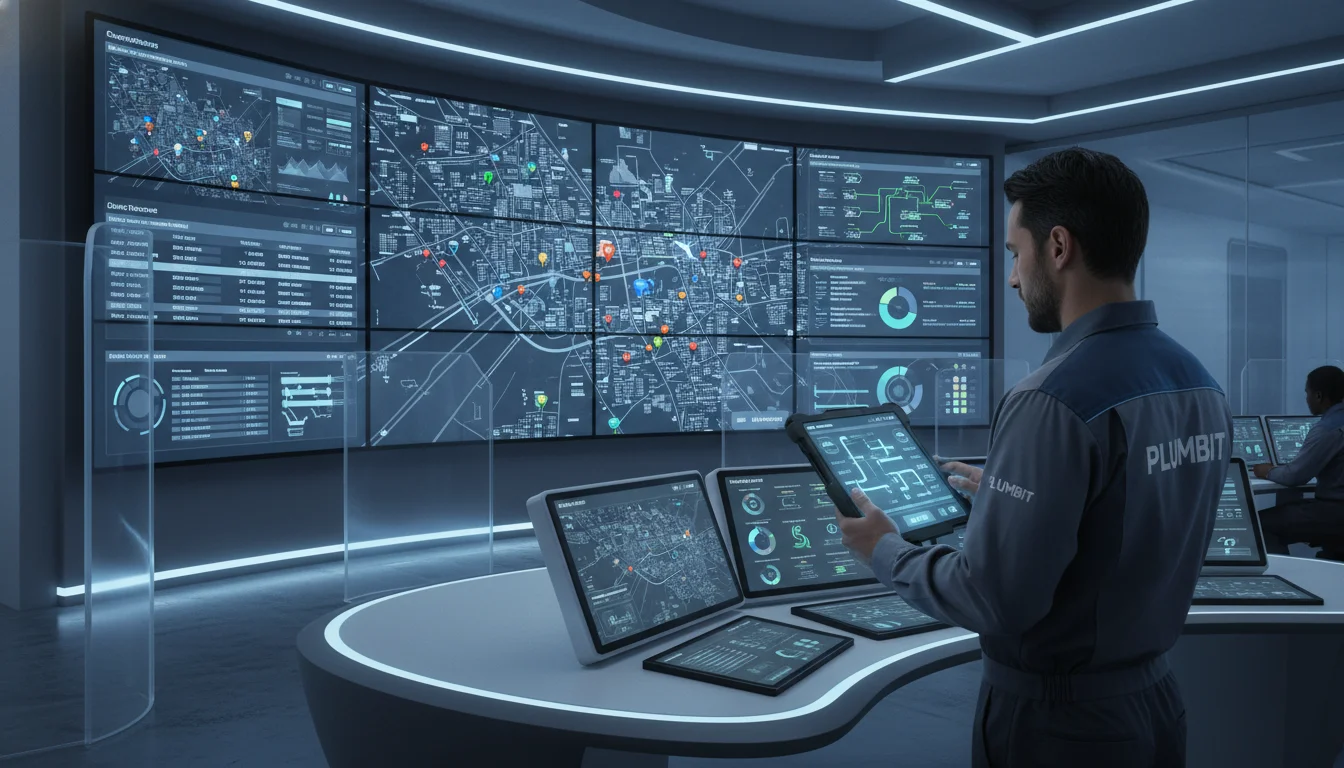
The cost of inaction is staggering. Research indicates that tradespeople and technicians frequently lose nearly a full workday each week to low-value administrative tasks, such as manual data entry, deciphering paper work orders, and navigating inefficiently planned routes. Conversely, operations that successfully implement automation at scale stand to capture immense financial benefits. In the related utility service sector, reports from Capgemini suggest that companies could save between $237 billion and $813 billion over three years by deploying automation at scale, a metric that underscores the massive financial leverage inherent in optimized dispatching. This report provides an exhaustive, comparative analysis of the leading automated dispatching platforms engineered for high-volume and enterprise-level plumbing fleets, serving as a definitive blueprint for organizations seeking to modernize their field service architecture.
The Operational Blueprint of High-Volume Plumbing Operations
Understanding the software requirements of a high-volume plumbing fleet requires an intimate understanding of the underlying operational dynamics. The plumbing industry is broadly segmented into commercial and residential services, with each domain demanding distinct technological capabilities from dispatching software architectures.
The Commercial and Industrial Imperative
Commercial plumbing contractors routinely service complex environments such as distribution centers, massive retail complexes, and industrial manufacturing plants. To illustrate the scale of such operations, infrastructure like the Burj Khalifa utilizes approximately 249,908 gallons of water daily across 163 floors, requiring masterful execution and highly specialized industrial-grade maintenance. These environments operate under strict operational constraints that standard residential dispatching tools are fundamentally ill-equipped to manage. Facilities often mandate exceptionally tight access windows, restricting service operations to specific two-hour slots to avoid interrupting loading dock operations or production lines.

Furthermore, commercial clients enforce rigorous compliance and documentation standards. Technicians are frequently required to capture digital sign-offs, photo documentation of completed repairs, and extensive job completion reports before vacating the premises. Additionally, commercial infrastructure often necessitates multi-trade coordination. A high-volume plumbing enterprise may need to coordinate complex installations that intersect with HVAC and electrical systems, requiring dispatch software capable of meticulously tracking the specialized skill sets, union statuses, and certifications of multiple technicians. Platforms engineered specifically for this sector, such as BuildOps, must provide native asset management, preventative maintenance scheduling, and project-based financial reporting that links labor tracking directly to profit margins to prevent cost overruns on massive bids.
The Residential and Emergency Service Dynamic
Conversely, high-volume residential plumbing focuses heavily on transactional volume, flat-rate pricing models, and rapid emergency response. Success in the residential sector hinges on maximizing the number of completed jobs per technician per day while driving high average ticket sizes through on-site quoting and membership renewals. Emergency dispatching acts as the ultimate stress test for any field service management platform. When an urgent call regarding a ruptured pipe is received, the dispatcher must instantly visualize the real-time location of the entire fleet, identify a technician with the correct skills who is in closest proximity, and reroute them without causing cascading delays across the remainder of the day’s schedule.
Advanced software utilizes live GPS tracking and smart algorithms to automatically identify the optimal technician, effectively removing the guesswork from emergency response and ensuring that specific arrival windows are communicated to the customer. Empirical data demonstrates that when plumbing operations utilize sophisticated GPS routing alongside their scheduling software, they can reroute field teams in less than sixty seconds, reduce travel times by up to thirty percent, and dramatically increase cash inflows through faster emergency responses that prevent catastrophic water damage.
Core Technological Pillars of Automated Dispatching
The transition from manual whiteboard scheduling to advanced algorithmic dispatching is supported by several core technological pillars. Evaluating an enterprise dispatch tool requires dissecting how effectively a platform executes across these mathematical and functional domains.
Combinatorial Optimization and Dynamic Routing
At the heart of automated dispatching lies the mathematical challenge of schedule optimization. To a human dispatcher, a daily schedule represents a simple visual calendar; to a computational algorithm, it represents a combinatorial explosion. For example, coordinating merely five technicians across six jobs generates approximately 2.65 x 10^32 possible scheduling combinations. Factoring in real-world constraints—such as Technician A possessing the necessary certification but being forty miles away, Technician B being nearby but lacking the required parts, and the customer demanding a strict two-hour arrival window—creates a problem of immense complexity that is effectively impossible for human dispatchers to solve efficiently at scale.
Sophisticated dispatching engines utilize optimization algorithms that continuously search through these millions of permutations in real-time to locate the most efficient mathematical schedule. Solutions such as Locus.sh and WorkWave excel in this precise domain, leveraging artificial intelligence to account for live variables like traffic delays, weather events, and vehicle capacity. Locus provides dynamic route optimization that automatically adjusts assignments when jobs overrun their scheduled time or when emergency calls disrupt the planned routing, ensuring that the fleet remains productive and on-time delivery rates are protected.
Telematics, Dashcams, and Fleet Management Integration
High-volume plumbing fleets manage millions of dollars in rolling assets. Integrating dispatching software with vehicle telematics provides an indispensable layer of operational control. Advanced fleet tracking systems offer live map views, route breadcrumbs, and real-time alerts regarding dangerous driver behavior.
The integration of telematics extends far beyond basic geographic positioning; it serves as a critical liability shield and a precise job-costing instrument. A compelling case study involving Riley Plumbing and Heating highlights this value. When a technician claimed a rollover accident involving a $200,000 truck was caused by a deer, the owner utilized ServiceTitan’s Fleet Pro front- and back-facing dashcam video to prove no deer was present, effectively protecting the company against fraudulent liability claims. More critically for daily operations, Fleet Pro’s Automated GPS Timesheets Integration intelligently updates technician timesheets according to strict GPS data. By cross-referencing a technician’s GPS coordinates with their digital timesheet, the software prevents wage theft, eliminates human error in time tracking, and guarantees that job costing calculations reflect the true cost of labor. When customers inevitably dispute an invoice by claiming the technician was only on-site for fifteen minutes, management can instantly produce immutable GPS data to verify the exact duration of the service call.
Mobile Connectivity and Technician Enablement
The efficacy of a dispatching system is inextricably linked to the operational stability of its mobile application. Field technicians operate as the frontline revenue generators, and their mobile interfaces must function flawlessly in highly varied environments. High-volume operations frequently require technicians to work in subterranean boiler rooms, rural environments, or reinforced commercial structures where cellular connectivity is nonexistent. Therefore, robust offline functionality is a mandatory requirement.
Technicians must be able to review job histories, update work orders, generate invoices, and capture customer signatures without an active internet connection, trusting the software to synchronize the data seamlessly once connectivity is restored.

Platforms such as ServiceTitan and Salesforce Field Service provide comprehensive mobile applications that empower technicians to transition from mere mechanics to active sales agents. ServiceTitan’s Field Mobile App features dynamic forms, interactive price books, and mobile estimate builders. Technicians can present tiered ‘Good-Better-Best’ options to clients, process credit card payments on-site, and offer financing directly from the field, all of which substantially increase the average ticket size and improve overall organizational profitability. However, the complexity of these apps requires rigorous optimization. User feedback occasionally highlights that heavily feature-laden apps can suffer from slow navigation or lag if the device is older or if the software updates are poorly optimized for field tablet interfaces.
The ERP and Financial Integration Nexus
While field service management software orchestrates the physical execution of services, it must communicate flawlessly with the organization’s enterprise resource planning (ERP) and accounting infrastructure to ensure financial integrity. Seamless integration prevents the manual re-entry of data across platforms, which is a primary source of administrative bottlenecks and costly payroll errors. Enterprise-grade platforms offer robust, pre-built connectors to major accounting systems. BuildOps, serving the commercial sector, provides native bidirectional integrations with sophisticated construction ERPs such as Viewpoint Vista, Viewpoint Spectrum, NetSuite, and Sage Intacct. Similarly, ServiceTitan supports complex integrations with Sage Intacct, Microsoft Dynamics, and QuickBooks Online Advanced, allowing massive plumbing enterprises to consolidate vendor management, sync general ledger accounts, and automate purchase orders directly from the field to the back office.
The Paradigm Shift: From Automated to Autonomous AI Dispatching
The most profound technological evolution currently reshaping field service management is the transition from rigid, rules-based automated scheduling to autonomous, agentic artificial intelligence. Historically, automated systems relied on rigid “Work Rules” (hard constraints) such as geolocation boundaries, union status, and required skills. While effective for ensuring basic compliance, strict rules inherently limit an algorithm’s ability to explore alternative routing options. Modern AI scheduling agents balance these hard constraints with “Work Objectives” (soft constraints), heuristically evaluating business goals such as minimizing overtime, reducing fuel consumption, or maximizing the deployment of top-performing sales technicians to high-value opportunities.
Conversational AI and Agentforce
Salesforce Field Service represents the vanguard of this autonomous transition through its Agentforce technology. Agentforce functions as an AI scheduling assistant that operates independently, utilizing natural language processing to interact directly with customers and technicians. Moving beyond static customer portals, customers can request an appointment via a conversational interface. The Agentforce AI instantly evaluates technician availability, skills, travel time, and inventory requirements to book the optimal slot without human intervention. The system handles complex verifications, such as sending One-Time Passcodes (OTPs) to secure sensitive information, and continuously re-optimizes the entire fleet’s schedule autonomously throughout the day in response to cancellations or traffic delays.
Smaller disruptors are also leveraging conversational AI. Platforms like FieldCamp feature AI Dispatchers that allow operational staff to interact with the scheduling board using plain English commands, such as “Schedule Sarah for emergency HVAC repair tomorrow morning,” instantly bypassing complex drop-down menus and manual calendar adjustments.
Predictive Revenue Optimization via Titan Intelligence
ServiceTitan has invested massively in industry-specific AI through its Titan Intelligence (TI) engine and the Dispatch Pro product suite. Dispatch Pro moves entirely beyond simple geographic routing by running thousands of predictive scenarios to assign the technician with the highest statistical likelihood of maximizing revenue for a specific call. By analyzing historical performance data, the software calculates a predictive job value and automatically pairs it with the technician whose sales metrics, closing rates, and technical skills align perfectly with that unique opportunity. Case studies indicate that the implementation of Dispatch Pro has resulted in a 14% boost in average ticket sizes, a 10% decrease in drive time per visit, and a 21% reduction in fleet idle time, effectively doubling the efficiency and capacity of human dispatchers.
The Human Element and Data Hygiene Constraints
Despite the transformative potential of artificial intelligence, implementation is not without profound operational challenges. The effectiveness of any algorithmic dispatching system is entirely dependent on the quality and hygiene of the underlying database. If a plumbing company’s database features incomplete technician skill profiles, inaccurate warehouse inventory logs, or fragmented customer histories, the AI will inevitably produce flawed, highly damaging routing decisions.
Industry feedback reveals that perfectly clean datasets are a rarity. Many established plumbing businesses service older demographics who may lack digital contact information, rendering automated email flows or SMS tracking links completely useless. Furthermore, the introduction of AI fundamentally shifts the role of the human dispatcher from a manual scheduler to a strategic supervisor. As noted in the Besser Garage Door case study regarding ServiceTitan’s Dispatch Pro, implementing AI is not a “set it and forget it” solution; it requires a steep learning curve, extensive database cleanup, and a profound cultural shift to foster trust in algorithmic recommendations among veteran office staff.
Comprehensive Evaluation of Enterprise-Grade FSM Platforms
Selecting the correct software architecture requires mapping the specific operational cadence of a plumbing fleet to the core development philosophy of the software vendor. The following analysis dissects the market leaders across critical performance vectors.
ServiceTitan: The Comprehensive Trade Ecosystem
ServiceTitan is widely regarded as the dominant operational force in residential and light-commercial field service management. Engineered specifically for the trades, its architectural philosophy centers on aggressive revenue maximization, highly detailed job costing, and end-to-end operational control.
The platform scales to manage massive enterprises. A prime example is Del-Air, a Florida-based company utilizing ServiceTitan to manage 600 employees and over 400 trucks, generating over $140 million in revenue. Prior to implementation, Del-Air struggled with fragmented data silos that prevented management from accurately viewing warehouse inventory alongside field data. Similarly, Rainforest Plumbing and Air leveraged ServiceTitan to replace manual processes, granting ownership unprecedented situational awareness and real-time cash flow visibility.
ServiceTitan excels in providing a unified platform encompassing CRM, call booking, highly customizable price books, mobile estimates, configurable payroll management, and sophisticated marketing analytics. Its marketing suite enables detailed attribution tracking, allowing companies to trace every booked job back to specific advertising campaigns, frequently reducing customer acquisition costs by up to 22%.
However, ServiceTitan is a highly complex system that is explicitly not optimized for operations with fewer than twenty technicians. The platform mandates long-term contracts and features a notoriously steep learning curve, with onboarding periods frequently lasting between three and six months.
ServiceTitan Evaluation Matrix
Assessment Metrics
Primary Market Focus: Large Residential Operations & Mid-Market Commercial
Key AI Capabilities: Dispatch Pro (Predictive revenue routing), Titan Intelligence
Mobile Application: Comprehensive sales enablement, forms, offline mode
Notable Constraints: High barrier to entry, heavy implementation lifting, complex UI
Salesforce Field Service: The Global Enterprise Engine
For massive, global enterprises, utilities, or plumbing fleets deeply entrenched in complex, multi-tiered B2B service agreements, Salesforce Field Service offers an unmatched ceiling for global scalability and customization.
Powered by the Agentforce AI engine, Salesforce provides fully autonomous, intelligent scheduling that continuously balances complex SLAs, multi-day work orders, and vast contractor networks. Because it resides natively within the world’s most robust CRM ecosystem, the platform provides an unparalleled 360-degree view of the customer, unifying sales pipelines, marketing automation, and field service execution. A case study involving WarpDriveTech, an exporter of UPVC column pipes with thousands of global employees, illustrates this scale. They leveraged the Salesforce Field Service app to automatically assign complex cases to contractors based on strict service territories and real-time availability, allowing plumbers to arrive completely prepared with advance knowledge of necessary tools.
The sheer scale of Salesforce Field Service necessitates a highly technical deployment.
Implementations frequently exceed six months and typically require the engagement of specialized third-party integration consultants. Furthermore, the software carries premium pricing, with advanced tiers like Field Service Plus and Einstein 1 Field Service costing between $230 and $600 per user per month.
Salesforce Field Service Evaluation Matrix
- Primary Market Focus Global Enterprises, Utilities, Complex B2B Service Networks
- Key AI Capabilities Agentforce, Conversational Scheduling, Autonomous Re-optimization
- Integration Architecture Infinite API customization, deep global ERP connectivity (Oracle, SAP)
- Notable Constraints Extreme complexity, requires dedicated system administrators, high TCO
BuildOps: The Commercial Construction Specialist
While many platforms originate in residential services and subsequently attempt to adapt to commercial needs, BuildOps was architected exclusively for commercial contractors from its inception.
BuildOps provides a highly visual, drag-and-drop dispatch board that flawlessly handles gated workflows—ensuring technicians explicitly complete prerequisite steps before proceeding to subsequent phases of complex installations. The platform vastly outperforms residential-focused software in project management and asset tracking. It empowers project managers to track labor, materials, and overall profitability against strict budgets in real-time, preventing disastrous cost overruns. Every single data point within the BuildOps system can be transformed into a custom report, providing executive leaders with deep visibility into departmental KPIs.
The financial impact of this commercial specialization is highly quantifiable. Case studies involving contractors like JBS Plumbing and Sloan Mechanical reveal that deploying BuildOps has allowed commercial firms to slash their billing times by 73%, grow top-line revenue by 30%, and increase net profits by an astounding 250%. Furthermore, its OpsAI engine actively flags critical timelines and margin deviations, allowing project managers to shift schedules and fix bottlenecks before they derail the project. However, BuildOps lacks some of the hyper-specialized residential tools, such as flat-rate consumer financing modules or autonomous AI predictive ticketing algorithms geared toward homeowners.
BuildOps Evaluation Matrix
- Primary Market Focus Mid-to-Large Commercial Plumbing, Mechanical, & Construction
- Key Differentiators Gated workflows, native commercial asset management, OpsAI
- ERP Connectivity Native integrations with Vista, Spectrum, Sage Intacct, Foundation
- Notable Constraints Lacks deep residential consumer marketing and flat-rate sales tools
WorkWave Service and Locus.sh: The Logistical Optimizers
WorkWave and Locus.sh approach field service management with a distinct focus on severe logistical efficiency, dynamic routing algorithms, and geographic optimization, making them superior choices for businesses with massive, dense, repeatable routes.
WorkWave Service focuses intensely on route planning and multi-location franchise oversight. The system’s routing engine significantly reduces fuel consumption and minimizes travel time by structuring daily agendas based on complex geographic clustering, a critical feature for fleets burning thousands of gallons of fuel weekly. However, user reviews indicate a steep learning curve lasting up to three months, and occasional instability with the mobile application during offline field operations.
Locus.sh operates as a specialized enterprise logistics engine rather than a traditional FSM. It automates repetitive operational decisions regarding job allocation, route adjustments, and return runs for parts. Its Dynamic Route Optimization engine digests real-world constraints—such as sudden road closures and strict customer time windows—to generate optimal paths. Locus excels in dynamic task reassignment mid-day without disrupting fleet stability, and its optimization logic actively improves as the operational scale and datasets expand. A plumbing fleet utilizing Locus would likely need to integrate it with separate, specialized software for advanced CRM or commercial project management, as Locus prioritizes the orchestration of physical movement over deep financial tracking.
Microsoft Dynamics 365, Zuper, and AI-Driven Disruptors
The enterprise FSM market also features highly adaptable platforms and emerging AI disruptors tailored for specific IT ecosystems and modernization efforts.
Microsoft Dynamics 365 Field Service is the premier choice for massive organizations already entrenched in the Microsoft ecosystem. It combines work order automation with cutting-edge tools like Copilot for natural language AI scheduling suggestions, GIS mapping, IoT-enabled asset visibility, and Augmented Reality (AR) collaboration, allowing senior engineers to guide junior technicians remotely through complex industrial plumbing repairs.
Zuper represents the modern wave of highly agile FSM software, prioritizing extreme flexibility, deep API integrations, and modular no-code workflow design. Designed for mid-market and enterprise organizations, Zuper’s standout feature is its ability to empower operations teams to build customized end-to-end logic for scheduling, contract renewals, and notifications using an intuitive drag-and-drop interface. It integrates seamlessly with over 60 applications, including HubSpot, QuickBooks, and Zendesk, maintaining a unified technology stack and offering comprehensive warranty and parts optimization.
Fieldproxy and FieldCamp serve as aggressive, AI-first disruptors challenging the legacy pricing models of giants like ServiceTitan. Fieldproxy offers an AI engine that continuously learns from service patterns to improve technician assignments, driving reported efficiency gains of 35% within the first quarter of deployment. Notably, Fieldproxy offers highly transparent pricing starting at $649 per month for unlimited users, presenting a stark financial contrast to per-user licensing models. FieldCamp similarly boasts an AI Dispatcher that delivers a 96% reduction in manual scheduling time by matching jobs to technicians in seconds, allowing a 15-technician HVAC/Plumbing firm in Arizona to increase their completed job volume by 40% without hiring additional staff.
High-Margin SMB and Mid-Market Alternatives: Sera and FieldEdge
For fleets that find global enterprise systems overly complex and rigid, platforms like Sera Systems and FieldEdge offer powerful, highly streamlined operational alternatives.
Sera Systems is built explicitly on the principles of operational simplicity and profitability. Sera utilizes an automated dynamic dispatcher to optimize routes and provides deep financial reporting focused on maximizing margins and minimizing wasted overhead. Case studies involving businesses like Brandon’s Heating & Air highlight Sera’s ability to drive massive growth in recurring revenue through its built-in membership management features. Another firm, Loyalty Plumbing, transitioned to Sera specifically because the dynamic dispatcher drastically reduced the number of times office staff had to manually drag-and-drop jobs on the board, providing real-time alignment across the entire operation.
FieldEdge positions itself as a highly accessible, rapid-deployment alternative to ServiceTitan. FieldEdge provides robust scheduling, deep native integration with QuickBooks, and highly stable mobile tools. Implementation is notably faster—typically 30 to 45 days quicker than ServiceTitan deployments—and it carries a substantially lower total cost of ownership. FieldEdge is the ideal deployment for mid-sized plumbing fleets seeking straightforward operational control and immediate ROI without the heavy administrative burden of configuring highly complex artificial intelligence constraints.
Comparative Analysis: Total Cost of Ownership and Implementation Logistics
The procurement of an automated dispatching tool extends far beyond evaluating feature checklists. Enterprise deployments involve massive capital expenditures, long-term contractual commitments, and profound organizational change management that can dictate a company’s financial trajectory for a decade. Analyzing the total cost of ownership (TCO) requires evaluating software licensing tiers, upfront implementation fees, complex data migration costs, and the hidden financial drain of operational disruption during onboarding.
Financial Modeling and Software Licensing Structures
| Software Platform | Primary Market Focus | Pricing Architecture | Estimated Monthly Cost | Implementation & Onboarding Dynamics |
|---|---|---|---|---|
| ServiceTitan | Large Residential & Light Commercial | Tiered, Per Technician (Starter, Essentials, The Works) | $245 - $300+ per tech/mo | $5,000 - $50,000+ upfront (Non-refundable). 3-6 month timeline. Manual data migration required. |
| Salesforce Field Service | Global Enterprise & Complex B2B | Tiered, Per User (Dispatcher, Technician, Field Service Plus) | $125 - $230+ per user/mo (Up to $600 for Einstein AI) | Extremely high. Requires specialized 3rd party consultants. 6+ month deployment. |
| BuildOps | Commercial Construction & Heavy Projects | Custom Enterprise Quote | Premium tier pricing | Moderate to High. Highly dependent on complex ERP integration configurations. |
| WorkWave Service | Multi-Location & Route-Heavy Logistics | Custom Enterprise Quote | ~$150 - $250+ per user/mo | 2-3 month learning curve. Focuses heavily on franchise onboarding. |
| Fieldproxy | Fast-scaling AI Adopters | Flat Rate, Unlimited Users | $649/mo (Unlimited users) | Rapid deployment. |
Highly transparent pricing.
FieldEdge
- Mid-Sized Residential/Commercial
- Tiered Licensing
- Lower relative to ServiceTitan
- Rapid deployment. Typically 30-45 days faster than ServiceTitan.
The Friction of Implementation and Change Management
The transition from legacy internal systems (or paper-based scheduling) to a modern, AI-driven FSM platform represents a major operational vulnerability for a plumbing fleet. Poorly executed implementations inevitably result in workflow paralysis, delayed invoicing cycles, plummeting cash flow, and widespread technician turnover.
The Burden of Data Migration
The complexity of migrating decades of fragmented customer histories, intricate multi-tiered price books, and active preventative maintenance service agreements cannot be overstated. ServiceTitan, for example, frequently requires these vast databases to be manually reconstructed within its proprietary structural framework. This labor-intensive data normalization process is a primary driver of their extended three-to-six-month onboarding timelines, and user reviews frequently cite the sheer exhaustion of this initial setup phase.
Mobile Workforce Adoption
Field adoption is the ultimate arbiter of software success. Technicians who are heavily accustomed to paper work orders or simple SMS text dispatching will face a massive psychological and operational learning curve when transitioning to comprehensive mobile apps that require real-time status updates, mandatory digital forms, and multi-option digital quoting. Extensive, continuous training is absolutely mandatory. Platforms like BuildOps and ServiceTitan assign dedicated customer success managers to actively shepherd this process, while platforms like FieldEdge offer free, one-on-one training sessions post-go-live to ensure that technicians do not abandon the software in frustration.
System Customization vs. Out-of-the-Box Functionality
Salesforce Field Service demands the longest deployment timeline precisely because it operates as a highly sophisticated blank canvas. Establishing the specific Work Rules, Soft Objectives, intricate routing policies, and global API connections requires sophisticated architectural planning and deep technical acumen. Conversely, platforms with rigid, out-of-the-box workflows deploy rapidly but force the plumbing business to fundamentally alter its standard operating procedures to conform to the software’s logic, rather than the software adapting to the business.
Synthesized Conclusions and Strategic Outlook
The landscape of automated dispatching tools for high-volume plumbing fleets is densely populated and heavily segmented, meaning that no single software platform presents a universal solution. The optimal architectural choice is entirely contingent upon the specific composition, market focus, and technological maturity of the enterprise undergoing the evaluation.
Fleet composition must dictate the software architecture. Operations heavily weighted toward massive commercial contracts, industrial installations, and long-term preventative maintenance must prioritize platforms with deep financial project management capabilities, native asset tracking, and robust ERP integration. In this specific commercial domain, BuildOps represents the superior technological alignment due to its gated project-centric workflows, OpsAI, and native accounting connectors to systems like Vista and Sage Intacct. Conversely, a massive global enterprise dependent on infinite scalability, complex interdependent subcontractor networks, and highly customized CRM infrastructures will find Salesforce Field Service to be the only platform capable of supporting its massive, global configurations.
For high-volume residential plumbing fleets—where profitability is driven strictly by rapid emergency response times, transactional efficiency, and elevated average ticket sizes—ServiceTitan remains the undisputed market heavyweight. Its heavy capital investment in Titan Intelligence and Dispatch Pro provides a mathematically proven, predictive mechanism for matching specific technicians to specific jobs in a manner that maximizes top-line revenue while simultaneously minimizing fleet idle time. However, executive leadership must be thoroughly prepared for the substantial upfront capital expenditure, the non-refundable implementation fees, and the extended operational disruption inherent in its deployment phase.
Organizations that demand elite logistical execution and dynamic route optimization above all else—particularly those operating diverse franchises across heavily congested urban environments—should heavily evaluate Locus.sh or WorkWave Service. The AI-driven optimization engines within these specific platforms are uniquely engineered to absorb the chaos of real-time environmental variables and maintain fleet efficiency at scale. Furthermore, organizations seeking to avoid exorbitant per-user licensing fees while still capturing the benefits of artificial intelligence should look toward disruptors like Fieldproxy, which offers unlimited users and generative AI routing at a fraction of the enterprise cost.
Ultimately, the future of plumbing fleet dispatching is undeniably autonomous. The competitive advantage in the field service sector will no longer belong solely to the plumbing fleet with the fastest trucks or the most aggressive marketing budget, but rather to the enterprise with the cleanest database and the most sophisticated algorithmic dispatching engine. By meticulously aligning their operational realities with the technological philosophies of these enterprise platforms, plumbing organizations can transcend manual limitations, turning field service from an administrative and logistical burden into a highly predictable, aggressively profitable machine.