Dallas Water Damage Restoration: Expert Contractor Guide
Emergency Water Damage Restoration in Dallas: Choosing the Right Contractor for Rapid Flood Recovery
The Dallas-Fort Worth (DFW) metropolitan area occupies a unique and highly volatile meteorological intersection that subjects its residential and commercial infrastructure to a vast array of water-related vulnerabilities. From sudden, severe convective thunderstorms and heavy, sustained seasonal rainfall to catastrophic winter freeze events that induce widespread plumbing failures and pipe bursts, property owners in North Texas face a constant, year-round risk of sudden water intrusion. When water breaches the envelope of a structure, the ensuing damage operates on an exponentially accelerating and unforgiving timeline. What frequently begins as a localized pooling of water rapidly evolves into severe structural degradation, material delamination, and, most critically, the proliferation of toxic biological hazards.
The Strategic Imperative of Rapid Mitigation in the Dallas Ecosystem
The fundamental principle governing professional water damage restoration is the concept of secondary damage prevention. The initial physical contact of water with building materials—such as drywall, hardwood flooring, insulation, and subflooring—constitutes the primary damage. However, if the liquid moisture is not rapidly extracted and the ambient relative humidity is not aggressively controlled, the trapped moisture will inevitably migrate into hidden structural cavities, wicking up walls and permeating porous materials far beyond the initial spill zone. Within a strict 24 to 48-hour window, microbial growth, specifically mold, begins to aggressively colonize these damp, dark environments. Once microbial amplification occurs, the complexity, duration, and financial burden of the restoration project increase dramatically, shifting the paradigm from basic water extraction to highly regulated, hazardous biohazard remediation.
Consequently, selecting the right emergency water damage restoration contractor is not merely a matter of facility maintenance or aesthetic repair; it is a critical exercise in risk management, legal liability limitation, and asset preservation. A highly qualified, rapid-response contractor will stabilize the environment, deploy advanced psychrometric drying techniques, and navigate the remarkably complex web of Texas regulatory compliance and insurance documentation. Conversely, engaging an unqualified entity—or falling victim to predatory “storm chasers” who flock to disaster zones with deceptive sales tactics—can result in devastating financial losses, denied insurance claims, and severe, long-term health consequences for the building’s occupants.
This comprehensive analysis examines the multifaceted landscape of water damage restoration in Dallas, Texas. It explores the highly technical scientific standards governing professional mitigation, the stringent regulatory frameworks enforced by the state regarding mold remediation, the complex dynamics of Texas property insurance underwriting, the legal protections available to consumers facing predatory contractors, and a detailed, data-driven evaluation of the top-tier restoration contractors currently operating within the DFW market.
The Science and Protocol of Professional Water Mitigation
Water damage restoration is a highly technical discipline governed by the principles of psychrometry—the study of the thermodynamic properties of moist air. Professional restoration extends far beyond the mere physical extraction of standing water using consumer-grade equipment; it requires the precise manipulation of temperature, humidity, and airflow to force bound moisture out of structural materials.
When a premier restoration firm responds to a crisis in Dallas, the intervention typically follows a stringent, scientifically validated protocol designed to arrest damage immediately. The first phase involves immediate damage assessment and site stabilization, a process that is often initiated within hours of the client’s emergency call. Advanced diagnostics, including high-resolution infrared thermal imaging cameras and both penetrating and non-penetrating moisture meters, are deployed to map the full extent of the water migration. This moisture mapping is an absolute necessity, as water frequently travels along the path of least resistance, pooling behind baseboards, settling under vapor barriers, and infiltrating within complex HVAC ductwork.
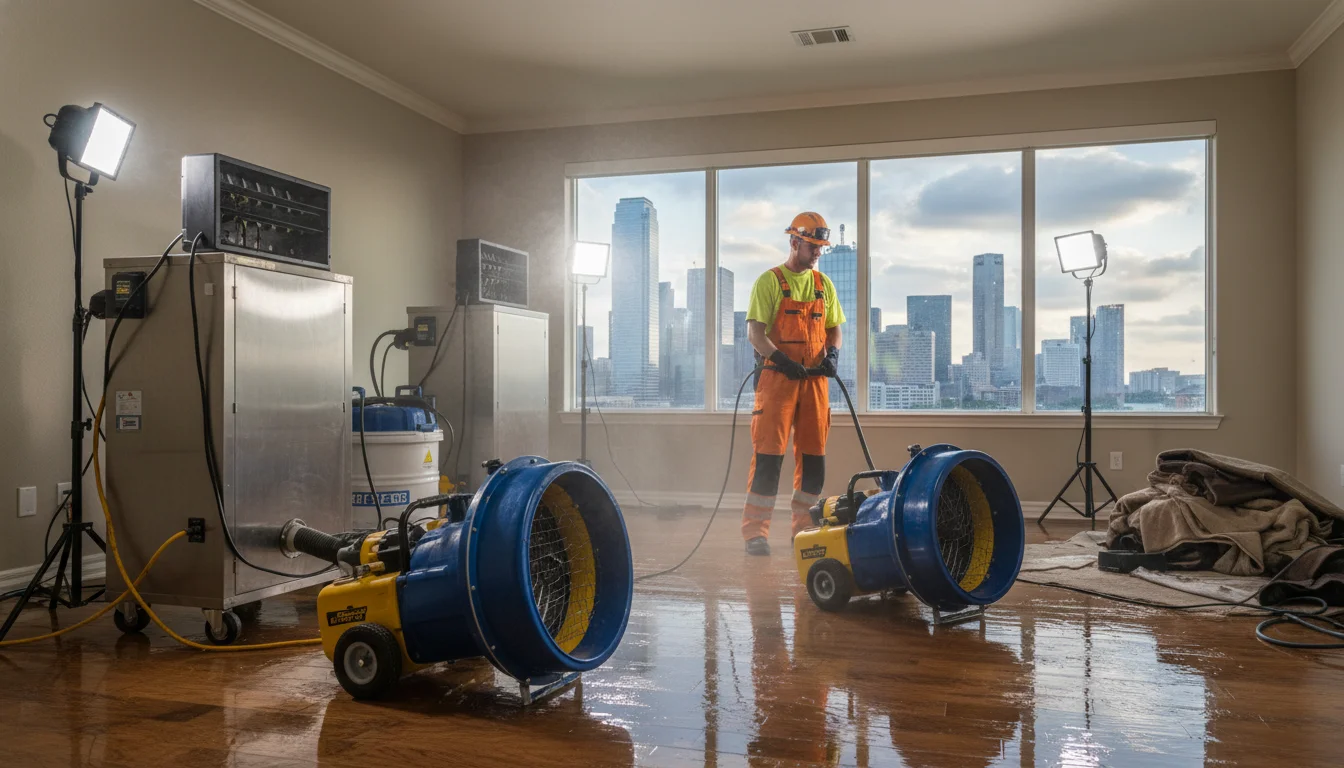
Once the precise moisture footprint is defined, aggressive emergency water extraction commences. Utilizing powerful truck-mounted extraction units and specialized subsurface extraction tools, technicians remove the bulk of the liquid water. This step is imperative because physical liquid extraction is exponentially more efficient than attempting to evaporate standing water using air movement alone. Following comprehensive extraction, the structural drying and dehumidification phase begins. Industrial-grade low-grain refrigerant (LGR) dehumidifiers are installed to drastically reduce the humidity of the ambient air, creating a vapor pressure differential that pulls moisture from the wet materials. Concurrently, high-velocity air movers are strategically positioned to disrupt the boundary layer of moist air that forms over wet surfaces, thereby continuously accelerating the evaporation process.
Throughout this multi-day process, the indoor environment must be rigorously and continuously monitored. Technicians take daily psychrometric readings to ensure the drying equipment is operating at peak efficiency and that the structural materials are progressing steadily toward their established dry standard. Simultaneously, the affected areas are frequently treated with EPA-registered antimicrobial and biocidal agents to sanitize the environment, deodorize the space, and suppress microbial amplification during the vulnerable drying phase. Only when all materials have reached their pre-loss moisture equilibrium is the mitigation phase considered complete, allowing the project to safely transition into the final repair and full interior reconstruction phase.
The Standardization of Excellence: IICRC Certification
In an industry that frequently and directly intersects with public health, structural engineering, and indoor air quality, standardized training and ethical accountability are paramount. The global benchmark for technical competence and standardized procedures in the restoration industry is established by the Institute of Inspection, Cleaning and Restoration Certification (IICRC). Founded in 1972, the IICRC functions as the industry’s primary standard-setting body, developing comprehensive, science-based protocols that dictate exactly how mitigation and remediation operations must be performed to ensure safety and efficacy. According to Environmental Protection Agency (EPA) guidelines, property owners should specifically seek out contractors possessing this level of verified training when dealing with water intrusion and mold.