Best Startup Payroll Software 2026: Global Solutions & EOR
The Strategic Landscape of Payroll Software for Startups in 2026: Navigating Domestic Scaling, Global Employer of Record Integration, and Localized Compliance

The Macroeconomic Evolution of Startup Payroll Architecture
The operational paradigm for early-stage enterprises and startup ventures has fundamentally shifted over the past decade. Historically, human capital compensation and payroll processing for small businesses constituted a highly manual, error-prone administrative endeavor. Founders and early administrative personnel often relied on rudimentary spreadsheet tracking or decentralized money transfer applications, dedicating significant capital and operational bandwidth to calculating tax withholdings, managing disparate benefits portals, and physically processing localized payments. This fragmented approach frequently resulted in severe operational bottlenecks, compliance failures, and stiff financial penalties levied by entities such as the Internal Revenue Service (IRS) and state tax agencies for inaccurate or delayed filings.
The advent of cloud computing facilitated the first major paradigm shift, giving rise to Software-as-a-Service (SaaS) payroll providers that automated tax calculations, direct deposits, and basic compliance reporting. However, the modern startup ecosystem of 2026 is characterized by challenges that extend far beyond simple domestic wage distribution. Today’s high-growth companies operate in a borderless environment, characterized by rapid global expansion, highly distributed remote workforces, and the necessity to navigate increasingly stringent, hyper-localized regulatory frameworks. Consequently, the selection of payroll software has evolved from a mere administrative checkpoint into a critical strategic decision. The chosen architecture directly dictates a startup’s ability to scale operations swiftly, maintain ironclad legal compliance across multiple jurisdictions, protect sensitive intellectual property, and meticulously manage financial burn rates in competitive fundraising environments.
The contemporary market reveals a profound bifurcation in software solutions. On one end of the spectrum reside domestic, single-country platforms optimized for early-stage companies managing traditional mixed teams of W-2 employees and 1099 independent contractors. These systems prioritize ease of use, automated local tax remittance, and integrated benefits administration. On the opposite end of the spectrum is the rapidly proliferating sector of Employer of Record (EOR) and global multi-country payroll platforms. These sophisticated ecosystems have engineered legal and technological solutions that allow startups to bypass the arduous, capital-intensive process of establishing foreign legal entities, thereby enabling the compliant hiring of contractors and full-time employees across hundreds of international jurisdictions with minimal friction.
Furthermore, the complexities of international expansion necessitate a profound understanding of hyper-local compliance mechanisms. Relying on global abstraction layers is sufficient for initial market entry, but as regional headcounts scale, companies must engage directly with local statutory requirements. An in-depth examination of emerging global talent hubs, such as the Federal Democratic Republic of Nepal, reveals an intricate web of progressive tax slabs, mandatory social security contributions, and highly specialized domestic Human Resource Management Systems (HRMS) that expanding global entities must eventually navigate or integrate with. By synthesizing platform capabilities, comparative cost structures, user sentiment, and localized statutory requirements, this comprehensive report provides an exhaustive evaluation of the best payroll software solutions available to startups in 2026, offering strategic recommendations meticulously tailored to varying stages of corporate maturation and geographic distribution.
mindmap
  root("(Startup Payroll 2026"))
      Domestic Scaling
          Gusto
          QuickBooks
          OnPay/Patriot
          ADP/Paychex
      Global EOR Integration
          International Hiring
          Legal Compliance
          Tax Withholding
      Localized Compliance
          Tax Slabs
          Social Security
          HRMS Integration
      Evaluation Criteria
          Scalability & Flexibility
          Global Capabilities & EOR
          Compliance & Risk Mitigation
          Integration Ecosystem
          User Experience & ESS
      HR, IT & Payroll Convergence
          Rippling (Unified Platform)
          Automated Provisioning
          Reduced Admin Overhead
Figure 1: Key Themes in Startup Payroll 2026
Core Evaluation Criteria for Modern Startup Payroll Ecosystems
Selecting the optimal payroll architecture requires founders and human resource executives to evaluate platforms across several multi-dimensional vectors. The data suggests that decision-makers prioritize the following critical criteria when abandoning manual spreadsheets and legacy systems in favor of modern, integrated solutions.
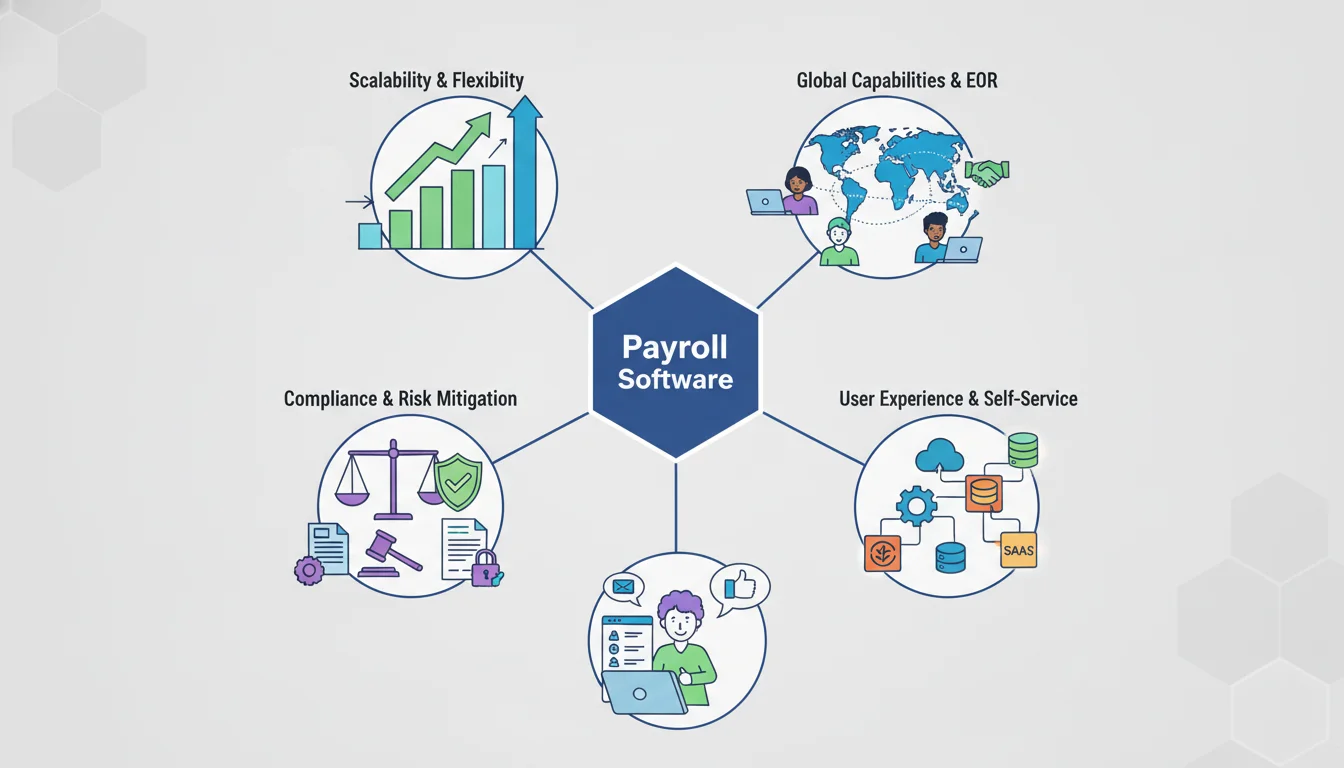
First and foremost is the metric of scalability and architectural flexibility. A startup’s headcount and organizational structure can fluctuate dramatically depending on funding rounds and market traction. The underlying software must accommodate pre-seed, lean teams of two founders operating on strict budgets just as efficiently as a Series C company scaling to 500 distributed employees across multiple time zones. Pricing structures must scale logically, ensuring that the per-employee economics do not impose prohibitive costs on early-stage companies while simultaneously offering the enterprise-grade features required by mature organizations.
Secondly , the demand for global capabilities and native Employer of Record (EOR) integration has become a baseline requirement for modern tech ventures. For companies looking beyond their domestic borders to source premier engineering or operational talent, the ability to hire via an EOR is paramount. An EOR acts as the recognized legal employer of a worker in a foreign country, absorbing the profound liability of tax withholding, health benefits administration, pension contributions, and local labor law compliance. The optimal software must seamlessly integrate EOR employees, localized domestic employees, and international contractors into a single, unified administrative dashboard, providing leadership with a holistic view of global labor expenditures.
Thirdly , modern payroll software must act as an automated legal safeguard, prioritizing compliance and risk mitigation. This encompasses the automated calculation and filing of taxes at the local, state, and federal levels, as well as strict adherence to international statutory requirements. In the context of global hiring, this includes managing mandatory statutory leave, minimum wage laws, localized anti-discrimination protocols, and data protection regulations. Crucially, the software must protect the startup against the severe legal risks associated with employee misclassification. Misclassifying a full-time foreign worker as an independent contractor can result in catastrophic financial penalties, back-tax liabilities, and complex intellectual property disputes that can derail fundraising efforts.
Fourth , the integration ecosystem is a vital consideration. Payroll data cannot exist in an operational vacuum. It must communicate bi-directionally and in real-time with core accounting software platforms, such as QuickBooks Online, Xero, and enterprise resource planning (ERP) systems. This ensures that labor costs are immediately reconciled in financial ledgers without manual data entry. Furthermore, integrations with time-tracking applications, point-of-sale systems, and performance management tools are necessary to create a cohesive operational stack.
Finally , the User Experience (UX) and the deployment of comprehensive Employee Self-Service (ESS) portals are critical differentiators. High-growth startups inherently lack the administrative bandwidth for extensive software training or the manual processing of routine employee requests. Intuitive interfaces that empower employees to independently manage their onboarding documentation, download tax forms, update banking details, and enroll in benefits significantly reduce the administrative burden on lean human resource departments, allowing leadership to focus on strategic growth rather than transactional processing.
Leading Domestic Payroll Platforms for US-Based Startups
For early-stage companies operating primarily within the United States, or those whose international presence is limited to a handful of independent contractors, several platforms have established themselves as industry benchmarks. These systems excel in automating complex domestic tax filings, administering localized health and retirement benefits, and providing exceptionally intuitive user experiences designed specifically for non-accountants.
Gusto: The Benchmark for Early-Stage Operations and Mixed Teams
Gusto has firmly cemented its position as one of the most widely adopted and highly recommended payroll and benefits management platforms for small to mid-sized startups. Founded in under the moniker ZenPayroll, Gusto is uniquely tailored for technology firms and software startups, particularly those generating between $1 million and $10 million in annual revenue, though its utility extends to businesses of nearly any stage.
Gusto is engineered specifically to handle mixed-role teams, allowing administrators to seamlessly process both W-2 employees and 1099 independent contractors within the exact same pay run. Its core strengths lie in its full-service benefits administration, highly automated tax calculations, and robust, native integrations with leading accounting tools such as Xero and QuickBooks Online. The platform’s user experience is frequently cited as best-in-class, removing the friction traditionally associated with payroll management and earning it a rating in expert editorial reviews for its payroll-specific functionalities. Setup time is remarkably swift, typically requiring only one to two days to become fully operational.
From a financial perspective, Gusto utilizes a tiered pricing model. The base plan commences at $ per month, accompanied by a $ per month fee for each active employee or contractor. While highly regarded, Gusto does exhibit certain limitations that mature enterprises may find restrictive.
The platform currently lacks native, fully integrated features for comprehensive background checks and robust IT systems management. Furthermore, while it automates federal compliance seamlessly, its state-level compliance registrations are not universally automated across all jurisdictions, occasionally requiring manual intervention from the startup’s administrative team. Despite these minor drawbacks, its Consumer Sentiment Index remains steady at 6.3, placing it solidly within the upper echelon of domestic providers.
QuickBooks Payroll: The Accounting-First Architecture
For startups that are already deeply embedded within the Intuit financial ecosystem, QuickBooks Payroll offers an integrated, accounting-first approach to human capital management. By housing accounting and payroll within the exact same architectural environment, QuickBooks eliminates data silos and ensures that all labor expenditures, tax liabilities, and contractor payouts are instantly and accurately reflected in the company’s general ledger.
QuickBooks Payroll is highly utilized by technology companies and local businesses operating with 10 to 50 employees. It provides essential features such as automated tax calculations, time tracking integration, and immediate payroll processing. The base pricing for QuickBooks Payroll begins at $45 per month, plus a $4 per month fee per employee, though Intuit frequently offers promotional discounts, such as 50% off for the first three months, to attract early-stage ventures. Additionally, the platform offers a 30-day trial period, allowing founders to evaluate its efficacy without financial commitment.
However, comparative metrics indicate areas where QuickBooks trails its specialized competitors. While it scores highly in ease of use (87%) and reporting dashboards (87%), its quality of support metric sits at 78%, which is notably lower than legacy providers in the space. For startups prioritizing deeply specialized HR workflows over pure accounting synchronization, this support gap may prove disadvantageous.
OnPay and Patriot Payroll: Optimizing for Budget and Flexibility
Startups operating under strict capital constraints, or those managing highly variable, shift-based workforces, frequently migrate toward solutions like OnPay and Patriot Payroll. OnPay is consistently recognized for its exceptional value proposition, charging a straightforward, transparent fee while providing fast, capable processing and an outstanding employee portal. It is particularly effective for mixed teams of W-2 and 1099 workers and boasts a rapid setup time of approximately 30 minutes, the fastest among top-tier providers. OnPay’s interface is highly responsive, and it offers expanded compliance resources tailored to numerous vertical industries, making it highly adaptable.
Patriot Payroll serves as a hyper-budget-conscious option for pre-seed or early-stage startups. It is designed for founders who require functional, accurate, no-frills payroll execution without the financial overhead of extensive, enterprise-grade human resource suites.
| Platform | Best Suited For | Setup Duration | Base Pricing | Accounting Integration |
|---|---|---|---|---|
| Gusto | Scaling startups, Tech | 1–2 days | $49/mo + $6/user | Seamless (QBO, Xero) |
| OnPay | Mixed role teams, Budget focus | ~30 mins | Highly Affordable | Limited native |
| QuickBooks | Embedded Intuit users (10-50 staff) | Varies | $45/mo + $4/user | Native QBO |
| Patriot | Early-stage, highly budget-conscious | 1–2 days | Budget Tier | Basic |
ADP RUN and Paychex Flex: Legacy Powerhouses for Scale
For risk-averse founders prioritizing ironclad reliability and the ability to scale seamlessly into a massive enterprise without changing vendors, legacy providers like ADP and Paychex remain formidable contenders. ADP is widely considered one of the most trusted payroll and HR providers globally. Its dedicated small business platform, RUN Powered by ADP, offers an exceptionally flexible solution that includes automated processing, meticulous tax calculations, compliance management, and integrated time and attendance tracking.
ADP dominates performance metrics, boasting a 92% performance and reliability rating, a 92% ease-of-use rating, and a 90% quality of support rating, significantly outperforming many newer SaaS market entrants in pure stability. Furthermore, as startups mature into mid-market or large enterprises, they benefit from a seamless migration path to ADP Workforce Now or ADP Lyric HCM, platforms capable of supporting highly sophisticated global payroll operations across 140 countries.
Paychex Flex offers a similar trajectory, providing highly scalable solutions tailored for growth-stage startups. It features an excellent mobile application designed for employee self-service and strong benefits management capabilities. While its consumer sentiment scores for performance (88%) and ease of administration (86%) lag slightly behind ADP, it remains a highly dependable option for startups requiring rigorous, traditional HR support structures.
SurePayroll and Square Payroll: Niche Solutions
SurePayroll, while offering full-service and self-service options, is notable for its dedicated customer service aimed at assisting startups transitioning from in-house tax-filing. Its pricing begins at $19.99 per month plus $4 per employee for self-service, or $29.99 per month plus $5 per employee for full-service. However, market analysis notes that it charges ancillary fees for services that other platforms provide natively for free, such as the creation and distribution of W-2 forms. Square Payroll, conversely, serves as a streamlined, simplistic option specifically favored by contractor-heavy teams or retail-focused startups already utilizing the Square point-of-sale ecosystem.
graph TD
    A["Startup Payroll Needs?"] --> B{"Team Type & Scale?"};
    B -- Mixed W2/1099, Early Stage --> C[Gusto];
    B -- Intuit Ecosystem, 10-50 Staff --> D[QuickBooks Payroll];
    B -- Budget Conscious, Flexible --> E["OnPay / Patriot Payroll"];
    B -- Enterprise Scale, Reliability --> F["ADP RUN / Paychex Flex"];
    B -- Contractor Heavy, Retail Focus --> G[Square Payroll];

    C -- Best-in-class UX, Benefits --> H[Consider Gusto for robust features];
    D -- Accounting-first integration --> I[Choose QuickBooks for seamless finance];
    E -- Cost-effective, fast setup --> J["Opt for OnPay/Patriot for value"];
    F -- Future-proof, high stability --> K["Select ADP/Paychex for large-scale growth"];
    G -- Simple, POS integration --> L[Go with Square Payroll for niche needs];
Figure 2: Domestic Payroll Platform Selection Guide
The Convergence of HR, IT, and Payroll Systems
A critical evolution in the startup software landscape is the total dissolution of traditional departmental silos. Historically, business models siloed payroll processing within finance departments, employee relations within human resources, and hardware/software access within information technology. The modern SaaS landscape demonstrates that these functions are mechanistically identical data processes anchored to a single employee identity profile.
Rippling: The Unified Infrastructure Pioneer
Rippling represents the vanguard of this unified architectural approach. While traditional platforms focus strictly on moving capital, Rippling solves a fundamental operational bottleneck for scaling startups: the fragmentation of operational systems. Rippling operates as a unified platform that binds core HR data, global payroll execution, benefits administration, and comprehensive Information Technology (IT) provisioning into a single, cohesive database.
The systemic implications of this convergence are profound. When a startup hires an employee via Rippling, the software acts as the master trigger mechanism. It not only adds the individual to the payroll ledger and calculates their specific global or state taxes, but it also automatically provisions their corporate email address, grants exact role-based access to required third-party SaaS applications (such as GitHub, Slack, or Salesforce), and can even coordinate the shipment of a pre-configured laptop to the employee’s physical location. Upon the employee’s termination or resignation, the system universally and instantly revokes all software access, halts payroll, and initiates offboarding protocols.
This convergence drastically reduces administrative overhead, eliminates the need for founders to maintain a
Related Posts and Resources
- Digital Marketing in Nepal (Complete Guide)
- Google Ads in Nepal: Practical Strategy
- SEO Analytics for Nepali Businesses
- eCommerce Analytics Setup in Nepal
- eCommerce Metrics That Matter
- Email Marketing Guide for Nepal
- Email Marketing ROI in Nepal
- Facebook Ads Budget Guide (Nepal)
- Cultural PPC Strategy for Nepal
- Competitor Analysis Framework for Nepal