Small Business Website Builders 2026: Compare Top Platforms
The Digital Storefront Architecture: A Comprehensive Analysis of Website Builders for Small Businesses in 2026
The digital landscape for small and medium-sized enterprises (SMEs) has undergone a profound transformation by the year 2026. Driven by an accelerated convergence of artificial intelligence, modular no-code infrastructure, and highly localized financial technologies, the fundamental utility of the website builder has transitioned from a static digital brochure into a dynamic, overarching operational hub. With e-commerce continuing to capture a dominant and ever-expanding share of global retail activity—accounting for an estimated $304.2 billion in the United States alone by the second quarter of 2025, representing 16.3 percent of total retail sales—small business owners can no longer afford to operate fragmented digital systems. Modern enterprises require integrated, seamless environments capable of handling complex inventory management, multi-channel marketing campaigns, automated customer relationship management, and highly secure, localized payment processing architectures.
This comprehensive research report provides an exhaustive evaluation of the best website builders available to small businesses in 2026. It meticulously assesses global market leaders such as Wix, Shopify, and Squarespace, analyzing their architectural strengths, pricing paradigms, and e-commerce ceilings. Furthermore, the analysis extends deeply into the critical friction points observed in emerging digital economies, utilizing the Nepalese market as a primary analytical case study. By examining the technical and strategic integration of localized payment gateways like eSewa, Khalti, and Fonepay, alongside the rise of indigenous platforms like ShriGo and Thulo.com, this report highlights the vital paradigm shift from global homogenization to hyper-localized e-commerce infrastructure. Finally, the report investigates the evolving relationship between custom web development agencies and no-code platforms, revealing structural shifts in how digital services are monetized in the era of artificial intelligence and commoditized web design.

Global Market Leaders: Architectural Philosophies and Core Capabilities
The ecosystem of global website builders is dominated by a select few platforms, each engineered around a distinct operational philosophy and target demographic. The choice of platform fundamentally dictates a small business’s long-term scalability, frontend design flexibility, and backend logistical capabilities. Understanding the foundational architecture of these platforms is the critical first step for any enterprise establishing its digital footprint.
Wix: The Design and Marketing Powerhouse
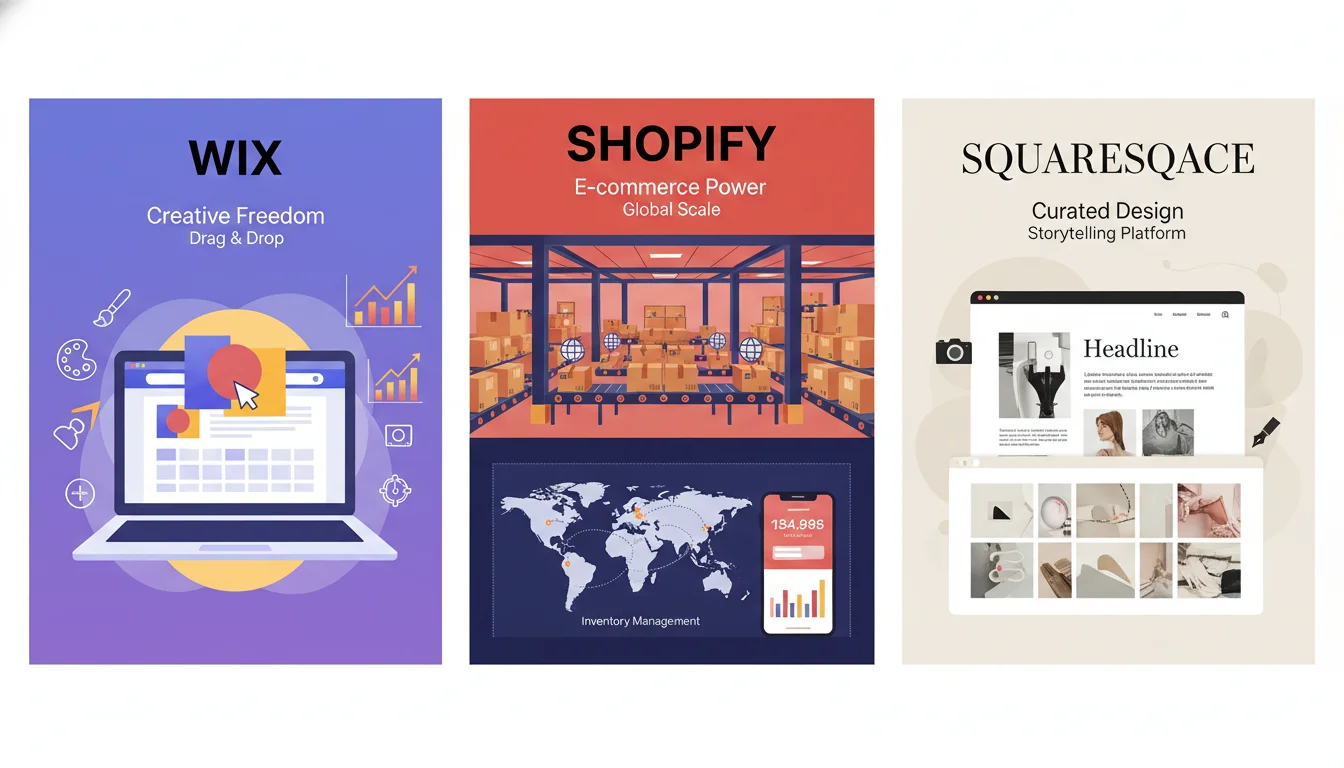
Wix has systematically solidified its position as the preeminent all-in-one platform for small businesses seeking maximum design autonomy coupled with robust native marketing tools. Historically viewed as a platform suited primarily for simple portfolios or service-based landing pages, Wix’s 2026 infrastructure supports advanced, high-capacity e-commerce functionality, accommodating up to 50,000 products within its core database.
The platform’s primary architectural strength lies in its highly intuitive drag-and-drop interface, which provides unparalleled visual freedom, allowing elements to be placed anywhere on the canvas without the strict grid restrictions imposed by other builders. This design paradigm is supported by an expansive inventory of over 800 to 900 highly specific templates tailored to diverse industries, alongside an automated AI web builder capable of generating customized layouts based on natural language prompts.
In terms of marketing and organic acquisition, Wix consistently surpasses many commerce-first competitors by offering a superior suite of built-in tools. Its native email marketing service permits the distribution of 5,000 free monthly emails, compared to significantly lower thresholds on competing platforms, which often require expensive third-party integrations to achieve similar volumes. Furthermore, Wix’s blogging infrastructure is highly developed, featuring AI-powered tools that generate blog ideas, outlines, and full posts, alongside an AI meta-tag creator, advanced categorization, and automated sitemap assistance. This makes Wix highly effective for content-driven organic search engine optimization (SEO), particularly for local businesses.
However, Wix exhibits certain structural limitations that must be considered during the procurement phase. The 50,000 product ceiling, while entirely sufficient for the vast majority of SMEs, creates a hard scalability limit for enterprise-level cataloging or aggressive dropshipping operations. Furthermore, while its native payment processing (Wix Payments) integrates with over 80 global gateways, it lacks deep, out-of-the-box penetration in specific emerging markets without significant developer intervention via its Velo API. Pricing for premium business tiers is highly competitive, generally starting between $11.75 and $17.00 per month, positioning it as a highly cost-effective solution for small to mid-sized operations.
Shopify: The Commerce-First Engine
Shopify operates on a fundamentally different paradigm from Wix, prioritizing backend logistics, scalable database architecture, and global sales channels over frontend design flexibility. It is universally recognized by industry analysts as the optimal platform for launching, managing, and scaling dedicated online retail stores.
Unlike Wix, Shopify imposes absolutely no limits on product listings, variations, or storage capacity, making it the definitive choice for businesses anticipating high-volume inventory growth or those operating extensive digital catalogs. The platform integrates seamlessly and deeply with third-party logistics providers, proprietary Point of Sale (POS) hardware for omnichannel retail environments, and global dropshipping networks. Its App Store is highly expansive, allowing merchants to augment their core stores with thousands of specialized software tools for conversion rate optimization. These include automated user-generated content (UGC) review management systems, advanced wishlist functionalities, sophisticated B2B wholesale pricing structures, and complex abandoned cart recovery sequences.
The strategic trade-off for this logistical supremacy is frontend design rigidity and a higher total cost of ownership. Shopify relies on a structured, theme-based design environment, offering approximately 1,000 templates, that ensures clean, conversion-driven storefronts but restricts the absolute creative freedom found in the Wix editor. Users cannot easily drag elements outside of predefined modular blocks. Furthermore, while base plans start between $19.00 and $29.00 per month, the necessity of subscribing to third-party apps to achieve functionalities natively present in Wix—such as advanced blog analytics, expansive email marketing, or specialized product option fields—can significantly inflate monthly operational expenditures.
Squarespace: The Aesthetic and Content-Driven Solution
Squarespace occupies a highly profitable middle ground within the builder ecosystem, appealing primarily to creative professionals, digital product sellers, and service-based businesses that require a highly polished, aesthetic presence with moderate e-commerce capabilities.
The platform eschews the overwhelming template volumes of Wix or Shopify, instead featuring a highly curated selection of just under 200 meticulously designed templates. These templates automatically enforce strong visual hierarchies, typography rules, and responsive design parameters, making it exceedingly difficult for a novice user to create an aesthetically displeasing website. Squarespace supports unlimited e-commerce products and integrates seamlessly with third-party processors alongside its native Squarespace Commerce infrastructure.
In 2026, Squarespace’s AI integrations are deeply and elegantly embedded into the user workflow. The platform is capable of generating entire design structures, cohesive site themes, nuanced copywriting, detailed product descriptions, and automated email campaigns directly from simple language prompts. Priced competitively, starting around $10.00 to $16.00 per month, Squarespace offers excellent value for businesses that prioritize brand perception and require simple selling mechanics without the overarching complexity of Shopify’s inventory systems or the potential design chaos of Wix.
mindmap
  root("(Small Business Website Builders 2026"))
    Wix
      Core Strength("(Design Freedom & Marketing"))
      Ideal User("(Service Businesses, Mid-sized Retail"))
      Limitations("(50k Product Cap, Emerging Market Payments"))
    Shopify
      Core Strength("(Scalable E-commerce & Logistics"))
      Ideal User("(High-Volume Retail, Dropshipping, Global Sales"))
      Limitations("(Design Rigidity, Higher App Costs"))
    Squarespace
      Core Strength("(Aesthetic Templates & Content"))
      Ideal User("(Creatives, Portfolios, Digital Products"))
      Limitations("(Moderate E-commerce Needs, Less Customization"))
Figure 1: Comparison of Global Website Builder Leaders
Specialized and Secondary Global Platforms
Beyond the dominant trio of Wix, Shopify, and Squarespace, several other platforms serve highly specific SME niches, offering targeted functionalities for distinct operational needs.
The budget-conscious and rapid-deployment sector is primarily served by platforms like Hostinger Website Builder, SITE123, and IONOS.
Hostinger and IONOS are positioned as highly affordable options for rapid startup launches, focusing on user-friendly basic site generation rather than complex, high-volume e-commerce. Starting at approximately $4.00 to $5.00 per month, these platforms are ideal for local service businesses requiring a simple digital footprint or landing page. SITE123 similarly focuses on simplistic blogging and quick content updates, prioritizing speed of deployment over deep customization.
For businesses seeking a “done-for-you” approach, platforms like UENI provide unlimited e-commerce products through a unique model that combines human editors with AI chatbots to build the site on behalf of the client, removing the technical burden entirely from the business owner. Conversely, GoDaddy provides a highly integrated suite utilizing its “Airo” AI website builder, prioritizing domain search integration and proprietary Insight SEO tools, though it caps e-commerce capabilities at 5,000 products and restricts certain payment processors like Square from US markets. Web.com similarly targets beginners with unlimited products and AI-driven design, content, and logo generation tools, supporting diverse payment options including Venmo for Buy Now, Pay Later (BNPL) functionality.
Finally, Weebly, now deeply integrated into the Square corporate ecosystem, offers a highly effective solution for brick-and-mortar stores moving online. Its simple drag-and-drop interface is augmented by automatic tax calculators, sophisticated inventory management, and native Square payment infrastructure, creating a seamless bridge between physical point-of-sale registers and the digital storefront.
| Platform | Starting Price (Est.) | E-Commerce Capacity | Core Architectural Strength | Ideal User Profile |
|---|---|---|---|---|
| Wix | $11.75 - $17.00/mo | Up to 50,000 products | Absolute design freedom, built-in SEO & marketing | Service businesses, small/mid-sized retail |
| Shopify | $19.00 - $29.00/mo | Unlimited products | Infinite scalability, backend logistics, app ecosystem | Dedicated e-commerce, dropshipping, global sales |
| Squarespace | $10.00 - $16.00/mo | Unlimited products | Aesthetic templates, simplicity, visual hierarchy | Creatives, portfolios, digital product sales |
| Hostinger | ~$4.00 - $5.00/mo | Limited basic tools | Speed of deployment, ultra-low cost | Budget-conscious startups, simple landing pages |
| Weebly (Square) | $0.00 - $26.00+/mo | Unlimited (Business Tier) | Native POS integration, brick-and-mortar synchronization | Physical retail stores expanding to digital |
The WordPress Ecosystem: Infinite Flexibility versus Maintenance Overhead
While SaaS website builders dominate the DIY market, WordPress remains the foundational architecture for a vast percentage of the internet, demanding distinct consideration. Unlike Wix or Shopify, WordPress.com (and its open-source counterpart WordPress.org) provides a content management system (CMS) that requires independent hosting and ongoing technical oversight.
For small businesses, the WordPress ecosystem is navigated via advanced page builders that overlay the CMS, providing drag-and-drop functionality akin to Wix but with the underlying power of open-source code. In 2026, the market is highly competitive among these builders, heavily utilized by freelance designers serving small businesses. Prominent tools include Elementor, Divi, Bricks, Beaver Builder, and Breakdance. Elementor and Divi offer massive template libraries and extensive third-party widget support, while newer entrants like Bricks focus aggressively on performance, outputting highly optimized, clean code that significantly improves page loading speeds and Core Web Vitals.
The e-commerce capability of WordPress is driven primarily by the WooCommerce plugin, which transforms the CMS into a highly scalable online store. Because WooCommerce is open-source, it offers unlimited products and the ability to modify the checkout process at the code level, a feature entirely restricted on platforms like Shopify.
However, the true cost of WordPress lies in its maintenance burden. Small businesses must procure their own web hosting, evaluating providers like Hostinger, Cloudways, SiteGround, DreamHost, and Namecheap across metrics of performance (real-world load times), scalability (auto-scaling flexibility during traffic spikes), and security (firewalls, malware protection, and automated backups). Without dedicated technical oversight, WordPress sites are vulnerable to plugin conflicts, security breaches, and performance degradation, making it a high-maintenance but infinitely scalable option for enterprises willing to invest in ongoing developer support.
The Localization Imperative: Emerging Markets and Payment Friction
While platforms like Shopify, Wix, and Squarespace provide unparalleled global infrastructure, their efficacy diminishes drastically in emerging digital economies. These economies are characterized by localized, mobile-first financial networks rather than traditional credit card ecosystems. A critical vulnerability of global website builders is their inherent reliance on Western banking paradigms—specifically international credit cards and gateways like Stripe, PayPal, and Authorize.net.
The digital market of Nepal serves as an optimal and highly illustrative analytical model for this phenomenon. In Nepal, over 70% to 80% of consumers rely exclusively on local digital wallets and mobile banking applications for digital transactions. Platforms like eSewa and Khalti dominate the landscape, functioning as essential infrastructure and processing hundreds of thousands of transactions daily. Fonepay further augments this by providing interoperable QR code payments accepted across a vast network of partner banks.
When a Nepalese small business attempts to utilize Shopify or Wix, they encounter severe infrastructural friction. International gateways require standardized postal ZIP codes and address verification systems, which are fundamentally incompatible with Nepal’s unstructured addressing realities. This mismatch leads to exorbitant cart abandonment rates, lost revenue, and general operational failure. Despite persistent lobbying by the merchant community, platforms like Shopify provide no official native support for gateways like eSewa, forcing businesses to seek complex, custom workarounds.
Technical Architecture of Local Payment Integrations
Bridging the chasm between global SaaS platforms and highly localized APIs like Khalti or eSewa is not a matter of simply enabling a native plugin; it requires sophisticated custom middleware, a deep understanding of cryptographic security, and precise handling of specific transaction parameters.
The architecture for a secure local payment integration involves four critical phases: Initiation , Redirection , Transaction , and Validation .
-
- Initiation and Redirection
- The server must prepare order data and securely transmit required hidden parameters to the gateway via HTTPS. For example, initiating an eSewa payment requires transmitting specific fields such as total order value (tAmt), subtotal (amt), tax amount (txAmt), a unique merchant code (scd), and designated callback URLs for success (su) and failure (fu).
-
- Cryptographic Validation
- To prevent sophisticated man-in-the-middle attacks—where a malicious actor intercepts the request and alters the transaction amount before it reaches the gateway—local systems utilize rigorous cryptographic hashing. Khalti, for instance, utilizes HMAC hashing (typically SHA-256) for signature verification. The integration middleware must recalculate the hash using a closely guarded Secret/Signature Key and compare it with the signature received from the gateway to ensure absolute data integrity.
-
- The Callback/IPN Mechanism (Instant Payment Notification)
- A common vulnerability in amateur integrations is relying on the user’s browser redirecting to a “Success URL” as proof of payment. This is easily spoofed. True confirmation requires a server-to-server IPN. The core logic dictates that the server must listen for raw POST data from the gateway, perform the signature verification, and critically, ensure the paid_amount strictly matches the expected database order total to prevent “amount mismatch” fraud.
-
- Idempotency and Resilience
- The server must check if the order is already marked as paid to prevent duplicate processing. Following successful validation, the server must return an HTTP 200 OK response immediately to acknowledge receipt; otherwise, the gateway will assume a timeout, retry the callback, and potentially cause duplicate fulfillment. Robust systems also implement background cron jobs to query the gateway status for orders stuck in “Pending” states, serving as a safety net for failed asynchronous callbacks.

Platform-Specific Integration Workarounds
Because global builders natively lock down their checkout environments to maintain Payment Card Industry (PCI) compliance, implementing these custom IPN architectures requires specific platform-dependent strategies.
-
- WooCommerce (WordPress)
- As an open-source platform, WooCommerce allows for direct server access, making it the most hospitable environment for local gateway integration.
Developers can install official or custom plugins, inputting Sandbox and Live keys directly into the WordPress administrative dashboard.
- Shopify: Because Shopify restricts direct modification of its checkout source code, integration relies on specialized third-party proxy applications that act as a bridge between Shopify’s API and local gateway APIs. Companies like HulkApps and CartDNA provide applications that intercept the checkout process, process the payment via eSewa or Khalti, and then securely communicate back to the Shopify Admin API to mark the order as paid.
- Wix: Wix provides a unique workaround via its Velo API and Payment Provider Service Plugins (formerly SPI). Developers utilize the Wix Pay Backend library to write custom Node.js functions (createPaymentForProduct) that initiate checkout sessions, process callbacks, and update product databases directly within Wix’s secure server environment, allowing for the integration of gateways like Tazapay, eSewa, or Khalti without leaving the Wix ecosystem.
- Custom Frameworks: For enterprise-grade custom applications, developers utilize modern frameworks like Next.js 14, employing Server Actions to securely handle API routes. This ensures that sensitive credentials like NEXT_PUBLIC_ESEWA_SECRET_KEY and Khalti secret keys remain strictly on the server and are never exposed to the client-side browser. Similar robust integrations exist for legacy enterprise systems using .NET Standard packages that ensure cross-platform compatibility across older and modern.NET frameworks.
| Integration Platform | Access Level | Integration Methodology for Local Gateways | Security Profile |
|---|---|---|---|
| WooCommerce | Full Server Access | Direct plugin installation, server-side IPN handling | High (dependent on host security) |
| Shopify | Restricted Checkout | Third-party proxy apps (e.g., CartDNA, HulkApps) | Very High (PCI compliant proxy) |
| Wix | Velo API Access | Node.js backend functions, Payment Service Plugins | Very High (Wix secured backend) |
| Custom (Next.js/.NET) | Full Source Code | Custom API routes, server actions, manual HMAC hashing | Ultimate Control (requires expert dev) |
The Rise of Indigenous No-Code Platforms
The intense friction created by global platforms in localized contexts has catalyzed the development of highly capable indigenous no-code website builders. In markets like Nepal, platforms such as ShriGo and Thulo.com have emerged, explicitly engineered from the ground up to bypass the limitations of Wix and Shopify by offering native, seamless compatibility with the local economic and linguistic ecosystem.
ShriGo: The Hyper-Localized No-Code Solution
ShriGo positions itself as a comprehensive digital solution tailored specifically for Nepali businesses, effectively eliminating the requirement for complex third-party API bridging or expensive developer retainers. Its primary and most disruptive competitive advantage is the native, out-of-the-box integration of local payment gateways. Users can instantly accept payments via Khalti, eSewa, Connect IPS, mobile banking, and Cash on Delivery (COD) without touching a single line of code.
Furthermore, ShriGo addresses nuanced operational realities by supporting dual-language functionality (English and Nepali), localized delivery routing, and a highly accessible, transparent pricing model devoid of hidden integration fees. Its subscription tiers represent a mere fraction of the cost of long-term Shopify ownership:
- Free Tier: Designed for micro-enterprises, supporting up to 50 products and 1,000 annual orders with a 5% transaction fee, providing vital, risk-free access to the digital economy.
- Startup/Standard Plans: Priced highly competitively at NPR 7,000 per year, supporting up to 100 products, reducing transaction fees to 4%, and unlocking advanced SEO tools.
- Super/Corporate Plans: Priced up to NPR 30,000 per year, offering free custom domains, capacity for 1,200 products, advanced sales analytics, and multi-staff accounts, catering to mature, scaling operations.
Unlike global platforms where customer support operates across vast, inconvenient timezone differences via ticketing systems, indigenous builders like ShriGo provide 24-hour localized phone and chat support. This drastically reduces operational downtime for critical e-commerce functions.
Thulo.com: The Ecosystem Aggregator
Thulo.com takes a broader ecosystem approach, aiming to digitally transform 100,000 Nepali businesses across all industries by 2030. It offers a proprietary DIY Site Builder utilizing an intuitive drag-and-drop editor featuring over 350 pre-designed content blocks, integrated stock photo libraries, and automated SEO structures.
Thulo’s pricing architecture is highly segmented and affordable. It offers an Entrepreneur Plan starting at just NPR 2,999 annually, a Business Starter Plan at NPR 9,999 annually (providing 10GB SSD storage and supporting 100,000 visitors), and a Business Growth Plan at NPR 59,999 annually for high-traffic, enterprise-level requirements. Uniquely, Thulo also operates as an official reseller and local integrator for Weebly. This strategic partnership allows local merchants to leverage Weebly’s world-class global drag-and-drop capabilities while managing all billing, domains, and customer support through local currencies and domestic channels.
The Shifting Economics of Web Development: From Static Builds to WaaS
The maturation and proliferation of AI-assisted website builders have fundamentally altered the economics of small business web development. An analysis of user sentiment across platforms like Reddit and enterprise review sites like G2 reveals a significant market polarization and a profound shift in how developers monetize their skills.
Historically, freelance web developers and small agencies sustained themselves by building custom HTML/CSS sites or configuring basic WordPress installations for local businesses—such as shops, consultants, and tutoring centers. By 2026, the capabilities of platforms like Wix and Squarespace—augmented by generative AI that can instantly produce functional copy, relevant imagery, and structurally sound layouts—have effectively commoditized basic web design. Many small business owners now view traditional custom website builds as an unnecessary and exorbitant expense, preferring the “good enough” aesthetic generated rapidly by an AI template.
Consequently, developer revenues derived from initial, simple website builds have contracted severely. Client requests have devolved into minor maintenance tickets, or worse, clients providing developers with AI-generated drafts and requesting simple “polish” or minor design tweaks, fundamentally misaligning budget expectations with the realities of professional development.
The Evolution of the Agency Model: Website as a Service (WaaS)
In direct response to the overwhelming capabilities of DIY builders, successful web development agencies have pivoted their strategic offerings to survive and thrive. Rather than attempting to sell a static digital product to a client who can generate a similar visual result on Squarespace for $16 a month, developers are now selling ongoing performance, specialized technical integrations, and relationship-based management services.
Agencies capitalize aggressively on the inevitable friction points that arise from DIY builders—such as notoriously poor site loading speeds, bloated code architectures that actively harm search engine rankings, and generic user interfaces that fail to convert incoming traffic. To address this, developers have universally adopted the “Website as a Service” (WaaS) business model.
Instead of charging a large, prohibitive upfront fee (e.g., $3,000 - $5,000), agencies offer zero-down, subscription-based packages (often ranging from $150 to $200 per month). These comprehensive packages typically include custom, high-performance hand-coded static sites (which dramatically outperform page builders in speed metrics), enterprise-grade hosting, unlimited content edits, technical SEO management, and 24/7 localized support. This model perfectly aligns with the small business owner’s ultimate desire: to offload the technical burden of digital management entirely to a trusted partner, moving far beyond the operational capabilities of an automated DIY builder.
Simultaneously, agencies operating in emerging markets, such as AITC International, Code District, and Vrit Technologies in Nepal, have found immense success by focusing on the precise technical hurdles that no-code builders simply cannot solve natively. Their service offerings pivot toward full-stack custom application development, highly secure fintech API integrations for local e-commerce, UX/UI optimization, and enterprise application modernization.
Industry-Specific Architectures: Medical and Hospitality Sectors
The ultimate utility of a website builder is further defined by its capacity to accommodate highly specific industry regulatory standards and localized operational requirements. The medical and hospitality sectors exemplify the need for specialized architectural considerations.
Healthcare and Medical Clinics
For medical practices, a website is no longer merely a marketing asset; it serves as a critical, interactive entry point for patient care, extending deeply into clinical service operations. The primary architectural requirements for medical websites in 2026 are absolute data security, hyper-localized search visibility, and seamless, HIPAA-compliant (or local equivalent) appointment management systems.
Website platforms serving this sensitive niche must support stringent security protocols.
This includes enforced SSL encryption across all subdomains, highly secure online patient intake forms, strict role-based administrative access to prevent unauthorized data viewing by non-clinical staff, and robust, automated malware protection with redundant data backups.
From an acquisition standpoint, medical websites rely almost entirely on Local SEO (e.g., “Best pediatrician in Pokhara” or “Physiotherapy clinic near me”). Consequently, the underlying platform must seamlessly integrate sophisticated medical clinic schema markup, Google Business Profile APIs, and location-based metadata.
While robust platforms like Wix and Squarespace can handle simple, single-practitioner clinic sites with basic scheduling widgets, multi-branch hospitals and specialized clinics increasingly rely on highly secure, custom implementations. These are typically built using frameworks like Laravel, Node.js, or hardened WordPress installations, developed and maintained by specialized local agencies such as eSignature or Bytecode Developers, ensuring complete control over patient data architecture.
Retail, Restaurants, and Omnichannel Payments
For the local retail and hospitality sectors, the historical line between the physical storefront and the digital website has completely dissolved. Modern website builders must facilitate real-time inventory synchronization, dynamic table reservation systems, and unified payment processing across both domains.
A critical financial innovation for local retail is the widespread integration of interoperable, dynamic QR codes, such as those provided by Fonepay Business. These systems allow businesses to completely bypass the need for expensive physical POS hardware rentals. Website platforms and custom e-commerce builds must integrate natively with these networks. The integration allows the website to generate unique, dynamic QR codes directly on the digital checkout screen, pulling precise order totals and securely settling transactions across an expansive network of international and local banking partners (e.g., Unified Payments Interface, Lanka Pay, and domestic commercial banks). This creates a frictionless payment environment that caters precisely to consumer habits in mobile-first economies.
Strategic Conclusions
The determination of the “best” website builder for a small business in 2026 is an entirely contextual exercise, heavily dependent on the enterprise’s strategic trajectory, geographic location, and operational complexity. There is no monolithic solution; rather, there is an optimal architectural fit for specific business models.
- For Design-Centric and Service Businesses: Wix remains the undisputed market leader. Its unparalleled design freedom, extensive AI augmentation, and superior built-in SEO and marketing tools make it the optimal choice for businesses that rely heavily on brand aesthetics, content marketing, and lead generation, provided their total product inventory does not exceed the 50,000 threshold.
- For Scalable, High-Volume E-Commerce: Shopify provides the mandatory infrastructure for businesses focused purely on aggressive retail growth. Its robust backend logistics, unlimited product capacity, and vast app ecosystem provide a foundation capable of supporting global dropshipping, complex multi-warehouse inventory routing, and heavy multi-channel sales, justifying its higher long-term operating costs and design rigidity.
- For Businesses in Localized Digital Economies: The utility of global platforms diminishes severely due to massive friction with local payment gateways and rigid address verification standards. In markets like Nepal, businesses face a critical strategic fork: they must either invest heavily in custom WordPress/WooCommerce development to securely integrate APIs for local wallets like eSewa and Khalti, or they must adopt indigenous SaaS builders like ShriGo or Thulo.com. These local platforms provide immediate, native access to the localized financial ecosystem and offer highly affordable, localized support, making them the most frictionless and financially viable choice for domestic-facing operations.
- For the Web Development Industry: The era of sustaining an agency by selling simple, static website builds to small businesses is concluding. To survive the commoditization driven by AI and no-code builders, developers must transition rapidly to subscription-based “Website as a Service” (WaaS) models. Future agency revenue relies entirely on providing ongoing performance optimization, managing complex API middleware (bridging global platforms with local fintech), and maintaining long-term, relationship-based digital management that transcends the capabilities of a DIY platform.
Ultimately, the most successful small business websites in 2026 are not simply those with the most visually appealing templates, but those that seamlessly and securely integrate their digital storefront with the precise, real-world financial, logistical, and communicative infrastructure utilized by their specific target consumer base.
graph TD
  A["Start: Choose Your Website Builder"]
  B{"Prioritize Design Freedom & Marketing?"}
  C{"Need Scalable, High-Volume E-commerce?"}
  D{"Operating in Emerging Market (e.g., Nepal)?"}
  E["Wix: Design Powerhouse for Service/Mid-sized Retail"]
  F["Shopify: Commerce Engine for Aggressive Retail Growth"]
  G["Local Platform / Custom Dev: For Emerging Markets"]
  H["Squarespace / WaaS Agency: Aesthetic, Content-Driven, or Managed Solution"]

  A --> B
  B -- Yes --> E
  B -- No --> C
  C -- Yes --> F
  C -- No --> D
  D -- Yes --> G
  D -- No --> H
Figure 2: Website Builder Decision Flowchart
Related Posts and Resources
- Start an Online Business in Nepal
- eCommerce SEO Guide for Nepal
- eCommerce Analytics Guide for Nepal
- eCommerce Metrics Guide
- Common eCommerce Challenges in Nepal
- eSewa vs Khalti for Businesses
- WordPress vs Shopify in Nepal
- Best Platforms to Sell Digital Products
- Sell Online Courses Without Udemy
- Best Platforms for Online Courses