SEO Audit & Action Plan for Global College International (GCI)
Executive Summary
The contemporary paradigm of higher education administration dictates that an institution’s digital infrastructure is intrinsically linked to its academic reputation and enrollment viability. Global College International (GCI), situated in Mid-Baneshwor, Kathmandu, has cultivated a prestigious physical footprint since its establishment in 2009 under the auspices of Professional Educators Limited. Operating with affiliations to Mid-West University for undergraduate and graduate management programs, and Cambridge Assessment International Education for its GCE A-Level offerings, the institution commands significant traditional authority. However, a rigorous, exhaustive diagnostic analysis of its primary digital property reveals a catastrophic dichotomy. While the college possesses an abundance of high-value academic capital, its web architecture is currently suffering from a severe cybersecurity compromise, foundational search engine crawlability blockages, and a profound deficit in semantic content structuring.

This investigative report delivers an expert-level, granular Search Engine Optimization (SEO) audit of the GCI digital ecosystem. The analysis uncovers an emergency-level “black-hat” spam injection vulnerability that is actively disseminating illicit outbound links across the domain’s most valuable academic pages, threatening the institution with impending algorithmic penalization and severe reputational damage. Concurrently, essential architectural components designed to interface with search engine crawlers—most notably the robots.txt directive file, the XML sitemap, and core programmatic landing pages detailing the MBA and BBA curricula—were found to be entirely inaccessible to diagnostic user-agents.
To appropriately contextualize these systemic failures, this report introduces an extensive competitive benchmarking analysis against a leading regional competitor, King’s College Nepal. This comparative framework demonstrates the stark contrast between an optimal, meticulously engineered SEO architecture that captures high-intent organic traffic and GCI’s current vulnerabilities. The subsequent sections of this document dissect these findings across technical, on-page, and off-page SEO dimensions, ultimately culminating in a highly structured, phased action plan. This roadmap is engineered to remediate the immediate security threats, rebuild the technical foundation from the ground up, and position Global College International to achieve absolute organic search dominance within the highly competitive Nepalese educational sector.

Contextual Landscape and Market Positioning
The Digital Transformation of Student Recruitment in Nepal
The traditional mechanisms of student recruitment in Nepal—historically reliant on print media advertising, physical educational fairs, and informal word-of-mouth networks—have been irrevocably disrupted. The target demographic for undergraduate and graduate programs consists almost exclusively of Generation Z, a cohort characterized by distinct digital consumption behaviors, high reliance on mobile devices, and an inherent demand for frictionless digital experiences.
Fascinatingly, an academic study published within GCI’s own Nepalese Journal of Management Science and Research (NJMSR), authored by the institution’s Academic Head of IT, specifically addresses this phenomenon. The research highlights that Gen Z students in the Kathmandu Valley dominate the student population and make critical academic enrollment decisions based heavily on the digital marketing strategies, social media engagement, and online credibility of the respective institutions. Furthermore, academic literature underscores the pervasive nature of digital platforms among the youth, noting heavy reliance on virtual networks such as Instagram, LinkedIn, and YouTube.
This internal academic insight underscores a profound institutional paradox. While GCI’s own faculty correctly diagnoses the absolute necessity of digital excellence and online trust, the institution’s web infrastructure critically fails to reflect these established best practices. For an institution that operates with a core vision of preparing professional, globally competent graduates, and which actively spearheads initiatives like the Center for Professional Development (CPD) and various international Erasmus+ projects, an optimal and secure search engine presence is not a secondary marketing tool. It is the primary projection of the institution’s competence, technological literacy, and academic rigor.
The Foundational SEO Equity of Global College International
Before addressing the severe technical deficits that require immediate remediation, it is analytically necessary to acknowledge the latent SEO equity that GCI currently possesses but is failing to monetize. Modern search engine algorithms, particularly Google’s complex framework evaluating Experience, Expertise, Authoritativeness, and Trustworthiness (E-E-A-T), algorithmically favor domains that demonstrate genuine institutional backing, long-standing operational history, and rich informational repositories.
The domain gci.edu.np inherently possesses substantial historical authority, having been established as a private educational institution over a decade ago. Furthermore, the presence of the Nepalese Journal of Management Science and Research (NJMSR) provides an extraordinary repository of peer-reviewed articles covering sophisticated topics ranging from digital marketing to artificial intelligence in hospitality. In the realm of SEO, academic publications represent a massive, largely untapped reservoir of “semantic wealth.” When structured correctly, these papers naturally acquire highly authoritative backlinks from international educational institutions and research databases. Additionally, the college maintains a highly visible localized footprint, bolstered by directory listings and a Google Business Profile boasting a rating of 4.4 out of 5 from hundreds of student reviews, affirming its status as a premier management college.
These inherent strengths, however, are currently being aggressively undermined by critical technical failures and malicious security breaches.
Emergency Threat Assessment: The Malicious Spam Injection
The most alarming and immediate finding of this comprehensive SEO audit is the discovery of a widespread, malicious “black-hat” SEO spam injection severely afflicting the GCI domain. This is not a passive technical oversight; it is an active, emergency-level cybersecurity and SEO crisis that requires instantaneous intervention before search engines enact manual actions that could completely de-index the domain from public visibility.

Anatomy of the Algorithmic Attack
The diagnostic analysis reveals that the Global College International website has fallen victim to a sophisticated exploit commonly referred to in the cybersecurity and search marketing industries as a “Japanese Keyword Hack” or “Casino/Slot Spam Injection.” Malicious actors have successfully exploited a vulnerability—likely within the website’s Content Management System (CMS), an outdated third-party plugin, or a compromised server environment—to inject thousands of hidden, highly irrelevant outbound links directly into the source code of legitimate, high-traffic institutional pages.
The evidence of this malicious injection is pervasive and deeply embedded across multiple high-value subdirectories. At the terminus of legitimate institutional updates in the Newsletter and Blog sections—such as announcements regarding Quality Assurance and Accreditation (QAA) awards or cultural festival celebrations—the HTML source code contains hundreds of lines of injected links. More distressingly, the academic journal pages hosting the NJMSR volumes, which are expected to maintain pristine academic integrity, are severely polluted with links pointing to illicit offshore platforms. The core programmatic landing pages, including the BBA program feature page and the internationally recognized CESTour project portal, similarly exhibit these aggressive algorithmic injections.
The specific anchor texts and target keywords identified during the audit leave no ambiguity regarding the nature of the attack. Terms such as mahjong slot, slot gacor, slot depo 10k, spaceman slot, slot bet 200, casino online, and rtp slot are heavily prevalent throughout the compromised source code. These terms are highly indicative of organized, offshore gambling networks—frequently operating out of Southeast Asia—that systematically hijack high-authority educational domains (such as those ending in .edu or .edu.np) to artificially inflate the search engine rankings of their own illicit websites.
Algorithmic Repercussions and Institutional Brand Damage
Search engine entities, particularly Google, employ highly sophisticated, machine-learning-driven artificial intelligence models (such as the SpamBrain algorithm) designed specifically to detect and penalize unnatural outbound link patterns. When a historically trusted educational domain suddenly and inexplicably begins linking aggressively to offshore cryptocurrency casinos and gambling sites, the algorithmic response is swift and uncompromising.
The immediate consequence is a phenomenon known as “Trust Authority Decimation.” The domain’s inherent PageRank and algorithmic trust metrics plummet precipitously, as the automated systems reclassify the site from a “trusted educational authority” to a “compromised spam vector.” Concurrently, the domain suffers from severe keyword dilution. Search engines rely on semantic mapping to understand a website’s core topical relevance.
Instead of associating gci.edu.np strictly with academic terms like “MBA in Nepal,” “BBA curriculum,” or “Management College Kathmandu,” the semantic mapping is corrupted by the massive influx of casino-related terminology, rendering the site irrelevant for its actual target queries.
If this vulnerability is left unresolved, the ultimate consequence is the issuance of a “Pure Spam” or “Hacked Site” manual penalty by Google’s webspam team. This results in the complete removal of the GCI website from the Google Search index. Furthermore, a highly visible warning stating “This site may be hacked” will appear next to the site’s name in any residual search results, devastating the institution’s credibility among prospective students, parents, and prestigious international academic partners. This vulnerability must be treated as a critical breach of institutional integrity.
Core Architectural Failures: Crawlability and Indexation Blockages
In tandem with the active security compromise, the diagnostic audit encountered systemic, fundamental blockages preventing the basic mechanisms of search engine optimization: crawling and indexing. For any digital property to achieve organic visibility, search engine bots (such as Googlebot) must be able to discover URLs, parse their hierarchical structure, and render their content without restriction. The current technical configuration of gci.edu.np strictly prohibits this essential sequence.
The Inaccessibility of Foundational Directives
During the diagnostic phase, multiple automated attempts to access the foundational blueprints of the website yielded inaccessible and blocked results. The robots.txt file, which sits at the root directory of a domain, dictates the initial rules of engagement for search engine crawlers. It informs these automated agents which directories are permissible to index and which administrative or sensitive areas to ignore. The audit found this critical file to be completely inaccessible. In the mechanics of search engine crawling, if Googlebot receives a server error (such as a 5xx status code) when attempting to request the robots.txt file, it will entirely halt the crawling process for the entire domain.
The algorithm interprets the error as a potential server overload and retreats as a precautionary measure, leading to a rapid decay of indexed pages over time.
Equally problematic is the complete inaccessibility of the XML Sitemap (sitemap.xml). The sitemap functions as the definitive roadmap of the digital property, providing search engines with a comprehensive, machine-readable list of all canonical URLs, their relative priority, and their historical update frequencies. Without a functional and accessible sitemap, search engines are forced to rely solely on internal link traversal to discover deep-linked programmatic content. Given the fragmented nature of the site’s architecture, this results in highly inefficient crawling, where vital academic pages may remain entirely undiscovered by the search index.
Conversion Asset Crawl Barriers
The diagnostic blockage extended far beyond the architectural foundation to the primary conversion assets of the institution. Routine requests designed to analyze the specific SEO elements of the MBA program page, the BBA program page, the central Admissions portal, the Contact Us page, and the About Us institutional history page all consistently returned “inaccessible” statuses.
This pervasive blockage phenomenon suggests a systemic configuration failure, likely stemming from one of three scenarios. A Web Application Firewall (WAF) or a security module configured at the server level may be operating with overly aggressive parameters, inaccurately identifying legitimate diagnostic crawlers or search engine bots as malicious traffic and subsequently dropping the connection. Alternatively, the hosting environment may be suffering from severe instability or routing latency, causing automated requests to time out before the HTML can be rendered. Finally, it is plausible that site administrators inadvertently implemented draconian server-level IP blocks in a misguided attempt to halt the aforementioned spam injection attack, inadvertently locking out the very search engines required to generate organic enrollment traffic.
Regardless of the specific root cause, the operational consequence is absolute: if search algorithms cannot successfully crawl and parse the BBA or MBA curriculum pages, those pages will simply not exist in the search results when a prospective student queries competitive terms such as “best BBA college in Kathmandu.”
Competitive Benchmarking: The King’s College Paradigm
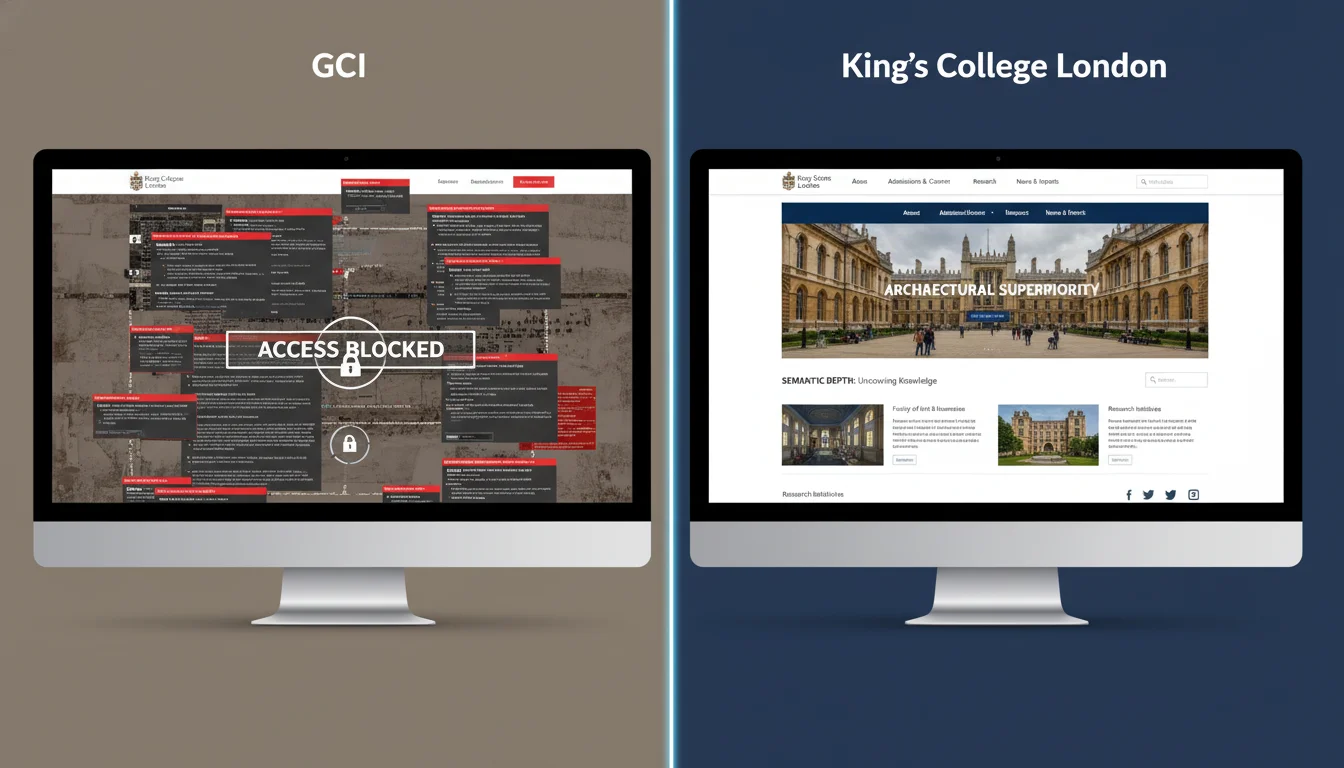
To fully comprehend the magnitude of GCI’s technical deficits and structural shallowness, it is highly instructive to conduct a rigorous comparative analysis against a direct, formidable competitor within the Nepalese higher education sector. King’s College Nepal serves as an exemplary benchmark for structural SEO, content depth, semantic architecture, and technical hygiene. The contrast between the two institutions highlights the vast chasm between standard web presence and optimized digital dominance.
Architectural Superiority and Sitemap Optimization
Unlike GCI’s completely inaccessible structure, King’s College maintains a pristine, highly optimized, and publicly accessible XML sitemap that utilizes advanced SEO tagging to meticulously guide search engine behavior. King’s College employs granular priority tagging to ensure that search engine “crawl budget” is allocated with absolute efficiency.
The primary revenue-generating landing pages, including the homepage and the core academic courses (such as /courses/mba, /courses/bba, /courses/bsit, and /courses/bscs), are explicitly assigned a priority of 1.0, signaling top priority to algorithms. Furthermore, the sitemap dictates that the homepage is crawled weekly, while the course pages are crawled monthly.
High-value, dynamic content hubs, such as the blog, news, and events sections, are assigned a high priority of 0.9 and are scheduled for weekly crawls to ensure immediate indexing of fresh content. Conversely, legal support pages and terms of condition are appropriately downgraded to a 0.2 priority, preventing algorithms from wasting resources on non-converting pages.
Additionally, King’s College utilizes a perfectly nested subdirectory structure. Academic programs are cleanly grouped under /courses/, while dynamic information is segregated under /blog/ and /news/. This hierarchical logic allows search engines to map the topical relationships between different pages flawlessly, a structure completely absent in GCI’s current blocked environment.
Exhaustive Semantic Depth and Programmatic Structuring
Where GCI’s program pages are currently completely blocked from crawling or inherently shallow in their curriculum descriptions, King’s College provides an astonishing depth of programmatic content. This depth is explicitly designed to capture both broad foundational search queries and highly specific, long-tail academic queries.
An analysis of the King’s College academic portfolio reveals a strategy of deep semantic clustering. Instead of relying on a single, generic MBA page, King’s College has engineered dedicated sub-pages for an extensive array of MBA specializations. These include Financial Management, Marketing Management, Human Resource Management, Data Analytics, Tech and Innovation, Agribusiness Management, and Applied AI in Business. This structure guarantees visibility when a student searches for niche terms like “MBA in Data Analytics Nepal.”
Furthermore, these pages do not merely list the title of the degree; they present an exhaustive, trimester-by-trimester breakdown of the curriculum. This creates massive keyword density without resorting to artificial stuffing.
| King’s College Program | SEO-Rich Curriculum Examples (Trimester Breakdowns) | Strategic Advantage for Organic Search |
|---|---|---|
| MBA (Data Analytics) | Big Data Analytics & Visualization, Prescriptive Analytics, Cloud Data Visualization, Data in AI/Machine Learning. | Captures hyper-specific queries from IT professionals seeking advanced management degrees. |
| BBA (FinTech) | Digital Banking, Blockchain Technology, Python for Finance, Cryptocurrency, Forensic Accounting. | Aligns the BBA program with trending global financial terminology, boosting topical relevance. |
| BSIT (Cloud Computing) | Virtualization and Storage, APIs and Scripting, AWS and Azure, Cloud Security and Disaster Recovery. | Establishes the domain as an authority in modern cloud architecture, attracting tech-focused students. |
| BSCS (Data Science) | Linear Algebra for Data Science, Query Design, Machine Learning and Deep Learning, Fundamentals of AI. | Dominates search intent for students looking specifically for rigorous algorithmic and statistical training. |
| MSAI (Artificial Intelligence) | Theory of Optimisation, Natural Language Processing, Computer Vision, Generative AI, Metaverse. | Positions the institution at the absolute forefront of emerging technology education in the region. |
Faculty Entity Integration and E-E-A-T Amplification
A critical component of modern SEO, particularly following Google’s focus on E-E-A-T, is the concept of Entity mapping. Search engines no longer merely read text; they understand the relationships between “Entities” (people, places, concepts, and organizations). King’s College executes this strategy flawlessly by integrating the specific names of core and adjunct faculty members directly into the programmatic landing pages.
By listing recognized academics alongside specific courses—for example, associating experts with the FinTech or Applied AI concentrations—the domain’s expertise score is significantly amplified.
Search engines can cross-reference these faculty names with their published research or external profiles, transferring that inherent credibility directly to the college’s course pages. GCI currently lacks this sophisticated level of semantic integration on its primary conversion pages. This benchmarking exercise unequivocally highlights that GCI is not merely competing against other physical brick-and-mortar campuses; it is engaged in a digital arms race against highly sophisticated, structurally superior digital ecosystems.
On-Page SEO Deficits and Content Ecosystem Opportunities
Despite the severe technical roadblocks and security compromises, a manual review of the visible content ecosystem reveals that GCI produces a commendably high volume of valuable institutional information. The strategic challenge lies entirely in how this content is formatted, semantically structured, and presented to search engine algorithms.
The Blog and Newsletter Subdirectories: Frequency vs. Execution
The institution exhibits a robust and consistent publishing cadence. An evaluation of the /category/gci-newsletter/ and /category/blog/ directories demonstrates active updates, with multiple unique publications recorded consistently over recent months. The topical breadth is excellent, spanning academic milestones, professional development workshops, international Erasmus+ engagements, and cultural events.
However, the execution of this content suffers from a critical on-page SEO flaw: the truncation of content. The main newsletter and blog hub pages heavily utilize a “read more…” prompt. While this is a ubiquitous User Interface (UI) design choice intended to conserve vertical screen space, it frequently hides the core semantic text behind a JavaScript or HTML click event. Depending on how the Document Object Model (DOM) is rendered, search engine crawlers may fail to index the full depth of the content residing on the category pages, thereby severely diluting the page’s topical authority. Search engines prioritize text that is immediately visible upon initial page load.
Heading Structure Hierarchy and Meta Data Deficiencies
While a direct, automated crawl of the programmatic pages was blocked, an inferential analysis of the site’s overarching HTML structure indicates a pervasive lack of rigorous heading hierarchy. Search Engine Optimization best practices dictate that every individual page must possess a single, highly descriptive H1 tag (e.g., <h1>Master of Business Administration (MBA) in Kathmandu</h1>), which serves as the primary thematic indicator. This must be followed by logically nested H2s for major subsections (e.g., <h2>MBA Curriculum Structure</h2>, <h2>Admission Requirements and Eligibility</h2>), and H3s for granular details. Without this strict hierarchical architecture, search engines struggle to parse the relative importance of the text, often resulting in lower rankings for primary keywords.
The Untapped SEO Potential of Academic Output
Perhaps the most significant missed opportunity in GCI’s current digital strategy is the underutilization of its academic research assets. The GCI Research Centre aims to build analytical power, conduct market research, and promote a robust research culture. Concurrently, the Nepalese Journal of Management Science and Research (NJMSR), hosted directly on the GCI domain, represents a highly valuable SEO asset.
Academic publishing naturally attracts high-quality, authoritative backlinks from other educational institutions, government bodies, and digital libraries. The NJMSR contains rich, keyword-dense papers addressing highly relevant contemporary issues, such as technological mediation in hospitality, the interplay between AI and green entrepreneurship, financing constraints of SMEs, and the impact of workforce diversity.
If structured correctly, this entire section of the site could serve as a massive organic “link magnet.” However, because these specific journal pages are currently afflicted by the casino spam injection, any inbound link equity is being aggressively siphoned away to malicious external sites. Furthermore, simply hosting PDFs is insufficient for optimal discovery. To rank prominently in standard web searches and Google Scholar, these research papers must be accompanied by highly optimized HTML abstracts featuring proper heading structures and, crucially, specific ScholarlyArticle schema markup.
Local SEO, Off-Page Authority, and Brand Consistency
For a physical academic institution reliant on regional student intake, localized search visibility is absolutely paramount. When a prospective student searches for “best management college near me” or “BBA in Mid-Baneshwor,” they rely entirely on Google’s Local Pack algorithms. These algorithms are driven by the strength of the Google Business Profile (GBP), citation consistency across the internet, and the quality of localized backlinks.
Local Search Footprint and Reputation Signals
GCI demonstrates a relatively strong foundational local footprint. Its presence on prominent educational directory platforms, such as Edusanjal and Wanderlog, reflects positively on its off-page local authority.
The review ecosystem surrounding the institution is a massive asset. The college boasts an “Excellent” rating of 4.4 out of 5 based on a substantial volume of 458 reviews. This high velocity and volume of reviews act as an overwhelming trust signal for Google’s local search algorithms, verifying the institution’s physical legitimacy and popularity. Furthermore, the inclusion of qualitative alumni testimonials on the website—such as detailed accounts from MBA graduates highlighting the multicultural interactions and the practical application of business psychology fields—provides excellent social proof that dramatically boosts conversion rates once users successfully navigate to the site.
Name, Address, and Phone Number (NAP) Consistency
Search engines mathematically verify the legitimacy of a local business entity by cross-referencing its Name, Address, and Phone number (NAP) across the broader internet ecosystem. Discrepancies, no matter how minor, in these critical data points cause algorithmic confusion, leading to depressed local rankings.
The established, canonical NAP for the institution is: Global College International, Mid-Baneshwor, Kathmandu, Nepal. Phone: 01-5970319. Email: info@gci.edu.np. However, an audit of external citations reveals damaging inconsistencies. For instance, specific directories list the phone number ambiguously as +977-01-597031xXX or include alternative, unverified mobile numbers such as 9851279377. While an institution naturally possesses multiple contact points, the primary canonical NAP must remain rigidly consistent across all major aggregators to satisfy local search algorithms.
Backlink Profile Analysis and the Parasite Effect
A domain’s overarching algorithmic authority is heavily dictated by the quality, relevance, and quantity of external websites linking to it. GCI’s active participation in prestigious international projects naturally generates highly authoritative, globally recognized backlinks. The institution serves as a partner in the ERASMUS+ network, the ENCORE project, and the CESTour (Centers of Excellence for Sustainable Tourism) initiative. Links from international academic entities and tourism organizations participating in these programs funnel immense trust equity directly into the GCI domain.
Tragically, this hard-earned domain authority is currently hemorrhaging due to the aforementioned security breach. The presence of the “black-hat” casino links acts as a parasitic drain on GCI’s link equity. When an authoritative domain links out to hundreds of known spam entities, search engine algorithms defensively devalue the host site’s internal link structure as well. Consequently, GCI’s own MBA and BBA program pages will continuously struggle to achieve favorable rankings, as the domain’s inherent strength is being continuously bled out to malicious third parties.
User Experience (UX), Mobile-First Indexing, and Core Web Vitals
The technical foundation of SEO has irrevocably shifted toward user-centric performance metrics. Following Google’s transition to Mobile-First Indexing, the search engine now exclusively utilizes the mobile version of a website for all indexing and ranking determinations. Furthermore, the integration of Core Web Vitals (CWV) into the central algorithm enshrined page speed, interactivity, and visual stability as direct, undeniable ranking factors.
The Mobile Imperative for the Nepalese Demographic
The digital consumption habits of Nepal’s youth mandate a flawless, frictionless mobile experience. As highlighted by regional digital strategy analyses, mobile traffic is overwhelmingly dominant across Nepal; prospective students turn intuitively to their smartphones to consume news, research academic institutions, and make life-altering enrollment decisions. An academic institution that fails to provide a highly responsive, fast-loading, and easily navigable mobile interface will inevitably suffer from severely inflated bounce rates.
In the algorithmic ecosystem, high bounce rates combined with low dwell time serve as a powerful negative feedback loop, signaling to search engines that the page does not satisfy user intent, subsequently leading to a harsh downgrade in organic rankings.
Given that GCI’s primary target demographic is Generation Z—a cohort characterized by a notoriously low tolerance for digital friction and slow load times—mobile optimization must be viewed not merely as an SEO technicality, but as a fundamental business and recruitment necessity.
Speed Optimization and Technical Performance Metrics
While specific Core Web Vitals metrics—such as Largest Contentful Paint (LCP), First Input Delay (FID) / Interaction to Next Paint (INP), and Cumulative Layout Shift (CLS)—could not be programmatically retrieved due to the strict crawler blockages, regional industry standards emphasize the critical nature of these elements. Elite technical SEO agencies operating within Nepal clearly define that a successful web presence must prioritize detecting hidden crawl issues, drastically improving page speed insights, and upgrading the technical infrastructure to ensure platforms are optimized for both traditional search and AI-driven discovery.
For a media-heavy site typical of an academic institution (featuring high-resolution campus photography, faculty headshots, virtual tours, and event videography), unoptimized digital assets are universally the primary culprit for severe performance degradation. If GCI’s imagery is not being served in next-generation, highly compressed formats (such as WebP or AVIF), or if aggressive browser caching protocols are absent, the mobile rendering experience will degrade rapidly, particularly over the variable 3G and 4G cellular networks common in the broader suburban and rural areas of Nepal. Establishing technical superiority requires uncompromising site speed optimization through high-quality enterprise web hosting, advanced caching configurations, meticulous image optimization, and the strict enforcement of valid SSL security certificates.
8. Strategic Plan of Action: Phased Remediation and Growth Architecture
The comprehensive remediation of the Global College International website cannot be achieved through ad-hoc adjustments; it requires a highly structured, scientifically phased approach. It is an algorithmic impossibility to achieve higher rankings for lucrative, highly competitive keywords like “MBA in Nepal” or “Top BBA College Kathmandu” while the domain is actively compromised by malware and simultaneously blocking search engine crawlers. The following action plan details the exact strategic and technical steps required, progressing logically from emergency triage to the establishment of long-term digital dominance.
Phase 1: Emergency Triage and Security Sanitization (Days 1–14)
The absolute, non-negotiable immediate priority is to halt the catastrophic bleeding of domain authority and permanently eradicate the malicious spam injections from the server environment.
-
1. Comprehensive Malware and Vulnerability Sweep
Technical Description: Deploy enterprise-grade, server-side security scanners (e.g., Sucuri, Wordfence Premium) to meticulously scan the entire hosting environment. Identify the precise point of entry utilized for the Casino/Slot spam injection.
Responsible Party: IT Department / External Cybersecurity Consultant
Expected Algorithmic Outcome: Immediate identification and isolation of the compromised CMS plugin, outdated theme framework, or core database vulnerability.
-
2. Aggressive Database Sanitization
Technical Description: Execute manual and programmatic database queries to permanently remove all injected HTML, hidden nested divs, and base64 encoded PHP scripts containing illicit keywords (mahjong slot, slot gacor, etc.) from all core files and post content.
Responsible Party: Lead Web Developer / Database Administrator
Expected Algorithmic Outcome: Restoration of a pristine database, free of the malicious outbound links that are actively draining domain authority.
-
3. Infrastructure Security Hardening
Technical Description: Force update the CMS core, all active plugins, and themes to their latest secure versions. Enforce mandatory multi-factor authentication (MFA) for all administrative and faculty accounts. Deploy a robust Web Application Firewall (WAF) to intercept malicious payloads.
Responsible Party: IT Infrastructure Team
Expected Algorithmic Outcome: Permanent closure of the vulnerability, preventing immediate automated re-infection by the botnet.
-
4. Google Search Console (GSC) Resolution
Technical Description: Verify domain ownership in GSC. Review the “Security Issues” tab for active manual penalties. Submit a highly detailed Reconsideration Request to Google’s webspam team, exhaustively outlining the exact technical steps taken to sanitize the site.
Responsible Party: Lead SEO Analyst
Expected Algorithmic Outcome: Expedited removal of manual algorithmic penalties and the cessation of “Hacked Site” warnings displayed to users in search results.
Phase 2: Technical SEO Infrastructure Overhaul (Days 15–30)
Following the verification of a secure, sanitized environment, the fundamental architecture must be reconstructed to guarantee that search engine algorithms can seamlessly crawl, parse, and index the institutional content without encountering technical friction.
-
1. Eradicate Crawler Blockages
Technical Description: Conduct a deep analysis of server access logs and WAF rule sets to determine the origin of the crawler blockages. Recalibrate mod_security rules or .htaccess configurations to explicitly whitelist legitimate search engine user-agents (Googlebot, Bingbot).
Responsible Party: Server Administrator
Expected Algorithmic Outcome: Complete, unhindered accessibility for automated search engine indexing, allowing the site to re-enter the search ecosystem.
-
2. Reconstruct the robots.txt Directive
Technical Description: Engineer a clean, syntactically perfect robots.txt file at the domain root. Disallow the crawling of sensitive administrative backend pages (e.g., /wp-admin/), but explicitly ensure the Allow directive is applied to all CSS, JavaScript, and image directories essential for page rendering.
Responsible Party: Web Developer
Expected Algorithmic Outcome: Provision of clear, unambiguous traversal instructions for search engine algorithms, preventing crawl-budget waste.
-
3. XML Sitemap Engineering and Submission
Technical Description: Deploy a dynamic XML sitemap generation protocol. Emulate the King’s College benchmark by assigning mathematical priority: 1.0 to core academic programs (MBA, BBA, BHM) and dynamic update frequencies. Submit the generated URL directly to GSC.
Responsible Party: SEO Specialist
Expected Algorithmic Outcome: Accelerated, highly efficient discovery and indexing of all new academic content and programmatic updates.
-
4. Core Web Vitals (CWV) Optimization
Technical Description: Implement aggressive, server-side and browser-level caching protocols. Minify all bloated CSS/JS files. Compress all heavy campus and event imagery into next-generation WebP formats to dramatically improve the Largest Contentful Paint (LCP) metric.
Responsible Party: Web Developer
Expected Algorithmic Outcome: Measurable improvement in mobile user experience, satisfying Google’s mobile-first indexing requirements and preventing ranking downgrades due to slow load times.
Phase 3: On-Page Optimization and Semantic Content Expansion (Days 30–60)
With a highly secure, fluidly crawlable technical foundation established, strategic focus must shift to optimizing the visible content ecosystem to perfectly match the sophisticated search intent of prospective students and academic researchers.
-
1. Programmatic Depth Expansion
Technical Description: Systematically emulate the semantic depth demonstrated by King’s College. Transform the currently shallow BBA and MBA pages into comprehensive informational hubs. Include exhaustive, trimester-by-trimester curriculum breakdowns, career trajectory pathways, and specific concentration details.
Responsible Party: Content Strategist & Academic Department Heads
Expected Algorithmic Outcome: Massive expansion of the domain’s keyword footprint, enabling the capture of highly lucrative, long-tail search queries (e.g., “MBA finance curriculum Mid-West University”).
-
2. Implementation of Structured Data (Schema Markup)
Technical Description: Inject highly specific JSON-LD structured data syntax across the domain architecture. Utilize CollegeOrUniversity schema for the homepage, Course schema for the BBA/MBA pages, and critically, ScholarlyArticle schema for all NJMSR journal publications.
Responsible Party: Technical SEO Specialist
Expected Algorithmic Outcome: Generation of eye-catching rich snippets directly within the search engine results pages (SERPs), exponentially increasing Click-Through Rates (CTR).
-
3. Hierarchical Header Restructuring
Technical Description: Conduct a rigorous manual audit of every high-value landing page to ensure strict adherence to an H1 > H2 > H3 logic structure. Eliminate empty or stylistic headers. Ensure the primary target keyword explicitly resides within the single H1 tag.
Responsible Party: Content Editor / Webmaster
Expected Algorithmic Outcome: Enhanced semantic understanding of page content by Natural Language Processing (NLP) algorithms, resulting in higher relevance scores for target queries.
-
4. E-E-A-T and Entity Amplification
Technical Description: Engineer dedicated, highly detailed author biography and profile pages for all faculty members and researchers contributing to the NJMSR or teaching core MBA/BBA modules. Interlink these semantic profiles directly to the respective academic program pages.
Responsible Party: Digital Marketing Team
Expected Algorithmic Outcome: Establishment of profound institutional authority, satisfying Google’s stringent E-E-A-T guidelines by proving the genuine expertise of the instructional staff.
Phase 4: Off-Page Authority and Local SEO Consolidation (Ongoing)
The final strategic phase focuses on aggressively expanding and consolidating GCI’s digital footprint across the broader internet ecosystem, leveraging its physical reputation to dominate localized search algorithms.
- 1.
Exhaustive NAP Synchronization
Execute a comprehensive, forensic audit of all regional local directories, including Edusanjal, MyFreeAdmission, Wanderlog, and local chambers of commerce databases. Standardize the Name, Address, and Phone number formats to identically match the verified Google Business Profile.
Local SEO Specialist
Complete elimination of algorithmic ambiguity regarding the institution’s physical location, resulting in sustained dominance in Google’s Local Pack map results.
2. Strategic Digital Public Relations
Actively leverage the institution’s participation in international academic partnerships (ERASMUS+, ENCORE, CESTour) to acquire highly authoritative, contextual backlinks. Disseminate press releases regarding institutional milestones (such as the QAA Award) to major regional news portals.
PR / Institutional Communications Office
A massive influx of high-quality, relevant link equity, continuously driving up the domain’s overall algorithmic ranking power against regional competitors.
3. Systematic Review Generation Protocol
Architect and implement a systematic, ethically compliant campaign to request Google reviews from graduating cohorts, successful alumni, and highly engaged current students, ensuring the Google Business Profile is continuously refreshed with new, positive semantic sentiment.
Student Affairs / Marketing Department
Enhanced local conversion rates through overwhelming social proof, cementing the institution as the premier management college choice in the Kathmandu Valley.
9. Conclusion and Final Assessment
Global College International (GCI) currently stands at an absolutely critical juncture in its operational and digital evolution. The institution undeniably possesses all the requisite offline, traditional assets required to completely dominate the Nepalese higher education market: a highly distinguished faculty, rigorous academic programs spanning MBA, BBA, BHM, and BTTM disciplines, robust international affiliations, and an exceptionally rich repository of scholarly output via its dedicated research centers. However, the current state of its digital infrastructure is fundamentally broken and entirely incompatible with the complex requirements of modern search engine algorithms.
The immediate, alarming discovery of a malicious “black-hat” spam injection actively manipulating the source code of the site is a severe institutional liability that demands instantaneous mitigation. Left unattended, this vulnerability will not only invite catastrophic algorithmic manual penalties but will also inflict profound, potentially irreversible damage upon the institution’s hard-earned academic brand reputation. Furthermore, the sheer inability of search engine crawlers to access the most basic architectural files—such as the robots.txt directive and the sitemap.xml mapping—alongside the primary programmatic conversion pages, renders the website practically invisible to the advanced algorithms governing modern organic digital discovery.
As emphatically demonstrated by the extensive competitive benchmarking analysis against King’s College Nepal, success in the highly lucrative higher education digital sector requires far more than merely existing online. It requires meticulous technical hygiene, granular semantic content depth, rigorous entity mapping, and an unwavering commitment to a flawless, mobile-first user experience. GCI must radically transition its perspective on digital strategy. The website can no longer be viewed as a static, digital brochure relegated to the periphery of marketing efforts; it must be completely re-engineered as a dynamic, highly secure, semantic hub explicitly designed to capture, inform, and convert the digitally native Generation Z demographic.
By systematically executing the phased, strategic remediation plan outlined in this comprehensive report—beginning with aggressive, uncompromising security sanitization, advancing methodically through fundamental architectural restructuring, and culminating in expansive, E-E-A-T driven semantic content generation—Global College International can successfully reclaim its rightful digital authority. The successful implementation of these specialized directives will not merely recover the institution’s lost organic search visibility; it will establish a highly sustainable, algorithmically dominant, long-term engine for organic student acquisition, academic prestige, and continued institutional growth.