How to Publish Technical Guides on Amazon KDP: Expert Strategy
Comprehensive Strategic Framework for Publishing Evergreen Technical Documentation and Mini-Guides on Amazon KDP
The landscape of technical communication has undergone a profound structural evolution over the past decade. Historically confined to internal corporate wikis, open-source repositories, and static read-the-docs pages, high-quality technical writing is increasingly being monetized through global self-publishing platforms. Amazon Kindle Direct Publishing (KDP) has emerged as the premier distribution channel for software engineers, data scientists, and system architects seeking to publish technical mini-guides, reference manuals, and evergreen tutorials. However, bridging the gap between developer-centric writing environments—such as Markdown and AsciiDoc—and Amazon’s proprietary digital and print ecosystems requires navigating a labyrinth of formatting constraints, algorithmic discoverability rules, and complex international royalty structures.
This exhaustive research report provides a systemic analysis of the methodologies required to successfully author, format, publish, and monetize technical documentation on Amazon KDP. The analysis spans the entire lifecycle of technical authorship, from establishing continuous integration pipelines for text generation to optimizing cascading style sheets (CSS) for e-ink displays, mitigating international tax withholding barriers, and leveraging algorithmic nuances in the Amazon marketplace.
Methodologies for Evergreen Technical Authorship and Content Longevity
The fundamental challenge of technical publishing is the rapid obsolescence of information. A guide detailing a specific programming framework or cloud architecture can become dangerously obsolete within months of publication. Therefore, the concept of “evergreen” documentation does not imply that the published content remains entirely static indefinitely; rather, it indicates that the content is structurally designed to be continuously and seamlessly updated alongside the underlying technology.
The Philosophy of Modularity and Version-Agnostic Content
To achieve sustained longevity in technical publishing, authorship must adopt the foundational principles of software engineering. Traditional word processors fail in this regard because they tightly couple content with formatting, making surgical updates across multiple platforms difficult. Evergreen documentation requires a complete decoupling of the text from its presentation layer. By authoring manuscripts in plain-text formats like Markdown or AsciiDoc, authors can integrate their documents into version control systems, tracking documentation changes parallel to code releases. This architectural decision allows documentation updates to become a mandatory component of continuous feature development workflows, effectively serving as a “definition-of-done” criterion before a new edition is compiled and deployed.

When documenting application programming interfaces (APIs) or software systems, the most resilient strategy is to focus on additive evolution rather than aggressive versioning. If changes to a software tool are backward-compatible—such as adding optional fields or expanding pagination metadata—a completely new edition of the book is often unnecessary. Instead, the author can simply push an updated manuscript file to the KDP backend, replacing the existing asset without losing the book’s established sales ranking or customer reviews. Furthermore, content longevity relies heavily on mastering the “why versus how” principle. While the specific syntax or graphical user interface (the “how”) may deprecate rapidly, the architectural philosophy, problem analysis, and use-case rationale (the “why”) remain highly stable and evergreen. Effective technical mini-guides over-index on conceptual foundations, isolating volatile code snippets into specific, easily updatable modules.
Addressing Tone, Accessibility, and the Ownership Matrix
The tone utilized within technical documentation significantly impacts reader comprehension and retention. Technical language fundamentally differs from everyday vernacular and general academic prose, requiring authors to maintain an impersonal, objective stance while carefully avoiding the extreme shifts between grandiose declarations and self-depreciating language that occasionally plague amateur science writing. The objective is to convey complex technical information in a simple, crystal-clear manner, simplifying vocabulary so that non-native speakers—or readers utilizing automated browser translation tools—can process the information without semantic degradation.
Furthermore, maintaining an evergreen catalog requires establishing strict accountability protocols. For organizations or multi-author collaborations publishing under a single imprint, establishing a content ownership matrix is critical. This involves assigning named individuals to specific chapters or architectural domains, ensuring that when an underlying technology reaches a new alpha, beta, or feature slush release stage, the designated owner is automatically tasked with updating the relevant KDP manuscript. This is heavily augmented by user analytics and continuous feedback loops; tracking which pages or chapters receive the most highlighting or external citations helps authors prioritize which sections require rigorous updating, even if there is no major software release pending.
Documentation Strategy Comparison
- Tooling: Traditional Approach uses proprietary word processors; Evergreen Approach uses plain-text (Markdown, AsciiDoc) with Version Control.
- Update Cycle: Traditional Approach is ad-hoc and reactive to major complaints; Evergreen Approach is CI/CD integrated and triggered by software release schedules.
- Content Focus: Traditional Approach relies heavily on UI screenshots (“How”); Evergreen Approach focuses on architectural principles and modular code (“Why”).
- Accountability: Traditional Approach suffers from ambiguous team ownership; Evergreen Approach utilizes a strict content ownership matrix linked to specific domains.
- Versioning Logic: Traditional Approach uses URL-based or entirely new book editions; Evergreen Approach uses additive evolution and date-based updates to existing ASINs.
The Plain-Text Publishing Pipeline: Compilation and Automation
The default Amazon KDP workflow heavily encourages authors to utilize Microsoft Word combined with Amazon’s proprietary Kindle Create software. While this graphical user interface is highly functional for narrative fiction, it is remarkably suboptimal for technical documentation, which relies on precise code blocks, monospace fonts, syntax highlighting, and complex tabular data. To bypass these limitations, developer-authors rely on command-line interface (CLI) tools that wrap document converters, allowing them to produce KDP-compliant print and digital files directly from their source control repositories.
Pandoc, XeLaTeX, and Lua Filter Engineering
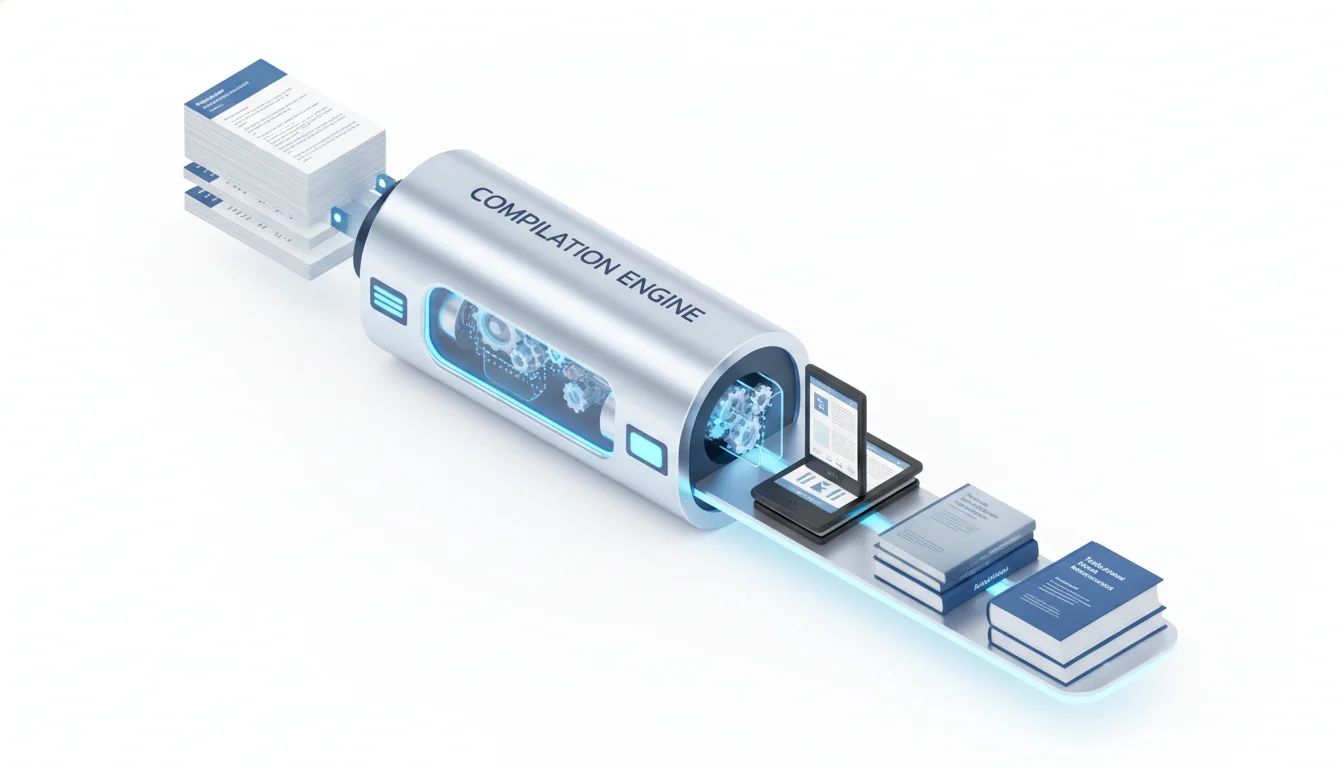
A prominent workflow for technical authors involves utilizing Node.js automated scripts to seamlessly convert directories of Markdown files into print-ready PDFs and reflowable EPUBs. Tools leveraging Pandoc and XeLaTeX serve as the compilation engine for this conversion. In such a pipeline, the author drafts individual chapters as isolated .md files, utilizing semantic heading structures. The pipeline then executes a multi-step resolution and post-processing script, often utilizing minimal dependencies such as Commander.js for argument parsing.
During this compilation, Pandoc parses the Markdown, resolving top-level divisions into distinct book chapters. To navigate KDP’s specific formatting quirks, developers inject custom Lua filters into the build process. For example, a dedicated scene-break.lua filter can systematically convert standard markdown scene breaks into typeset separators (such as a centered * * *) for the EPUB output, while simultaneously mapping the exact same markdown syntax to a specialized LaTeX command for the print PDF. Another critical function of these programmatic filters involves heading promotion. By dynamically removing the primary title heading and promoting subheadings to chapters, the Lua script ensures the Abstract Syntax Tree (AST) is perfectly aligned with book publishing standards. For EPUB generation specifically, subheadings are often intercepted and converted into bold paragraphs nested within a custom section-heading div; this explicitly prevents Pandoc from generating superfluous HTML section wrappers, which are notorious for causing awkward, forced page breaks within the Kindle rendering engine.
The PDF generation relies on a custom LaTeX template that strictly enforces KDP’s physical geometric requirements. Print-on-demand publishing requires precise inner and outer margins to account for the physical binding of the book, known as the gutter. For instance, a standard 6” x 9” paperback requires an inner margin of 0.85 inches and an outer margin of 0.60 inches.
However, if the author wishes to offer a premium hardcover variant, the inner margin must be systematically increased to 1.00 inch to properly accommodate the thicker case-laminate binding. An optimized automated CLI pipeline generates both the paperback and hardcover PDFs simultaneously from the exact same source text, utilizing the advanced LaTeX openright command to ensure that chapters consistently begin on the recto (right-hand) page, adhering to traditional publishing standards. Furthermore, authors can specify professional typography, ensuring the script utilizes high-quality serif fonts like EB Garamond via TeX Live, rather than relying on default system fonts.
The Asciidoctor Semantic Architecture
For highly complex technical books—such as comprehensive API references or enterprise architecture manuals requiring deep semantic structuring, callouts, and multi-layered cross-references—AsciiDoc is frequently preferred over Markdown. The Asciidoctor EPUB3 toolchain is explicitly designed to output highly aesthetic, semantic XHTML5 documents that rigorously adhere to modern EPUB3 standards.
Asciidoctor excels in the technical authorship domain because it inherently supports advanced formatting requirements natively from the source document, including the generation of font-based icons, modular font size scaling, and precise metadata population. This is critical for preventing widowed and orphaned content, which severely degrades the readability of technical textbooks. When compiling an EPUB via Asciidoctor specifically for Amazon’s Kindle Format 8 (KF8) or legacy MOBI formats, particular attention must be paid to the Table of Contents (TOC) architecture. While modern tablet applications dynamically generate a TOC from embedded chapter headings, Amazon’s stringent publishing guidelines recommend an embedded HTML TOC (often named nav.xhtml and mapped correctly in the package.opf spine) to ensure backward compatibility with older e-ink Kindle devices.
Toolchains like Asciidoctor generate these structures automatically; however, technical authors frequently deploy post-processing scripts to manipulate the output prior to finalization. For example, a cleanupEpub function might unzip the generated EPUB archive, strip out duplicated front-matter or copyright blocks that erroneously replicate across individual chapter files (ch.xhtml), remove redundant back-matter from the navigation index, and then repack the file using standard zip compression to ensure a pristine, valid EPUB ready for KDP ingestion.
Digital Typography, Syntax Highlighting, and Display Constraints
Formatting dense technical information for digital consumption on Amazon Kindle requires an intimate understanding of the limitations of the proprietary Kindle Format 8 (KF8) and Amazon’s Enhanced Typesetting engine. Technical books frequently break when authors attempt to force modern web-standard CSS into the highly constrained Kindle ecosystem.
E-Ink Optimization and Syntax Highlighting Protocols

Displaying raw code snippets on mobile devices and e-ink screens presents significant user experience challenges. A line of programming code that exceeds the physical screen width will naturally wrap, potentially destroying the logical indentation and structural readability of the language. To mitigate this, CSS media queries are necessary to dictate differing margins for 6-inch e-ink displays versus larger 9-inch tablet displays. Furthermore, technical authors must utilize CSS hanging indents (e.g., text-indent: -2em; padding-left: 3em; line-height: 80%;) to visually distinguish a wrapped line of code from a deliberately authored new line. While Kindle devices possess a default, readable monospace font triggered by standard HTML tags such as <code>, <kbd>, <samp>, or <var> paired with font-family: monospace;, aggressive styling is discouraged.
Syntax highlighting—the application of specific color codes to distinct programming tokens—must be handled with extreme restraint. The introduction of full-color e-ink devices, such as the Kindle Colorsoft, has radically expanded the viability of syntax highlighting in eBooks, supporting a native palette that accurately renders yellow, pink, blue, orange, and green. However, the color space on an e-ink display remains vastly different from an OLED or LCD monitor. A standard Integrated Development Environment (IDE) dark theme will render as an illegible, muddy grey on a light-background e-reader. The optimal strategy for KDP syntax highlighting relies on a minimalist, high-contrast light theme. Best practices advocate applying color selectively: rendering string literals in dark green, marking comments in deep red or italicized grey, reserving magenta for constants or booleans, and applying dark blue exclusively to variable or function definitions, leaving all standard punctuation and regular syntax in the default black. This restrained methodology ensures that the code remains perfectly legible across high-end Fire tablets, modern color e-ink displays, and legacy black-and-white Paperwhites.
The Strict Constraints of HTML Tables
Tabular data represents one of the most frequent points of failure in KDP formatting. If a table contains whole paragraphs of text, it forces the reader to pan horizontally across the screen, resulting in a severe user experience degradation. Amazon’s Enhanced Typesetting engine explicitly rejects tables containing more than 1,800 cells or 20,000 total characters; attempting to upload such a table will cause the ingestion process to fail or force the entire book to render in a degraded, legacy format.
Technical authors must adhere to exceptionally strict guidelines when constructing HTML tables (<table>, <thead>, <tbody>, <tr>, <td>):
- Size Restrictions: Tables should ideally be kept under 100 rows and 10 columns to ensure rendering stability.
- CSS Prohibitions: Negative margins within table content are entirely unsupported and will break the Enhanced Typesetting compilation. Furthermore, floating elements (float) within table cells are strictly prohibited.
- Caption Positioning: The CSS property caption-side: bottom is actively ignored by the Kindle rendering engine; any captions styled this way will default to the top of the table.
- Complex Layout Integrity: The colspan and rowspan attributes must be mathematically perfect and cannot exceed the total number of defined columns or rows; nested tables should be avoided entirely as they frequently break the pagination algorithm.
If a technical matrix, software comparison chart, or architecture diagram cannot be simplified into a basic HTML table meeting these constraints, the official Amazon recommendation is to convert the data into a high-resolution image.
High-Resolution Diagrams and Vector Limitations
Technical books rely heavily on architecture diagrams, system flowcharts, and performance graphs. To prevent visual pixelation on high-density reader displays (such as the 300 PPI screen of a standard Kindle Paperwhite), all images must be inserted at 100% scale with a minimum resolution of 300 Dots Per Inch (DPI). Inserting images via cut-and-paste is heavily discouraged; authors must insert the physical file and configure software like Microsoft Word to disable automatic image compression, which otherwise degrades technical diagrams.
While software developers naturally prefer Scalable Vector Graphics (SVG) for architecture diagrams due to their infinite scalability, mathematically precise rendering, and minimal file size footprint, Amazon explicitly discourages the use of SVG tags within the EPUB HTML source. The KDP guidelines note that embedded SVGs frequently lead to compilation errors during the conversion to KF8. Instead, complex diagrams must be exported as flattened, high-resolution PNGs or JPEGs, maintaining a maximum resolution of 600 DPI to avoid overwhelming the rendering engine.
For optimal readability, Amazon dictates that diagrams containing text should occupy at least 80% of the screen width on smaller devices, while purely pictorial images require at least 60% width. Furthermore, for compliance with digital accessibility standards, every diagram must include descriptive text within the HTML alt attribute, or be explicitly marked with role=”presentation” if it serves a purely decorative function. Managing these image files is a delicate balancing act; KDP imposes a hard ceiling of 650MB per manuscript upload. However, authors are heavily penalized for large file sizes via KDP’s digital delivery fees, making rigorous image optimization—flattening transparencies and stripping Exif metadata—a critical component of the publishing pipeline.
| Technical Element | KDP Enhanced Typesetting Constraint | Optimal Workaround |
|---|---|---|
| Code Blocks | Wrapping destroys code structure and syntax | Use CSS media queries and text-indent: -2em for hanging indents. |
| Syntax Color | Standard IDE dark themes render poorly on e-ink | Minimalist light theme; green strings, red comments, black base font. |
| Data Tables | Max 1,800 cells / 20,000 characters | Split large data sets or convert complex matrices to 300 DPI images. |
| Vector Diagrams | Embedded SVG tags cause compilation errors | Flatten into high-resolution PNGs (300-600 DPI); no transparencies. |
| Manuscript Size | Hard cap of 650MB per upload | Optimize and compress images strictly to avoid excessive delivery fees. |
Algorithmic Discoverability, Authority Building, and Market Positioning
Authoring a technically flawless and beautifully formatted book does not guarantee visibility in the marketplace. Amazon functions as the world’s largest search engine for commercial intent, and technical authors must rigorously optimize their metadata to capture organic search traffic.
The overarching discoverability strategy involves a precise combination of category selection, keyword clustering, and author brand consolidation.
Navigating the KDP Category Taxonomy and the BSR Sweet Spot
Amazon book categories function as highly specific digital shelves, guiding readers to relevant genres. Authors are permitted to select up to three primary categories during the KDP setup process, with the objective of placing the book exactly where highly motivated potential buyers are browsing. The taxonomy for technical books is deeply nested and highly specific; for instance, a guide on Python development should not be placed in generic technology, but rather routed through the exact hierarchical path: Computers & Technology > Programming > Languages & Tools > Python.
The primary strategic goal in category selection is to identify the “BSR Sweet Spot” (Best Sellers Rank). Attempting to rank a new release in the broad “Software Development” parent category is a severe miscalculation for an independent author, as it requires competing with massive traditional publishing houses, established classics, and massive advertising budgets. Instead, authors should leverage Amazon autocomplete functions to perform rapid market research, identifying hyper-niche subcategories where the top-ranking books maintain a BSR between 100,000 and 500,000. A BSR below 100,000 indicates a highly competitive niche requiring significant paid advertising to penetrate, while a BSR above 500,000 suggests a fundamental lack of baseline consumer demand. By actively targeting a specialized category where the number five ranked book holds a BSR of 200,000 and the number one book possesses fewer than 50 customer reviews, a newly published technical mini-guide can easily capture the coveted “#1 New Release” badge with minimal initial sales velocity, thereby triggering sustained organic algorithmic promotion.
Keyword Optimization Constraints and Search Psychology
If a technical book cannot be perfectly aligned with a pre-existing category, keywords serve as the secondary, and often more powerful, mechanism for discoverability. KDP provides authors with seven discrete keyword fields, each subject to strict character limits.
Keyword selection must avoid redundancy; KDP metadata guidelines strictly prohibit the duplication of words that already exist in the book’s title, subtitle, or chosen categories (e.g., repeating “Programming” in the keywords when it is already in the category path is a wasted opportunity). Furthermore, incorporating subjective claims (such as “best Python book”), time-sensitive promotional phrases (“newly updated for 2026”), or utilizing the names of other authors to siphon their traffic violates KDP’s zero-tolerance metadata policy and can result in immediate account termination.
For technical guides, highly effective keywords focus on specific, highly searched use cases, adjacent architectural frameworks, or specific problem domains not explicitly mentioned in the title. Best practices dictate combining keywords in logical, human-readable orders—because readers search for “machine learning deployment,” not “deployment learning machine”—and avoiding the use of quotation marks, which unnecessarily restrict the search algorithm from capturing partial matches. Furthermore, maintaining title brevity is crucial; titles exceeding 60 characters are frequently skimmed over by consumers browsing on mobile devices.
Consolidating Authority via Amazon Author Central
A frequently overlooked component of the KDP ecosystem is Amazon Author Central, a dedicated marketing hub that serves as the author’s primary digital storefront. When a reader clicks on a technical author’s name on a product page, encountering an empty profile signals amateurism, immediately degrading consumer trust in the technical validity and authority of the book’s content. Given that Amazon commands between 50% to 80% of total book sales in the United States, neglecting this profile is detrimental to long-term success.
Author Central allows authors to claim their published ASINs across multiple regions, upload professional headshots, and curate an extended, keyword-rich biography in multiple languages. Crucially, the platform enables the accumulation of “Followers.” When an author publishes a new mini-guide, Amazon’s automated marketing engine will seamlessly send a notification email to their entire follower base, providing an immediate, free algorithmic spike on launch day. For technical authors producing an ongoing series of 30-50 page mini-guides on related programming topics, consolidating these works under a fully optimized Author Central profile facilitates cross-selling and establishes undeniable domain authority. Furthermore, Author Central provides access to proprietary NPD BookScan data, offering granular, geographic insights into where print copies are being purchased, which allows the author to deploy highly targeted, location-based advertising campaigns.
Royalty Optimization, Pricing Psychology, and the KDP Select Decision
The financial modeling of a technical mini-guide on KDP requires navigating Amazon’s bifurcated digital royalty tiers, complex print cost formulas, and the subscription mechanics of the Kindle Unlimited global fund. Understanding these levers is the difference between generating a sustainable passive income stream and operating at a net loss.
The eBook Royalty Tiers and the Delivery Fee Trap
For digital eBooks, Amazon offers two distinct royalty tiers: 35% and 70%. The 70% tier is highly coveted and represents the primary vehicle for profit, but it comes with stringent pricing and geographical prerequisites.
To qualify for the 70% royalty rate, the eBook must be priced between $2.99 and $9.99 (USD) and sold within specific eligible territories, including the United States, United Kingdom, Canada, Germany, and Japan. If the price falls outside this specific bandwidth, the book automatically defaults to the 35% tier. Similar bandwidths exist for international storefronts; for example, the 70% tier in the Indian marketplace (Amazon.in) requires a list price between ‹99 and ‹449. For technical authors, a pricing strategy just below the maximum threshold, such as $9.99, is often optimal. It maximizes the perceived value of the specialized, expert information while capturing the highest possible royalty percentage per transaction.
However, the 70% tier harbors a critical, often-overlooked caveat: the Amazon Delivery Fee. Under this tier, Amazon deducts $0.15 per megabyte (MB) from the author’s royalty prior to final payout. For standard text-only fiction, a 1MB file incurs a negligible $0.15 fee. However, for technical documentation laden with high-resolution architecture diagrams, complex formatting, and embedded monospace fonts, file sizes can easily balloon to 15MB or more.
Consider the financial model of a technical guide priced at $9.99 with a massive, unoptimized file size of 20MB:
- Base Royalty Calculation: 70% of $9.99 = $6.99
- Delivery Fee Deduction: 20MB * $0.15 = $3.00
- Net Royalty to Author: $3.99
In stark contrast, the 35% tier does not charge any delivery fee regardless of file size. If the author were to price that exact same 20MB book at $9.99 under the 35% tier, they would earn a flat $3.49 royalty. More importantly, if the book is a massive, premium technical textbook requiring a list price of $24.99, it must be placed in the 35% tier, yielding an $8.74 royalty with zero delivery fee penalties. Therefore, optimizing image compression to keep technical eBooks strictly under 5MB is not merely a technical best practice; it is a vital financial imperative to protect the 70% margin.
Print Economics: Anchor Pricing and the Cost of Color
When publishing physical paperback or hardcover variants of technical guides, the royalty calculation shifts entirely away from percentages of digital delivery toward raw manufacturing costs. KDP offers a flat 60% royalty on the list price of print books, minus the actual printing costs incurred by the facility. If the author chooses to enroll the book in Expanded Distribution—making it available to external bookstores, academic libraries, and third-party retailers—the royalty percentage drops to 40% minus printing costs.
The primary variable in print economics is the ink type selected. Black-and-white printing is highly economical; a 100-page black-and-white paperback costs approximately $2.15 to print, allowing the author to comfortably price the book at $9.99 and still earn a robust, sustainable royalty. However, technical books often require color to differentiate syntax highlighting in code blocks, or to make complex, multi-variable data visualizations readable.
Standard Color and Premium Color printing costs are exceptionally high. A 100-page standard color book formatted at 8.5” x 11” costs roughly $5.20 to print, while upgrading to premium color ink pushes the base cost to a staggering $7.15 per unit. To maintain any semblance of profitability on a full-color, 100-page technical guide, the minimum viable list price frequently exceeds $15.99. Authors must strategically evaluate whether the pedagogical value of color syntax highlighting justifies the massive increase in retail price, which naturally depresses total sales volume.
A highly effective pricing psychology technique utilized by successful authors is “Anchor Pricing”. By publishing a premium color paperback version priced at an elevated $15.99, the author establishes a high psychological anchor value in the consumer’s mind.
When the consumer then views the digital eBook alternative priced at $4.99 or $9.99, it appears as a massive bargain, dramatically increasing digital conversion rates while simultaneously offering a premium physical product for enterprise or academic buyers.
- eBook (70%): $2.99 – $9.99 pricing tier; 70% base royalty rate; -$0.15 per MB delivery fee deduction. Best use case: Highly optimized technical mini-guides under 5MB.
- eBook (35%): Under $2.99 or over $9.99 pricing tier; 35% base royalty rate; no delivery fee. Best use case: Massive, image-heavy manuals or premium textbooks priced over $10.00.
- Print (B&W): Price varies by page count; 60% base royalty rate; deducts base print cost (approximately $2.15). Best use case: Standard text and greyscale diagram reference manuals.
- Print (Color): Price varies by page count; 60% base royalty rate; deducts high print cost (approximately $7.15). Best use case: Used for anchor pricing to drive high-margin eBook conversions.
- Expanded Print: Price varies by page count; 40% base royalty rate; deducts base print cost. Best use case: Distribution to academic libraries and brick-and-mortar storefronts.
Exclusivity vs. Wide Distribution: Navigating KDP Select
Upon publishing, authors must make a critical, binary distribution choice: enroll the eBook in KDP Select (granting Amazon total digital exclusivity for 90-day rolling periods) or “go wide” (publishing simultaneously on Apple Books, Google Play, Kobo, and direct website sales).
Enrolling in KDP Select allows the eBook to enter Kindle Unlimited (KU), Amazon’s massive subscription reading service. Under the KU program, authors are not paid a flat royalty per download; instead, they are compensated based on the exact number of pages a user reads, tracked via the proprietary Kindle Edition Normalized Pages (KENP) metric. The payout rate fluctuates monthly based on the total size of the KDP Select Global Fund, but it generally hovers between $0.004 and $0.005 per page read. Thus, a reader consuming a standard 100-page technical mini-guide from cover to cover via KU yields the author roughly $0.45 in royalty.
For technical authors, KDP Select presents a profound behavioral paradox. Readers of fiction read linearly from start to finish, maximizing page reads. Technical readers, however, utilize books as non-linear reference material, frequently utilizing the table of contents to jump directly to a specific chapter, copy a necessary command snippet, and close the book. This sporadic reading behavior severely depresses the KENP page-read count, resulting in minuscule, fractions-of-a-cent payouts. Furthermore, technical audiences are highly diverse in their device usage and heavily prefer DRM-free formats like PDF, meaning KDP exclusivity deliberately cuts off a massive segment of the potential market share.
Conversely, the primary benefit of KDP Select is algorithmic velocity. The program provides access to powerful promotional tools like Kindle Countdown Deals and Free Book Promotions, and KU borrows count toward the book’s overall sales rank. This algorithmic boost can elevate the book’s visibility, driving organic, full-priced outright sales. Authors must carefully weigh the immediate algorithmic benefits of Amazon exclusivity against the long-term stability and broader reach of a diversified, multi-platform, wide publishing strategy.
Account Infrastructure and International Financial Logistics
For software developers, data scientists, and technical writers operating outside the United States, accessing and monetizing within the KDP ecosystem introduces severe infrastructural, banking, and financial hurdles. Amazon’s legacy disbursement mechanisms and stringent international tax protocols can inadvertently consume the majority of an author’s net royalties if not navigated with extreme precision.
Bypassing the Check Threshold with Virtual Neobanking
Amazon KDP primarily disburses monthly royalties via Electronic Funds Transfer (EFT) or Direct Deposit, depositing funds approximately 60 days after the end of the month in which the sale occurred. For authors residing in the US, UK, Canada, and the Eurozone, this process is frictionless; EFT payments possess a $0 minimum threshold, meaning the author is paid their exact earnings regardless of volume. However, for authors residing in developing technology hubs—such as Nepal, Nigeria, or various nations across Latin America—Amazon does not possess the banking infrastructure to support direct EFT to local, domestic banks.
If an author resides in an unsupported country and inputs their local banking information, Amazon defaults to issuing a physical paper check or a traditional wire transfer. Both legacy methods enforce a strict minimum financial threshold—typically $100 USD, 100, or 100 accumulated independently within a single, specific marketplace—before a payout is generated. A new technical author might take months to hit the $100 threshold on Amazon.com, and years to hit the equivalent threshold on smaller marketplaces like Amazon.co.jp or Amazon.ca, meaning their capital remains locked on Amazon’s ledgers indefinitely. Furthermore, international wire transfers incur massive currency conversion fees and receiving fees from intermediate correspondent banks, while physical checks are prone to postal loss, take upwards of 30 days to arrive, and are frequently rejected or subject to massive clearing fees by local banking institutions.
The industry-standard methodology for international authors to bypass these systemic barriers is to utilize borderless fintech neobanks, such as Wise (formerly TransferWise) or Payoneer. These platforms function by providing the author with a legitimate, virtual US routing and account number linked to a receiving wallet. By inputting this virtual US account information into the KDP payment backend, Amazon’s automated systems recognize the account as a standard domestic US entity, instantly granting the author access to threshold-free, direct deposit EFT payments. The digital funds arrive in the virtual wallet swiftly—typically within 1 to 5 business days—after which the author can execute a low-fee, highly favorable foreign exchange transfer directly to their domestic bank account in their local currency.
Navigating the IRS 30% Withholding Barrier and Tax Treaties
The most punitive structural barrier for international authors publishing on KDP is United States federal tax law. By default, the US Internal Revenue Service (IRS) mandates that Amazon act as a withholding agent and retain 30% of all royalty income generated from US sales (e.g., sales on Amazon.com) by a non-US person or entity. This 30% withholding is applied gross, meaning it is stripped off the top of the transaction before the author receives any net payout, fundamentally altering the profitability of the enterprise.
The primary mechanism to mitigate this aggressive taxation is the completion of the mandatory W-8BEN tax interview within the KDP dashboard. If the author’s country of permanent residence maintains an active bilateral income tax treaty with the United States, they are legally permitted to claim treaty benefits to substantially reduce the withholding rate (frequently lowering it to 10%, 5%, or completely eliminating it at 0%, depending entirely on the negotiated terms of the specific treaty). To successfully claim this critical reduction, the author must input a valid foreign Tax Identification Number (TIN) issued by their local government. If their local government does not issue an applicable TIN, the author must endure the bureaucratic process of applying for an Individual Taxpayer Identification Number (ITIN) directly from the IRS to claim the benefit. It is imperative to note that the W-8BEN form is not permanent; it legally expires on the last day of the third succeeding calendar year from the date it was signed. If an author allows the form to expire, Amazon will automatically default their account back to the maximum 30% withholding rate without warning.
However, for authors residing in nations that do not possess a bilateral tax treaty with the United States—such as Nepal—no legal relief from the withholding tax is available. The 30% withholding on all US-sourced royalties is absolute and unavoidable. This fundamentally alters the financial modeling for authors in non-treaty nations. A Nepali developer publishing a technical guide priced at $9.99 (qualifying for the 70% tier, assuming minimal delivery fees) will earn roughly $7.00 in base royalty. Amazon then legally strips 30% ($2.10) for the IRS, leaving the author with a net of $4.90. This remaining income may then be subject to domestic income tax upon repatriation to Nepal. To maintain baseline profitability and offset this massive margin compression, technical authors located in non-treaty nations must compensate by either publishing at a significantly higher volume, raising their anchor prices, or aggressively shifting their marketing and advertising focus toward non-US Amazon storefronts (such as Amazon.co.uk, Amazon.de, or Amazon.com.au), where US withholding laws do not apply to localized sales.
Conclusion
Publishing evergreen technical documentation on Amazon KDP is a profoundly multidisciplinary endeavor that transcends the simple act of writing. It requires the precise architectural alignment of continuous software development workflows, digital typography, algorithmic marketing, and international financial logistics. By transitioning away from static word processors and embracing CI/CD pipelines powered by plain-text formats like Markdown and Asciidoctor, authors can effectively decouple their technical knowledge from legacy formatting. This ensures that their technical mini-guides can be rapidly, programmatically iterated to seamlessly match the relentless pace of technological change.
Simultaneously, authors must meticulously engineer their output to respect the rigid, often archaic constraints of the Kindle formatting engine.
This involves stripping out unsupported SVG vector tags, relentlessly optimizing image resolutions to circumvent punitive delivery fee penalties, and designing minimalist CSS that provides highly legible, high-contrast syntax highlighting across both modern color e-ink displays and legacy devices.
Furthermore, financial success is dictated by the ability to navigate Amazon’s complex categorization algorithms, bypass international banking thresholds using modern fintech solutions, and aggressively mitigate IRS tax withholding mechanisms. Ultimately, mastering the entire KDP platform allows technical experts to transform ephemeral, internal project documentation into scalable, highly authoritative, and consistently monetizable intellectual property, provided they execute the strategy with rigorous, systemic foresight.