PMP vs PRINCE2: Which Project Management Certification Pays More in 2026?

Project management certifications are not created equal. PMP and PRINCE2 are the two most recognized credentials in the field globally — but they serve different markets, carry different salary premiums, and demand very different levels of preparation. Choosing the wrong one is not just a wasted few months of study time. It can mean years of working toward a credential that your target employers do not recognize, in a region where a different standard dominates.
This guide cuts through the noise with direct comparisons: salary data by region, exam difficulty, total cost, preparation timelines, and a clear decision framework based on your location, industry, and career goals.
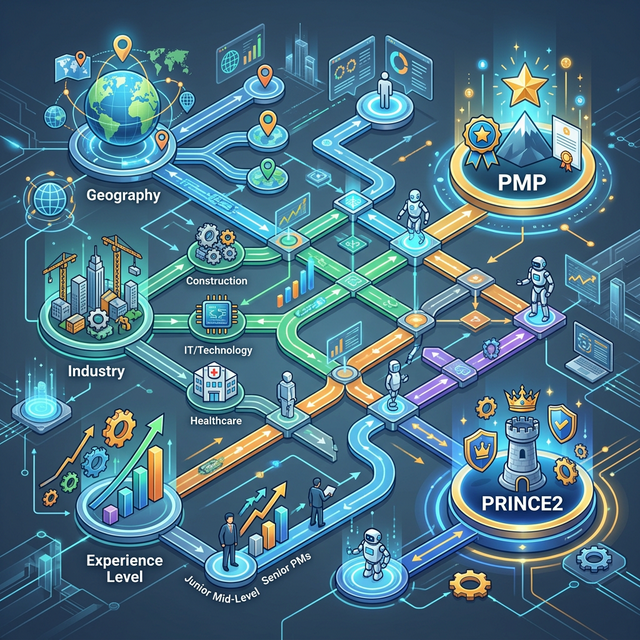
PMP vs PRINCE2: Quick Comparison
| Factor | PMP | PRINCE2 |
|---|---|---|
| Issuing Body | PMI (Project Management Institute, USA) | PeopleCert (formerly Axelos, UK) |
| Total Cost | $600–$2,000 USD all-in | £700–£2,500 combined (Foundation + Practitioner) |
| Experience Required | 36 months (degree) or 60 months (no degree) leading projects | None (Foundation); minimal (Practitioner) |
| Exam Format | 180 scenario-based questions, 230 minutes | Foundation: 60 MCQ, 60 min / Practitioner: 68 objective, 150 min |
| Difficulty | High — applied judgment, Agile + predictive blend | Moderate (Foundation: Low / Practitioner: Moderate) |
| Passing Score | Not publicly disclosed; estimated 61% correct | 55% (Foundation and Practitioner) |
| Validity / Renewal | 3 years; 60 PDUs required | 3 years (Practitioner); re-examination or CPD |
| Regional Strength | USA, Canada, Australia, global private sector | UK, Europe, public sector, government contracts |
| Best Industry Fit | Technology, construction, healthcare, finance, consulting | UK government, infrastructure, defence, public sector |
What is PMP?
The Project Management Professional (PMP) certification is issued by the Project Management Institute (PMI), headquartered in the United States. Established in 1984, the PMP is the most widely recognized project management credential in the world — particularly across North America, Australia, and the global private sector.
The PMP is grounded in the PMBOK Guide (Project Management Body of Knowledge), which organizes project management practice across five process groups (Initiating, Planning, Executing, Monitoring and Controlling, Closing) and ten knowledge areas including scope, schedule, cost, quality, risk, procurement, and stakeholder management. Since the major 2021 exam revision, approximately 50% of PMP exam content now covers Agile and hybrid project delivery — reflecting how significantly the profession has shifted away from exclusively waterfall methodologies.
What the PMP covers:
- Traditional (predictive/waterfall) project management frameworks
- Agile and hybrid project delivery (Scrum, Kanban, SAFe-adjacent concepts)
- Leadership, team development, and stakeholder engagement
- Business environment, portfolio alignment, and benefits realization
- Risk, quality, and procurement management
PMP prerequisites (you need all of these to apply):
- A four-year degree (bachelor’s level) plus 36 months of documented experience leading projects, OR a high school diploma plus 60 months of documented project leadership experience
- 35 hours of formal project management education (from a PMI Registered Education Provider or qualifying course)
- The experience must demonstrate that you led and directed projects — not just participated in them
PMP’s strict prerequisites are the primary reason it commands a salary premium. The certification is not accessible to inexperienced candidates — it functions similarly to a professional license that requires verified experience before you can sit the exam.
What is PRINCE2?
PRINCE2 (PRojects IN Controlled Environments) is a structured project management framework created by the UK government in 1996, originally for IT project management. Ownership has passed through multiple organizations and is now held by PeopleCert (which acquired Axelos in 2021). PRINCE2 is widely used across UK and European public sector organizations and in countries with historic ties to British government contracting standards, including Australia, South Africa, and parts of the Middle East.
PRINCE2 is built on a framework of 7 principles, 7 themes, and 7 processes that together define how a project should be governed from start to finish. The methodology emphasizes business justification, defined governance (including distinct roles for project boards and project managers), stage-gate controls, and clear documentation.
PRINCE2 exists at two levels:
Foundation — the entry-level knowledge certification. No experience is required. Candidates demonstrate they understand the PRINCE2 terminology, principles, and framework well enough to participate in a PRINCE2 project. The exam is 60 multiple-choice questions. It is commonly completed in a 3-5 day intensive training course.
Practitioner — demonstrates the ability to apply PRINCE2 to real project scenarios. Requires Foundation certification. The exam is open-book (PRINCE2 official manual permitted), 68 objective-format questions over 150 minutes. Renewal is required every three years through continuing professional development or re-examination.
PRINCE2 Agile is a separate qualification that combines the PRINCE2 governance framework with Agile delivery approaches — relevant for UK digital transformation projects and government IT programs.
Salary Comparison by Region
Salary is often the decisive factor in certification choice. The data below draws from PMI’s Earning Power: Project Management Salary Survey (most recent edition), UK salary aggregators including Glassdoor UK and Totaljobs, and Australian market data from Seek and PayScale.
| Region | PMP Average Salary | PRINCE2 Average Salary | PMP Premium |
|---|---|---|---|
| USA | $120,000–$145,000/year | $85,000–$110,000/year | +$25,000–$35,000 |
| UK | £55,000–£75,000/year | £50,000–£68,000/year | +£5,000–£10,000 |
| Australia | AUD $120,000–$150,000/year | AUD $100,000–$130,000/year | +AUD $15,000–$25,000 |
| Canada | CAD $110,000–$135,000/year | CAD $85,000–$105,000/year | +CAD $20,000–$30,000 |
| UAE / Middle East | AED $250,000–$360,000/year | AED $180,000–$280,000/year | +AED $50,000–$80,000 |
Important context for the UK market: The salary gap between PMP and PRINCE2 is significantly narrower in the UK than in other regions. This reflects genuine market reality — PRINCE2 is the dominant standard for UK public sector contracts, and holding PRINCE2 Practitioner is often a contractual requirement for project managers working on government frameworks. In that context, PRINCE2 is not a lesser credential in the UK; it is the expected baseline. Adding PMP provides additional differentiation, particularly for senior roles and private sector work.
PMI’s documented salary premium: PMI’s own salary survey consistently shows that PMP-certified project managers earn a 22–25% premium over non-certified project managers with equivalent experience in the USA. The premium is meaningful enough that the total cost of PMP certification — even at the high end of $2,000 — is typically recovered within the first two months of employment at the elevated salary level.
Industries with the highest PMP salary premiums: Technology (software development, infrastructure, cybersecurity), financial services (banking, insurance, investment management), healthcare IT, and defense contracting in the US market. These sectors consistently show the largest gap between certified and uncertified project manager compensation.
Exam Difficulty Comparison
Difficulty is where the two certifications diverge most dramatically. This matters not just for preparation planning but for understanding what the credential signals to employers.
PMP Exam
The PMP exam is one of the more demanding certification exams across any professional discipline — not because of obscure trivia, but because it tests applied judgment in complex, ambiguous scenarios.
- Format: 180 questions over 230 minutes (approximately 77 seconds per question)
- Question types: Multiple choice, multiple responses, matching, hotspot, and fill-in-the-blank — all scenario-based
- Content split: ~50% predictive/waterfall project management, ~50% Agile and hybrid delivery
- Pass rate: Estimated 50–60% on first attempt (PMI does not publish official pass rates)
- What makes it hard: Questions present realistic project scenarios with four plausible-sounding answer choices. The correct answer is nearly always the one that reflects what a competent, experienced PM would do based on PMI values — not necessarily what is most obvious or expedient. Candidates who memorize the PMBOK without developing judgment fail. Candidates who have real PM experience but ignore Agile content fail.
- Recommended preparation: 3–6 months studying part-time (10–15 hours per week)
PRINCE2 Foundation Exam
- Format: 60 multiple-choice questions over 60 minutes
- Question type: Knowledge recall — “Which principle applies here?”, “What is the purpose of this document?”
- Pass mark: 55% (33 out of 60 questions)
- Open book: No
- Pass rate: High — the majority of candidates who complete a Foundation course pass on first attempt
- What makes it manageable: The questions test whether you understand PRINCE2 terminology and framework. A candidate who studies the manual and completes a proper training course has most of what they need.
- Recommended preparation: 3–5 days intensive, or 2–3 weeks part-time
PRINCE2 Practitioner Exam
- Format: 68 objective-format questions over 150 minutes
- Question type: Scenario-based, but with a structured and somewhat predictable format
- Pass mark: 55%
- Open book: Yes — the official PRINCE2 manual is permitted
- What makes it manageable: The open-book format significantly reduces the need to memorize content. The scenarios are longer and require applying PRINCE2 concepts, but the answer choices are generally more clearly differentiated than in the PMP exam.
- Recommended preparation: 2–4 additional weeks beyond Foundation
The practical implication: a motivated candidate with no prior formal PM certification can achieve PRINCE2 Foundation in 2–3 weeks and PRINCE2 Practitioner within 6–8 weeks total. The PMP, by contrast, requires years of qualifying experience before you can even apply — and then months of preparation.
Cost Comparison
PMP Total Cost Breakdown
| Item | Cost |
|---|---|
| PMI Annual Membership (recommended) | $159 USD |
| PMP Exam Fee (PMI member price) | $405 USD |
| 35-hour qualifying education course | $200–$1,500 USD |
| Study materials (books, practice exams) | $100–$300 USD |
| Total realistic range | $600–$2,000 USD |
PMI membership is worth purchasing before the exam. The member discount on the exam fee ($150 savings) exceeds the membership cost, and members receive free digital access to the PMBOK Guide and Agile Practice Guide — reference materials that cost $50–$80 each if purchased separately.
The PMP exam can be taken at Pearson VUE test centers globally or via online proctored testing from home. The certification is valid for 3 years and renewed through accumulating 60 Professional Development Units (PDUs) in qualifying project management education and activities — typically achievable through normal professional development.
PRINCE2 Total Cost Breakdown
| Item | Cost |
|---|---|
| Foundation training + exam (ATO) | £350–£750 GBP |
| Practitioner training + exam (ATO) | £350–£900 GBP |
| Combined Foundation + Practitioner (typical training package) | £1,200–£2,500 GBP |
| Self-study with exam only (Foundation) | £200–£350 GBP |
PRINCE2 training is commercially dominated by Accredited Training Organizations (ATOs). Costs vary considerably between providers. UK prices are generally lower per-exam than comparable US professional exams because of competitive trainer pricing. Candidates can reduce costs by self-studying and purchasing exam vouchers independently rather than buying bundled training packages.
Value for money perspective: PRINCE2 Foundation is one of the most cost-efficient formal project management credentials available — achievable for £200–£350 with self-study. PMP is substantially more expensive and time-intensive but delivers a larger salary return, particularly in markets where it commands the greatest premium.
Which Certification Should You Choose?
The answer depends almost entirely on your location, career stage, and target industry. There is no universally correct choice.
Choose PMP if:
- You are based in the USA, Canada, or globally with US-aligned employers
- You have or are approaching the required project management experience (36 months with a degree)
- You work in or are targeting technology, healthcare, finance, or consulting
- You want maximum long-term salary leverage, particularly in the North American market
- You are already working in project management and want the credential that most employers worldwide recognize
Choose PRINCE2 Foundation first if:
- You are new to formal project management and want a credential without experience prerequisites
- You are early-career and need something demonstrable while you accumulate PMP-eligible experience
- You work in the UK, Europe, or a Commonwealth country where PRINCE2 is the standard
- You want the fastest path to a recognized PM credential (achievable in weeks, not months)
Choose PRINCE2 Practitioner if:
- You work in UK government, public sector, or contracts that require PRINCE2 by specification
- You have completed Foundation and want to demonstrate applied capability
- You are building a UK-based project management career in infrastructure, defence, or civil service
Choose both if:
- You work across international projects spanning UK and non-UK environments
- You completed PRINCE2 early in your career and have now accumulated PMP-eligible experience
- You want to maximize employability across both public sector (UK) and private sector (global) opportunities
Choose PMP over PRINCE2 Agile if:
- Your projects are Agile — PMP now includes 50% Agile content and is more broadly recognized than PRINCE2 Agile outside of UK government contexts
Agile Alternatives: PMI-ACP and PRINCE2 Agile
The project management certification landscape extends beyond PMP and PRINCE2. If your work is predominantly Agile, these alternatives are worth understanding.
PMI-ACP (Agile Certified Practitioner): PMI’s Agile-specific credential. Requires 21 contact hours of Agile education plus 12 months of general project experience and 8 months of Agile project experience. The exam covers Scrum, Kanban, SAFe, XP, and hybrid Agile frameworks. PMI-ACP is less recognized than PMP but is gaining traction in technology organizations that want demonstrated Agile knowledge specifically. It is also a stepping stone for candidates building toward PMP eligibility.
PRINCE2 Agile: Combines the PRINCE2 governance and control framework with Agile delivery practices (primarily Scrum and Kanban). It is particularly relevant for UK government digital transformation programs, which often mandate PRINCE2 governance while expecting Agile delivery. Outside of UK public sector contexts, PRINCE2 Agile has limited market recognition compared to either PRINCE2 Practitioner or PMP.
Scrum Master certifications (CSM, PSM): The Certified ScrumMaster (Scrum Alliance) and Professional Scrum Master (Scrum.org) are team-level Agile credentials rather than project management certifications. They are widely held in technology teams and valuable for Scrum Masters and Agile coaches, but they do not position you as a project manager in the way that PMP or PRINCE2 does. Many professionals hold both a Scrum credential and PMP or PRINCE2 — the Scrum credential demonstrates team-level Agile fluency while PMP or PRINCE2 demonstrates project-level management capability.
How to Prepare for PMP
PMP preparation is a multi-month commitment. Treating it casually is the most common reason candidates fail.
Step 1: Confirm eligibility Log your project management experience carefully before applying. PMI audits a random sample of applications and requires supporting documentation. Be accurate about months of experience and project types. Your experience must demonstrate that you led and directed projects, not just contributed to them.
Step 2: Complete a qualifying 35-hour education course This is a prerequisite and also provides structured exam preparation. Good options include:
- Andrew Ramdayal’s PMP Exam Prep Mega Course (Udemy) — consistently rated as the best value option, frequently on sale for $15–$25
- Simplilearn’s PMP certification training — more structured, higher price point (~$400–$800)
- PMI’s own training resources and REP partners — good but often expensive
Step 3: Submit your PMI application Complete the PMI.org application with your experience documentation. Applications are typically reviewed within 5–10 business days. If selected for audit, you have 90 days to submit supporting documentation.
Step 4: Build your study plan
- Read the PMBOK Guide (free for PMI members) — do not try to memorize it, read it for understanding
- Read the Agile Practice Guide (free for PMI members) — the 2021 exam shift means Agile is tested heavily
- Work through a large practice question bank — target 2,000+ practice questions across multiple sources
- Use the PM PrepCast practice exam simulator — widely regarded as the closest approximation to actual exam question difficulty and style
Step 5: Take full-length mock exams Before booking your actual exam, complete several full-length timed mock exams under realistic conditions. Target a consistent score of 70%+ on mock exams before sitting the real thing. Candidates who schedule their exam before reaching this benchmark significantly increase their risk of failure.
Key insight for the 2026 exam: The Agile content is not optional and not secondary. Approach it with the same depth as the predictive content. Many experienced waterfall project managers underestimate the Agile half and fail as a result.
How to Prepare for PRINCE2
PRINCE2 preparation is more structured and shorter than PMP preparation, but cutting corners on the Practitioner level creates problems.
PRINCE2 Foundation preparation:
- Enroll in a Foundation course through an Accredited Training Organization (ATO) — accreditation matters because ATOs have commitments to official courseware quality
- The most efficient format is a 3-5 day intensive course (in-person or virtual classroom)
- Alternatively, self-study using the official PRINCE2 manual (Managing Successful Projects with PRINCE2) and purchase a standalone exam voucher
- Complete practice exams from the official PeopleCert sample materials
- Timeline: 1–3 weeks including study
PRINCE2 Practitioner preparation:
- Foundation certification is a prerequisite
- Study the application of PRINCE2 principles and themes to project scenarios — Practitioner tests application, not just recall
- Since the exam is open-book, practise navigating the PRINCE2 manual quickly under time pressure — you will not have time to read entire sections during the exam
- Use official PeopleCert sample Practitioner questions as your primary practice material
- Timeline: 2–4 weeks of additional study after Foundation
Cost reduction strategy: If your employer does not fund PRINCE2 training (which many UK employers do as a contractual requirement), purchasing a self-study package and standalone exam voucher from PeopleCert directly is significantly cheaper than full ATO training bundles. Foundation self-study is viable; Practitioner benefits more from structured training given the scenario-based nature of the exam.
The Verdict: PMP vs PRINCE2 in 2026
Neither certification is universally superior. Each is the right choice under specific conditions.
PMP wins on salary premium in North America, Australia, and global private sector roles. It wins on international recognition breadth. It wins on Agile relevance post-2021. It wins for technology, consulting, finance, and healthcare careers where employers globally recognize the PMI brand. The difficulty and experience requirements are not bugs — they are features that protect the credential’s value and explain the salary premium.
PRINCE2 wins on accessibility for early-career professionals. It wins on UK public sector relevance — not just recognition, but contractual requirement. It wins on speed-to-credential for those who need something demonstrable now. It wins on cost for candidates in markets where PMP salary premiums do not apply. And PRINCE2 Practitioner, in combination with the MSP (Managing Successful Programmes) and MoP (Management of Portfolios) qualifications, creates a powerful credential stack for UK government and public sector senior roles.
For most global professionals early in their project management career: start with PRINCE2 Foundation (it is fast, affordable, and immediately demonstrable), then pursue PMP once you have accumulated the required experience. The two certifications are not in conflict — they are complementary.
Frequently Asked Questions
Which pays more: PMP or PRINCE2?
PMP consistently pays more than PRINCE2 in North America and Australia. In the USA, PMP-certified project managers earn $120,000–$145,000/year on average (PMI Salary Survey data), compared to $85,000–$110,000 for PRINCE2 holders. In the UK, salaries are more comparable — PMP averages £55,000–£75,000 while PRINCE2 averages £50,000–£68,000. PRINCE2 is the dominant standard in UK government and public sector contracts, which partly explains its strength there. In Australia, PMP commands AUD $120,000–$150,000 vs PRINCE2 at AUD $100,000–$130,000. The salary premium reflects both the higher difficulty and experience requirements of PMP and its stronger recognition in private sector and technology industries globally.
Is PMP or PRINCE2 harder?
PMP is significantly harder to obtain than PRINCE2. PMP prerequisites require documented project management experience: 36 months (with a 4-year degree) or 60 months (without) of leading projects, plus 35 hours of PM education. The exam itself is 180 questions over 230 minutes with a mix of scenario-based questions requiring applied judgment — not just knowledge recall. PRINCE2 requires no experience prerequisite (Foundation level) or minimal experience (Practitioner level). The PRINCE2 Foundation exam is 60 multiple-choice questions; Practitioner is 68 objective-format questions. Both PRINCE2 exams are significantly more straightforward than PMP. If PMP is equivalent to a professional license requiring apprenticeship, PRINCE2 Foundation is equivalent to a textbook knowledge test.
Which certification is more recognized internationally?
PMP is more globally recognized overall, particularly in the USA, Canada, Australia, and across Asia-Pacific private sector organizations. It is the standard in technology, construction, healthcare, and finance project management globally. PRINCE2 dominates in the UK, Europe (particularly in public sector and government), parts of the Middle East, and former British Commonwealth countries for government-contracted work. If you work internationally across regions, PMP provides broader recognition. If you are UK-based or targeting UK/European public sector work, PRINCE2 — especially combined with the Management of Portfolios (MoP) and Managing Successful Programmes (MSP) extensions — may be more relevant.
How much does PMP certification cost?
Total PMP certification cost: application fee $405 (PMI member) or $555 (non-member) for the exam; PMI annual membership $159 (optional but worth it for exam discount + study resources); exam prep course to meet 35-hour requirement $200–$1,500; study materials (Agile Practice Guide, PMBOK Guide free for members, prep books $40–$80); optional prep courses $200–$500. Total realistic cost: $600–$2,000. The exam can be taken online proctored or at a Pearson Vue test center. PMI membership is worth getting before purchasing the exam — the membership discount on the exam exceeds the membership cost. PMP holders receive 3 years of certification before renewal, which requires 60 PDUs (Professional Development Units) in project management education.
How long does it take to prepare for PMP certification?
PMP preparation takes 3–6 months for most candidates studying part-time (10–15 hours per week). The study process: complete a 35-hour qualifying PM education course (1–3 weeks); study the PMBOK Guide and Agile Practice Guide (4–8 weeks); work through a practice question bank (aim for 2,000+ practice questions across multiple sets); take full-length timed mock exams (target 70%+ consistently before scheduling your exam). The PMP exam shifted significantly in 2021 to include approximately 50% Agile/hybrid content alongside traditional predictive project management. Candidates from waterfall-heavy backgrounds need additional Agile preparation.
Can you get both PMP and PRINCE2 certifications?
Yes — and for certain career paths, holding both is advantageous. Professionals working across international projects (especially UK-US or UK-Australia project environments) benefit from having both credentials. PRINCE2 is also commonly completed first (as a lower-barrier entry point to formal PM certification), with PMP added after accumulating the required experience. The methodologies are compatible in practice — PRINCE2 provides a structured governance framework while PMP covers broader project management knowledge including Agile. Candidates who hold both can adapt their approach to client preferences and project types.
Related Guides
- Best Digital Marketing Certifications in 2026 — The top credentials for digital marketing careers, ranked by employer recognition and salary impact
- Is an MBA Still Worth It in 2026? — An honest analysis of MBA ROI across program types, industries, and career stages
- Digital Marketing Salary Guide: USA, UK, Canada, Australia — Current compensation data for digital marketing roles across major markets
- How to Transition Into Tech Without Coding — Career paths into the technology industry for non-engineers, including project management tracks