Non-Resident LLC Formation USA: 2026 Legal & Tax Guide

Non-Resident LLC Formation USA: 2026 Legal & Tax Guide
Strategic Architectures for Non-Resident U.S. Limited Liability Companies: Legal, Financial, and Compliance Frameworks in 2026
Introduction to the U.S. Corporate Ecosystem for Foreign Nationals
The United States represents the undisputed epicenter of global commerce, offering an unparalleled consumer market, an advanced financial infrastructure, and robust legal protections that foster entrepreneurial growth. For non-resident aliens—defined within the United States Internal Revenue Code as individuals who do not possess U.S. citizenship, a permanent resident card, or a substantial physical presence within the country—accessing this economic ecosystem has historically been fraught with profound regulatory complexities. However, over the past decade, the Limited Liability Company structure has solidified its position as the premier corporate vehicle for international entrepreneurs seeking a foothold in the American market without the necessity of physical immigration or complex visa processes.
A U.S. LLC is a statutory creation that combines the formidable liability shield of a traditional C-Corporation with the operational flexibility and pass-through taxation characteristics of a partnership or sole proprietorship. For non-residents, this structural hybridity facilitates seamless access to elite payment processors such as Stripe and PayPal, integration into global banking networks, and the ability to conduct business in a jurisdiction known for its economic stability. Furthermore, under specific operational conditions, the U.S. LLC can potentially mitigate U.S. federal income tax liabilities entirely, allowing entrepreneurs to lawfully channel profits to their home jurisdictions.
Nevertheless, the regulatory landscape governing foreign-owned U.S. entities has experienced seismic legislative and administrative shifts leading into 2026. The intersection of increasingly stringent Know Your Customer (KYC) and Anti-Money Laundering (AML) banking protocols, dynamic federal beneficial ownership reporting mandates, and aggressive state-level transparency legislation requires a highly sophisticated approach to corporate structuring. Ignorance of these statutory obligations can result in the administrative dissolution of the entity, frozen financial assets, or devastating punitive fines from the Internal Revenue Service (IRS) that can instantly bankrupt a fledgling enterprise. This comprehensive report provides an exhaustive, expert-level analysis of the jurisdictional, procedural, financial, and tax compliance frameworks necessary to successfully establish, maintain, and operate a U.S. LLC as a non-resident in the current regulatory environment.
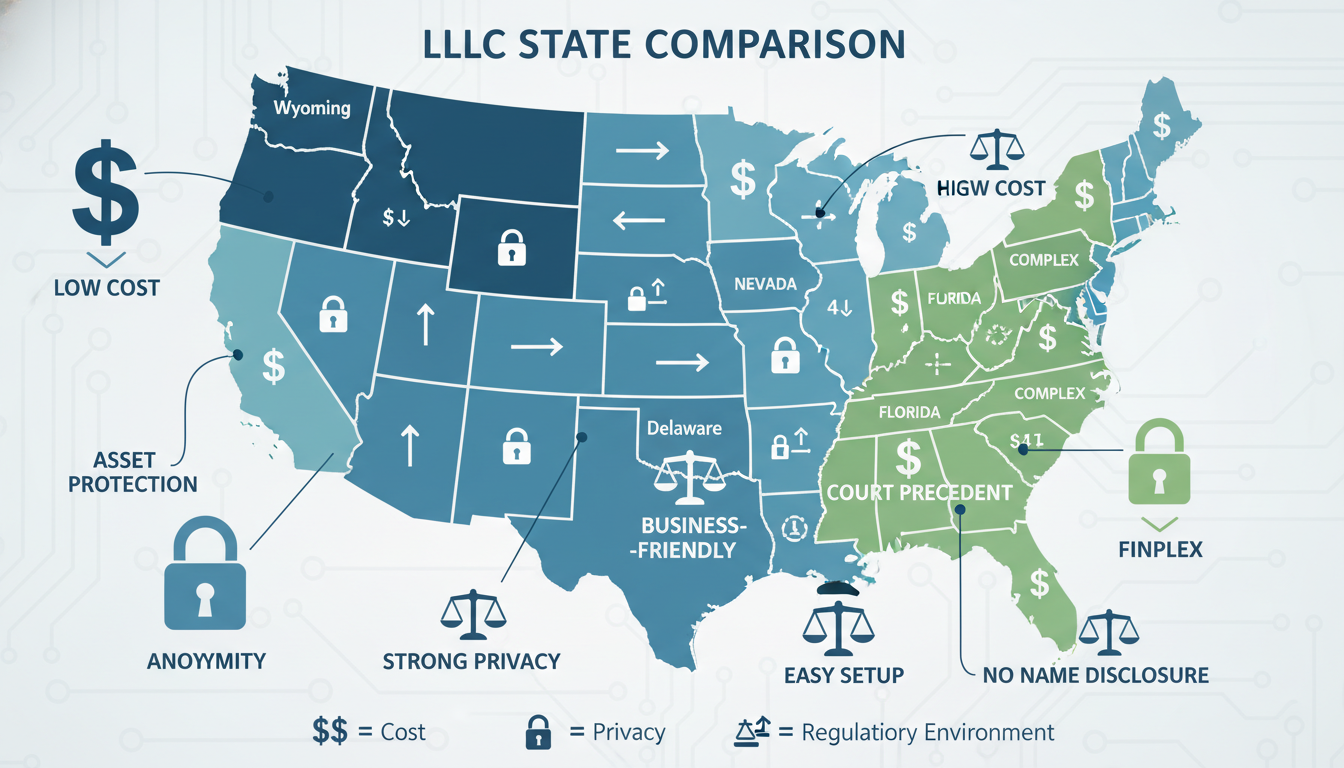
Jurisdictional Arbitrage: A Comparative Analysis of U.S. States
In the United States, corporate entities are chartered at the state level rather than the federal level. Consequently, the selection of a domicile state is the foundational strategic decision in the LLC formation process. Each of the fifty states maintains distinct statutory regimes governing initial formation fees, annual maintenance costs, fiduciary duties, privacy protections, and corporate taxation. For a non-resident founder operating a digital, e-commerce, or consulting enterprise without a physical U.S. footprint—such as localized employees, a brick-and-mortar storefront, or a dedicated warehouse—the choice of jurisdiction becomes an exercise in regulatory arbitrage. Conversely, if the enterprise maintains physical operations or continuous economic presence in a specific state, it is legally obligated to register the LLC (or register as a foreign LLC) in that specific jurisdiction, rendering out-of-state formation strategies largely irrelevant and economically inefficient.
While the internet is replete with advisory materials and marketing campaigns extolling the universal virtues of Delaware, Nevada, and Wyoming, empirical analysis indicates that the optimal jurisdiction is highly contingent upon the entity’s capitalization strategy, operational model, and long-term objectives.
Delaware: The Illusion of Universal Applicability
Delaware’s reputation in the corporate sphere is historically unmatched, driven by its highly specialized Court of Chancery and an extensive, predictable body of corporate case law that resolves disputes with unmatched efficiency. However, this prestige is primarily advantageous for C-Corporations seeking to raise venture capital, facilitate complex mergers and acquisitions, or prepare for initial public offerings. Institutional investors demand Delaware corporations due to the predictability of director fiduciary duties and shareholder rights.
For a standard, single-member LLC owned by a non-resident, Delaware imposes an unnecessary and recurring financial burden. The state mandates a $110 initial filing fee coupled with a strict $300 annual franchise tax, regardless of the business’s revenue or operational activity level. The evidence suggests that for the average non-resident small business owner, e-commerce seller, or freelance developer, the legal prestige of Delaware does not yield a tangible return on investment that justifies the elevated maintenance costs. If a business does not intend to issue complex equity structures to American venture capitalists, the Delaware premium is an unnecessary expenditure.
Wyoming: The Standard for Digital Entrepreneurs
Wyoming pioneered the LLC structure in the United States and remains the dominant choice for non-resident digital entrepreneurs. The state explicitly protects single-member LLCs through robust statutory charging order protections, insulating an owner’s personal assets from business liabilities and protecting the business from the owner’s personal creditors. Crucially, Wyoming does not levy corporate or personal state income taxes, and its administrative costs are exceptionally favorable. The state requires a $100 initial formation fee and a minimal $60 annual report fee to maintain good standing.
Furthermore, Wyoming prioritizes owner privacy, allowing beneficial owners’ personal details to remain off public state registries when the entity is structured properly through a registered agent. In an era of increasing digital surveillance and data scraping, this privacy shield provides a distinct operational advantage for international founders who wish to maintain a low public profile.
New Mexico: The Apex of Cost Efficiency and Privacy
Emerging as a hyper-efficient alternative to Wyoming, New Mexico offers arguably the lowest long-term administrative cost profile in the nation. The state charges a mere $50 formation fee and completely waives ongoing annual reporting requirements, resulting in a $0 annual state maintenance fee. Furthermore, New Mexico permits anonymous LLC formation by statute, shielding ownership details from public corporate registries without requiring complex trust structures. For cost-conscious international founders prioritizing absolute privacy and minimal bureaucratic friction, New Mexico represents a highly strategic choice, particularly for businesses that intend to hold passive assets or intellectual property.
Nevada: The High-Cost Trap
Despite aggressive marketing campaigns highlighting its lack of state income tax and corporate-friendly environment, Nevada is increasingly viewed as suboptimal for the standard non-resident LLC. Nevada imposes the highest entry and maintenance barriers among the popular business-friendly jurisdictions. Formation fees commence at $425, and the state mandates an annual business license and list of officers submission costing approximately $350. Furthermore, industry data indicates that Nevada entities frequently face heightened scrutiny from financial institutions and federal regulators due to historical associations with domestic and international fraudulent activity, neutralizing many of its theoretical benefits and complicating the banking process for legitimate international founders.
Emerging Alternatives: Ohio, Texas, and Florida
For businesses that require a physical presence or wish to avoid the stigma sometimes associated with “haven” states, alternative jurisdictions offer compelling benefits. Ohio has emerged as a surprisingly affordable option, requiring a $99 setup fee with absolutely no annual reporting fees, making it cost-competitive with New Mexico while projecting a more traditional corporate image. Texas and Florida both offer massive consumer markets and lack personal state income taxes. Florida requires a $125 formation fee and an annual fee of $138.75, while Texas charges a steeper $300 formation fee but waives annual fees for most standard LLCs (though a Public Information Report is still mandatory).
State
Initial Filing Fee
Ongoing Annual Fee
Privacy Level
Primary Strategic Advantage
Wyoming
$100
$60
High
Strong charging order protections, low cost, high privacy
New Mexico
$50
$0
High
Lowest long-term cost, statutory anonymity
Delaware
$110
$300
Medium
Specialized Chancery Court, venture capital readiness
Nevada
$425
$350
High
No state income tax, strong corporate veil, high friction
Ohio
$99
$0
Low
Traditional business image, zero annual maintenance fees
Florida
$125
$138.75
Low
No personal income tax, strategic location for LatAm trade
The Mechanics of Entity Formation and Identity Acquisition
Once the optimal jurisdiction is selected, the physical and bureaucratic instantiation of the company must occur.
The primary foundational step requires appointing a Registered Agent within the state of formation. The Registered Agent must possess a physical street address—expressly not a Post Office Box—and be available during standard business hours to accept service of process (legal summons) and official state correspondence on behalf of the LLC. This ensures the state always has a reliable mechanism to contact the corporate entity regarding legal or administrative matters.
Subsequently, the founder must file the Articles of Organization (sometimes referred to as a Certificate of Formation or Certificate of Organization) with the respective Secretary of State. Upon state approval of these documents, the LLC is legally recognized as a distinct entity. Immediately following formation, the owner must draft an Operating Agreement. While generally an internal document that is not filed with the state government, the Operating Agreement is the fundamental governing contract of the LLC. It dictates ownership percentages, management structures, capital contribution requirements, and operational protocols. Financial institutions universally require a fully executed Operating Agreement during the compliance onboarding process to verify beneficial ownership and managerial authority.
Navigating the Employer Identification Number (EIN) Labyrinth
The most significant bureaucratic bottleneck for a non-resident founder is obtaining an Employer Identification Number (EIN) from the Internal Revenue Service. The EIN serves as the federal tax identification number for the entity, serving a function analogous to a Social Security Number (SSN) for an individual. It is a strict prerequisite for opening a U.S. business bank account, hiring employees, establishing merchant processing accounts, and integrating with payment gateways like Stripe.
U.S. residents possessing an SSN or an Individual Taxpayer Identification Number (ITIN) can acquire an EIN instantaneously via the IRS’s automated online portal. However, the IRS categorically prohibits non-residents lacking these specific identifiers from utilizing the online system. Instead, non-residents must manually submit IRS Form SS-4 (Application for Employer Identification Number) via international fax or postal mail.
The completion of Form SS-4 by a non-resident demands exacting precision to avoid processing delays. The form should ideally be completed using capital letters. Line 1 requires the exact legal name of the entity as approved by the state. The mailing address provided on lines 4a and 4b can be an international address; however, utilizing a U.S. commercial address is strategically advantageous as it establishes consistency for subsequent banking applications. Line 6 must reflect the county and state where the principal business is located within the U.S..
Crucially, Line 7b, which requests the SSN, ITIN, or EIN of the responsible party, must explicitly be filled with the word “Foreign” to indicate the applicant’s non-resident status and justify the lack of a standard taxpayer identification number. Lines 10 through 17 require detailed descriptions of the business activity, primary products, and the reason for applying.
The submission modality directly dictates the processing timeline. Faxing the completed Form SS-4 to the dedicated IRS international operation center at 1-855-641-6935 (or 304-707-9471 from outside the U.S.) typically results in an EIN issuance within 4 to 8 weeks, though non-resident processing queues can occasionally extend this to 2.5 to 3 months. If submitted via physical mail to the IRS facility in Cincinnati, Ohio, the processing duration expands to 6 to 8 weeks, extending up to 3.5 months for international applicants.
Once approved, the IRS will return a faxed copy of the SS-4 with the EIN written in the top right corner, followed by a formal CP575 Confirmation Letter mailed to the address on record. If the approval is delayed beyond 62 days, applicants can contact the IRS to request a 147C Verification Letter. These documents (the CP575 or 147C) must be securely retained, as they form the cryptographic key required to unlock relationships with all U.S. financial institutions.
The Address Imperative: Overcoming KYC and CMRA Restrictions
In 2026, the global financial system is governed by aggressive Know Your Customer (KYC) and Anti-Money Laundering (AML) directives. Consequently, U.S. financial institutions require definitive, documentary proof of a business’s physical operating location to prevent sanctions evasion and financial crime. A common, critical error made by unadvised non-resident founders is attempting to utilize their Registered Agent’s address as their primary business operating address during bank onboarding. A Registered Agent address is strictly a statutory requirement for receiving legal correspondence; utilizing it to masquerade as an operational headquarters triggers immediate algorithmic rejection by modern compliance software.
Furthermore, traditional mail forwarding services and cheap virtual mailboxes are routinely flagged in the United States Postal Service (USPS) database as Commercial Mail Receiving Agencies (CMRAs). When a bank’s verification API checks a CMRA address, it identifies that the location is merely a mail-sorting facility rather than a legitimate commercial office or residential dwelling, leading to swift account denial. To successfully navigate this bottleneck, non-residents must invest in sophisticated physical address solutions that satisfy the rigors of modern banking compliance:
- 1. Premium Virtual Offices: Providers such as Opus Virtual Offices, Alliance Virtual Offices, and Northwest Registered Agent offer robust services that transcend basic mail forwarding. These providers lease real commercial office space, providing unique suite numbers, local phone lines, and occasionally, access to physical meeting rooms. While highly professional and suitable for state filings, some of these addresses may still carry a CMRA flag depending on the specific building’s USPS registration, which can occasionally complicate banking depending on the institution’s strictness.
- 2. Commercial Lease Generation (e.g., TruLease): To bypass CMRA restrictions entirely, specialized services like TruLease partner with commercial property owners to provide non-resident LLCs with an actual, legally binding one-year lease agreement for a dedicated office suite. Crucially, these services can also generate a utility bill (e.g., internet or landline phone) in the LLC’s name. A lease agreement coupled with a matching utility bill forms the ultimate verification package for U.S. banking, satisfying the most stringent KYC requirements by proving physical commercial occupancy.
Financial Infrastructure: Remote Banking for Foreign Founders
Securing a U.S. business bank account is the operational lifeblood of the LLC, enabling the entity to process transactions in USD, pay domestic vendors without exorbitant exchange fees, and integrate with crucial digital infrastructure. Historically, foreign founders were compelled to physically travel to the United States to open accounts at traditional banking institutions. While physically visiting a branch of a “foreigner-friendly” bank like Wells Fargo or Chase remains a highly reliable method for acquiring an account without an SSN, it incurs significant travel expenses, requires physical proof of address, and introduces immense logistical friction.
To bridge this gap, Financial Technology (Fintech) platforms have developed remote-first banking infrastructure designed specifically for global entrepreneurs. However, as of 2026, the compliance standards of these digital platforms have drastically tightened in response to federal pressure, requiring meticulous documentary preparation and flawless consistency.

Financial Institution
Institution Type
FDIC Insurance
Primary Address Requirement for Non-Residents
Ease of Approval
Wise Business
Electronic Money Institution (EMI)
No
Registered Agent address + verifiable international trading address
High
Relay
Fintech (Partner Banks)
Yes
Verifiable personal residential address + business address (Registered Agent conditionally accepted)
Medium
Mercury
Fintech (Partner Banks)
Yes
Verifiable physical U.S. or international address (No Registered Agents or P.O. Boxes allowed)
Low / Strict
Wells Fargo
Traditional Chartered Bank
Yes
In-person visit usually required, U.S. physical address often requested
Dependent on travel
The Fintech Compliance Ecosystem
Mercury: Historically the default choice for tech startups and international founders, Mercury operates as a fintech overlay on top of partner banks, providing up to $5M in FDIC insurance through sweep networks. Mercury’s approval algorithms have become highly restrictive. Mercury explicitly rejects the use of Registered Agent addresses, P.O. Boxes, or standard virtual mailboxes for the principal place of business. Applicants must provide undeniable proof of physical operations—either a verifiable international residential address or a U.S.
physical address backed by a valid lease agreement and a utility bill issued within the last 90 days. Furthermore, Mercury requires government-issued identification for all beneficial owners, the CP575 EIN confirmation, and a detailed description of the business model and revenue streams.
Relay
Relay represents another powerful fintech alternative, offering FDIC-insured accounts through its banking partners. Relay’s compliance architecture takes a slightly different approach: it strictly requires a verifiable residential address for every business owner. If the foreign founder provides a legitimate international residential address, Relay will tentatively permit the use of a Registered Agent address for the business’s location. However, Relay still routinely requests address verification documents, such as utility bills, bank statements, or lease agreements matching the provided addresses to prevent fraudulent applications.
Wise Business
Wise (formerly TransferWise) is universally recognized as the most accessible platform for non-resident approval. Wise effectively acts as a multi-currency receiving account, ideal for capturing USD payments from American clients and routing them globally. Unlike Mercury and Relay, Wise is an Electronic Money Institution (EMI), not a chartered bank; therefore, funds held within Wise are not FDIC-insured. Wise allows the use of the LLC’s Registered Agent address as the “business registered address,” though it mandates a distinct “business trading address” indicating where the founder physically performs their daily work. Wise accepts international utility bills, tax documents, or government correspondence to verify this trading address, making it the most flexible option for digital nomads.
It is vital to note that due to strict U.S. Treasury Department sanctions, founders residing in or operating from restricted jurisdictions (such as Belarus, Cuba, Iran, North Korea, Russia, Syria, and Venezuela) are universally prohibited from opening U.S. bank accounts, regardless of the platform utilized.
U.S. Taxation Mechanics: The ETBUS Doctrine and Tax Treaties
The paramount concern for any international entrepreneur is the mitigation and management of U.S. federal income tax liability. A profound misconception that frequently deters foreign investment is the belief that the mere existence of a U.S. LLC triggers universal, unavoidable U.S. taxation. By default, a single-member LLC is treated by the IRS as a “disregarded entity” for tax purposes. This means the LLC itself does not pay corporate income tax; rather, the profits and losses “pass through” directly to the individual owner, who is responsible for reporting them on their personal tax return.
For a non-resident alien owner, the critical determinant of U.S. tax liability relies entirely on the legal concepts of “Effectively Connected Income” (ECI) and whether the individual is “Engaged in a Trade or Business in the United States” (ETBUS).
The ETBUS Threshold and Effectively Connected Income
The IRS dictates that a non-resident is subject to U.S. federal income tax exclusively on income that is Effectively Connected Income (ECI)—which is income generated as a direct result of being ETBUS. An entity achieves ETBUS status only if it maintains a “substantial, continuous, and regular” operational presence within the United States. Legally, this threshold is crossed if the LLC has:
- Physical Infrastructure: Owning or leasing an office, warehouse, factory, or retail storefront within the U.S.
- Dependent Agents: Utilizing employees or contractors who operate within the U.S. and work almost exclusively for the LLC. A dependent agent is one who possesses the authority to negotiate and execute contracts on the LLC’s behalf, thereby establishing an economic nexus.
If a non-resident founder operates a digital agency, a Software as a Service (SaaS) platform, or an e-commerce dropshipping business entirely from outside the United States, utilizes independent contractors (e.g., Amazon FBA, third-party logistics providers, freelance developers), and lacks U.S. offices, the enterprise is generally classified as non-ETBUS. Consequently, the income generated is considered foreign-sourced and is not subject to U.S. federal income tax, allowing the profit to pass through to the owner’s home jurisdiction tax-free from an American perspective.
Fixed, Determinable, Annual, or Periodical (FDAP) Income
In contrast to actively earned business profits, non-residents who earn passive income from U.S. sources—such as dividends, interest, royalties, or rents—are subject to a different taxation regime known as FDAP. FDAP income is generally subject to a flat 30% withholding tax at the source, unless modified by an applicable tax treaty.
The Ultimate Shield: Tax Treaties and Permanent Establishments
Even in scenarios where an LLC’s activities might technically cross the threshold into ETBUS territory (for example, by having a U.S. partner or significant physical inventory), bilateral tax treaties between the United States and the founder’s home country can provide an overriding layer of protection.
The vast majority of U.S. tax treaties stipulate that a resident of the treaty partner country will only be subject to U.S. taxation on business profits if those profits are attributable to a “Permanent Establishment” (PE) located within the United States. A Permanent Establishment is generally defined as a fixed place of business through which the business of the enterprise is wholly or partly carried on.
For example, if a founder operates from Germany or the United Kingdom, the relevant treaty ensures that without a physical U.S. permanent establishment, the business profits remain taxable only in the resident’s home nation. If the LLC generates actual Effectively Connected Income (ECI) that is not protected by a treaty, the non-resident owner is legally obligated to file Form 1040-NR (U.S. Nonresident Alien Income Tax Return) to report the U.S.-sourced income and pay the applicable graduated tax rates.
The Form 5472 Trap: Mandatory Information Reporting
A devastating and commonly misunderstood reality of U.S. corporate law is the distinction between tax liability and information reporting compliance. A non-resident owner may legally owe $0 in U.S. taxes due to non-ETBUS status, yet still fall victim to catastrophic IRS penalties for failing to file mandatory informational disclosures.
Under regulations enacted to curb global tax evasion (specifically referencing Internal Revenue Code Sections 6038A and 6038C), a 100% foreign-owned single-member LLC that is treated as a disregarded entity is technically classified as a “reporting corporation” strictly for federal information reporting purposes. As a result, the non-resident owner is mandated to file a highly specific informational return with the IRS annually.
The Pro Forma 1120 and Form 5472 Mechanics
The compliance package consists of a “pro forma” Form 1120 (U.S. Corporation Income Tax Return) with Form 5472 (Information Return of a 25% Foreign-Owned U.S. Corporation or a Foreign Corporation Engaged in a U.S. Trade or Business) attached.
Because the LLC is a disregarded entity and not a traditional corporation, the Form 1120 is filed “pro forma”—meaning it is mostly blank. The preparer must handwrite “Foreign-owned U.S. DE” at the top of the form, provide the entity’s name, address, and EIN in Section B, check the applicable boxes in Section E, and leave the standard corporate income and deduction lines entirely empty.
The critical component of the filing is the attached Form 5472. This document requires the entity to detail its direct and indirect foreign ownership (identifying the 25% or more foreign shareholders) and comprehensively disclose any “Reportable Transactions” that occurred during the fiscal year between the LLC and related parties.
Reportable Transactions and the $25,000 Penalty
The IRS definition of a “Reportable Transaction” is exceptionally broad and captures almost all economic activity. It encompasses any exchange of money or property between the LLC and its foreign owner, or between the LLC and other entities controlled by the owner. This includes:
- Capital Contributions: The initial deposit of personal funds into the LLC’s bank account to commence operations or fund a deficit.
- Capital Distributions: The transfer of LLC profits from the U.S. corporate account to the owner’s personal foreign bank account.
- Formation Expenses: Incredibly, even the act of paying the state filing fee to form the LLC, or paying for a Registered Agent out of personal foreign funds, qualifies as a reportable transaction.
Consequently, it is virtually impossible for an active LLC to exist for a single fiscal year without triggering a Form 5472 filing requirement. The deadline for this filing aligns with the standard corporate tax deadline: April 15th of the year following the tax year (e.g., April 15, 2027, for the 2026 tax year). An automatic extension can be secured by filing Form 7004 before the primary deadline.
The consequences of non-compliance are severe and unyielding. Failing to file Form 5472, filing it late, or submitting a substantially incomplete form triggers an automatic, flat penalty of $25,000 imposed by the IRS. This fine is assessed per missing form and constitutes the most dangerous financial trap for unadvised foreign entrepreneurs operating U.S. entities.
The Evolving Transparency Landscape: FinCEN and State Mandates
In a sweeping effort to combat illicit finance, money laundering, and shell company abuse, the U.S. Congress enacted the Corporate Transparency Act (CTA), enforced by the Financial Crimes Enforcement Network (FinCEN). Initially, the CTA required almost all small businesses operating in the U.S.
to submit Beneficial Ownership Information (BOI) reports identifying the specific individuals who ultimately own or control the entity. However, the regulatory framework experienced a massive recalibration in the first quarter of 2025 following intense litigation, drastically altering the compliance obligations for non-resident founders operating in 2026.
The FinCEN Domestic Exemption (March 2025)
On March 26, 2025, following a series of federal injunctions and departmental reviews, FinCEN published an Interim Final Rule that significantly narrowed the scope of the CTA. The ruling formally and permanently exempted all entities previously defined as “domestic reporting companies” from federal BOI reporting requirements.
Under the revised statute, an entity is exempt if it was “created by the filing of a document with a secretary of state or any similar office under the law of a State or Indian tribe”. Crucially, an LLC formed in Wyoming, Delaware, New Mexico, or any other U.S. state by a non-resident is classified mechanically as a domestically created entity. Therefore, entering 2026, U.S. LLCs owned by foreign nationals are entirely exempt from federal FinCEN BOI reporting.
The federal CTA now exclusively applies to “foreign reporting companies”—defined strictly as entities formed under the law of a foreign country (e.g., a UK LTD, an Indian Pvt Ltd, or a German GmbH) that subsequently register to do business as a foreign entity in a U.S. state. These specific entities face an extended compliance deadline of April 25, 2025, and must report their non-U.S. beneficial owners to FinCEN, facing a failure-to-file penalty of $591 per day.
The Rise of State-Level Transparency Legislation
While the federal government has retreated from regulating domestic small businesses via the CTA, aggressive state legislatures have stepped in to fill the perceived transparency void, creating a highly fragmented and localized compliance landscape.
The New York LLC Transparency Act (NY LLCTA)
Effective January 1, 2026, the NY LLCTA was implemented to unmask anonymous real estate purchases and illicit corporate structures operating within the state. However, mirroring the recent FinCEN rollback, the scope of the NY LLCTA was drastically restricted prior to implementation. The law explicitly exempts LLCs formed within the United States—both domestic New York LLCs and out-of-state LLCs (e.g., a Wyoming LLC) authorized to do business in New York. The NY LLCTA’s reporting requirements—which demand the disclosure of names, addresses, and ID numbers of beneficial owners—apply exclusively to non-U.S. (foreign) LLCs that register to conduct business within the State of New York.
California Senate Bill 1201 (SB 1201)
Conversely, California has adopted the most draconian transparency legislation in the nation. Effective January 1, 2026, SB 1201 mandates that all domestic and foreign LLCs and corporations doing business in California publicly disclose their beneficial owners. A beneficial owner is defined as an individual holding 25% or more equity or exercising “substantial control” over the entity.
Unlike FinCEN’s confidential federal database, California requires entities to list the full names and complete business or residential addresses of these beneficial owners directly on their biennial Statements of Information. This information will be readily discoverable and publicly accessible on the California Secretary of State’s online portal. For non-resident founders leveraging privacy-focused jurisdictions like Wyoming or New Mexico, conducting physical operations or triggering economic nexus in California entirely negates those privacy benefits by forcing public disclosure.
Legislation / Agency
Scope of Reporting
Publicly Accessible
Exemption Status for Domestic LLCs
Federal CTA (FinCEN)
Foreign reporting companies only
No (Law Enforcement only)
Fully Exempt
New York LLCTA
Non-U.S. formed entities registered in NY
No (Database access restricted)
Fully Exempt
California SB 1201
All domestic and foreign entities doing business in CA
Yes (Secretary of State portal)
Not Exempt
Strategic Synthesis and Operational Imperatives
Establishing and maintaining a U.S. Limited Liability Company as a non-resident in 2026 requires precise execution across a multidimensional landscape of state corporate law, federal tax code, and increasingly stringent banking compliance protocols. The strategic framework can be synthesized into several critical operational imperatives:
- First, founders must optimize jurisdictional selection by abandoning the assumed prestige of Delaware in favor of the cost-efficiency and privacy of Wyoming or New Mexico, unless venture capital acquisition is an immediate, structured objective. The absence of state income tax and minimal ongoing maintenance fees provide a distinct competitive advantage for early-stage and digital enterprises.
- Second, entrepreneurs must master the IRS identification protocol. Planning for the bureaucratic friction of Form SS-4 is essential. Utilizing fax channels over international mail reduces the EIN acquisition timeline from several months to a matter of weeks, accelerating the business’s time-to-market and allowing for rapid bank integration.
- Third, investing in verifiable infrastructure is non-negotiable. The era of bypassing bank KYC with cheap virtual mailboxes is permanently closed. Non-residents must secure premium virtual offices or commercial lease agreements (such as TruLease) capable of producing legitimate utility bills to satisfy the rigorous physical address requirements demanded by premier fintech platforms like Mercury and Relay.
- Fourth, founders can legally leverage the ETBUS doctrine. By maintaining operations strictly outside U.S. borders, utilizing independent contractors rather than dependent agents, and relying on international tax treaties, non-resident founders can legally generate non-ETBUS, foreign-sourced income, entirely sidestepping U.S. federal income tax liabilities.
- Fifth, prioritizing Form 5472 compliance must supersede all other administrative tasks. The most significant threat to a foreign-owned U.S. LLC is not taxation, but information reporting non-compliance. Ensuring the timely filing of the pro forma Form 1120 and Form 5472 by April 15th annually is absolutely necessary to avoid the automatic and devastating $25,000 IRS penalty.
- Finally, while the March 2025 FinCEN ruling provides massive compliance relief by exempting domestic U.S. LLCs from federal BOI reporting, vigilance must shift to state-level legislation. Founders must actively structure their operations to avoid forced public disclosures under extreme state statutes like California’s SB 1201 by carefully monitoring where they establish an economic or physical nexus.
By meticulously navigating these legal, financial, and tax architectures, the non-resident entrepreneur can successfully harness the unmatched economic power of the U.S. corporate ecosystem while minimizing operational friction, protecting personal assets, and ensuring rigorous compliance with federal and state authorities.