Nepal Digital Electorate: Political Content & Voter Behavior
Nepal Digital Electorate: Political Content & Voter Behavior
The Himalayan Digital Shift: Political Content Consumption and Voter Behavior in Nepal
Executive Analysis of the Digital Electorate
The political landscape of Nepal has undergone a radical transformation, culminating in the watershed events of September 2025. The transition from traditional, analog electioneering to a hyper-connected, algorithmically driven political marketplace has redefined the relationship between the voter and the state. This report provides an exhaustive analysis of how voters in Nepal consume political content, driven by a unique convergence of infrastructural limitations, platform-specific cultural norms, and a generational revolt against established governance structures.
The data indicates that the Nepali electorate is no longer a monolithic entity influenced solely by party cadres and mainstream media. Instead, it is a fragmented, digitally active population that leverages specific platforms—TikTok for rural connectivity, Discord for youth mobilization, and Facebook for community discourse—to bypass traditional gatekeepers. The failure of the “foreign playbook,” characterized by imported strategies from India or the West, stems from a fundamental misunderstanding of these local digital behaviors, specifically the nuances of language (Maithili, Bhojpuri, Tamang), the psychology of the “Uncle Network,” and the distinct temporal rhythms of Nepali internet usage. The analysis reveals a stark dichotomy: while the hardware penetration suggests a hyper-connected society, the behavioral reality reflects a population navigating a “data-rationed” digital existence, where content consumption is dictated as much by the cost of a data pack as it is by political ideology.
The Infrastructural Foundation of Political Consumption
To understand content consumption, one must first analyze the physical and digital architecture through which information flows. The disparity between access and meaningful connectivity dictates the format and reach of political messaging.
The “Sim Card” vs. “Real User” Paradox and Connectivity Metrics
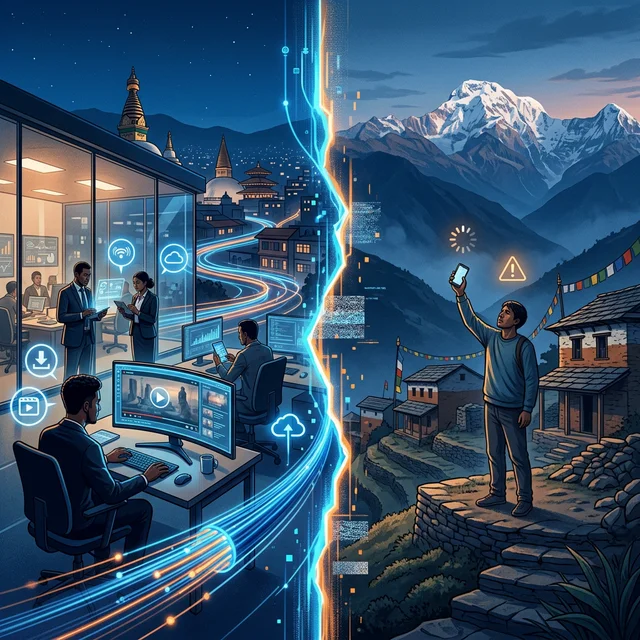
By early 2025, statistical data presented a deceptive picture of hyper-connectivity. Cellular mobile connections stood at 39.0 million, equating to 132% of the total population. However, this saturation does not imply universal internet literacy or access. The number of unique internet users was approximately 16.5 million, representing a penetration rate of 55.8%. This gap reveals a critical dynamic in political consumption: a significant portion of the electorate possesses the hardware (mobile phones) but lacks consistent, high-speed access to the open internet, relying instead on intermittent data packages or shared Wi-Fi.
This “data rationing” behavior influences content consumption significantly. Voters prioritize low-bandwidth, high-impact content. Text-heavy manifestos are ignored in favor of short-form video content that can be cached and shared offline via Bluetooth or SHAREit, particularly in rural belts where consistent broadband is absent. The phenomenon of multiple SIM ownership further complicates targeted messaging; a voter may have one Ncell SIM for data and one Nepal Telecom (NTC) SIM for voice, swapping them based on signal strength or promotional offers, making “database” campaigning via SMS highly inefficient and prone to error.
Table 1: Digital Adoption Metrics (January 2025)
| Metric | Figure | % of Population | Implication for Political Strategy |
|---|---|---|---|
| Mobile Connections | 39.0 Million | 132% | High fragmentation; SMS lists are unreliable due to multi-SIM ownership. |
| Internet Users | 16.5 Million | 55.8% | The “Digital Divide” is the primary fault line; 44% of voters are offline or use proxy access. |
| Social Media Users | 14.3 Million | 48.1% | Social media is the de facto internet for half the country; platform bans equal information blackouts. |
| Adult Social Media Reach | 14.3 Million (18+) | 72.8% | Digital campaigning is now mandatory for engaging the voting-age population. |
pie title Nepal Digital Divide 2026
  "Internet Users" : 55.8
  "Offline / Proxy Access" : 44.2
Data aggregated from DataReportal and NTA Reports.
The Urban-Rural Digital Divide as a Political Fault Line
The consumption of political content is geographically stratified, creating two distinct political realities within the same nation. While national internet penetration hovers around 56%, urban centers like the Kathmandu Valley boast penetration rates nearing 79.3%, whereas rural regions such as Karnali drop to as low as 13%. This is not merely a technological statistic; it is a determinant of political agency.
In urban centers like Kathmandu, Lalitpur, and Pokhara, voters consume political content as a steady stream of real-time information. They watch 4K live streams of parliamentary sessions, engage in Twitter Spaces debates, and participate in high-bandwidth Discord servers. Conversely, in the rural hinterlands of Karnali and Sudurpashchim, content is consumed in “bursts.” A villager might travel to a zone with cellular reception or Wi-Fi, download a batch of TikToks or YouTube videos, and then return to their village to consume them offline. This “burst” consumption means that rural narratives are often delayed and lack the real-time interactivity of urban discourse.
Table 2: Regional and Socioeconomic Connectivity Disparities
| Region/Group | Connectivity Rate | Dominant Consumption Mode | Political Consequence |
|---|---|---|---|
| Kathmandu Valley | 79.3% | Real-time, High Bandwidth (Live Video, Discord) | Rapid mobilization; reaction to events happens in minutes (e.g., Gen Z protests). |
| Bagmati Province | 60% | Continuous Connection | High exposure to national media and central party narratives. |
| Rural Average | 16% - 17.4% | Intermittent, Low Bandwidth (Cached Video, Radio) | Reliance on word-of-mouth amplified by viral clips; slower feedback loops. |
| Karnali Province | 13% | Information Scarcity | Susceptible to unchecked rumors; heavy reliance on local influencers (“Uncle Network”). |
| Dalit Community | 21% | Digital Exclusion | Systemic exclusion from digital civic spaces; voices often absent from online discourse. |
Data compiled from Nepal Living Standards Survey (NLSS) 2024 and NTA reports.
The implication of this divide is profound. A political scandal that erupts in Kathmandu on Monday morning might trigger immediate protests in New Baneshwor, but the narrative will not fully penetrate the rural consciousness of Rukum or Rolpa until days later, often distorted by the “telephone game” of offline sharing.
Bandwidth and the “Live Stream” Economy
The quality of internet connection further segments the electorate. While the median fixed internet download speed in Nepal was recorded at 70.94 Mbps in early 2025, this average masks the volatility of service. The Speedtest Intelligence report highlights that CGNET offers the fastest median download speeds at 97.27 Mbps, followed by Classic Tech and Vianet.
However, this high-speed infrastructure is concentrated in urban pockets. In peri-urban and rural areas, users rely on mobile data, where speeds are significantly lower and costs are higher. This dictates format. A 1080p live stream of a political speech is inaccessible to a voter in a remote village relying on a weak 4G signal. Successful political content in these areas must be optimized for low bandwidth: static images with text overlays, audio-only files (podcasts/radio rips), or highly compressed short videos (TikTok/Reels). The “Live Stream” economy is an urban luxury, while the “Cached Content” economy drives rural opinion.
Platform Dynamics: The Architecture of Dissent and Discourse
The events of September 2025 demonstrated that platforms in Nepal are not merely communication tools but political actors in their own right. Each platform serves a distinct demographic and psychographic function, and the government’s attempt to regulate them triggered a regime change.
Facebook: The “Town Square” and the “Uncle Network”
With 14.3 million users, Facebook remains the default operating system for the Nepali internet. It is the “utility” layer of the digital state.
-
The “Uncle Network”:
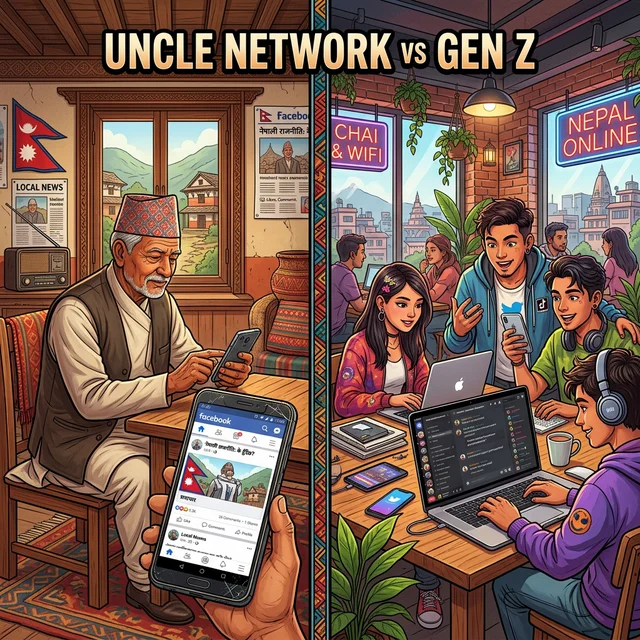
A specific and powerful phenomenon observed in Nepal is the “Uncle Network”—informal groups of older, male users (typically 45+) who dominate local community groups and Messenger chats. These men, often retired bureaucrats, teachers, or local business owners, serve as the gatekeepers of local information. They act as “digital elders,” curating news for their families and communities. However, they are also the primary vectors for misinformation. They tend to share links from sensationalist YouTube channels or “clickbait” news portals without verification, trusting the sender (a friend or relative) rather than the source.
-
Service Delivery Integration:
Unlike in Western markets where Facebook is purely social, in Nepal, it is an administrative necessity. Many citizens use Facebook credentials to log into government e-services. When the government banned Facebook in September 2025, they inadvertently locked citizens out of essential services, transforming a “censorship” issue into a “service delivery” crisis. This alienated the older, typically pro-establishment voter base who might otherwise have supported a ban on “unruly” youth platforms.
-
The Algorithm of Outrage:
Facebook’s algorithm in Nepal prioritizes high-engagement content, which often translates to polarizing political debates. The platform is the primary battleground for the established parties (Congress, UML, Maoists), whose cadres are most active here.
However, their engagement metrics are often inflated by party loyalists, creating an “echo chamber” that blinds them to the shifting sentiments of the broader, younger electorate.
TikTok: The Engine of Rural and Working-Class Politics
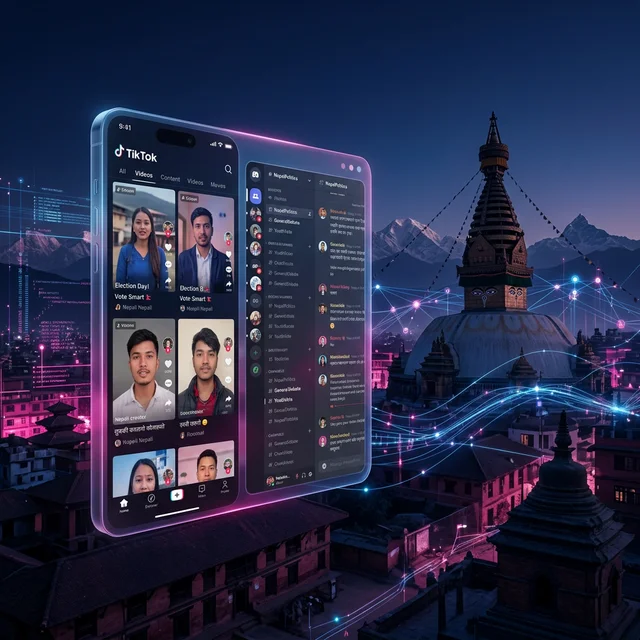
Despite regulatory turbulence, including a ban in 2023 and subsequent restrictions in 2025, TikTok remains the most potent political force in Nepal, particularly for the “invisible” electorate—migrant workers, rural youth, and non-literate populations.
Visual Literacy and the Language Barrier
TikTok bypasses the literacy barrier. For the Maithili-speaking Madhesi population or Tamang communities in the hills, a 15-second video explaining a grievance is infinitely more effective than a written op-ed in The Kathmandu Post. The algorithm’s ability to surface hyper-local content allows regional grievances—such as a broken bridge in a specific ward—to gain national traction rapidly.
The “Nepo Kid” Viral Loop
The #NepoKid and #NepoBaby hashtags, which mocked the children of established politicians for their lavish lifestyles, originated on Reddit but achieved mass scale on TikTok. The visual contrast between the political elite’s wealth (luxury cars, foreign degrees) and the average voter’s economic stagnation was tailor-made for TikTok’s “duet” and “stitch” features. Young users would stitch videos of politicians’ speeches with clips of their children partying abroad, creating a devastatingly effective visual critique of hypocrisy without uttering a single word.
Navigating Bans
When the government banned 26 platforms in September 2025, TikTok (which had registered and remained accessible) became the primary funnel for redirecting users to other, more secure channels like Discord. It served as the “top of the funnel” for the revolution, capturing attention and directing it toward organized dissent.
Discord: The Command Center of the Gen Z Uprising
The most unprecedented shift in 2025 was the migration of political organization to Discord. Traditionally a gamer’s chat platform, Discord became the “Parliament of Nepal” during the protests.
Leaderless Coordination
Discord allowed for a decentralized command structure. Unlike Facebook, which relies on public posts that can be monitored by the state, Discord’s server structure allowed for segmented, topic-specific discussions. Channels were created for logistics, medical aid, legal support, and strategy, allowing for a level of sophisticated organization that the police intelligence units could not penetrate or disrupt effectively.
The Interim PM Vote
In a historic digital event, over 100,000 users on a “Youths Against Corruption” Discord server voted to nominate Sushila Karki as the interim Prime Minister. This suggests a profound shift in voter psychology: the electorate now views digital consensus as a legitimate precursor to formal democratic processes. The “legitimacy” of the street was transferred to the server, creating a parallel power structure that the traditional parties could not ignore.
The “Parliament of Nepal” Server
The server grew to 145,000 members, effectively functioning as a shadow parliament. This digital assembly debated policies, vetted candidates, and coordinated real-world protests, proving that the youth electorate is not “apathetic” but rather “alienated” from traditional structures.
YouTube: The Alternative News Ecosystem
For many Nepalis, YouTube is the news. With mainstream media viewed as compromised by political partisanship or corporate interests, independent YouTubers have filled the void.
The “Youtubey Patrakar” (YouTuber Journalist)
These unregulated content creators often roam the streets with cameras, providing raw, unedited footage of protests or grievances. While they provide immediacy, they also contribute to the “infodemic” by prioritizing sensationalism over verification. Channels like “Trishuli Khabar TV” and “Nepali Khabar TV” have hundreds of thousands of subscribers and often broadcast unverified rumors—such as the PM fleeing by helicopter—which then become accepted facts on the street.
Search Engine Behavior
Voters do not “Google” political candidates; they “YouTube” them. The algorithm’s tendency to recommend controversial content means that polarizing figures like Balen Shah or Rabi Lamichhane dominate the feed. A search for a traditional leader often yields negative “expose” videos or dry news clips, whereas new-gen leaders have high-energy, edited montages. This algorithmic bias fundamentally alters the perception of “electability.”
The Content Paradigm: Language, Format, and Tone
The medium is the message, but in Nepal, the language and format are the mobilization. The 2025-2026 cycle has seen a rejection of the high-Nepali (Khas Kura) formal dialect typically used by the political elite in favor of vernacular and indigenous languages.
Linguistic Federalism in Digital Content
The political dominance of the Nepali language is being eroded by digital content in indigenous and regional languages. The internet has enabled a form of “Linguistic Federalism” that the constitution promised but failed to deliver.
Maithili and Bhojpuri Rap
Artists like DK Sagar have weaponized Maithili rap to articulate the frustrations of the Madhesh region. Songs like “Jan Chetna” (Public Awareness) blend Hindi, Nepali, and Maithili to criticize corruption, the dowry system, and the neglect of the Terai. This is not merely entertainment; it is political education for a demographic often ignored by Kathmandu-centric media. The lyrics resonate because they speak the “language of the home,” creating an emotional connection that a formal Nepali speech cannot achieve.
Tamang Selo as Protest
The Tamang community, historically marginalized despite their proximity to the Kathmandu Valley, utilizes Tamang Selo rhythms in digital content to assert identity. When a political message is wrapped in a cultural artifact like a Selo song, it travels through the “emotional” channels of the voter, bypassing their cynicism toward political speeches. The visual components of these music videos often depict the struggles of migrant labor or displacement, linking cultural identity directly to political grievance.
The Weaponization of Memes and Pop Culture
The “Gen Z” protests introduced a new visual vocabulary to Nepali politics, heavily influenced by global internet culture.
Global Symbols, Local Meaning
The use of the “Jolly Roger” flag from the anime One Piece by protesters symbolized a desire to “liberate the oppressed” from the “World Government” (the Oli administration). This usage indicates that the voting block consumes global pop culture and maps it onto local political realities. To an outsider, it looks like cosplay; to the Gen Z voter, it is a sophisticated political allegory about freedom and resistance.
Satire over Sermons
Traditional political campaigns rely on long, sermon-like speeches. The new voter consumes satire. Memes depicting the absurdity of the social media ban—such as people pretending to make phone calls on landlines outside burning buildings—went viral because they highlighted the government’s technological illiteracy. Humor effectively delegitimized the government’s authority more than any opposition speech could. The “Troll Nepal” and “Meme Nepal” pages acted as the unofficial propaganda wing of the movement, turning government decrees into punchlines within minutes.
Case Study: The 2025 Gen Z Uprising and the Failure of Control
The events of September 8-12, 2025, serve as the definitive case study for how political content consumption translates into kinetic action. It was a collision between an analog government and a digital citizenry.
The Trigger: The Disconnection of the Lifeline
The government’s decision to ban 26 social media platforms on September 4, 2025, was the catalyst. The ban was framed as a measure to control “hate speech” and “social disharmony” and to force platforms to register in Nepal. However, the government failed to account for the economic and social reality of these platforms.
The Remittance Lifeline
For the 7.5% of the population living abroad and their families back home, platforms like WhatsApp and Messenger are not “social media”; they are the primary communication link. The ban severed this link, panicking families who rely on these apps to coordinate remittances and check on loved ones.
Insight
The government treated social media as a “luxury” or a “nuisance,” failing to understand that it is the infrastructure of the remittance economy. By attacking the medium, they radicalized the economically dependent voter base—the families of migrant workers—who are usually politically quiescent.
The Escalation: From Online to Offline
The transition from digital complaints to physical riots was rapid. The “perfect storm” involved economic stagnation, corruption allegations (the “Nepo Kids” narrative), and the sudden silence of the digital space.
The “Streisand Effect”
The ban validated the accusations of authoritarianism. When the government attempted to block information, they inadvertently signaled that they had something to hide. This drove even apolitical users to download VPNs and access restricted content, thereby exposing them to more radical anti-government narratives that they might not have otherwise seen.
The “Discord” Migration
As Facebook and Instagram went dark for many, users flocked to Discord and Reddit, which were less effectively blocked or were accessed via VPNs. These platforms, being less regulated and more anonymous, allowed for more radical organization. The government’s attempt to control the narrative backfired by pushing the conversation into “dark social” channels where they had zero visibility or influence.
The Outcome: A Digital Coup
The resignation of Prime Minister K.P.
Sharma Oli and the appointment of Sushila Karki as Interim PM was driven by the “Street + Screen” pincer movement. The physical protests made the country ungovernable, while the digital consensus (via Discord and Reddit) delegitimized the ruling coalition’s authority. The burning of the Parliament building was the physical manifestation of the digital rage—a rejection of the “old hardware” of democracy in favor of a new, albeit chaotic, software.
Temporal Dynamics: The Rhythm of Nepali Politics
Understanding when voters consume content is as critical as understanding what they consume. The Nepali internet has a specific temporal rhythm dictated by lifestyle and infrastructure.
The “Office Hour” Myth vs. The Commute
Data suggests that peak social media interaction occurs between 9:00-11:00 AM and 7:00-9:00 PM.
- Implication: Political campaigns that post press releases during the “official” working hours (10 AM - 5 PM) often see lower engagement. The “golden hours” are during the commute (often on public transport where users scroll idly on mobile data) and post-dinner relaxation.
- The “Shadow Ban” Perception: Users who post during off-peak hours and receive low engagement often mistakenly believe they have been “shadow-banned” by the government or platforms. This fuels conspiracy theories about censorship, further eroding trust in institutions.
Seasonality and Ad Costs
Internet traffic patterns and ad costs are also dictated by the cultural calendar.
- The Dashain Spike: Ad traffic costs (CPC) spike during major festivals like Dashain and Tihar due to intense competition from e-commerce brands.
- Political Implications: Campaigns launching political ads during these festive windows face higher costs and fiercer competition for attention. They are often drowned out by retail advertising. Smart political operators effectively “go dark” on paid ads during Dashain and rely on organic, emotionally resonant content (e.g., greetings, cultural videos) that rides the festive algorithm without competing for ad slots.
Load Shedding Memory and Battery Anxiety
Although load shedding (power cuts) has largely been resolved, the psychology of battery preservation remains, especially in rural areas where electricity can still be erratic. Users engage in “power-saving” consumption habits—preferring text or downloaded video over live streaming during the day, and saving high-bandwidth consumption for when they are near a charging point in the evening. This reinforces the 7:00-9:00 PM peak.
Why Foreign Playbooks Fail in Nepal
International political consultants often attempt to apply strategies from India (the BJP’s “IT Cell” model) or the West (micro-targeting based on liberal/conservative divides) to Nepal. These consistently fail due to structural and cultural mismatches.
The Fallacy of the “IT Cell” Model
The Indian model, popularized by the BJP, relies on a highly centralized, hierarchical “IT Cell” that pushes a unified narrative through thousands of bots and paid workers. In Nepal, the digital landscape is federated and chaotic.
- Reasoning: The “Uncle Network” and Gen Z Discord servers operate independently and organically. A centralized narrative pushed by a party bot farm is quickly spotted and mocked by the cynical user base. The “leaderless” nature of the 2025 protests demonstrates that Nepali voters resist top-down messaging. The social fabric is too small and interconnected; “fake” profiles are easily identified because “everyone knows everyone” in the local context.
- Trust Dynamics: In India, the sheer scale allows for anonymity. In Nepal, trust is relational. Content spreads not because a bot shared it, but because a known entity (a cousin, a local shopkeeper) shared it. The “IT Cell” model fails to penetrate these trusted kinship networks.
The “Color Revolution” Misinterpretation
Narratives blaming the US (via the NED) or China for the protests failed to gain traction domestically, despite being a staple of foreign intelligence analysis.
- Reasoning: While geopolitical actors are undoubtedly present, the primary grievances of the Nepali voter are hyper-local: garbage collection in Kathmandu, road safety, the price of onions, and the cost of a passport. Foreign playbooks often focus on grand ideological narratives (Democracy vs. Communism, China vs. India) which resonate less with a voter concerned about “delivery.” When political parties tried to frame the 2025 protests as a “foreign plot,” they were ridiculed for being out of touch with the reality of the street.
Misunderstanding the “Floating Voter”
Traditional parties (NC, UML) operate on the assumption that voters are locked into vertical patronage networks—that families vote for a party because they always have. However, the rise of the Rastriya Swatantra Party (RSP) and Balen Shah proves that the urban floating voter is growing and decisive.
- Reasoning: This voter consumes content to validate their disappointment with the status quo, not to seek affirmation of party loyalty. Traditional campaigns that emphasize “history” and “revolutionary struggle” (referencing the 1990 or 2006 movements) fail because the median voter (under 30) has no memory of these events. They care about “digital rights,” “e-governance,” and “transparency”. The foreign playbook of “mobilizing the base” fails when the base itself is eroding.
Strategic Analysis of Political Actors
The digital battlefield has created clear winners and losers, defined by their ability to adapt to these new consumption habits.
Balen Shah & The New Alliance: The Algorithm Surfers
The alliance between Kathmandu Mayor Balen Shah and RSP leader Rabi Lamichhane represents the first “digitally native” political coalition.
- Strategy: Their content is character-driven, highly produced, and optimized for algorithmic sharing. They do not rely on party structures to distribute content; they rely on the virality of their persona. They understand the “Attention Economy” perfectly—posting controversial or decisive statements during peak hours, using high-contrast visuals, and engaging directly with comments to boost algorithmic reach.
- Foreign Policy as Content: Balen’s criticism of India’s role is not just foreign policy; it is content designed to tap into the nationalist sentiment of the online youth. It performs exceptionally well on TikTok and YouTube, distinguishing him from traditional leaders who are seen as subservient to foreign powers.
The Traditional Parties (NC, UML, Maoists): The Analog Giants
These parties faced a “complete failure” in the 2025 context, to the point of withdrawing from certain electoral contests.
- Failure Analysis: Their digital presence is essentially “digitized analog”—they post photos of speeches, PDF statements, and long videos of garland ceremonies. They fail to engage in the culture of the internet (memes, replies, live streams). Their withdrawal signals a realization that they have lost the ability to control the narrative in a digital-first environment. They are speaking to an audience that is no longer listening.
- Internal Discord: Even within these parties, there is a divide. Leaders like KP Oli attempted to enforce discipline via the “IT Cell” approach, but this was undermined by younger cadres who leaked internal dissent onto social media, fueling the “fragmentation” narrative.
Misinformation: The Shadow of the Digital Democracy
The “Uncle Network” and “Youtubey Patrakar” ecosystem create a fertile ground for misinformation, which has become a structural feature of Nepali politics.
The “Fake News” Cycle and the “Infodemic”
During the 2025 protests, the information ecosystem collapsed into an “infodemic.” Rumors of 32 dead students inside the Parliament and the Prime Minister fleeing by helicopter circulated unchecked.
- Verification Vacuum: The lack of trusted institutional media allowed these rumors to spark real-world violence (arson attacks on government buildings). Because the government was blocking social media, official clarifications could not reach the public, leaving the rumor mill as the only source of “news.”
- Trust Deficit: Because the government and mainstream media are deeply distrusted, “alternative facts” shared on WhatsApp or Discord are often given higher credibility than official statements. A blurry video on TikTok claiming to show police brutality is believed over a police press conference.
The “Deep Fake” Vulnerability
The rise of AI tools has introduced a new threat. AI-generated clips impersonating news anchors or politicians have begun to circulate.
- Vulnerability: The “Uncle Network” is particularly vulnerable to this. They lack the digital literacy to distinguish between a legitimate news clip and a deep fake, especially when it confirms their pre-existing biases. The 2026 election will likely see the weaponization of audio deep fakes (politicians “caught on tape” saying offensive things) circulated via private Messenger groups where fact-checking is impossible.
Conclusion
The way voters in Nepal consume political content has moved from a passive, reception-based model to an active, participatory, and often volatile engagement. The “Gen Z” uprising of 2025 was not an anomaly but the logical conclusion of a decade of digital penetration meeting analog governance.
For political actors, the lesson is clear: The electorate cannot be “broadcast” to; it must be engaged with. The winning formula for the 2026 elections will likely belong to those who can navigate the linguistic diversity of the Madhesh, the visual culture of TikTok, and the decentralized organization of Discord. They must understand that the Nepali voter is sophisticated, cynical, and digitally empowered, capable of organizing a revolution from a gaming chat room and delegitimizing a government with a meme.
The “Foreign Playbook” of centralized control and ideological binaries is obsolete; the new playbook is written in Maithili rap, Discord polls, and 15-second TikToks.
Deep Dive: The Mechanics of the “Uncle Network”
A critical, often overlooked aspect of the Nepali digital landscape is the “Uncle Network”—a colloquial term for the digital behavior of men aged 45+ who hold significant sway in local community decisions.
Composition and Behavior
- Demographics: Typically male, retired or semi-retired, often ex-bureaucrats, teachers, or returned migrant workers. They command respect in the tole (neighborhood) and local tea shops.
- Platform Preference: Exclusively Facebook and Facebook Messenger. They are less likely to use Instagram or TikTok for content creation, though they consume TikTok videos reshared to Facebook Reels.
- Content Diet: They consume long-form video interviews (often 1+ hours) on YouTube channels like “The Prakash Subedi Show” or “Tamasoma Jyotirgamaya,” but crucially, they access these via Facebook links. They value “authoritative” sounding voices and confrontational interview styles.
- The Trust Mechanism: Information shared by a “trusted peer” (another Uncle) in a Messenger group is granted higher validity than a report from a mainstream newspaper like Kantipur. This makes this network highly susceptible to “deep fakes” or manipulated context. The “Good Morning” image often comes attached with a political rumor, blending social pleasantries with propaganda.
The “Uncle” as a Micro-Influencer
In the 2025 crisis, the “Uncle Network” initially supported the government’s ban on social media, viewing it as a necessary step to curb “immorality” and “chaos” among the youth. However, when the ban disrupted their own ability to communicate with children studying abroad (in Australia, US, Japan), the sentiment flipped.
- Insight: The turning point of the anti-Oli protests wasn’t just the youth on the street; it was when the “Uncle Network” withdrew its tacit support for the government because the ban became a personal inconvenience. When the Uncles stopped defending the government in the tea shops, the government lost its last line of social defense.
The Geopolitics of Connectivity
Nepal’s internet infrastructure is not geopolitically neutral. It relies on bandwidth purchased from India (via Airtel/Tata) and China (via China Telecom), making the very pipes of the internet a subject of political discourse.
- The “Choke Point” Vulnerability: The 2025 ban highlighted that the government could technically throttle specific platforms because of the centralized nature of the international gateways. However, the proliferation of VPNs (Virtual Private Networks) rendered this ineffective. The youth taught the elders how to use VPNs, creating a cross-generational transfer of “subversive” technical skills.
-
Narrative Warfare:
- Pro-India Narratives: Often circulate in Hindi/Nepali mixed content, focusing on cultural and religious ties (Hindutva). These gain traction in the “Uncle Network” but are viewed with deep suspicion by the youth.
- Pro-China Narratives: Focus on infrastructure and “anti-imperialism” (anti-MCC/SPP). These appeal to the leftist student unions but struggle to find a broader audience due to the language barrier.
- Voter Skepticism: The average Nepali voter is hyper-aware of being a “yam between two boulders.” Consequently, content that feels too strongly aligned with either neighbor is often dismissed as “dalali” (brokering/sell-out behavior). Domestic nationalism—criticizing both neighbors—remains the highest-performing content vertical.
Future Outlook: The 2026 Election
As Nepal heads toward the 2026 elections, the content consumption habits suggest a few inevitable trends:
- The Death of the Rally: Large physical rallies will continue as a show of strength, but they will be “staged for the camera.” The primary audience is not the 10,000 people in the field, but the 1,000,000 people watching the drone shot on TikTok. Parties will invest more in drone operators than in busing in supporters.
- The Rise of the “Technocrat” Candidate: Candidates like Balen Shah appeal to the electorate not just because of their policy, but because they embody “digital competence.” Voters associate digital literacy with the ability to solve complex modern problems (waste management, traffic, pollution). An analog candidate who cannot operate a smartphone appears “unfit to govern” to a Gen Z voter.
- Algorithmic Polarization: As voters retreat into their specific platform bubbles (Discord for youth, Facebook for elders), reaching a “national consensus” will become increasingly difficult. The 2026 election may well be decided by which party can best bridge these fragmented realities—likely by running two completely separate campaigns: a “Respect and Stability” campaign for the Uncles on Facebook, and a “Change and Retribution” campaign for the youth on Discord.