Monetize Simple Android Apps: Ads for Passive Income
Strategic Monetization of Android Applications: Maximizing Advertising Revenue in Simple Utility and Gaming Ecosystems

The global mobile application economy is currently undergoing a massive and structural transformation. Analysts project that global in-app advertising spend will exceed the $390 billion to $400 billion threshold by the end of 2025. Within this vast digital ecosystem, the Android platform remains the undisputed global leader in terms of sheer volume and demographic reach. Bolstered by billions of daily active users who spend an average of nearly five hours per day engaged with their mobile devices, the Android operating system provides an unprecedented canvas for digital monetization. While high-budget, technologically complex applications dominate the top-grossing charts of the Google Play Store, a highly lucrative, parallel sub-economy exists exclusively for “simple” mobile applications. These encompass utility tools, niche content platforms, and casual offline games. By leveraging lean development cycles and sophisticated ad-driven monetization models, these simple applications can generate significant, recurring passive income for independent developers and small startup teams.
The financial success of a simple Android application relies not on groundbreaking technological innovation, but rather on the precise execution of specific application archetypes, the strategic integration of programmatic advertising networks, rigorous geographic targeting, and a thorough understanding of the bureaucratic infrastructures required for global payment processing. For developers operating in emerging markets—such as Nepal—navigating the complexities of local banking regulations, international tax compliance, and developer verification protocols is equally as important as the software code itself. This comprehensive report provides an exhaustive, granular analysis of the methodologies required to build, monetize, deploy, and scale simple Android applications in 2025 and 2026. The analysis places a specific focus on navigating the intricacies of advertising revenue, the financial infrastructure required for developers in restricted economic zones, and the algorithmic strategies necessary for zero-budget organic user acquisition.

High-Retention Application Archetypes for Advertising Monetization
The core foundational driver of advertising revenue is user retention. An application that experiences thousands of downloads but is uninstalled within twenty-four hours will fundamentally fail to generate meaningful ad impressions. Conversely, an application that integrates seamlessly into a user’s daily digital routine creates a continuous, highly predictable stream of monetization opportunities. Therefore, the initial architecture of the application must prioritize utility and habitual usage over fleeting entertainment.
Niche Utility and Content-Rich Tools
Utility applications represent one of the most stable and reliable archetypes for solo developers aiming to build passive income streams. Rather than attempting to construct comprehensive, bloated software suites, successful independent developers focus their efforts on hyper-specific, micro-use cases. Standard examples of these focused utilities include specialized financial calculators, professional habit trackers, localized weather alert systems, and specific industry tools. These tools benefit tremendously from high search intent; users actively seek them out in the Play Store to solve immediate, specific problems, leading to high conversion rates upon discovery.
Content-rich tools, such as productivity organizers, daily wellness trackers, and language learning companions, also provide incredibly fertile ground for recurring ad revenue. For instance, applications offering curated daily meditation tracks, specialized fitness routines, or personalized finance management inherently require the user to perform daily check-ins. This frequency of use directly correlates to higher daily ad impressions, exponentially increasing the lifetime value (LTV) of a single user.
Furthermore, the integration of artificial intelligence APIs has elevated simple utilities into highly personalized daily companions. In the 2025 market landscape, standard user expectations demand that applications present smarter, faster, and more intuitive experiences as the basic default package. Applications such as AI fitness coaches—which process daily biometric metrics like sleep quality, resting heart rate, and energy levels to generate customized daily workouts—have demonstrated exceptional retention rates. Similarly, voice-first shopping assistants that utilize emotional technology to gauge user mood and recommend specific products (e.g., suggesting relaxing loungewear when the user sounds stressed) are highly effective at maintaining daily user engagement.
Casual Gaming and Template Generators
Mobile gaming remains a massive, dominant advertising channel, accounting for roughly 30% of global in-app ad spend, a figure surpassing $100 billion in 2024 alone. While AAA mobile games require massive budgets, simple, offline strategy games or basic physics-based puzzle applications require relatively low overhead to develop but offer immense ad inventory. The gaming environment is uniquely suited for advertising because users are culturally conditioned to accept interruptions, rewards, and interface elements that would be deemed intrusive in standard productivity applications.
Template and generator applications—such as automated logo makers, resume builders, or graphic design templates—also perform exceptionally well in the current market. These applications provide immediate, tangible, and exportable value. Users are highly tolerant of viewing advertisements in exchange for a completed, professional resume or a downloadable business logo, making them ideal candidates for high-paying interstitial and rewarded ad placements. The transaction of time (watching an ad) for a concrete asset (a logo) is universally understood and accepted by the user base.
Case Studies in Geographic Localization
Localization acts as a powerful strategic moat against global, well-funded competition. Applications developed specifically for regional needs often achieve dominant market penetration with absolutely zero marketing spend. A prime example of this phenomenon can be observed in the Nepali app development ecosystem. Applications addressing the highly specific conversion between Bikram Sambat (BS) and Anno Domini (AD) dates for Nepali users have achieved significant organic success by solving a persistent local friction point.
Similarly, localized weather safety applications providing tailored alerts for severe regional conditions, or cultural countdown applications focused on major regional festivals like Dashain, guarantee a deeply engaged user base. While building a hyper-local application restricts the total addressable market and establishes a geographic ceiling on downloads, it virtually guarantees high retention and low user acquisition costs. This makes it an ideal strategy for a developer’s first portfolio project to establish a baseline of recurring revenue.
Development Frameworks: No-Code, Low-Code, and Cross-Platform Native Solutions
The technical barrier to entry for Android application development has been effectively eradicated by the rapid proliferation of advanced development frameworks. The strategic choice of framework dictates the speed of application deployment, the level of native device hardware control, the long-term maintainability of the codebase, and the ease of advertising SDK integration.
No-Code Ecosystems for Rapid Prototyping
No-code platforms abstract the entire traditional coding process behind highly visual, drag-and-drop interfaces. They are highly suitable for validating minimum viable products (MVPs), launching content-heavy applications, or testing market demand before committing to expensive native development cycles.
The capabilities of modern no-code builders vary significantly based on their intended target audience.
| Framework | Primary Strength and Use Case | Key Features for Developers | Source |
|---|---|---|---|
| Andromo | Rapid monetization and content delivery. | One-click Android builds; native support for AdMob and Facebook Audience Network interstitial/banner ads without manual SDK setup. | |
| Appy Pie | General purpose, AI-assisted app creation. | AI-powered generation, multiplatform publishing (iOS and Android), and simple drag-and-drop UI components. | |
| Glide | Internal tools and data-driven directories. | Instantly transforms Google Sheets or Excel databases into functional applications; ideal for rapid MVP testing. | |
| Adalo | Custom user interfaces and native logic. | Provides custom database support, component-level control, and generates native application packages for store deployment. | |
| Twinr | Website-to-App conversion. | Best suited for converting existing, responsive websites into native mobile applications with real-time syncing. |
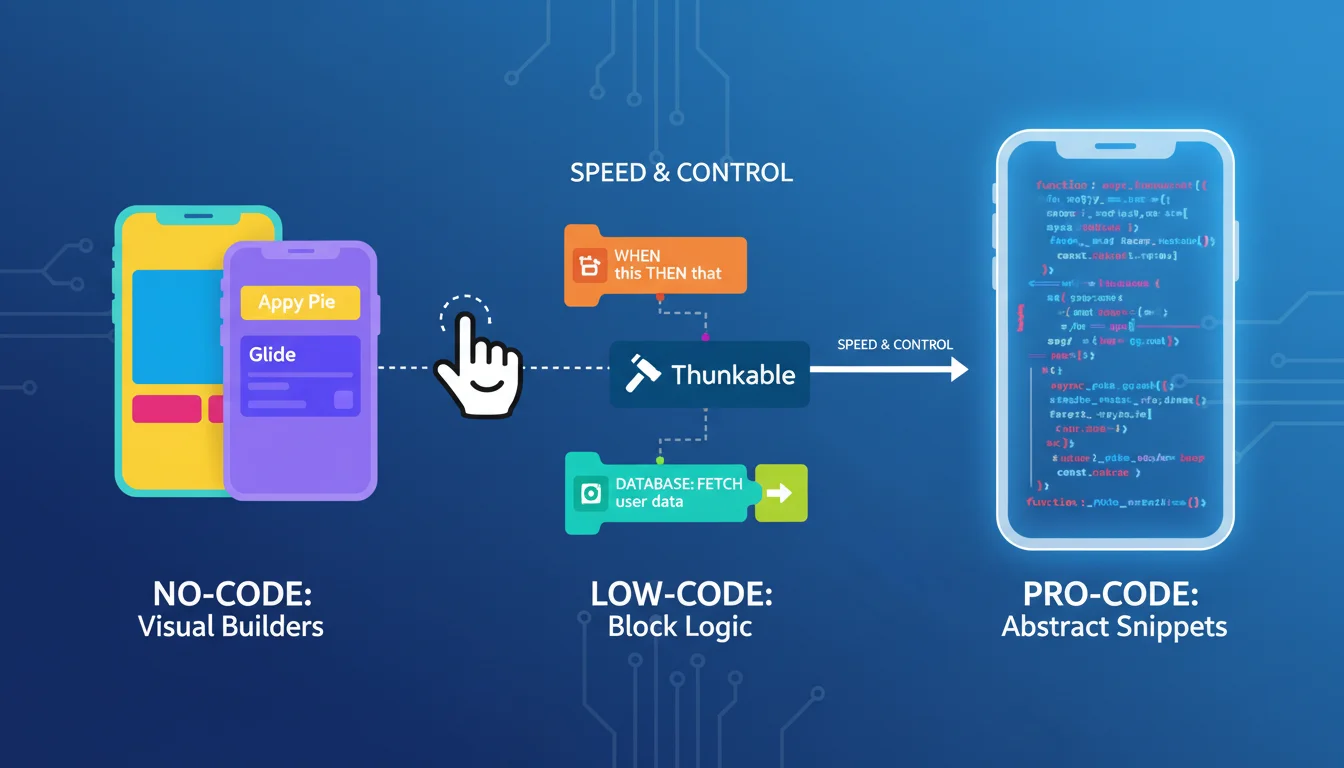
Low-Code and Visual Logic Development
Low-code platforms represent a bridge between pure visual design and programmatic control. They provide visual interfaces for UI construction while granting the developer access to underlying algorithmic logic, external APIs, and native hardware features.
Thunkable sits precisely in the sweet spot between no-code and low-code, providing deep visual control without masking the underlying power of the device. Instead of requiring manual syntax coding, Thunkable utilizes a logic block system (heavily inspired by MIT App Inventor) to handle complex app behaviors.
This allows the developer to access native hardware such as the device camera, GPS module, and microphone, while easily routing data to backend services like Firebase or custom REST APIs. Furthermore, Thunkable natively supports cross-platform compilation, meaning the logic constructed for the Android build can be deployed to iOS with minimal refactoring.
Advanced Cross-Platform Frameworks
For developers willing to write traditional syntax code, cross-platform frameworks—specifically Google’s Flutter—represent the absolute industry standard for independent development in 2025 and 2026. Flutter allows developers to write and maintain a single unified codebase (using the Dart programming language) and compile it natively for both Android and iOS operating systems.
The utilization of a cross-platform framework dramatically reduces the effort and time spent coding, cutting development cycles effectively in half. Flutter’s inherent modularity ensures easier long-term maintenance, allowing developers to update specific components or fix localized bugs without destabilizing the entire system architecture. Furthermore, modern frameworks include built-in performance optimization tools, seamlessly handling complex memory management and rendering speeds at 60 to 120 frames per second. For simple utilities, pairing Flutter with a Backend-as-a-Service (BaaS) provider like Firebase enables incredibly rapid scaling. Firebase handles real-time database synchronization, secure user authentication, and cloud storage, allowing the developer to focus purely on the client-side user experience rather than server maintenance.
Advertising Monetization Models and User Experience (UX)
Integrating advertisements into a mobile application requires maintaining a highly delicate, psychological equilibrium with the user base. Overloading an application with intrusive, unskippable advertisements may yield short-term revenue spikes, but it inevitably triggers mass user uninstalls, negative store reviews, and punitive algorithmic downgrades within the Google Play Store. Strategic monetization prioritizes the long-term user experience while carefully maximizing the yield of each session.
Ad Formats and Strategic Placement Architecture
Different application archetypes necessitate different advertising formats to maintain a cohesive and non-disruptive user experience. Implementing the wrong format in the wrong context actively destroys user retention.
| Ad Format | Operational Description | Optimal Placement Strategy | Expected Efficacy |
|---|---|---|---|
| Banner Ads | Rectangular ad units that occupy a fixed portion of the device layout, typically anchored adaptively to the top or bottom of the screen. | Continuous utility screens where the user spends extended time (e.g., calculators, to-do lists, reading panes). They must never obstruct interactive UI elements. | High impression volume, low user disruption, lower comparative payout. |
| Interstitial Ads | Full-screen interactive ads that completely cover the application interface. | Must be placed exclusively at natural transition points, such as between game levels, after completing a workout, or upon successfully saving a generated file. | High payout, moderate user disruption if frequency capped properly. |
| Rewarded Video | Opt-in video ads that users voluntarily choose to watch in direct exchange for a valuable in-app reward (e.g., virtual currency, premium content). | Highly effective in gamified environments, allowing users to unlock a specific feature for 24 hours, gain an extra life, or bypass a wait timer. | Highest payout, positive user sentiment due to the opt-in, transactional nature. |
| Native Ads | Highly customizable ads designed to match the visual look, feel, and typographical design of the app’s standard content. | Best utilized in social feeds, news aggregators, or endless scrolling lists (e.g., a recipe app) where the ad seamlessly mimics a standard content block. | High engagement, minimal disruption, feels organic to the interface. |
To prevent the psychological phenomenon of “ad blindness”—where users subconsciously ignore physical areas of the screen historically occupied by banner ads—developers must systematically and continuously test ad placements. Conducting A/B testing on variations in ad size, visual format, and specific display timing is critical to optimizing the click-through rate without harming retention. Furthermore, strict frequency capping is absolutely essential. Limiting the display of interstitial ads to natural “breaks” rather than strictly enforced time intervals prevents severe user frustration and abandonment.
The Hybrid Monetization Paradigm
Relying entirely on advertising revenue is increasingly viewed as a suboptimal and fragile business strategy. The most financially successful simple applications in the 2025 landscape employ hybrid monetization models, meticulously combining in-app advertising (IAA) with strategic in-app purchases (IAP) or recurring subscriptions.
A highly prevalent implementation of this strategy is the modernized “Freemium” model. The core, essential value of the application remains entirely free and ad-supported, which allows for exceptionally high install rates and low-friction user acquisition. Concurrently, the application offers an in-app purchase to permanently remove all advertisements, or a premium subscription tier to access advanced features like cross-device cloud syncing or AI generation limits.
Recent market data suggests that leaning into current consumer “anti-subscription sentiment” is highly profitable. Many users are deeply fatigued by recurring monthly charges and demonstrate a much higher willingness to pay a larger, upfront cost if they know it is a permanent, one-time deal. Therefore, offering a “buy once, own it forever” option to remove ads often converts at a significantly higher rate than a micro-subscription. Crucially, the programmatic layers of these monetization strategies must never conflict; if a user pays for premium access, the developer must ensure the advertising SDKs are completely suppressed and uninitialized to honor the transaction and maintain user trust.
Navigating the Mobile Ad Network Ecosystem and AdMob Mediation
Revenue generation in the mobile ecosystem is quantified primarily through the metric of eCPM (effective Cost Per Mille), which represents the estimated financial earnings generated for every 1,000 advertisement impressions served within the application. Understanding the algorithmic variables that manipulate eCPM is the most critical component of an independent developer’s financial strategy.
Dominant Advertising Networks in 2025/2026
While Google AdMob remains the absolute default choice for new Android developers due to its vast global inventory, seamless integration with Google Play, and general ease of use, maximizing revenue requires diversifying exposure across multiple competing networks.
| Ad Network | Core Strengths and Market Position | Considerations | Source |
|---|---|---|---|
| Google AdMob | Largest market player, powered by Google Ads. Offers the highest global fill rates and a vast array of ad formats. | Developers frequently cite strict, opaque policy enforcement, which can lead to sudden, unappealable account suspensions. | |
| Unity Ads | Highly optimized for gaming applications. Excellent at monetizing the 97% of players who never make in-app purchases through rewarded video. | Slower to reach immediate ROI compared to AdMob, but offers superior technical support for developers. | |
| Meta Audience Network | Provides highly targeted, personalized advertising utilizing Facebook’s deep demographic data graphs. | Requires users to have the Facebook app installed on their device for optimal cross-app tracking. | |
| AppLovin MAX | A dominant mobile monetization platform featuring over 100+ advertising integrations; highly aggressive in the gaming sector. | Exceptionally strong in driving high eCPMs for rewarded and interstitial gaming traffic. | |
| SmartyAds / InMobi | Full-stack programmatic ad networks providing advanced monetization solutions through real-time bidding algorithms and AI-driven optimization. | Excellent supplementary networks to increase auction pressure on the major players. |
The Implementation of Ad Mediation Architecture
Relying exclusively on a single network like AdMob represents an artificial performance ceiling. To achieve maximum financial yield, developers must utilize a technology known as Ad Mediation. Mediation allows a single application to send an ad request to multiple different ad networks simultaneously, forcing them to compete in a real-time programmatic auction for the right to display an ad in that specific slot.
The setup process for AdMob Mediation requires precise configuration:
- Create Ad Units: The developer first configures the baseline ad units (Banner, Interstitial) within the AdMob dashboard.
- Set Up Ad Sources: The developer registers accounts with third-party networks (e.g., Meta, Unity) and generates API credentials.
- Map Ad Units: This critical step involves linking the AdMob unit ID to the specific placement IDs generated by the third-party networks, allowing AdMob to communicate with external servers.
- Create Mediation Groups: The developer groups specific ad units and defines the auction parameters.

Configure Bidding and Waterfall: The developer adds “bidding ad sources” (which bid in real-time) or “custom events” (waterfall sources that are called in sequence based on a manual, historical eCPM input).
By strategically setting eCPM floors (the absolute minimum acceptable financial bid), developers can guarantee that premium ad placements are only filled by high-paying advertisers, significantly boosting overall revenue. Empirical market data indicates that publishers utilizing sophisticated, multi-network mediation strategies typically achieve 40% to 60% higher total revenue than developers relying on a single-platform approach.
5. Geographic Arbitrage and eCPM Dynamics
Geography is unequivocally the single most defining factor in eCPM performance and overall revenue generation. Programmatic advertisers bid for ad placements based heavily on the historical purchasing power, disposable income, and conversion likelihood of the target user demographic. Consequently, the global advertising market categorizes countries into specific economic tiers.
5.1 The Country Tier System in Advertising
The tier system dictates the foundational value of the ad inventory. A user viewing an ad in a high-income nation is exponentially more valuable to an advertiser than a user viewing the exact same ad in a developing nation.
| Economic Tier | Geographic Examples | Average Banner eCPM | Average Interstitial eCPM | Average Rewarded Video eCPM |
|---|---|---|---|---|
| Tier 1 | United States, United Kingdom, Canada, Australia, Western Europe | $0.50 - $1.50 | $5.00 - $8.00 | $15.00 - $30.00 |
| Tier 2 | Eastern Europe, select Middle Eastern nations, affluent Asian markets | Moderate | Moderate | Moderate |
| Tier 3 | India, Nepal, parts of Latin America, parts of Africa | $0.20 - $0.80 | $2.50 - $5.00 | $8.00 - $18.00 |
Furthermore, the category of the application itself heavily skews these numbers. Gaming applications consistently command eCPMs that are 20% to 30% higher than non-gaming categories, simply because the user interface paradigm of games inherently supports highly engaging, full-screen video formats.
5.2 The Strategy of Geographic Arbitrage
The stark disparity in tier-based eCPM dictates the entire marketing and development strategy for a profit-driven independent developer. An application that successfully commands a user base consisting of 80% Tier 1 traffic will generate roughly 300% more revenue than an identical application with 20% Tier 1 traffic. In the mobile ad economy, the location of the user is vastly more critical than raw download counts or app store ratings.
Therefore, a developer physically located in an emerging market (such as Nepal or India) must explicitly design, localize, and market their application for Western, Tier 1 audiences to achieve substantial financial returns. Building a niche, English-language tax calculator tailored for the United States market will out-earn a highly popular, localized utility app trending in South Asia by orders of magnitude, despite having a fraction of the total active users.
6. Overcoming Bureaucratic Infrastructure in Emerging Markets (Nepal Case Study)
Deploying a compiled application to the Google Play Store requires navigating a highly complex web of platform fees, international banking regulations, and strict identity verification protocols. For developers operating in emerging markets—using Nepal as a detailed primary case study due to its specific and restrictive regulatory environment—this financial infrastructure presents a massive barrier to entry. However, developers who successfully navigate these hurdles establish a significant competitive moat against local peers.
6.1 Securing the Google Play Developer Account
Creating a Google Play Developer account for an organization or an individual requires the payment of a one-time registration fee of $25 USD. While this fee is trivial for developers in Tier 1 nations, this requirement triggers strict foreign exchange controls in countries like Nepal, where the outward remittance of foreign currency is heavily regulated by the central bank.
To legally process this $25 international payment, Nepali developers must obtain a specialized financial instrument known as the “NRB Dollar Card” (a prepaid USD card explicitly authorized by the Nepal Rastra Bank for online international payments).
- Documentation and Prerequisites: Obtaining this card strictly requires the developer to possess a Permanent Account Number (PAN) issued by the local tax authority. The physical card often carries a secondary issuance or renewal fee (e.g., Rs 300 annually).
- The Strict Cap: The NRB Dollar Card carries a strict, legally enforced limit of $500 USD per year. This incredibly tight operational budget must cover the $25 console fee, any necessary cloud hosting infrastructure (e.g., Firebase, AWS), domain names, and essential developer tools. Developers must meticulously track their usage on Google Sheets to avoid hitting the cap mid-project, and consolidate SaaS subscriptions wherever possible.
- Banking Friction and Rejections: The banking ecosystem is fragmented. Certain commercial banks issue restricted “E-commerce cards” that suffer from compatibility issues with Google’s merchant systems, or feature hidden $100 per-transaction limits, leading to frequent payment rejections (most notably the OR_CCR_61 error indicating prepaid cards cannot be used). Developers have crowdsourced the most reliable institutions, noting significantly higher success rates using dollar cards issued by Nabil Bank, NMB Bank, or Global IME Bank.
6.2 Navigating Google Play Billing Service Fees
For developers utilizing in-app purchases or premium subscriptions as part of a hybrid monetization model, Google strictly mandates the use of Google Play Billing for all transactions involving digital goods.
- The Standard Fee Extraction: The default service fee extracted by Google is an aggressive 30% per transaction. This massive overhead severely impacts the profitability of small micro-transactions and limits the developer’s ability to aggressively discount their products.
- The 15% Reduction Tier: To alleviate pressure on smaller businesses, developers can proactively apply for a reduced 15% service fee tier, which applies to their first $1 million in annual revenue. Furthermore, for subscription-based apps, the service fee automatically drops to 15% after a specific user has maintained their subscription for twelve continuous months.
- Geographic Limitations on Alternatives: While intense regulatory pressure in the European Union and the United Kingdom (e.g., the Digital Markets Act) has forced Google to allow third-party Payment Service Providers (PSPs) like Noda to process transactions at slightly reduced fees, this option is entirely unavailable globally. Developers in Nepal and other emerging markets remain completely locked into Google’s proprietary fee structure, necessitating careful pricing strategies to absorb the 15% to 30% revenue loss.
7. AdMob Verification, Compliance, and Local Taxation
Once an application is successfully deployed and begins generating advertising revenue, the accumulated capital must be routed from Google’s international corporate accounts to the developer’s local bank account. This financial bridge is heavily guarded by strict anti-fraud protocols, identity verification checks, and international tax compliance mandates.
7.1 AdMob Identity and Address Verification (The PIN Process)
Google enforces strict, physical verification thresholds to combat ad fraud. When a developer’s AdMob account balance reaches the equivalent of $10 USD in initial earnings, Google automatically initiates the address verification protocol by dispatching a 6-digit Personal Identity Number (PIN) via standard international mail to the address listed on the account.
- The Postal Infrastructure Delay: The PIN mailer typically takes up to three weeks to arrive under optimal conditions. However, in regions with underdeveloped or unreliable postal infrastructure, the physical mailer frequently becomes lost in transit or fails to arrive entirely, leaving the developer in financial limbo.
- The 4-Month Suspension Deadline: The verification process operates on a strict countdown timer. Developers have exactly four months from the date the very first PIN is generated to receive it and enter it into the AdMob dashboard. If the address remains unverified after this 4-month window expires, Google completely suspends all ad serving to the application, reducing daily revenue to zero until compliance is achieved.
- The Manual Verification Fallback: To bypass failed postal deliveries, developers are permitted to request up to three replacement PINs, waiting a mandatory three weeks between each request. If all postal attempts fail, Google unlocks a manual, digital verification process.
This requires the developer to utilize systems like Persona to submit high-resolution, color images of a valid, non-expired government-issued photo ID, alongside a formal, official document bearing their exact residential address (such as a recent utility bill or bank statement). Crucially, the name and address details on these uploaded documents must perfectly and identically match the profile information entered in the AdMob payments center; minor discrepancies will trigger automatic rejection.
International Taxation and Withholding
As a multinational entity, Google is legally obligated to collect detailed tax information from all developers to comply with international tax treaties, most notably the United States Chapter 3 withholding rules. Developers must navigate to the “Manage tax info” section within the AdMob settings and submit the appropriate documentation—typically a W-8BEN form for individual developers residing outside the United States.
For developers operating in Nepal, this process requires inputting their local Permanent Account Number (PAN). Without a valid, verified PAN submitted to Google’s tax portal, the platform is legally mandated to apply a default maximum withholding tax rate (which can be up to 30%) on all earnings generated specifically from users located within the United States. Once full verification is achieved, earnings are disbursed via international wire transfer directly to the developer’s local bank account. This transfer is initiated automatically when the monthly balance exceeds the minimum payout threshold (usually $100 USD), with funds typically arriving between the 21st and 26th of the month.
Local Income Tax Obligations (The Nepal IRD Framework)
Upon receiving the international wire transfer, the developer immediately assumes local tax liabilities. In Nepal, foreign-earned income derived from digital services is subject to formal taxation administered by the Inland Revenue Department (IRD).
Individual developers acting as sole proprietors must file annual income returns. The Nepali tax system provides specific, structured deductions that developers can utilize to lower their taxable liability. These include deductions of up to Rs 40,000 for approved life insurance premiums, Rs 20,000 for health insurance premiums, and specific deductions for contributions to approved retirement funds (capped at 1/3 of total taxable income or Rs 500,000, whichever is lower). Crucially, the tax code features a “Foreign Tax Credit” provision; if a resident developer has already had tax withheld by Google in a foreign jurisdiction (e.g., the US), they can claim this amount as a credit against their local Nepali tax liability, effectively preventing double taxation on the same income. The actual payment of these local taxes has been modernized, allowing developers to generate a transaction voucher via the IRD digital portal and remit the required payments instantly using local digital payment gateways such as ConnectIPS, eSewa, or Khalti.
Algorithmic User Acquisition and App Store Optimization (ASO)
Architecting a flawlessly coded, highly monetized application is entirely futile without a sustained, compounding influx of new users. For independent developers operating without the backing of venture capital, paid user acquisition (running expensive Facebook or Google Ads to force downloads) is financially unviable. Success relies entirely on mastering algorithmic, organic growth strategies.
Mastering App Store Optimization (ASO)
App Store Optimization is the mobile ecosystem’s equivalent of Search Engine Optimization (SEO). It dictates exactly how highly an application ranks when a user inputs a query into the Google Play Store search bar. The Play Store algorithm aggressively prioritizes keyword relevance embedded within the app’s metadata, sustained daily download velocity, and the positive momentum of user ratings.
To compete effectively, independent developers must leverage data analytics platforms to identify high-volume, low-competition search terms, avoiding highly saturated keywords dominated by massive studios.
| ASO Platform | Core Free Capabilities for Developers | Strategic Application |
|---|---|---|
| Data.ai (App Annie) | High-level store statistics, ranking history, and detailed ratings tracking. | Broad market intelligence and tracking overall app performance across competitor portfolios. |
| AppTweak | Completely free keyword auto-suggestion tool. | Initial brainstorming of niche keyword phrases and expanding the application’s target keyword universe. |
| AppFollow | Keyword rank tracking and granular review monitoring. | Monitoring live user sentiment and tracking the daily rank fluctuations for specific, targeted search terms. |
| Google Trends | Spotting rising search queries and regional filtering based on macro-data. | Discovering trending concepts or viral phenomena before they become saturated in the Play Store environment. |
| Mobile Action | Tracks up to 5 keywords across stores with on-demand market intelligence. | Competitor analysis and receiving actionable, algorithmically recommended marketing steps. |
The ASO Execution Strategy: Developers must continually and iteratively refine their application’s Title, Short Description, and Long Description using the empirical insights gathered from these tools. The visual presentation is equally, if not more, critical. In the 2025 digital landscape, users scroll rapidly and possess minimal attention spans, demanding clean, high-contrast, text-heavy screenshots that immediately and forcefully communicate the application’s core value proposition. Furthermore, algorithmically prompting satisfied users for five-star reviews at strategic moments (e.g., immediately after a user successfully completes a difficult task or wins a level) generates the vital social proof required to boost organic algorithmic rankings.
Off-Store Organic Acquisition Tactics
Relying solely on the opaque Google Play Store algorithm is a high-risk strategy. To secure the first 1,000 active users—the critical mass required to train the app store algorithm, generate initial reviews, and gather baseline analytics—developers must execute aggressive hustle across external, off-store channels.
- Micro-Media and Niche Communities: Pitching the application to highly specific niche bloggers, specialized Substack newsletters, and micro-influencers on YouTube yields exceptionally high conversion rates because their audiences are deeply engaged and trust the curator.
- Directory Submissions: Launching the application on platforms like Product Hunt and submitting it to specialized software directories drives high-intent early adopters who are eager to test new tools. Developers have reported securing their first 500 to 1000 downloads within a single month purely through aggressive directory submission strategies.
- Authentic Social Engagement: Creating organic content on highly algorithmic platforms like Reddit or TikTok, focusing directly on the problem the app solves rather than utilizing polished, corporate marketing speak, has proven highly effective. For example, a solo developer who built a micro-learning app achieved their first 1,000 active users by studying viral “study app” formats on TikTok and authentically engaging with relevant subreddits. Documenting the raw solo-developer journey, or showcasing the application’s utility in a real-world scenario, builds a loyal audience that feels personally invested in the product’s success.
- Establishing a Web Presence: Maintaining a dedicated, professional landing page (built rapidly via no-code tools like Webflow, Framer, or Typedream) acts as a central trust hub. It captures web-based SEO traffic from Google search and funnels it directly to the Play Store, providing a critical layer of brand legitimacy that a simple link tree inherently lacks.
Data Privacy, Legal Compliance, and the Google Play Data Safety Form
As global privacy regulations (such as the GDPR in Europe and the CCPA in California) become increasingly stringent and heavily enforced, Google has structurally shifted the immense burden of legal compliance directly onto the shoulders of the individual developer. Failure to transparently, accurately, and legally declare data handling practices results in immediate application rejection, removal from the store, or in severe cases, the permanent banning of the developer account. In 2025 alone, Google prevented over 1.75 million policy-violating apps from being published, underlining the severity of their automated enforcement.
Generating and Hosting Privacy Policies
Every single application published on the Google Play Store must provide a valid, publicly accessible Privacy Policy URL, regardless of whether the developer explicitly believes they are collecting sensitive user data. Even seemingly benign, simple utility applications that solely display advertisements are strictly subject to this rule. This is because integrated ad networks (like AdMob, Meta, or Unity) inherently and automatically collect sensitive device IDs, IP addresses, location proxies, and application diagnostic data to serve targeted, high-eCPM ads.
Automated Free Generation: Independent developers rarely possess the capital to hire legal counsel for a simple utility app. Instead, they utilize free, lawyer-vetted generation tools such as Termly, FreePrivacyPolicy, or CookieYes. These tools utilize simple, automated questionnaires to dynamically generate legal documents that fully comply with GDPR, CCPA, and specific Google Play requirements.
Zero-Cost Hosting Infrastructure: Independent developers who do not maintain a dedicated corporate website can host their generated privacy policies at absolutely no cost using developer-centric platforms like GitHub Pages or Firebase Hosting.
9.2 Navigating the Google Play Data Safety Form
Introduced to provide end-users with transparent, easily readable insight into exact data collection practices, the Data Safety form is a mandatory prerequisite that must be filled out before any app can be published or updated.
Developers must meticulously audit their application’s codebase—and crucially, the documentation of all integrated third-party SDKs—to accurately declare the following parameters in the Play Console:
- Specific Data Types Collected: The developer must identify precisely if the app (or its ad networks) collects Location data, Personal Info, Financial Info, Device IDs, or App Activity metrics.
- Purpose of Data Collection: The developer must declare exactly why the data is collected. For an ad-supported app, this typically involves checking the boxes for “App Functionality,” “Analytics,” and crucially, “Advertising or Marketing”.
- Data Security and Encryption Practices: The developer must confirm whether the data is encrypted in transit (typically achieved automatically if APIs utilize HTTPS) and whether users have a dedicated, accessible mechanism to request the total deletion of their collected data.
For a simple utility app utilizing AdMob, the developer is forced to explicitly state that Device IDs and diagnostic data are collected specifically for the purpose of “Advertising or Marketing” and “Analytics”. Misrepresenting this information on the Data Safety form, even accidentally due to ignorance of how an integrated SDK operates under the hood, is treated as a severe policy violation by Google’s automated reviewers and can result in severe punitive action.
10. Conclusion
Earning substantial, reliable, and recurring revenue through the deployment of simple Android applications remains a highly viable and lucrative enterprise in the 2025 and 2026 digital landscape. However, success dictates that the independent developer treats the endeavor as a rigorous, data-driven business operation rather than a purely technical coding exercise.
The strategic path to profitability requires a multidisciplinary approach. Developers must intelligently select high-retention application archetypes—such as niche utilities or engaging casual games—that natively solve specific user problems and guarantee daily habitual engagement. Simultaneously, they must navigate the complex technical and bureaucratic hurdles of global financial infrastructure. For developers in emerging markets, this means securing the necessary restricted financial instruments (like the NRB Dollar Card) and local tax clearances to ensure the seamless, legal flow of capital from international programmatic ad networks directly into local bank accounts.
Crucially, the maximization of advertising revenue is achieved not through passive, singular reliance on default networks like AdMob, but through the aggressive implementation of Ad Mediation technology, actively forcing multiple networks to compete in real-time auctions for screen real estate. This technical setup, combined with a geographic arbitrage strategy that focuses algorithmic organic acquisition efforts strictly on high-eCPM Tier 1 nations, ensures that every single ad impression yields maximum financial value. Ultimately, by balancing aggressive monetization logic with a frictionless, high-quality user experience, and adhering strictly to rapidly evolving data privacy and ASO protocols, independent developers can successfully extract significant wealth from the multibillion-dollar mobile advertising ecosystem.