Agency Retainer Pricing Model: How to Package and Sell Marketing Retainers

The single most important transition for a digital marketing agency is moving from project work to retainer revenue.
Project income is unpredictable. You close a $3,000 website project, deliver it, invoice it, and then the revenue pipeline is zero until you close the next project. Your time is split between delivery and constant business development just to maintain cash flow.
Retainer revenue is different. A client paying $2,500/month commits to that revenue for 3, 6, or 12 months. You know your revenue in January. You plan your team in February. You invest in growth in March. The predictability changes how you operate.
This guide covers how to structure, price, and sell retainer agreements that clients want to sign and agencies want to deliver.
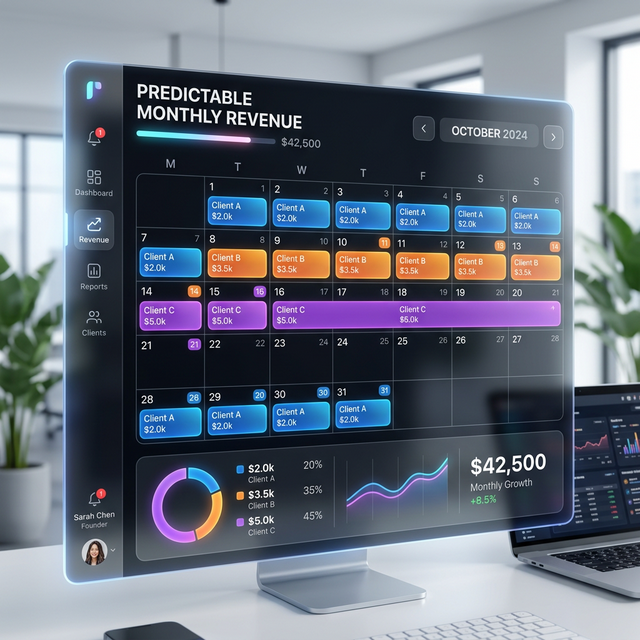
Table of Contents
- Why Retainers Win Over Projects
- The Three Types of Marketing Retainers
- How to Structure a Retainer Agreement
- Retainer Pricing: The Math Behind the Models
- How to Package Retainers for Different Client Types
- The Retainer Sales Conversation
- Contract Terms That Protect Both Parties
- How to Transition Existing Project Clients to Retainers
- Managing Multiple Retainers Without Burning Out
Why Retainers Win Over Projects
The business case for retainer-dominant agency revenue is straightforward:
Retainers create compounding relationships. A client who has worked with your agency for 12 months has shared context, built trust, and integrated your team into their operations. This is nearly impossible to replicate with a one-time project client.
Retainers fund team investment. When you know you will have $15,000/month in retainer revenue for the next 6 months, you can hire a contractor, invest in better tools, or expand your services with confidence. Project uncertainty prevents this kind of investment.
Retainers are more cost-efficient to operate. The cost of onboarding and context-building for each new client is significant. A retainer client spreads this fixed cost over 12+ months; a project client compresses it into a 4–8 week relationship.
Agency valuation is tied to recurring revenue. If you ever sell your agency or seek investment, monthly recurring revenue (MRR) is valued at 2–4x annual recurring revenue. Agency revenue from projects is valued at 0.5–1.5x. Retainers build asset value; projects generate income.
Monthly Recurring Revenue Target Example:
| Target MRR | Average Retainer | Clients Needed |
|---|---|---|
| $5,000 | $1,000 | 5 |
| $10,000 | $2,000 | 5 |
| $20,000 | $2,500 | 8 |
| $50,000 | $3,500 | ~14 |
| $100,000 | $5,000 | 20 |
The Three Types of Marketing Retainers
1. Service Delivery Retainer
The most common type. The agency delivers a defined set of marketing services each month for a fixed fee.
Examples:
- SEO retainer: keyword research, technical monitoring, 6 blog posts, 5 links per month
- Social media retainer: 20 posts per month, community management, monthly analytics
- Full-service retainer: SEO + content + social + email + reporting
Service delivery retainers are volume-based — the client pays for a specific output volume each month.
2. Access/Availability Retainer
Less common but valuable for senior consultants and strategists. The client pays a monthly fee for access to your expertise — as-needed consulting, strategy reviews, and advisory calls — rather than for a defined output volume.
An access retainer might be $2,000–$5,000/month for “up to 8 hours of consulting, strategy review, and access via email for rapid response.” These work between clients with internal marketing teams who need senior oversight without a full-time CMO hire.
3. Managed Account Retainer
Specific to paid advertising. The agency manages the client’s ad accounts entirely — account structure, campaigns, creative, optimization, reporting — for a fixed monthly fee or percentage of ad spend.
Managed account retainers are the most straightforward to sell because the value is directly tied to ad performance metrics (ROAS, CPL, CPA) that both parties can see in real time.
How to Structure a Retainer Agreement
A retainer that lacks structure creates confusion, scope creep, and churn. A well-structured retainer creates clarity, trust, and long-term relationships.
The Retainer Structure Framework
1. Monthly Deliverables
Be precise. “Content creation” is not a deliverable. “4 blog posts of 1,200–1,500 words each, SEO-optimized for agreed target keywords, delivered by the 25th of each month” is a deliverable.
Every item in the retainer should be:
- Countable or measurable
- Time-bound within the month
- Clearly within the agency’s control to deliver
2. Communication Protocol
Define:
- Weekly or bi-weekly status calls (duration, format, who attends)
- Monthly performance review (report delivered by what date)
- Response time for ad-hoc requests (24 hours? 48 hours? end of business day?)
- Communication channel (email only? Slack? project management tool?)
3. Reporting
Specify:
- Which metrics are tracked (organic traffic, rankings, leads, ROAS, engagement rate)
- Report format (template, dashboard, slide deck)
- Report delivery date (1st of each month for prior month performance)
- What benchmarks define success
4. Out-of-Scope Handling
Explicitly state:
- What is not included in the retainer (design work, website development, video production, additional platforms)
- How out-of-scope requests are handled (billed at $X/hour, or discussed and re-scoped)
- The process for adding services to the retainer
Retainer Pricing: The Math Behind the Models
The Cost-Plus Pricing Calculation
Start with your costs, add margin.
Example: SEO retainer for a B2B company
| Cost Item | Monthly Cost |
|---|---|
| Strategist time (10 hrs @ $70 cost/hr) | $700 |
| Writer time (8 hrs @ $40 cost/hr, or 4 posts @ $80 each) | $320 |
| SEO tools proportion (Ahrefs/Semrush allocation) | $50 |
| Link building (5 links at $25/link average cost) | $125 |
| Reporting time (2 hrs) | $140 |
| Total cost | $1,335 |
| 50% gross margin | $667 |
| Minimum retainer price | $2,000/month |
This calculation shows why retainers below $1,500/month for SEO delivery are margin-destructive at market rates for skilled labor.
The Market Rate Anchoring
Cost-plus gives you a floor. Market rates give you a ceiling.
If comparable agencies in your market charge $2,500–$4,000/month for similar SEO delivery, pricing at $2,000 is competitive without being below market. When you have strong case studies, move pricing to $2,500–$3,000.
The Value Anchor
Never quote a price without first establishing the value context.
If a B2B client generates $8,000 in lifetime contract value per customer, and your SEO retainer generates 2 additional clients per month, the value is $16,000/month. A $2,500/month retainer represents a 6.4x ROI — an easy sell.
How to Package Retainers for Different Client Types
For Local Service Businesses (HVAC, Plumbing, Real Estate)
These businesses need leads, not brand awareness. Package around lead generation metrics.
Local Lead Generation Retainer — $1,200/month
- Google Business Profile optimization and management
- 8 local SEO-focused blog posts/month
- Google Ads management (up to $1,500 ad spend)
- Monthly lead report (calls tracked, form fills, direction requests)
Local Full Marketing — $2,200/month
- Everything in Lead Generation
- Meta Ads management (up to $1,500 ad spend)
- Monthly email newsletter
- Social posting (4 times/week, Facebook + Instagram)
For SaaS / Tech Companies
These clients are data-driven and understand marketing metrics. Package around MQL/SQL generation.
SaaS Content Engine — $3,500/month
- 8 long-form SEO blog posts (1,500–2,500 words each)
- Keyword strategy and topical authority mapping
- Guest post outreach (5 pitches/month, 2–3 placed)
- Bi-weekly strategy call
- Monthly dashboard report (rankings, traffic, MQL attribution)
For E-commerce Brands
Performance marketing is paramount. Package around ROAS.
E-commerce Growth Retainer — $3,000/month + ad spend
- Google Shopping and Search Ads (full account management)
- Meta Ads (catalog ads, retargeting, lookalikes)
- Bi-weekly ad creative refresh
- Weekly performance report with spend breakdown
- CRO recommendations
For Professional Services (Law, Accounting, Consulting)
Brand and trust are critical. Package around visibility and lead quality.
Professional Services Visibility — $2,000/month
- 4 long-form blog posts (thought leadership)
- LinkedIn content calendar (3 posts/week for the firm’s page)
- Email newsletter (2/month to existing client and prospect list)
- Monthly report (traffic, engagement, lead form completions)
The Retainer Sales Conversation
The retainer sale fails when you present a proposal before understanding the client’s situation. The retainer sale succeeds when you diagnose the problem first, then position the retainer as the solution.
The Discovery Questions
Ask these before presenting any pricing:
- “What is your current monthly marketing budget, including any tools or ad spend?”
- “What marketing have you tried before, and what results did you get?”
- “What does a new customer look like for your business, and what is their average value?”
- “What marketing outcome would make this engagement feel like a clear success in 6 months?”
- “What is preventing you from hitting that outcome right now?”
The answers reveal budget parameters, risk tolerance, past disappointments, and success definitions — all of which shape how you frame your proposal.
The Retainer Pitch Framework
After discovery, present the retainer with this structure:
1. Mirror their problem. “Based on what you shared, the core issue is [X] — you are generating leads from referrals but have no predictable inbound pipeline.”
2. Explain why recurring effort is required. “Getting consistent inbound leads from SEO requires sustained content and technical effort over 6+ months. A one-time project will not create a sustainable channel.”
3. Present the retainer as the solution. “What I propose is a 6-month SEO and content engagement where we [specific deliverables]. Based on what I see in your market, I expect to have you ranking for [specific keywords] within 90 days and generating [X] additional leads per month by month 6.”
4. Present pricing with three options. Always present three tiers — entry, core, recommended — to anchor on value rather than cost.
5. Address the commitment objection directly. “I know 6 months feels like a commitment before you have seen results. That is why I structure the first 30 days as a foundation phase with a specific deliverable — [audit/strategy/campaign launch] — so you can evaluate our work before the full program is in motion.”
Contract Terms That Protect Both Parties
Every marketing retainer needs a written contract. Verbal agreements lead to billing disputes, scope confusion, and destroyed relationships.
Essential Contract Clauses
Scope of services — The exact monthly deliverables, deliverable timelines, and what is explicitly excluded.
Fees and payment terms — Monthly fee amount, invoice date, payment due date (typically Net 7 or Net 15), accepted payment methods, and late payment penalties (1–2% per month is standard).
Term and cancellation — Start date, minimum commitment (3 or 6 months), and cancellation notice requirements (typically 30 days written notice after the minimum term).
Ownership of work product — Who owns the content, ad accounts, website changes, and other deliverables? Standard: client owns all deliverables. Ad account access: client’s ad account; agency has access, not ownership.
Confidentiality — Both parties agree not to disclose the other’s confidential business information.
Performance disclaimer — The agency does not guarantee specific rankings, revenue, or lead volume. Marketing involves variables outside the agency’s control (search algorithm changes, client-side conversion factors, competitive market changes).
Dispute resolution — How disputes are managed (direct negotiation, then mediation, then arbitration).
Simple contracts can be created in Google Docs or using tools like HelloSign, PandaDoc, or HoneyBook — which also handle e-signature collection.
How to Transition Project Clients to Retainers
The easiest retainer to sell is to a project client who has seen your work.
At the end of a successful project engagement, present the retainer as the logical next step:
“We have completed the website content and the technical SEO foundation. The next step is building the ongoing content and authority that actually drives traffic — that is where the project work starts to compound. Would you want to continue this with a monthly content and SEO retainer? Based on what we have done so far, my recommendation is [Package] at $[price] per month.”
This works because:
- The client already trusts you (they have seen delivery quality)
- You have project context (faster onboarding onto retainer)
- You are presenting the retainer as the natural continuation of momentum you have already created
Success rate of this transition is typically 40–60% with satisfied project clients — far higher than cold retainer sales.
Managing Multiple Retainers Without Burning Out
Five retainers at $2,000/month is $10,000/month in predictable revenue. It is also five monthly deliverable cycles, five reporting obligations, five communication relationships, and five different sets of expectations to manage simultaneously.
Systematize Delivery
Create templates and workflows for recurring deliverables:
- Blog post brief template (SEO target, structure, sources)
- Monthly report template (pre-populated with dashboard metrics)
- Social content calendar template
- Client update email template
Systematized delivery means less cognitive load per client account. What takes 4 hours ad hoc takes 90 minutes with a system.
Use a Project Management Tool
Each client account needs a dedicated workspace in ClickUp, Asana, or Notion with:
- Monthly deliverable checklist (same checklist, refreshed monthly)
-
Delivery deadlines
- Communication log
- File storage for client assets and delivered work
Time Blocking for Delivery
Batch delivery for each client rather than context-switching. Monday = Client A content review. Tuesday = Client B reporting. Wednesday = Client C ad optimization. This reduces the cognitive cost of frequent client-switching.
Set Maximum Client Load
Know your sustainability limit. A solo agency owner or two-person team can sustainably manage 5–8 retainer clients before delivery quality degrades. Scale by hiring, not by overcommitting.