High-Yield Savings for Beginners in Nepal (2026)
The Macroeconomic Context of Nepalese Banking in Q1 2026
The banking sector in Nepal has undergone a profound structural transformation leading up to the first quarter of 2026, characterized by a complex interplay of high systemic liquidity, falling interest rates, and rapid digital acceleration. For individuals entering the formal financial ecosystem—particularly beginners seeking high-yield savings mechanisms—understanding this macro-financial landscape is the foundational prerequisite for optimizing risk-adjusted returns.
By February 2026, corresponding to the month of Falgun 2082 in the Nepalese calendar, the monetary environment is defined by a continuous downward adjustment in base rates across Class “A” commercial banks. The macroeconomic data reveals a sustained period of yield compression. For example, the base rate of Nepal Investment Mega Bank (NIMB) dropped from 5.19% in Mangsir 2082 to 5.16% in Poush 2082, and further declined to 5.00% by the end of Magh 2082. Similarly, the cost of funds across the sector has compressed significantly, reaching levels as low as 3.68%, with banking interest spreads hovering around 3.22%. This structural decline in the cost of funds is a direct consequence of excess liquidity within the banking system, driven primarily by robust remittance inflows and a relatively sluggish domestic credit expansion environment.
Consequently, the Nepal Rastra Bank (NRB)—the central regulatory and supervisory authority—has overseen an environment where commercial banks are aggressively revising their deposit rates downward to protect their net interest margins. In the review period leading up to mid-February 2026, out of the 20 operational commercial banks in the country, 12 maintained their individual fixed deposit rates unchanged from the previous month of Poush. These included Citizens Bank International, Himalayan Bank, Kumari Bank, Laxmi Sunrise Bank, Machhapuchchhre Bank, Nabil Bank, Nepal Bank, NIC Asia Bank, NMB Bank, Prabhu Bank, Rastriya Banijya Bank, and Sanima Bank. Conversely, 8 banks executed sharp reductions in their yields, with Global IME Bank recording the steepest reduction by lowering its rates on individual fixed deposits by a full 0.75 percentage points.
For a financial beginner, the overarching implication of this macroeconomic reality is that the era of effortlessly securing 7% to 9% yields on standard retail savings accounts has concluded. Yield optimization in 2026 requires a highly nuanced understanding of product segmentation, demographic targeting, and digital fee mitigation. High yields are no longer uniformly distributed across the retail banking spectrum; instead, they are selectively allocated to specialized demographic accounts, long-term locked fixed deposits, and strategically incentivized remittance channels.

Comparative Analysis of Standard Retail Savings Accounts
The baseline yield for standard retail savings accounts across Nepalese commercial banks has uniformly plateaued at a highly concentrated cluster around the 2.75% per annum mark. This convergence indicates a highly commoditized retail banking market where institutions, awash with deposit liquidity, lack the economic incentive to compete aggressively on price for standard, un-targeted retail deposits.
A systemic review of the standard savings rates effective from February 13, 2026, reveals near-identical pricing structures among the leading financial institutions. Nabil Bank, a leading private sector entity, offers a flat 2.75% yield across a wide swath of its portfolio, including its General Savings, Premium Nari Bachat, Corporate Staff, Jestha, Bal, and Karmashil accounts. Global IME Bank perfectly mirrors this pricing strategy, setting a 2.75% yield on its Global Normal Savings, Global Nari Bachat, Global Balbalika Bachat, Global Navaratna Salary, and Global Share Lagani accounts.
The state-affiliated entities exhibit similar pricing dynamics. Nepal Bank Limited (NBL) anchors its Normal Saving and NBL Shubha Gyan Bachat Khata at exactly 2.75%. In the broader private sector, Siddhartha Bank prices its Siddhartha Sajilo Bachat Khata and Siddhartha Peacekeeping Savings identically at 2.75%, and NIC Asia Bank applies this exact rate to its highly promoted Sarbashrestha Sunya Maujdat Bachat Khata and its broad category of “All other Savings Products”.
| Commercial Bank | Standard Saving Account Product | Minimum Balance Requirement | Annual Interest Rate |
|---|---|---|---|
| Nabil Bank | Nabil General Savings Account | Varies by branch | 2.75% |
| Global IME Bank | Global Normal Savings | Varies by branch | 2.75% |
| Nepal Bank Limited | Normal Saving | NPR 500.00 | 2.75% |
| NIC Asia Bank | Sarbashrestha Sunya Maujdat Bachat Khata | Zero | 2.75% |
| Siddhartha Bank | Siddhartha Sajilo Bachat Khata | Varies by branch | 2.75% |
| Nepal SBI Bank | Saral Bachat Khata | Zero | 2.75% |
| Prabhu Bank | Prabhu Salary / Special / Foreign Savings | Zero | 2.75% |
The severe homogenization of standard interest rates forces consumers to look beyond the headline yield and meticulously evaluate the structural utility and hidden costs of the accounts. For instance, while NIC Asia offers 2.75% on its Sarbashrestha Sunya Maujdat Bachat Khata, the account is structurally superior for a beginner because it mandates a zero minimum balance while providing a free debit card and free mobile banking services for the first year. Nepal SBI Bank’s Saral Bachat Khata similarly features a zero minimum balance requirement and waves fees for internet banking and cheque books, making it a highly accessible entry point for low-capital beginners.
graph TD
  A["Start: Seeking Standard Savings Account?"] --> B{"Are Bundled Fee Waivers Available?"};
  B -- Yes --> C["Choose Zero-Balance, Fee-Waived Account (e.g., NIC Asia Sarbashrestha)"];
  B -- No --> D["Compare Nominal Yield (2.75%) & Hidden Fees (Debit Card, Mobile Banking)"];
  C --> E["End: Optimal Standard Account"];
  D --> E;
Figure 1: Standard Savings Account Selection Flow
Demographic Segmentation and Targeted Yield Premiums
While the standard baseline rate is firmly anchored at 2.75%, commercial banks actively utilize fractional yield premiums to capture specific demographic segments. This strategy fosters financial inclusion while securing sticky, long-term deposits from populations less likely to move their capital for marginal gains. These targeted accounts offer a slightly elevated return profile, making them the first logical step-up for eligible beginners seeking to optimize their idle cash.
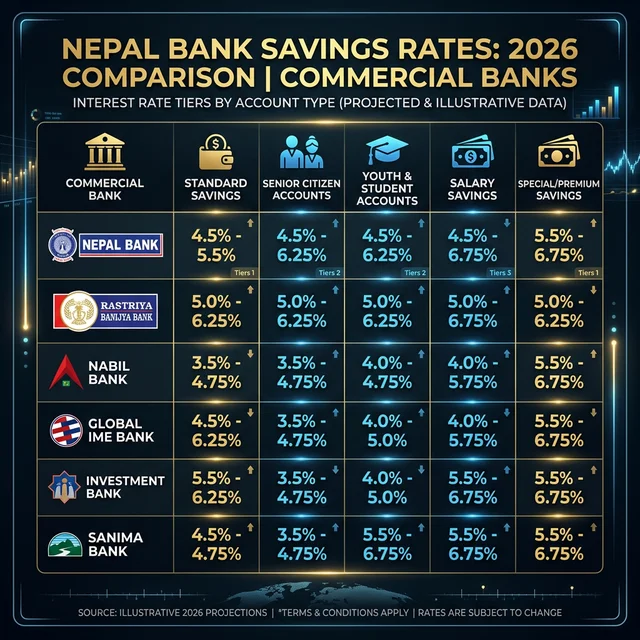
Nepal Bank Limited employs a highly tiered and granular segmentation strategy. While its base rate remains 2.75%, it offers a distinct premium tier of 2.95% on its NBL Diamond Saving, Women Special Saving, Yuva Bachat Khata, Investor’s Saving Account, and Senior Citizens Special Saving accounts. A further premium tier at 3.00% is reserved for specific utility and socially oriented accounts, including the NBL Staff Pension Saving, Earthquake Relief Saving, Nari Samman Bachat Khata, Sambandha Bachat Khata, and Green Saving Deposits. The absolute peak for standard domestic savings yields at NBL is reserved for the NBL Staff Salary Saving and NBL Ex-staff Saving accounts, which yield an impressive 3.75%.
Prabhu Bank breaks the industry consensus by offering higher baseline yields across a broader spectrum of its portfolio. Its Prabhu Visista Savings and Prabhu Shatabdi Savings accounts yield 3.00%, outperforming the standard offerings of the ‘Big Three’ (Nabil, Global IME, NIC Asia). The Shatabdi Savings, however, requires a substantial minimum balance of NPR 25,000, illustrating the tradeoff between yield and liquidity requirements. NIC Asia provides a modest premium through its Sathi Bachat Khata, offering 3.25%.
Laxmi Sunrise Bank demonstrates how institutions are competing beyond pure cash yields. It caters heavily to the youth demographic with its Sunaulo Bachat account, offering a 2.76% interest rate alongside heavily bundled insurance benefits. The account provides medical insurance of up to NPR 100,000 per year (allocated as NPR 20,000 for OPD facilities and NPR 80,000 for hospitalization) and Accidental Death or Disability Insurance of up to NPR 500,000 through its insurance partner, Himalayan Everest Insurance Ltd.. For a beginner or a guardian opening an account for a minor, these bundled protections represent a significant non-cash yield that a pure percentage fails to capture.
For a beginner entering the Nepalese banking system, the strategic takeaway is unambiguous: opening a generic “normal” savings account is an economically suboptimal decision. Depositors must actively align their demographic profile—whether they are a student, a woman, a senior citizen, or a specialized professional—with targeted accounts to capture the available 20 to 50 basis point premium and the associated bundled insurance benefits.
The Remittance Paradigm: The Ultimate Yield Enhancer and Equity Gateway
The most profound distortion in the Nepalese interest rate market is the massive premium assigned to remittance-backed capital. In a macroeconomic bid to shore up national foreign exchange reserves and disincentivize informal and illegal ‘Hundi’ transfer networks, the Nepal Rastra Bank has systemically engineered a high-yield environment exclusively for formal remittance inflows. For any beginner with income originating from abroad, whether through employment in the Middle East, East Asia, or Western nations, remittance accounts are unequivocally the most lucrative risk-free asset class available in Nepal.

Standard commercial bank savings accounts currently max out at around 3.00% to 3.25% for domestic capital, but remittance savings accounts consistently yield between 3.75% and 4.75%.
Nepal Bank Limited is the market leader in this segment, offering a highly attractive 4.75% on its Remittance Saving Account and NBL Remittance IPO Saving account. NIC Asia Bank provides 4.25% on its Sarbashrestha Remittance Bachat Khata. Prabhu Bank offers 4.00% on its Prabhu Foreign Unnati Savings and Prabhu Shramik Bachat Khata. Global IME Bank prices its Global Remit Savings Account at 3.75%.
| Commercial Bank | Remittance Savings Account Product | Annual Interest Rate |
|---|---|---|
| Nepal Bank Limited | Remittance Saving Account | 4.75% |
| NIC Asia Bank | Sarbashrestha Remittance Bachat Khata | 4.25% |
| Prabhu Bank | Prabhu Shramik / Foreign Unnati | 4.00% |
| Global IME Bank | Global Remit Savings Account | 3.75% |
The IPO Quota: A Transformative Wealth Generation Mechanism
Beyond the elevated cash yields, the most critical secondary benefit of utilizing a remittance account is the preferential access it grants to the Nepalese primary equity market. The Securities Board of Nepal (SEBON) mandates that 10% of every Initial Public Offering (IPO) is reserved exclusively for migrant workers. To qualify for this strictly ring-fenced allocation, individuals must have remitted a minimum of NPR 50,000 through formal, verifiable channels—such as City Express, IME, or direct SWIFT transfers—into a designated Remittance Saving Account within the trailing six months.
Given the historical oversubscription of Nepalese IPOs and the substantial listing gains often observed in the secondary market upon debut, this 10% quota acts as a massive equity-risk premium embedded within a risk-free savings account. A beginner relying on cash pick-ups or informal transfers entirely forfeits this financial history, locking themselves out of wealth-generation opportunities in the highly lucrative hydropower, microfinance, and telecom sectors.
graph TD
  A["Start: Income from Abroad"] --> B{"Use Formal Remittance Channel?"};
  B -- No --> C["Informal Transfers (Hundi): No IPO Access, Lower Yield"];
  B -- Yes --> D["Remit Minimum NPR 50,000 (within 6 months)"];
  D --> E[Open Designated Remittance Saving Account];
  E --> F["Access 10% IPO Quota & Higher Interest (3.75%-4.75%)"];
  F --> G["End: Enhanced Wealth Generation"];
  C --> G;
Figure 2: Remittance to IPO Wealth Generation Pathway
Furthermore, modern digital platforms allow remitters to transition from passive saving to active wealth accumulation. Through digital ecosystems, remitters can initiate Systematic Investment Plans (SIPs) into mutual funds with as little as NPR 1,000 per month. Therefore, transitioning from cash remittance to formal digital wallet or bank routing is not merely a matter of convenience; it is the foundational step in structured wealth building for the Nepalese diaspora, turning routine family support transfers into a verifiable financial investment footprint.
Structuring the Yield Curve: Fixed Deposits for Beginners
For beginners who have accumulated sufficient emergency liquidity and are capable of relinquishing immediate access to a portion of their capital, Fixed Deposits (FDs) offer the next tier of yield optimization. However, the FD landscape in early 2026 is uniquely challenging due to the pervasive downward trend in rates, leading to a flattening of the yield curve. Banks are actively discouraging short-term institutional hot money while cautiously rewarding long-term retail commitments.
Individual vs. Institutional Yields
The regulatory framework ensures that individual retail depositors receive preferential rates over institutional depositors. At Nepal Bank Limited, an Individual Fixed Deposit for a 6-month to 1-year tenor yields 3.00%, whereas an Institutional Fixed Deposit for the exact same tenor yields only 2.75%. Global IME Bank exhibits a similar spread, offering individuals 3.25% for 6 to 12 months, while institutions receive only 2.75% for 6 months up to 2 years. This spread is designed to protect retail savers and ensure that large corporate entities do not extract excessive risk-free returns from the banking system at the expense of productive lending.
Navigating Tenors and Remittance Bonuses
Nepal Bank Limited maintains the most competitive personal fixed deposit ladder among state-affiliated entities. For individual depositors with a minimum balance of NPR 25,000, NBL offers 3.00% for tenors of 3 months to 1 year, scaling up to 3.50% for 1 to 2 years, 3.85% for 2 to 5 years, and peaking at 5.10% for tenors exceeding 5 years. Crucially, NBL amplifies the remittance premium in its FD portfolio as well: a Remittance Fixed Deposit locked for 3 months to 1 year yields 4.00%, scaling to 4.85% for 2 to 5 years, and reaching an industry-leading 6.10% for tenors above 5 years.
Conversely, the private sector giants have adopted more conservative stances, reflecting their expectation of further rate cuts. Global IME Bank offers individual FDs starting at 3.00% for 3 to 6 months, scaling to 4.00% for 2 to 3 years, and peaking at 4.75% for tenors above 3 years, with a standard 1.00% bonus applied across the board for remitters. NIC Asia Bank’s standard FDs yield 2.75% for 3 months to 3 years, slightly increasing to 3.00% for 3 to 5 years, and maxing out at 5.00% for deposits held over 5 years. The broader industry reflects this constraint; banks like Standard Chartered, Agricultural Development Bank, Prime Commercial, Nepal SBI, Everest, and Siddhartha cap their maximum individual FD rates at 4.25%.
| Commercial Bank | 3 to 6 Months (Individual) | 1 to 2 Years (Individual) | Above 5 Years (Individual) | Maximum Remittance FD |
|---|---|---|---|---|
| Nepal Bank Limited | 3.00% | 3.50% | 5.10% | 6.10% |
| NIC Asia Bank | 2.75% | 2.75% | 5.00% | 4.25% (3 months) |
| Global IME Bank | 3.00% | 3.50% | 4.75% | 5.75% (3 yrs+) |
For a beginner, the analytical insight drawn from this yield curve data is twofold. First, the spread between a standard savings account (2.75%) and a short-term FD (2.75% to 3.00%) is virtually non-existent. Making short-term lockups economically irrational due to the loss of liquidity for a negligible 0 to 25 basis point gain. Second, locking in long-term rates (5+ years) at current levels (5.00% - 5.10%) is a speculative bet that the NRB’s monetary easing cycle will persist, driving future rates even lower. If the beginner anticipates a resurgence in inflation or a reversal in central bank policy within the next few years, maintaining liquidity in high-yield remittance savings or agile fintech wallets may prove superior to locking in at the bottom of the rate cycle.
The Cost of Banking: Analyzing Service Charges and Real Yield Erosion
A critical blind spot for financial beginners is calculating the gross yield of an account without deducting the recurrent administrative and operational fees levied by commercial banks. In a low-yield environment where basic savings accounts generate only 2.75% per annum, fixed service charges can completely erode nominal returns, resulting in a negative real yield for low-balance depositors.
Debit Card and ATM Operational Fees
The issuance, maintenance, and utilization of debit cards represent a standard fixed cost across the Nepalese banking sector. Nepal Bank Limited charges an initial fee of NPR 500 for the issuance of an instant debit card, followed by an annual renewal fee of NPR 300. In the event of loss or damage, the replacement of a card costs NPR 400 for a current account or NPR 200 for a savings account. Furthermore, domestic ATM withdrawal charges through NBL cards involve a 1.00% to 1.50% domestic transaction fee for POS usage, escalating sharply to 3.00% for international card transactions.
NIC Asia Bank commands a higher premium for its card services. The annual debit card issuance fee is NPR 550, though users can opt for a bundled 5-year payment of NPR 2,500 to secure a slight discount. The penalty for card replacement jumps significantly to NPR 1,500, and PIN replacement costs NPR 250. While cash withdrawals are free at NIC Asia’s proprietary terminals, utilizing other domestic ATMs costs NPR 15 per transaction, and cross-border withdrawals in India cost NPR 250 per transaction.
Nabil Bank maintains an equally aggressive fee schedule, charging NPR 500 for card reissuance and enforcing a massive NPR 1,000 fee for forced PIN activation. Cross-border fees at Nabil are standardized at 1% of the transaction amount.
Mobile Banking, Digital Access, and Administrative Penalties
Digital access is rarely complimentary after the promotional first year. NBL charges NPR 300 for annual mobile banking registration and renewal, alongside NPR 50 for PIN resets. Nabil Bank integrates its mobile banking (nBank) and internet banking (nBank Web) for free, but exclusively if the customer maintains a substantial lien balance of NPR 10,000, tying up capital that could otherwise be deployed productively.
Administrative penalties also pose a risk. At NBL, a cheque returned due to insufficient balance incurs a steep NPR 250 penalty for savings accounts and NPR 500 for current accounts. Record retrieval for attested copies of statements beyond 6 months costs between NPR 500 and NPR 1,000 per transaction. Even cash withdrawals through pay slips, bypassing cheque books, cost NPR 250.
The Mathematics of Real Yield
To conceptualize the impact of these fees: A beginner depositing a modest NPR 20,000 into a standard savings account at a 2.75% yield generates exactly NPR 550 in gross annual interest. If this customer utilizes an NBL account, paying NPR 300 for an annual debit card renewal and NPR 300 for annual mobile banking renewal, the total fixed cost (NPR 600) exceeds the interest generated. The effective real yield is negative. The depositor is literally paying the bank to hold their money.
Therefore, beginners must actively seek bundled products to mitigate these operational drags.
NIC Asia’s Sarbashrestha Bundled Sahaj Bachat Khata, for example, offers a comprehensive five-year waiver on debit card fees, mobile banking, internet banking, DEMAT account charges, MERO share charges, and locker rentals. For a beginner with limited initial capital, minimizing operational drag through bundled fee waivers is mathematically far more impactful on portfolio growth than endlessly chasing a marginal 0.25% yield increase across different institutions.
The Fintech Paradigm: Digital Wallets, Interoperability, and Open Banking
Recognizing the limitations, rigidities, and costs of traditional banking, the Nepalese financial sector is undergoing a massive paradigm shift. This evolution is being heavily fueled by systemic upgrades, including a recently approved $50 million digital transformation project funded by the World Bank, aimed at bolstering secure government-wide data exchange, digital lockers, and interoperable platforms.
For the modern financial beginner in 2026, reliance on legacy bank accounts is rapidly being supplemented, and in some micro-transactional cases replaced, by robust Payment Service Providers (PSPs) and digital wallets. The domestic landscape, long dominated by pioneers like eSewa, is now heavily contested by agile innovators.
The Evolution of Digital Wallets: eSewa vs. Khalti
eSewa maintains its position as the market leader with the largest user base in Nepal, operating heavily on transactional utility encompassing utility bills, mobile top-ups, merchant payments, and government disbursements. eSewa has recently integrated two-factor authentication, biometric verification, and expanded its integration with major banks for seamless fund transfers. However, eSewa remains fundamentally a transactional conduit, charging transaction fees ranging from 1.5% to 2.5%, and notably lacks an aggressively high-yielding core balance product, making it less attractive as a primary savings vehicle.
The most disruptive event in the 2026 fintech landscape is the strategic merger of Khalti and IME Pay. This consolidation birthed a “Super Wallet” architecture that fundamentally challenges the value proposition of traditional commercial banks. The most revolutionary feature of the newly merged platform is the provision of a 3% interest rate on wallet balances for users maintaining at least NPR 1,000. By offering 3% on highly liquid, easily accessible digital funds, Khalti mathematically outperforms the 2.75% standard retail savings rates offered by banking titans like Nabil, Global IME, and NBL.
Furthermore, Khalti introduced “Smart Deposit,” Nepal’s first wallet-based recurring deposit system in partnership with Manjushree Finance, allowing users to automate savings with contributions starting as low as NPR 100. Paired with the integration of IME Pay’s legacy architecture—which allows for zero transfer fees for amounts under NPR 10,000—this ecosystem effectively eliminates the financial barriers to entry for micro-savers while delivering superior liquidity, lower friction, and higher baseline yields than Class ‘A’ banks.
Interoperability: connectIPS and the Fonepay Network
The connective tissue of the Nepalese digital economy is the connectIPS framework and the ubiquitous Fonepay network. Fonepay has established absolute dominance in QR-based merchant acquisitions across the nation, functioning as an interoperability network that allows users of almost all bank mobile apps and major wallets to transact seamlessly. Fonepay charges minimal merchant fees (0.5% - 1.5%) and bypasses the need for users to maintain separate, fragmented wallet balances.
For moving high-yield savings across different banks to capitalize on changing interest rates or arbitrage opportunities, connectIPS provides the essential infrastructure. The transaction limits structured by Nepal Clearing House Ltd. (NCHL) allow individual users to transfer up to NPR 2,000,000 per transaction via online channels and NPR 200,000 via mobile channels. The daily cap matches those single transaction limits across a maximum of 100 transactions per day. The fee structures are highly favorable to the consumer; internal transfers or payments to Federal, Provincial, and Local Government entities are largely free, while external transfers incur negligible flat fees (e.g., NPR 100 for specific remittance agent transfers or a minor percentage for inter-valley transfers).
Mobile Banking Application Utility
The user experience of accessing these features is heavily dependent on the banks’ proprietary mobile applications. Applications like Global Smart Plus (Global IME) and nBank (Nabil) focus heavily on omnichannel integration, allowing single sign-on access across web and mobile platforms to manage everything from fixed deposits to government LokSewa payments and capital market (Mero Share) transactions. Upgraded apps like HIMB Plus (Himalayan Bank) incorporate biometric security, gallery-based QR image reading, and rapid bill payment arrays.
However, independent academic research and user feedback across the sector indicate that platform stability remains an ongoing challenge. A 2026 study analyzing electronic banking in Nepal revealed that while ATMs and debit cards exert a significant positive effect on customer satisfaction due to reliability, internet and mobile banking often fall short due to inadequate digital infrastructure and frequent connectivity issues. User reviews frequently cite transaction timeouts, failed payments, and UI/UX friction in apps like NBL Mobile Banking. Consequently, a prudent beginner should utilize robust bank apps primarily for high-value fund management and capital preservation, while leveraging specialized wallets like Khalti or eSewa for low-friction, high-frequency daily micro-transactions.
Foreign Currency (FCY) Accounts: Hedging Currency Risk
For individuals with verifiable foreign income sources—including expatriates, freelancers, consultants, and Non-Resident Nepalis (NRNs)—holding wealth entirely in Nepalese Rupees (NPR) exposes their portfolio to underlying sovereign currency depreciation and macroeconomic inflation. The NRB, while maintaining strict capital controls, permits the establishment of Foreign Currency (FCY) savings accounts under stringent regulatory frameworks, serving as a dual-purpose vehicle for modest yield generation and essential currency hedging.
FCY accounts generally offer lower nominal yields compared to NPR accounts, reflecting the lower inflationary environment and differing central bank policies of the underlying reserve currencies, but they inherently protect domestic purchasing power.
Nabil Bank offers 1.50% on GBP savings, 0.25% on EUR, and a nominal 0.10% on JPY and AUD accounts. For those willing to lock FCY in a fixed deposit, Nabil yields 3.25% for 3 to 6 months in USD, dropping inversely to 2.75% for tenors above 12 months—a classic inverted yield curve indicating anticipated Federal Reserve rate cuts in the United States. Nepal Bank Limited provides a slightly higher yield curve, offering 3.00% on USD savings, 1.00% on EUR, 1.50% on GBP, and 0.50% on JPY. Furthermore, NBL offers a USD Fixed Deposit rate of 3.50% for minimum balances of USD 500.
Global IME Bank maintains highly competitive FCY pricing, offering 2.25% on USD savings, 2.50% on GBP and AUD savings, and 1.50% on EUR and CAD savings. Furthermore, Global IME’s specialized NRN FCY Fixed Deposits (for tenors of 1 year and above) yield up to 3.75% for USD and 4.00% for GBP and AUD, provided the depositor meets the minimum balance threshold of USD 1,000 or its equivalent.
Opening these accounts requires rigorous documentation, including a valid passport, proof of foreign income, travel documents, or an NRN ID card issued by the Government of Nepal or the NRN Association, alongside verification of migration. While banks like Machhapuchchhre, Nepal Investment Mega Bank (NIMB), and Laxmi Sunrise mandate a minimal opening balance equivalent to 10 to 100 USD/GBP/AUD, the administrative friction is highly justified for beginners seeking to build a globally diversified, inflation-resistant financial base without violating national capital control laws.
International High-Yield Alternatives: Legalities and Jurisdictional Constraints
As financial literacy increases, Nepalese citizens often explore international high-yield platforms in search of sovereign diversification and higher interest rates driven by global central banks. However, access is tightly constrained by the regulatory perimeter established by the Nepal Rastra Bank.
International financial giants like Barclays and Standard Bank offer highly attractive offshore structures. Barclays provides International Reserve Accounts in GBP and USD, and Treasury Deposits offering fixed yields from three months up to five years. Standard Bank offers Offshore Reserve savings with bi-annual interest payments. However, these tier-one international options feature prohibitive barriers to entry for beginners, with Barclays requiring a staggering minimum balance of £100,000 (or currency equivalent) just to establish an account.
Retail fintech platforms present a different challenge regarding jurisdictional legality. Wise (formerly TransferWise) operates globally, offering multi-currency accounts, but it explicitly limits the ability to hold Nepalese Rupees (NPR) directly as a primary account balance. Furthermore, opening a functional international account on platforms like Wise or Charles Schwab requires strict compliance with complex jurisdictional regulations. Charles Schwab explicitly warns that its brokerage and banking services (offered via Charles Schwab Bank, SSB) are subject to U.S.
state laws and may not be registered, legal, or accessible in all foreign jurisdictions.
Under the NRB’s strict capital control regime, Nepalese residents are broadly prohibited from transferring domestic wealth abroad to fund offshore accounts without explicit regulatory approval, and the repatriation of assets is heavily monitored. Therefore, for a resident beginner, establishing a genuine international high-yield savings account is legally and practically unfeasible. The only legitimate pathway to accessing foreign yields is through the aforementioned domestic Foreign Currency (FCY) accounts (if eligible via foreign income) or through NRB-approved non-resident (NRN) frameworks.
Evaluating Institutional Risk: Safety of Principal in Nepalese Banking
While yield optimization is a primary goal, a beginner must rigorously assess counterparty risk before depositing capital. The Nepalese banking sector features multiple tiers, ranging from highly regulated Class ‘A’ Commercial Banks to Class ‘D’ Microfinance institutions (Laghubitta). Understanding the financial health metrics of these institutions is critical, as a higher yield often correlates with higher systemic risk.
Commercial Bank Health Metrics: EPS, NPL, and Capitalization
The resilience of a commercial bank is measured by its capital adequacy, non-performing loans (NPLs), and profitability metrics like Earnings Per Share (EPS). A comparison between two industry titans—Nabil Bank and Global IME Bank—highlights differing risk profiles beneath the surface of their identical 2.75% retail yields.
In terms of sheer scale and footprint, Global IME Bank leads the sector with a Total Capital Fund of Rs. 68,182 million compared to Nabil Bank’s Rs. 64,000 million. However, Nabil demonstrates superior operational efficiency, profitability, and asset quality. Nabil Bank boasts an impressive EPS of Rs. 35.04, drastically outperforming Global IME’s Rs. 17.06. Furthermore, Nabil maintains a significantly tighter grip on credit quality, reporting bad loans (NPLs) at 4.25%, compared to Global IME’s higher NPL ratio of 4.91%. The net worth per share further reflects this divergence: Nabil stands at Rs. 218.27, while Global IME sits at Rs. 168.30.
NIC Asia presents a volatile middle ground. While aggressive in its retail expansion and product offerings, its recent EPS was reported at Rs. 26.58, representing a sharp decline from a previous high of Rs. 59.62. Its net worth per share remains robust at Rs. 202.05.
For a depositor, high NPL ratios suggest underlying vulnerabilities in the bank’s loan book, often exacerbated by macroeconomic stress, real estate illiquidity, or industrial slowdowns. While the NRB heavily regulates Class ‘A’ banks to ensure systemic stability, beginners who prioritize absolute safety over fractional yields should gravitate toward institutions demonstrating lower NPLs, higher EPS, and a history of prudent risk management, such as Nabil Bank or Standard Chartered (which frequently sacrifices high yields to maintain pristine asset quality).
The Microfinance (Laghubitta) Conundrum
Microfinance institutions (MFIs) were initially structured on the Grameen model to provide essential financial access to underserved rural demographics, allowing the mobilization of micro-deposits and the provision of uncollateralized credit. Historically, these Class ‘D’ institutions have offered interest rates significantly higher than Class ‘A’ commercial banks—sometimes offering 8% yields on mobile banking deposits—to attract necessary liquidity.
However, the microfinance sector in Nepal faces severe structural headwinds and crises of confidence in 2026. The industry grapples with unhealthy market competition, multi-banking (where borrowers take loans from multiple MFIs simultaneously), high leverage among vulnerable borrowing demographics, political unawareness, and severe threats to financial discipline. As a result, the default rates and NPLs in MFIs possess a significantly higher tail risk compared to the heavily capitalized commercial banks.
For a financial beginner primarily seeking a “safe” high-yield savings account to park an emergency fund, venturing into the MFI space introduces a severe mismatch in risk tolerance. The pursuit of an 8% MFI yield carries uncompensated liquidity and institutional risk that is entirely inappropriate for foundational savings. Capital preservation must supersede aggressive yield chasing when the underlying institution lacks the capital buffers of a Class ‘A’ bank.
Strategic Synthesis and Actionable Frameworks
Navigating the high-yield savings landscape in Nepal during the first quarter of 2026 requires moving far beyond the illusion of a single “best” bank account. In a macro-environment characterized by a high liquidity surplus, declining base rates, and aggressively converging standard yields, the optimal strategy for a beginner is to construct a hybridized financial foundation. This approach must prioritize structural fee benefits, targeted demographic premiums, and digital agility.
The comprehensive analysis of the banking and fintech data suggests the following strategic framework for a beginner in 2026:
- 1. Exploit the Fintech Premium for Daily Liquidity: The severe convergence of standard commercial bank savings rates at 2.75% renders them economically inefficient for holding small, highly liquid balances. Beginners should aggressively utilize integrated digital wallets like Khalti. By offering an unprecedented 3% yield on wallet balances combined with the micro-saving utility of “Smart Deposits,” Khalti provides a superior risk-to-return ratio for daily operational capital. It completely bypasses the burdensome annual service charges associated with legacy bank accounts while maintaining instant liquidity.
- 2. Mitigate Yield Erosion through Comprehensive Bundling: For capital that must reside in a traditional commercial bank, the primary adversary of the beginner is the fee structure. A 2.75% yield is entirely nullified by NPR 500 debit card issuance fees and NPR 300 mobile banking renewal charges. Depositors must actively seek out zero-balance, fully bundled accounts. Products like NIC Asia’s Sarbashrestha Sunya Maujdat or the Sarbashrestha Bundled Sahaj Bachat Khata, which guarantee zero minimum balances and waive card, mobile banking, DEMAT, and internet banking fees for extended periods (up to five years), mathematically outperform accounts with higher nominal yields but aggressive fee schedules.
- 3. Capitalize on Demographic Arbitrage: Beginners should never settle for generic “normal” accounts. By leveraging age, gender, or professional status, individuals can secure targeted accounts like NBL’s Yuva Bachat or Laxmi Sunrise’s Sunaulo Bachat. These accounts capture a 20 to 50 basis point premium over standard rates and, more importantly, secure unquantifiable value through bundled medical and accidental insurance policies that protect the depositor against unforeseen health expenditures.
- 4. Maximize the Remittance Quota for Equity Exposure: The single greatest wealth-generation mechanism for a beginner in 2026 is the formalized remittance channel. Earning 3.75% to 4.75% on cash savings is highly attractive, but the true underlying value lies in meeting the NPR 50,000 threshold within six months to unlock the SEBON-mandated 10% IPO quota. This regulatory mechanism transforms a basic savings account into a gateway for high-upside equity investments, serving as the ultimate high-yield strategy that bridges the gap between passive saving and active wealth accumulation.
- 5. Exercise Extreme Caution on Fixed Term Lockups: With maximum individual fixed deposit rates currently peaking at 5.00% to 5.10% (excluding specific remittance bonuses) and macroeconomic base rates actively trending downward, locking capital into long-term structures is a bet on continued disinflation. Beginners should absolutely avoid the 3-to-6-month FD trap, which offers nominal premiums (3.00%) over basic savings but entirely destroys liquidity. If capital can be locked away, it should be deployed in 2-to-5-year tenors to capture the 3.85% to 4.75% brackets, utilizing highly capitalized, low-NPL institutions like Nabil Bank to guarantee the absolute safety of the principal against systemic shocks.
In conclusion, achieving high yields in Nepal’s 2026 financial ecosystem is an exercise in structural efficiency rather than simple rate chasing. By expertly blending the 3% fluidity of advanced digital wallets, the fee-mitigation of bundled commercial accounts, the demographic premiums of targeted products, and the unparalleled equity upside of remittance channels, a beginner can successfully navigate the complexities of a declining interest rate environment and establish a robust, mathematically sound trajectory for long-term wealth accumulation.
Related Resources
- Digital Marketing Strategy Template for Nepali Businesses
- Google Ads Cost in Nepal: Complete Breakdown
- Facebook Ads vs TikTok Ads for Local Businesses
- Content Marketing Services in Nepal
Need Strategic Support?
If you want help turning these insights into an actionable growth plan, contact Arjan KC for consulting, campaign strategy, and team training.
Related Posts and Resources
- Digital Marketing in Nepal (Complete Guide)
- Google Ads in Nepal: Practical Strategy
- SEO Analytics for Nepali Businesses
- eCommerce Analytics Setup in Nepal
- eCommerce Metrics That Matter
- Email Marketing Guide for Nepal
- Email Marketing ROI in Nepal
- Facebook Ads Budget Guide (Nepal)
- Cultural PPC Strategy for Nepal
- Competitor Analysis Framework for Nepal