Global Offshore Injury Law Guide: Claims & Jurisdictions
Offshore Oil Rig and Maritime Injury Claims: A Global Legal Guide

The maritime and offshore energy sectors represent a vital, interconnected nexus of global commerce, driving the extraction of hydrocarbons, the deployment of marine infrastructure, and the movement of international trade. Concurrently, the operational environments characterizing these industries—ranging from ultra-deepwater semi-submersibles in the Gulf of Mexico to severe weather drilling in the North Sea—are inherently perilous. When catastrophic incidents, equipment failures, or routine operational hazards result in severe injury, occupational disease, or loss of life, the ensuing legal battles are governed by an intricate, often fragmented web of domestic statutes, international conventions, and ancient maritime common law.
Determining liability and calculating compensation in offshore injury claims is rarely a straightforward exercise in terrestrial tort law. The legal framework applicable to a specific incident is contingent upon a triad of jurisdictional triggers: the geographical location of the incident, the specific occupational classification of the injured worker, and the legal status of the offshore structure as either a “vessel” or a “fixed platform.” This report provides an exhaustive, comparative analysis of the legal architecture governing maritime and offshore injury claims worldwide, synthesizing the interplay between historical common law doctrines, modern domestic legislation across key maritime jurisdictions, and the evolving strategies of marine insurers in the face of cross-border litigation.
Historical Foundations and Evolutionary Jurisprudence
The legal protections afforded to seafarers and offshore workers are deeply rooted in historical maritime codes, which recognized the unique isolation, inherent dangers, and vital economic importance of seafaring. Modern offshore injury law is largely an evolutionary product of these ancient doctrines, adapted over centuries to accommodate the industrialization of the maritime sector.
The Ancient Origins of Maritime Obligations
Shipping was one of the earliest channels of international commerce, and the rules for resolving maritime disputes were developed in antiquity. Traces of the seaworthiness concept can be found as early as the Rhodian Sea Law, which governed the Mediterranean circa 900 BC. While not a strict legal warranty at the time, merchants were morally and practically obligated to ensure ships were watertight and adequately crewed.
The formalization of seafarer protections emerged during the Middle Ages. The doctrine of “maintenance and cure” is rooted in Article VI of the Rolls of Oléron, promulgated around 1160 AD. Subsequently, Article 35 of the Laws of the Hanseatic League (governing trade from the 14th to 17th centuries) stipulated that if a seaman was wounded defending the ship, they “shall be healed and cured at the general charge,” and if disabled, “maintained as long as he lives.” These medieval codes established the philosophical foundation that a shipowner’s duty to an injured crew member arises from the employment relationship itself, entirely independent of fault or negligence.
Historically, maritime law was largely judge-made. Admiralty courts viewed seamen as “emphatically the wards of the admiralty,” requiring judicial protection against the superior skill and shrewdness of shipmasters and owners. This protective, paternalistic approach shaped the development of the three fundamental causes of action that dominate modern maritime personal injury litigation: maintenance and cure, the doctrine of unseaworthiness, and statutory negligence.
The Triad of Maritime Personal Injury Protections
In jurisdictions that heavily rely on common law traditions, particularly the United States, an injured maritime worker will typically assert three distinct but overlapping causes of action against an employer or vessel owner. These claims function independently but are frequently bundled in personal injury litigation to maximize the avenues for recovery.

Maintenance, Cure, and Unearned Wages
The ancient obligation of maintenance and cure remains a vibrant and heavily litigated doctrine. It imposes an absolute, non-delegable, and no-fault obligation upon a shipowner to provide for a seaman who becomes ill or is injured while in the service of the vessel.
“Maintenance” refers to a daily living stipend designed to replace the room and board the seafarer would have received aboard the vessel. Historically, this rate has been heavily contested. While actual living expenses have risen significantly, courts and collective bargaining agreements have often suppressed maintenance rates to modest sums, sometimes as low as $20 to $30 per day, prompting ongoing legal debates over whether the rate should reflect the actual costs incurred by the seaman.
“Cure” encompasses the obligation to pay for all reasonable and necessary medical treatments, hospital visits, surgeries, diagnostic tests (such as MRIs and CT scans), physical therapy, and required medical equipment. Crucially, the obligation to provide cure continues until the injured worker reaches Maximum Medical Improvement—the medical determination by a qualified physician that the condition has stabilized and further treatment will not yield any functional improvement. Additionally, the worker is entitled to unearned wages for the remainder of the contracted voyage or until they are fit for duty.
The absolute nature of this duty means that maintenance and cure cannot be waived by contract, nor is it defeated by the injured worker’s contributory negligence. Preexisting conditions do not bar a claim; if shipboard work aggravated a preexisting medical condition, the seaman remains eligible for benefits, provided there was no material misrepresentation on a pre-employment medical questionnaire.
If a shipowner willfully, wantonly, or maliciously denies, delays, or improperly terminates these benefits, they expose themselves to severe legal consequences. The United States Supreme Court, in cases such as Vaughan v. Atkinson and Atlantic Sounding Co. v. Townsend, has affirmed that injured seamen may recover attorney’s fees and punitive damages for an employer’s bad-faith refusal to pay maintenance and cure.
The Doctrine of Unseaworthiness
Distinct from the contractual obligation of maintenance and cure, the doctrine of unseaworthiness imposes a strict liability standard upon vessel owners. Under this doctrine, a vessel owner owes an absolute, non-delegable duty to provide a vessel, including its hull, decks, appurtenances, and equipment, that is reasonably fit for its intended purpose.
The modern interpretation of unseaworthiness for personal injury was solidified by the U.S. Supreme Court in the 1903 landmark case The Osceola. In this decision, the Court articulated four propositions, notably cementing that the vessel and her owner are liable to an indemnity for injuries received by seamen in consequence of the unseaworthiness of the ship or a failure to supply and keep in order proper appliances.
Crucially, an unseaworthiness claim does not require the injured party to prove that the vessel owner was negligent, lacked ordinary care, or had prior notice of the defect. The mere existence of an unfit condition that proximately causes an injury is sufficient to establish liability. The scope of “unseaworthiness” has expanded over decades of jurisprudence to encompass not only mechanical failures—such as worn-out rigging, lack of non-skid surfaces, missing rubber feet on a ladder, or defective winches—but also systemic and operational deficiencies. An inadequate number of crew members, a crew lacking proper training, a crew member with a violent disposition, or a vessel lacking appropriate personal protective equipment all render a vessel unseaworthy as a matter of law.
The intersection of unseaworthiness and negligence was heavily debated during the mid-20th century, particularly regarding “operational negligence”—instances where a seaworthy piece of equipment is used negligently by a fellow crew member, causing simultaneous injury. The Supreme Court ultimately resolved this in Usner v. Luckenbach Overseas Corp., determining that an isolated, personal negligent act by a fellow worker does not instantly render a vessel unseaworthy, delineating the boundary between a condition of the ship and an act of a person.
A critical restriction on the unseaworthiness doctrine was recently established regarding available remedies. In Dutra Group v. Batterton, the U.S. Supreme Court resolved a circuit split by holding that sailors injured due to unseaworthy conditions may not seek punitive damages from vessel owners. The Court reasoned that allowing punitive damages for unseaworthiness would disrupt the uniformity of maritime law by permitting recoveries not authorized by overlapping statutory negligence frameworks (such as the Jones Act).
Statutory Negligence and the Jones Act
While general maritime law provides strict liability remedies, statutory frameworks govern fault-based negligence claims. In the United States, the Merchant Marine Act of 1920, universally known as the Jones Act (46 U.S.C. § 30104), provides the exclusive remedy for seamen to sue their employers for negligence.
Prior to the Jones Act, seamen were barred from recovering damages for the negligence of a master or fellow crew member under the “fellow servant” rule. The Jones Act fundamentally altered this by extending the protections of the Federal Employers’ Liability Act (FELA) to maritime workers, allowing an injured seaman to hold the employer vicariously liable for the negligence of any co-worker or superior.
The standard of proof for causation in a Jones Act negligence claim is exceptionally favorable to the plaintiff, often described as a “featherweight” burden.
The injured worker need only prove that the employer’s negligence played “any part, however slight,” in causing the injury. This stands in sharp contrast to the stricter proximate cause standard required in unseaworthiness claims or standard terrestrial tort litigation. Negligence under the Jones Act can include failing to clean a spill, forcing workers to maintain dangerous schedules leading to fatigue, or failing to replace worn-out equipment.
Unlike unseaworthiness (which applies to the vessel owner), a Jones Act claim is brought strictly against the employer, who may or may not be the owner of the vessel. Furthermore, comparative negligence applies to mitigate damages but does not bar recovery. Under 45 U.S.C. § 53, if a jury determines an injured seaman was 50% at fault for their own injury, their total compensatory award is simply reduced by that percentage.
Jurisdictional Triggers: Worker Classification and Asset Ontology
The applicability of these powerful maritime doctrines relies entirely on the occupational classification of the injured worker and the structural ontology of the maritime asset upon which the injury occurred.
The Threshold of the “Seaman”
A foundational threshold in offshore injury litigation is determining whether the injured party qualifies as a “seaman.” The definition is not strictly tied to a job title (e.g., roughneck, roustabout, driller) but rather to the worker’s connection to a vessel in navigation.
To qualify for Jones Act protections, a worker must contribute to the function or mission of a vessel and have a connection to the vessel (or an identifiable fleet of vessels under common ownership) that is substantial in both duration and nature. In practical terms, courts often apply a “30 percent rule,” requiring the worker to spend at least 30 percent of their working time aboard a navigable vessel.
Workers who do not meet this threshold—such as stevedores, longshoremen, harbor workers, shipbuilders, and offshore personnel permanently stationed on fixed structures—are generally excluded from seaman status. Instead, they are protected by specialized, administrative workers’ compensation frameworks, such as the Longshore and Harbor Workers’ Compensation Act (LHWCA). The LHWCA is a no-fault system that provides defined compensation for medical care and temporary wage replacement, but it explicitly bars the worker from suing their employer for non-economic damages such as pain and suffering, though third-party negligence claims remain permissible.
The Legal Status of Offshore Structures
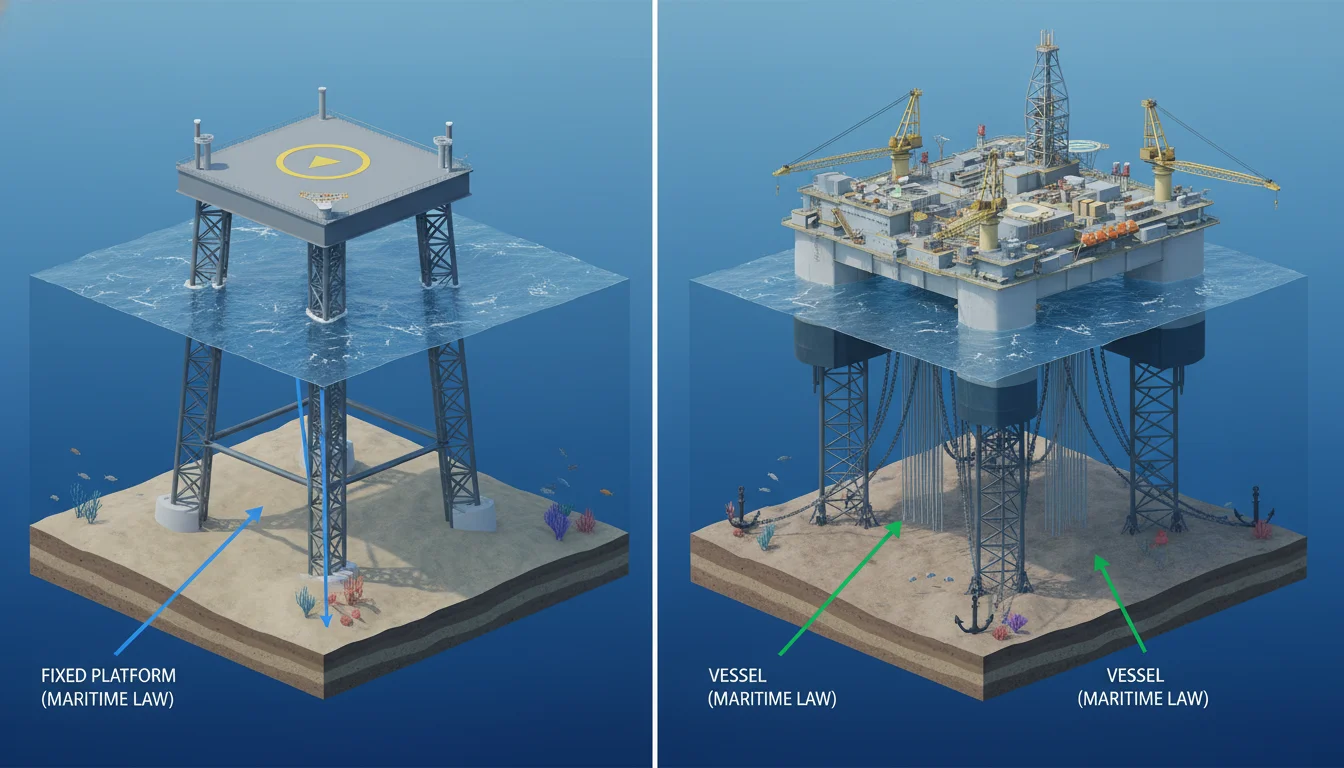
The technological evolution of the offshore oil and gas industry has profoundly complicated the traditional legal definition of a “ship” or “vessel.” In maritime law, the classification of the offshore structure itself dictates whether international maritime law or terrestrial state law applies.
If a structure is capable of moving over navigable waters and is used as a means of transportation or commerce, it is classified as a vessel, triggering general maritime law and seafarer protections. Conversely, structures permanently affixed to the seabed are treated as artificial islands, removing them from admiralty jurisdiction and placing them under the purview of the adjacent coastal state or specialized federal statutes.
The following details the legal categorization of common offshore structures and the corresponding legal frameworks:
- Jack-up Rigs / Mobile Offshore Drilling Units (MODUs): Mobile platforms with adjustable legs that lower to the seabed during drilling operations. Capable of independent mobility or towage. Legal Classification: Vessel. Primary Frameworks: Jones Act, General Maritime Law (Unseaworthiness), Maintenance & Cure.
- Semi-Submersibles & Drillships: Floating, self-propelled or towed vessels utilizing dynamic positioning systems (propellers/sensors) or anchors to maintain position. Legal Classification: Vessel. Primary Frameworks: Jones Act, General Maritime Law, International Conventions.
- Floating Liquified Natural Gas (FLNG) Facilities: Massive floating structures utilized for gas extraction, liquefaction, and storage. Legal Classification: Vessel. Primary Frameworks: General Maritime Law, Admiralty Jurisdiction.
- Fixed Platforms: Permanent structures anchored directly into the seabed via steel jackets or concrete gravity bases. Immobile. Legal Classification: Non-Vessel / Artificial Island. Primary Frameworks: Outer Continental Shelf Lands Act (OCSLA), State Workers’ Compensation, LHWCA.
- Tension Leg Platforms (TLPs) & Spars: Floating structures permanently moored to the seabed via tensioned tendons or cables. Intended for permanent, long-term deployment. Legal Classification: Generally Non-Vessel. Primary Frameworks: OCSLA, LHWCA (Dependent on specific jurisdictional interpretations of mobility).
This structural dichotomy highlights a stark legal reality: a wireline operator injured on a mobile jack-up rig may sue their employer for millions in pain and suffering under maritime law, whereas an employee performing the identical task on a fixed platform just one mile away is strictly limited to statutory workers’ compensation benefits.
In the United States, if an injury occurs on a fixed platform on the Outer Continental Shelf, the Outer Continental Shelf Lands Act (OCSLA) applies. Established in 1953, OCSLA extends the geographical jurisdiction of the U.S. to submerged lands and artificial islands, explicitly adopting the workers’ compensation benefits of the LHWCA for injured offshore employees. Furthermore, OCSLA utilizes the laws of the adjacent state as surrogate federal law to fill gaps, provided such state laws are not inconsistent with existing federal maritime law.
When a maritime tragedy results in a fatality beyond three nautical miles from U.S. shores, the Death on the High Seas Act (DOHSA) is triggered. Historically, DOHSA was notoriously restrictive, limiting recovery for surviving family members purely to pecuniary (economic) losses and barring recovery for the deceased’s pre-death pain and suffering or the family’s loss of consortium. Furthermore, the Oil Pollution Act (OPA) provides specific compensatory avenues for workers who sustain injuries directly resulting from oil spills or refinery catastrophes, separate from standard operational injuries.
The Geopolitics of Jurisdiction: Flags of Convenience and Forum Selection
Because the maritime industry is inherently transnational, domestic laws frequently clash with international conventions. An offshore worker might be a Philippine national, employed by a Swiss crewing agency, working on a Panamanian-flagged drillship operating in the exclusive economic zone (EEZ) of Brazil. Determining the applicable law and the appropriate forum for an injury claim requires navigating complex conflict-of-laws doctrines.
Flags of Convenience (FOCs)
The widespread use of Flags of Convenience (FOCs) significantly complicates offshore injury litigation. Over half of the global merchant fleet is registered in open registries, where the shipowner’s nationality differs from the flag state. The modern practice began in the 1920s when U.S. shipowners registered vessels in Panama to serve alcohol to passengers during Prohibition. Realizing the economic benefits of bypassing domestic labor laws and strict safety regulations, the practice exploded; by 1968, Liberia had surpassed the United Kingdom to possess the world’s largest ship register.
Under the United Nations Convention on the Law of the Sea (UNCLOS), the flag state has the exclusive duty to maintain checks on seaworthiness, crew qualifications, and the investigation of shipping casualties. However, critics argue that FOC registries often lack the regulatory apparatus to enforce international maritime laws effectively, creating dark fleets and fragmented policies that endanger workers and critical infrastructure. When an injury occurs on an FOC vessel, the choice of law is generally dictated by the flag state. Consequently, injured workers frequently attempt to bring claims in more favorable jurisdictions—such as the United States or the United Kingdom—triggering intense jurisdictional battles.
Choice of Law and the Rome I Regulation
Within the European Union, the determination of applicable law in international employment contracts is governed by the Rome I Regulation (EC No 593/2008). Article 8 of Rome I acknowledges the principle of party autonomy, allowing the employer and the seafarer to explicitly choose the governing law of the contract.
However, Rome I introduces a vital safeguard to prevent exploitation via FOCs: the chosen law cannot deprive the employee of the protections afforded by the mandatory provisions of the law that would have applied in the absence of a choice. Therefore, if an employment contract selects the law of an open registry with substandard labor protections, European courts will override the clause to enforce the mandatory minimums (e.g., maximum working hours, termination protections, minimum wage) of the country with which the contract is most closely connected, ensuring a baseline of worker welfare.
In the United States, choice-of-law clauses in maritime contracts are presumptively enforceable under federal maritime law, analogous to the enforcement of forum-selection clauses established in Carnival Cruise Lines, Inc. v. Shute. The U.S. Supreme Court recently reaffirmed this in Great Lakes Insurance SE v.
Raiders Retreat Realty Co, noting that identifying the governing law in advance cuts litigation costs and allows vessel owners to assess risk. These clauses are upheld subject only to very narrow exceptions, such as fundamental unfairness or a contravention of strong public policy.
Forum Non Conveniens
When a plaintiff attempts to bring a claim in a jurisdiction contrary to an employment contract, defendants routinely invoke the doctrine of forum non conveniens (FNC), requesting the court to stay or dismiss the proceedings in favor of a more appropriate, naturally connected foreign forum.
In common law jurisdictions, the leading authority on this doctrine is the English case Spiliada Maritime Corporation v Cansulex Ltd, which established that a stay will be granted if the defendant can show another forum is clearly and distinctly more appropriate to try the case for the interests of all parties and the ends of justice.
This framework is robustly applied worldwide. In the landmark Singapore Court of Appeal case The Rainbow Joy, the court evaluated an FNC application involving a foreign seafarer’s injury. The court applied the Spiliada framework, ruling that the mere fact that the seafarer happened to join the vessel in Singapore was entirely insufficient to anchor jurisdiction there. By granting a stay of proceedings, the court demonstrated the willingness of sophisticated maritime hubs to decline jurisdiction when the nexus to the forum is tenuous, forcing injured seafarers back to the legal frameworks of the flag state or their country of domicile, regardless of whether the foreign law is less favorable to the plaintiff.
Comparative Domestic Legal Architectures
Beyond overarching principles of international law, the mechanics of securing compensation for an offshore injury vary radically by domestic jurisdiction. A comparative analysis reveals a spectrum ranging from highly litigious, tort-based systems to heavily regulated, state-sponsored administrative regimes. Table 2 provides a high-level summary of these distinct jurisdictional approaches.
| Jurisdiction | Primary Legislation | Governing Philosophy | Key Mechanisms for Compensation |
|---|---|---|---|
| United States | Jones Act, General Maritime Law, LHWCA, OCSLA, DOHSA | Tort-based, Plaintiff-friendly | Negligence suits (featherweight burden), Unseaworthiness strict liability, Punitive damages for M&C denial. |
| United Kingdom | Health and Safety at Work Act 1974, Employer’s Liability Act 1969 | Statutory duty & Common law negligence | Strict liability for defective equipment via third parties; regulatory safety cases; 3-year limitation. |
| Norway | Petroleum Act, Working Environment Act | High regulation, Collective safety net | “Loss of Licence” (LOL) private compensation, trade union oversight, stringent HSE approvals. |
| Brazil | Consolidation of Labor Laws (CLT), Federal Constitution | Hyper-protective, Administrative & Civil | Strict liability, INSS social security claims, regressive state lawsuits against employers (Art. 120). |
| Australia | Navigation Act 2012, Seafarers Rehabilitation & Compensation Act | Administrative & Common Law | Seacare workers’ compensation scheme, Admiralty Act definitions, coastal cabotage. |
| Singapore | Work Injury Compensation Act (WICA), Common Law | Efficient, Capped administrative compensation | No-fault WICA claims (capped at $225k for death) vs. uncapped fault-based common law suits. |
| Nigeria | NIMASA Act 2007, Cabotage Act 2003 | Developing, Protectionist | Admiralty Jurisdiction Act (wage/injury liens), enforcement of MLC standards, NSDP capacity building. |
The United Kingdom: Statutory Duties and Equipment Liability
Unlike the United States, the United Kingdom does not have a bespoke maritime statute akin to the Jones Act offering a lowered burden of proof for negligence. Instead, offshore personal injury claims in the UK—particularly in the perilous North Sea oil and gas sector—are governed by general common law negligence principles and strict statutory duties.
The UK framework relies heavily on the Health and Safety at Work etc. Act 1974. Following disasters like Piper Alpha, this legislation requires operators to prepare comprehensive “safety cases” demonstrating effective control over major accident risks, subject to rigorous approval by the Health and Safety Executive (HSE).
Crucially, in the context of unseaworthiness and equipment failure, the Employer’s Liability (Defective Equipment) Act 1969 provides a powerful tool for injured workers. If an employee suffers an injury in the course of employment due to a defect in equipment provided by the employer, and the defect is attributable wholly or partly to the fault of a third party (such as a manufacturer or a previous supplier), the employer is held strictly liable. This prevents employers from escaping liability by blaming an insolvent or overseas manufacturer, ensuring the injured worker has a direct avenue for compensation against their immediate employer without bearing the burden of tracking down the original manufacturer. Furthermore, any contractual agreement attempting to exclude this liability is rendered unequivocally void under the Act.
In terms of litigation culture, the UK system casts a narrower net regarding liability compared to the US. While US plaintiffs’ counsel often sue property owners, management companies, and municipal entities concurrently due to broad concepts of foreseeability, UK litigation is generally more focused. In England and Wales, personal injury claims are also subject to a strict three-year limitation period from the date of the accident or knowledge, requiring swift legal action.
Norway: The “Loss of Licence” Scheme and High-Regulation Environments
Norway’s approach to offshore safety and injury compensation in the North Sea is recognized globally as a gold standard, heavily emphasizing preventative regulation and collective welfare over protracted tort litigation. The Norwegian Petroleum Act and the Working Environment Act establish the legal framework, ensuring extensive employee participation in safety management through elected safety delegates across all phases of offshore activities.
A unique mechanism within the Norwegian offshore sector is the “Loss of Licence” (LOL) compensation system. To work on the Norwegian continental shelf, offshore workers must pass stringent medical examinations to hold a health certificate. If a worker suffers an injury or develops a disease that permanently disqualifies them from meeting these health requirements, they lose their license and, consequently, their offshore livelihood.
In response, three trade unions representing Norwegian offshore workers (OSO) established a private compensation system in 2002, funded by offshore operating companies. This scheme provides vital financial support to workers who lose their health certificates, operating semi-independently of traditional state workers’ compensation. Empirical data analyzing this scheme between 2002 and 2010 revealed that musculoskeletal conditions accounted for 42.5% of LOL claims, highlighting the chronic physical toll of offshore extraction work. Furthermore, the data revealed specific demographic vulnerabilities: among women granted compensation, 78% were catering workers, while 50% of men were process workers, reflecting the gender distribution and specific ergonomic hazards within the offshore environment.
Brazil: The CLT, INSS, and Regressive State Litigation
Brazil operates under a codified, hyper-protective labor system. The Consolidação das Leis do Trabalho (CLT) governs employment relationships, setting strict limits on working hours, mandating specific health and safety protocols (Normas Regulamentadoras, or NRs), and guaranteeing severance funds (FGTS). Foreign employers operating offshore in Brazilian waters must adhere strictly to the CLT; its protections cannot be waived by individual contracts, and attempting to classify full-time offshore workers as independent contractors to bypass benefits carries severe legal risks and invalidates non-compliant foreign employment agreements.
In the event of an offshore injury, the worker receives medical and disability benefits from the national social security institute, the INSS. However, the Brazilian system contains a unique, highly punitive mechanism against negligent employers: the Ação Regressiva (Regressive Lawsuit) established under Article 120 of Law No. 8.213/91. If an offshore incident occurs due to an employer’s negligence or failure to comply with occupational health and safety regulations, the INSS will actively sue the employer to recover all social security payouts made to the injured worker.
This creates a severe dual-threat environment for offshore operators in Brazil. Not only can the injured employee sue for civil damages (moral and material in labor courts), but the state itself acts as a plaintiff to recoup administrative costs. Furthermore, under Brazilian concession rules, joint and several liability applies to all members of an oil and gas consortium, meaning that if one operator defaults on safety, compensation, or decommissioning liabilities, the co-venturers are entirely responsible for the financial burden.
To ease international workforce mobility, Brazil and the United States maintain a Totalization Agreement.
This treaty eliminates dual social security taxation for expatriate offshore workers and allows workers to combine credits from both countries to qualify for retirement and disability benefits, easing the bureaucratic burden on multinational drilling contractors. Additionally, recent updates to the CLT address modern remote work environments, placing strict limits on AI-enabled monitoring of employees to protect constitutional privacy rights and comply with the General Data Protection Law (LGPD), preventing employers from conducting abusive monitoring of offshore or remote workers via corporate tools.
Australia: Navigation Act 2012 and the Seacare Scheme
Australia regulates its vast maritime domain through the Navigation Act 2012, a contemporary legislative framework that domesticates major international conventions like the Maritime Labour Convention, STCW, and MARPOL. Under this Act, shipowners are legally bound to fulfill the ancient duty of maintenance and cure, including providing conveyance to a port and covering burial expenses in the event of death.
For occupational injuries, the Seafarers Rehabilitation and Compensation Act 1992 (the Seacare scheme) provides a comprehensive, no-fault administrative remedy. The jurisdictional threshold for Seacare relies on the definition of a “seafarer” engaged on a “prescribed ship”. Under the intersecting Admiralty Act 1988, the definition of a ship explicitly includes “off-shore industry mobile units” (such as jack-up rigs and semi-submersibles) but excludes fixed platforms, mirroring the vessel classification complexities seen in the United States. Injured Australian seafarers must carefully elect their remedies, as statutory mechanisms (Sections 56, 57, and 59 of the Seafarers Act) exist to offset or restrict common law negligence claims once Seacare administrative benefits are instituted.
Singapore: WICA and the UNCITRAL Model Law
As a premier global maritime and arbitration hub, Singapore offers an efficient, dual-track system for maritime injuries. The Work Injury Compensation Act (WICA) provides an expedited, no-fault mechanism for claiming compensation for medical expenses, lost wages, and lump sums for permanent incapacity or death. WICA explicitly covers seafarers injured on Singapore-registered vessels regardless of their global location. Since recent updates, WICA death benefits are capped at a maximum of $225,000 SGD, and minimums are set at $76,000 SGD, providing predictable limits for insurers.
If an injured worker believes the employer was negligent, they can bypass the WICA caps and pursue a common law tort claim, seeking uncapped damages. Singaporean jurisprudence is highly influential across the Commonwealth; the courts frequently refine maritime law principles to suit a modern free-trade port. This is evident in recent rulings adopting the UNCITRAL Model Law on Cross-Border Insolvency. In the 2023 case Ascentra Holdings, the Singapore Court of Appeal established a wide construction of “foreign proceedings,” creating a light threshold for recognizing foreign insolvency proceedings. This ensures that when foreign offshore entities enter bankruptcy, the rights of creditors and injury claimants in Singapore are protected through a structured, predictable restructuring process.
Nigeria: Emerging Cabotage and NIMASA Enforcement
Nigeria’s maritime legal landscape is currently undergoing rapid development, driven by a national imperative to indigenize its massive offshore oil and gas sector. The Coastal and Inland Shipping (Cabotage) Act of 2003 restricts domestic coastal trade strictly to Nigerian-owned, crewed, and built vessels, though waivers have historically been utilized.
The Nigerian Maritime Administration and Safety Agency (NIMASA) serves as the apex regulatory body, tasked with enforcing safety standards, port state control, and the implementation of the Maritime Labour Convention 2006. For injured seafarers seeking compensation, the Admiralty Jurisdiction Act (AJA) classifies claims for seafarers’ wages and compensation as “general maritime claims”. This classification allows plaintiffs to invoke the admiralty jurisdiction of the Federal High Court to arrest vessels in Nigerian territorial waters to secure their claims, providing a powerful remedy against transient shipowners.
However, the regulatory system is still maturing. To address a severe lack of qualified indigenous maritime labor required to safely man the offshore rigs and satisfy Cabotage requirements, NIMASA launched the Nigerian Seafarers Development Programme (NSDP) in 2008. Furthermore, NIMASA has instituted robust internal whistleblowing policies to protect workers from reprisals when reporting unsafe offshore conditions or environmental hazards, signaling a shift toward higher operational accountability.
The Defense Shield: Protection and Indemnity (P&I) Clubs and Direct Action
A crucial, often hidden dimension of offshore injury claims involves the complex mechanisms of marine insurance. Liability for personal injury, illness, occupational disease, and death is generally not covered by standard Hull & Machinery policies, which protect the physical asset. Instead, these liabilities are insured by Protection and Indemnity (P&I) Clubs. P&I Clubs are mutual insurance associations owned and governed by the shipowners themselves, pooling risk to provide coverage for third-party liabilities.
The Indemnity Principle and the “Pay to be Paid” Rule
The cornerstone of P&I insurance is the indemnity principle, contractually codified in the “pay to be paid” rule. This rule stipulates that the P&I Club is only obligated to reimburse the shipowner after the shipowner has actually discharged the liability by paying the injured claimant out of pocket.
This mechanism creates a severe vulnerability for injured workers. If an offshore operator or shipowner goes bankrupt—a frequent occurrence during volatile fluctuations in the global oil market—the injured worker cannot collect from the employer. Because the insolvent employer never paid the claim, the P&I Club invokes the “pay to be paid” rule and refuses to disburse funds, leaving the injured party with an uncollectible judgment.
The Rise of Direct Action Statutes
To counteract this structural inequity and protect third-party claimants, many jurisdictions have enacted “Direct Action Statutes.” These laws allow a victim to bypass the insolvent shipowner and file a lawsuit directly against the P&I Club.
Jurisdictions such as Spain (via Article 465 of the Maritime Navigation Act 2014), the Scandinavian countries, and several U.S. states aggressively permit direct actions, effectively nullifying the “pay to be paid” contractual defense under local public policy. In Norway, for instance, claims for pollution damage may be brought directly against the insurer, who may avail themselves of certain limitation of liability defenses but cannot rely on the bankruptcy of the owner to avoid payment.
Anti-Suit Injunctions as a Countermeasure
The proliferation of direct action statutes represents a profound jurisdictional threat to the London-based P&I market. In response, English courts have developed a robust mechanism to protect the Clubs: the anti-suit injunction. Because P&I Club rulebooks universally mandate that coverage disputes be resolved via arbitration in London under English law, the clubs petition English courts to issue injunctions preventing claimants from pursuing direct actions in foreign jurisdictions.
In cases such as Shipowners’ Mutual Protection and Indemnity Association v Containerships Denizcilik (the Yusuf Cepnioglu), the English High Court successfully granted an anti-suit injunction restraining a foreign plaintiff from prosecuting a direct claim against a P&I Club in Turkey. The court forced the matter back into the contractual arbitration forum where the “pay to be paid” rule would be strictly enforced. This ongoing legal tug-of-war highlights the reality that securing a liability judgment against an offshore operator is often only half the battle; piercing the insurance veil remains a highly contested geopolitical and legal struggle.
Macro-Trends in Maritime Safety and Litigation (2024–2026)
The trajectory of maritime injury law is inexorably linked to the operational realities, safety records, and technological advancements of the global fleet. Recent statistical analyses covering the 2024–2026 period, compiled by entities such as the International Union of Marine Insurance (IUMI) and Allianz Commercial, indicate a complex dichotomy in maritime safety.
Table 3 highlights the key statistical indicators driving current maritime injury and loss trends:
- Statistical Indicator: Total Vessel Losses
- 2024/2025 Data Point: 27 vessels globally (Record Low).
-
Implication for Maritime Injury Claims: Indicates improving structural safety standards and better weather routing technologies, potentially reducing mass-casualty events.
- Total Losses: Represents a 75% decline over the past decade. Improved systemic safety and regulatory compliance (e.g., ISM Code), reducing mass-casualty events.
- Total Casualties/Incidents: 3,310 incidents (A 10% year-over-year increase). Despite fewer sinkings, routine operational hazards remain high, ensuring a steady volume of personal injury and unseaworthiness claims.
- Primary Loss Causes: Foundered/Sunk (50%), Fire/Explosion (Second highest cause). Fires onboard vessels and rigs result in severe burn injuries and smoke inhalation claims, often implicating defective equipment.
- Geographic Hotspots: South China Sea, Indochina, Indonesia, Philippines, British Isles, East Mediterranean. High traffic density correlates with collision risks, triggering complex multi-jurisdictional liability disputes.
- Sector Vulnerability: Fishing vessels accounted for ~40% of all lost vessels in 2024. Highlights the disproportionate peril faced by commercial fishermen, who rely heavily on Jones Act and general maritime law protections.
While catastrophic sinkings have decreased, the aging of the global fleet presents a growing systemic risk. As offshore assets, particularly drillships and semi-submersibles, remain in service beyond their originally intended lifespans, the frequency of equipment failures, structural fatigue, and corresponding unseaworthiness claims will inevitably rise.
Furthermore, environmental disasters continue to shape liability frameworks. The catastrophic blowout of the Deepwater Horizon—a semi-submersible mobile offshore drilling unit—resulted not only in tragic loss of life but also fundamentally altered the application of the Oil Pollution Act (OPA). Similarly, significant offshore incidents, such as the Chevron leak in Brazil that resulted in a $20 billion punitive damages demand from federal prosecutors, demonstrate the increasing willingness of sovereign states to aggressively penalize offshore operators for environmental and safety breaches.
Concurrently, the increasing automation of vessels introduces novel legal questions regarding unseaworthiness. As electric, autonomous “sea drones” and uncrewed surface vessels (USVs) enter commercial operation, the definition of a “competent crew” shifts. If an autonomous navigational system on a dynamically positioned drillship fails due to a software glitch, courts will be forced to determine whether this constitutes traditional vessel unseaworthiness under maritime law or shifts liability into the terrestrial realm of complex product liability against software developers.
Conclusion
The pursuit of compensation following an offshore injury requires navigating one of the most complex, multi-jurisdictional matrices in modern jurisprudence. The foundational dichotomy between mobile drilling units and fixed platforms artificially divides the workforce, subjecting identically injured workers to vastly different compensatory schemes based entirely on the buoyancy and navigational capabilities of their worksite.
For the injured seafarer or offshore worker, the most advantageous legal strategy lies in identifying multiple avenues of liability—combining strict liability doctrines like unseaworthiness with statutory negligence claims (such as the Jones Act or the UK’s Defective Equipment Act), and targeting the deep pockets of third-party equipment manufacturers. Conversely, offshore operators and their P&I insurers rely heavily on corporate compartmentalization, Flags of Convenience, choice-of-law clauses, and the “pay to be paid” rule to isolate liabilities and defend their assets in predictable, contractual forums like London arbitration.
As the offshore sector pivots toward deeper waters, integrates autonomous technologies, and transitions toward renewable offshore wind infrastructure, domestic courts will increasingly be called upon to reconcile ancient maritime doctrines with modern industrial realities. The overarching global trend—driven by frameworks like the Maritime Labour Convention, the expansion of direct action statutes, and rigorous national regulatory bodies like Norway’s Petroleum Safety Authority and Brazil’s Labor Courts—is a gradual harmonization. This evolution aims to pierce corporate veils and ensure that the ultimate financial and moral burden of offshore casualties is borne by the enterprises that profit from the sea, rather than the workers who risk their lives upon it.