Freight Brokerage Software 2026: CRM & Dispatch Comparison
Strategic Evaluation of Freight Brokerage CRMs and Dispatch Software for 2026

The 2026 Macroeconomic Freight Landscape: Transitioning from Volume to Margin Optimization
The North American freight brokerage industry in 2026 is navigating a complex transition out of a prolonged capacity-driven recession, characterized by a fundamental reordering of operational strategies. For years, the prevailing model within third-party logistics (3PL) and freight brokerage prioritized high-volume, transactional growth, frequently at the expense of sustainable operating margins. However, current macroeconomic indicators, persistent inflationary pressures, and a shifting supply-demand equilibrium have forced an industry-wide pivot. A comprehensive late-2025 survey of freight brokers, forwarders, and 3PL professionals conducted by Bloomberg Intelligence and Truckstop revealed that 53% of brokers now expect gross margins to improve over the next three to six months, whereas only 48% expect top-line revenue growth. This data point underscores a strategic maturation: the industry is explicitly prioritizing margin preservation and yield optimization over sheer volume acquisition.
This strategic pivot is largely driven by evolving, yet highly volatile, capacity signals. Approximately 46% of industry professionals anticipate tighter capacity in 2026, driven by a sustained acceleration of carrier exits that are finally beginning to rebalance supply and demand. While overall freight volumes remain relatively soft, regional capacity pockets are tightening rapidly, and spot market volatility is increasing even as long-term contract rates remain functionally flat. Underlying market data from early 2026 reflects this building pressure, with flatbed load-to-truck ratios hitting 60-to-1 in late February, representing the highest capacity constraint in that sector since mid-2022. Concurrently, truckload contract rates have begun rising in the mid-single digits year-over-year, marking the first meaningful rate increase in over four years, according to ACT Research.
In this environment, operational inefficiency presents an existential threat to both carriers and the brokers who rely on them. The cost of operating a commercial truck in the current market averages a staggering $2.26 per mile. Within this high-cost environment, empty miles—which account for 16% to 20% of total miles driven industry-wide—represent a massive drain on profitability. Furthermore, dwell time at shipper and receiver facilities has severe financial implications; every 15-minute increase in dwell time is linked to a 6.2% increase in expected crash rates and contributes to an estimated $1.1 billion to $1.3 billion in lost driver earnings annually within the truckload sector. On the customer service front, visibility demands have peaked, with “where is my order?” inquiries driving 25% to 35% of contact center volume, spiking to 50% during peak periods.

Consequently, the technological infrastructure of a brokerage—specifically its Transportation Management System (TMS), Customer Relationship Management (CRM) platform, and dispatch software—serves as the primary mechanism for defending margins against these macroeconomic headwinds. The data indicates a widening technological bifurcation within the sector: 41% of brokerages are actively deploying artificial intelligence (AI) tools to automate workflows, optimize pricing, and reduce dwell times, while 48% remain reliant on legacy systems. Those who leverage advanced, AI-driven software are positioned to capitalize on tightening capacity without needing to drastically expand headcount, thereby widening their competitive advantage in a volatile market.
The Regulatory Imperative: FMCSA Directives Shaping Technological Infrastructure
Technological acquisition strategies in 2026 are not merely driven by efficiency goals; they are increasingly mandated by a sweeping series of regulatory changes implemented by the Federal Motor Carrier Safety Administration (FMCSA). These updates place unprecedented financial and operational scrutiny on freight brokers, necessitating software systems that offer flawless accounting integrations and real-time compliance monitoring.
Stricter Financial Responsibility and Bond Requirements
Effective January 16, 2026, the FMCSA fully implemented its “Broker and Freight Forwarder Financial Responsibility” Final Rule. This regulation fundamentally alters how brokers manage their required $75,000 surety bonds (BMC-84) or trust funds (BMC-85). Under the new framework, the definition of “assets readily available” has been updated to ensure funds consist of stable assets that can be easily liquidated within seven calendar days of a triggering event, effectively eliminating many traditional BMC-85 trust arrangements. Most critically, the rule grants the FMCSA the explicit authority to immediately suspend a broker’s or freight forwarder’s operating registration if their available financial security falls below the $75,000 threshold due to a valid claim drawdown. Upon notice of a drawdown, brokers have precisely seven days to replenish the surety bond or trust; failure to do so results in an immediate suspension of authority.
The downstream software implications of this rule are profound. Small and mid-sized brokerages can no longer tolerate latency in invoicing, freight auditing, or accounts receivable. The technological response requires a TMS with robust, automated accounting integrations—such as seamless, bidirectional synchronization with platforms like QuickBooks Online—and AI-powered freight audit and pay features that compress the order-to-cash cycle. Software that reduces days sales outstanding (DSO) and automates carrier settlements is now a critical compliance tool, ensuring brokers maintain the liquidity necessary to protect their operating authority.
ELD Enforcement, Safety Fitness, and the Motus Platform
Furthermore, effective February 7, 2026, the FMCSA escalated enforcement regarding Electronic Logging Devices (ELDs). Carriers utilizing ELDs that have been revoked and removed from the FMCSA’s approved list face immediate out-of-service orders. For freight brokers, this introduces a severe supply chain disruption risk: dispatching a load to a carrier using a non-compliant ELD could result in a roadside shutdown, delaying critical shipments and irreversibly damaging shipper relationships.
To mitigate this risk, brokerages are heavily investing in dispatch software and CRM tools that feature deep telematics integrations. Platforms that integrate directly with enterprise telematics providers like Samsara, Motive, or through identity verification systems like the Highway app, allow brokers to digitally verify a carrier’s physical assets and specific ELD compliance in real-time prior to tendering a load.
Simultaneously, the impending 2026 launch of the FMCSA’s Motus platform—the modernized replacement for the legacy Unified Registration System (URS)—promises to streamline fraud detection and identity verification. Software vendors that build robust Application Programming Interfaces (APIs) to interface directly with Motus, as well as the actively enforced FMCSA Drug and Alcohol Clearinghouse and state Motor Vehicle Record (MVR) systems, will provide their brokerage clients with automated, frictionless carrier onboarding and continuous compliance monitoring. Furthermore, with early 2026 pilot programs exploring increased flexibility in Hours of Service (HOS) regulations and anticipated March 2026 updates to MAP-21 provisions regarding safety fitness determinations, brokers require highly agile software capable of instantly adapting to shifting carrier qualification metrics.
The Architectural Evolution of the Transportation Management System (TMS)
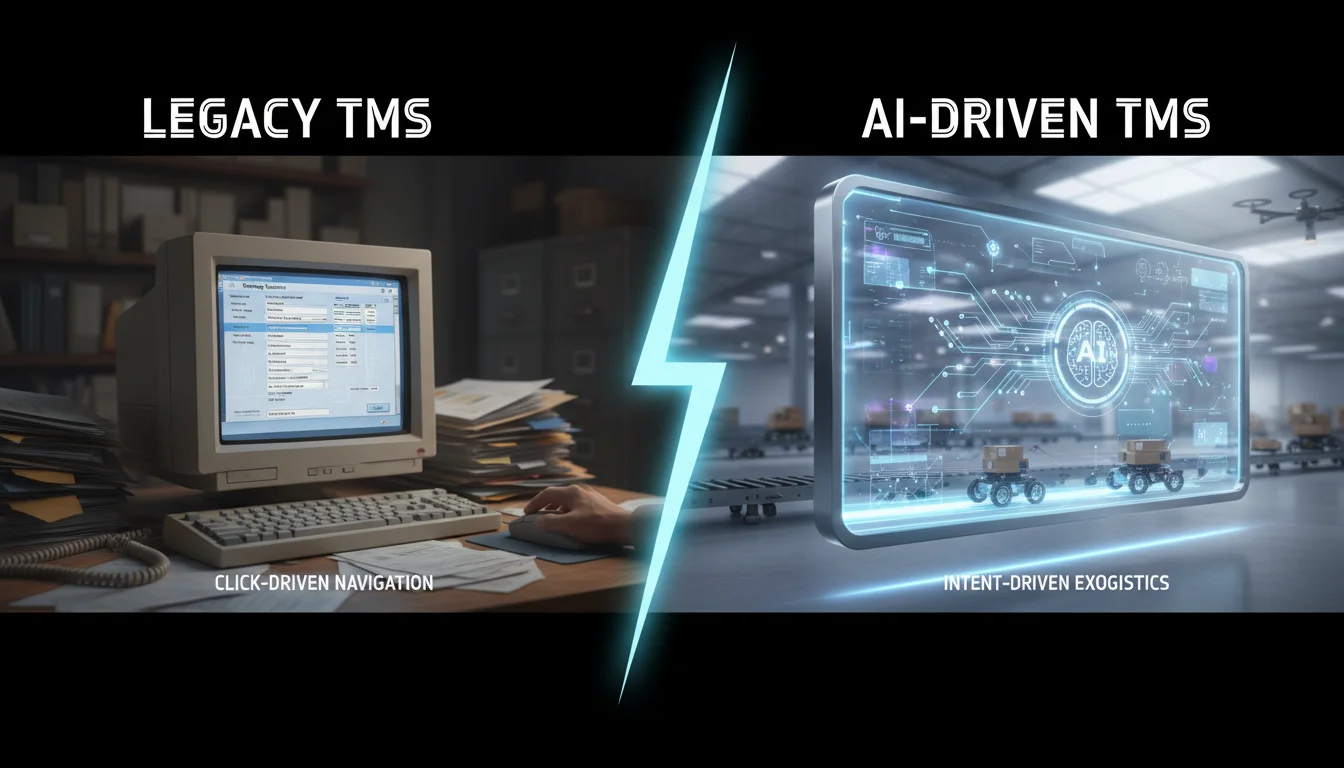
The conceptual definition of a Transportation Management System has undergone a radical architectural evolution by 2026. Legacy systems, characterized by on-premises servers, siloed databases, and rigid, click-driven navigation, are being rapidly replaced by cloud-native, API-first platforms centered entirely around embedded Artificial Intelligence.
From Click-Driven Navigation to Intent-Driven Execution
Historically, a TMS functioned primarily as a static digital filing cabinet. Dispatchers manually entered data from emails, posted loads to digital boards, and executed hundreds of manual check calls per week. Modern AI-driven platforms, such as ShipperGuide, Rose Rocket, and DispatchMVP, have shifted this paradigm from click-driven navigation to intent-driven workflows. In these advanced systems, autonomous AI agents handle routine procurement, scheduling, and settlement processes, transforming the role of the logistics coordinator.
The transition from basic Optical Character Recognition (OCR) to Context-Aware Large Language Models (LLMs) represents a significant technological leap. In previous years, OCR struggled with the unstructured nature of logistics documents; human entry clerks frequently outperformed OCR models because they possessed innate contextual knowledge about specific shipper requirements and operational nuances that OCR lacked. By 2026, AI tools utilize LLMs capable of understanding deep operational context.
For example, Rose Rocket’s “Databot” parses highly unstructured emails and PDF rate confirmations, automatically capturing and processing information to populate the TMS without human intervention. This capability resolves the industry’s pervasive manual data problem, reducing input time by an average of 75% and saving logistics teams upwards of 20 hours per week in manual administrative work.
Similarly, intelligent load matching has evolved from basic manual filtering—where dispatchers set parameters for origin, equipment type, and minimum rate—to predictive algorithms that analyze historical carrier performance, lane velocity, and market trends to provide real-time recommendations for the optimal carrier. This level of automation shifts execution from managing individual shipments to governing a broader freight operation that largely runs itself.
Redefining the Total Cost of Ownership (TCO) Equation
As technology advances, the methodology for evaluating the Total Cost of Ownership (TCO) has become highly scrutinized. A traditional feature-by-feature comparison is insufficient; brokerages must comprehensively model the software licensing cost, onboarding fees, integration charges, and ongoing maintenance over a standard 24-to-36-month operational horizon.
Legacy enterprise systems continue to command high five-to-six figure annual contracts, paired with implementation timelines stretching from 8 to 24 months. Furthermore, these legacy platforms often impose hidden fees for third-party integrations, charging between $50 and $500 per month for essential connections to QuickBooks, tracking services like MacroPoint, or load boards like DAT.
Conversely, the mid-market segment has aggressively disrupted this model by offering transparent, flat-rate Software as a Service (SaaS) pricing. Platforms like ARK TMS provide all-inclusive pricing at $199 per user, per month, explicitly eliminating setup fees, per-load transactional fees, and long-term contracts. By including native integrations out-of-the-box, these modern platforms offer an accelerated Return on Investment (ROI). Industry ROI calculators demonstrate that by avoiding $2,000 to $100,000+ in setup fees and eliminating hidden integration charges, average brokerages transitioning to modern SaaS platforms save between $20,000 and $50,000 in their first year of use, representing a potential cost reduction of over 50% compared to legacy maintenance.
Comprehensive Analysis of Broker-First and Mid-Market TMS Platforms
The mid-market and broker-first TMS segment is currently the most dynamic space in logistics software. These platforms are explicitly designed to balance sophisticated AI automation with high-speed deployment, catering to brokerages that require enterprise-grade capabilities without the burden of enterprise-level IT overhead.
Rose Rocket: The AI-Native Network TMS
Rose Rocket has established itself as a leading “Network TMS,” emphasizing deep, portal-driven collaboration between brokers, carriers, and shippers. The platform is highly regarded for its modern interface and strong integration capabilities, maintaining an exceptional 4.8 out of 5 rating on major software review aggregates.
In 2026, Rose Rocket’s primary value proposition is anchored in its AI-native architecture, marketed as TMS.ai. This suite features three distinct AI agents. “Databot” handles automated data entry via advanced document parsing. “Rosie” operates as an intelligent co-pilot embedded within every order, assisting users with updates, connecting disparate data points, and surfacing hidden logistical insights. Finally, “Rocky” functions as an automated onboarding partner that continuously optimizes how a business utilizes the system. Furthermore, Rose Rocket’s AI-powered Freight Audit and Pay module is designed to eliminate 80% of manual inputs during financial reconciliation, severely reducing costly billing errors.
Beyond AI, Rose Rocket offers extreme configurability. Recent 2025 and 2026 product updates introduced complex formula fields, advanced object builders, multi-currency conversion (vital for cross-border logistics), QuickBooks Desktop integration, and sophisticated automated tax rounding rules. While its pricing is quote-based and generally positioned in the mid-market SaaS tier, its deployment timeframe—measured in days or weeks rather than months—makes it highly attractive for scaling brokerages. However, some industry operators note that its broad focus across shippers, 3PLs, and carriers can make its core broker-specific dispatch workflows slightly less specialized than pure-play broker systems.
Alvys: The Hybrid Operations Powerhouse
Alvys targets hybrid operations—companies operating both non-asset brokerage divisions and asset-based carrier fleets—and has built a formidable reputation for end-to-end workflow automation. With a strong 4.7 out of 5 market rating, users frequently praise Alvys for its superior customer support, ease of use, and rapid onboarding experience, specifically citing it as a major upgrade over glitchy, slow legacy systems.
A key differentiator for Alvys in 2026 is its heavy, sustained investment in settlement infrastructure. Recognizing that accurate and timely driver and carrier pay is a core retention strategy in a high-turnover market, Alvys completely revamped its driver and accounts payable workflows. The updated “Driver Settlements” system supports the bulk generation of settlements, draft reviews to catch errors prior to finalization, and built-in guardrails to ensure consistent pay periods. Early adopters of this specific module report completing driver settlement cycles 13% faster, with significantly fewer errors. By bridging the gap between dispatch operations and granular accounting, Alvys provides the exact financial clarity required to navigate the tightening margin environment and strict FMCSA bond regulations.
ARK TMS: Unmatched Speed-to-Value for Small to Mid-Size Brokers
ARK TMS is positioned as a highly disruptive, broker-first platform targeting lean teams and brokerages ranging from 1 to 50 users. Its primary competitive advantage is radical financial transparency combined with extreme speed-to-value.
ARK TMS operates on a flat SaaS model of $199 per user, per month, explicitly rejecting setup fees, long-term contracts, and hidden integration costs.
The platform’s architecture features a unique split-screen workflow, allowing brokers to manage loads, monitor load boards, and communicate with carriers simultaneously without constantly navigating between multiple browser tabs. It utilizes proprietary AI models trained specifically on logistics documents to automate the one-click generation of Rate Confirmations (Rate Cons) and Bills of Lading (BOLs), reducing manual data entry by up to 90%. Furthermore, it features instant carrier onboarding that processes MC numbers and conducts built-in compliance checks in seconds. By including native, zero-cost integrations with QuickBooks Online, DAT, and real-time tracking providers like MacroPoint and Trucker Tools out-of-the-box, ARK TMS enables brokerages to go live in approximately 15 minutes, offering an unparalleled TCO for small to mid-sized firms. Its primary limitation is that it is less suited for highly customized, global multimodal programs, focusing instead on optimizing domestic truckload and LTL operations.
Tai Software (Tai TMS): Deep Automation for LTL/FTL Scalability
For brokerages specializing heavily in Less-Than-Truckload (LTL) operations or those managing high-throughput workflows, Tai Software (Tai TMS) is consistently recognized as a top-tier solution. Tai TMS is engineered for automation depth, allowing brokers to quote, book, and manage both LTL and Full Truckload (FTL) shipments with highly repeatable precision.
Tai integrates extensively with major LTL carriers, load boards, tracking tools, and pricing APIs, embedding machine learning directly into the daily workflow to automate repetitive tasks. It is highly regarded for its ability to turn complexity into clarity, allowing high-volume brokers to scale efficiently without sacrificing granular control. However, industry analysis notes that implementing Tai requires strict operational discipline and active change management; furthermore, its premium pricing can be prohibitive for smaller, lower-volume startups, with some users migrating to platforms like ARK TMS for more cost-effective accounting functionality.
The Ecosystem and Entry-Level Solutions: AscendTMS, DAT Broker TMS, and Descartes Aljex
Beyond the primary contenders, several other platforms occupy distinct strategic niches:
- AscendTMS: AscendTMS remains a highly popular entry-level system, frequently shortlisted by startups and solo brokers due to its low barrier to entry, which includes a highly accessible “free” tier and low-cost premium options. It is highly regarded for its seamless integration with QuickBooks and native connectivity to DAT and Truckstop load boards. However, as brokerages scale, users report that AscendTMS lacks the advanced AI automation depth and complex analytical reporting found in newer, specialized platforms, and some note frustrations with unintuitive UI features during high-volume operations.
- DAT Broker TMS: For brokerages that already live and breathe within the DAT ecosystem for carrier capacity and pricing signals, DAT Broker TMS provides unparalleled workflow continuity. Backed by DAT iQ analytics and the massive DAT One load board (which processes nearly 700,000 daily load posts), it offers a robust accounting infrastructure and native ecosystem fit.
- Descartes Aljex: Serving as a mature, deeply established platform, Descartes Aljex (holding a 4.6/5 rating) is particularly favored by intermodal freight brokers and operations prioritizing strict compliance. It excels in automated order entry, lane pricing, and Electronic Data Interchange (EDI) capabilities. Furthermore, Descartes provides industry-leading trade intelligence and denied party screening tools, making it invaluable for compliance-heavy operations, though some users feel its UI is less modern than cloud-native upstarts.
Other notable mentions include Tailwind, celebrated for its user-friendly interface; FreightPath, recognized for its streamlined load booking capabilities; and LoadPilot and Transport Pro, both serving as solid, lightweight foundations for smaller brokerages.
Feature Comparison Matrix: Mid-Market & Broker-First TMS Platforms
| Platform | Target Segment | Pricing Structure | Estimated Setup Time | Core Differentiators & Strengths | Limitations |
|---|---|---|---|---|---|
| Rose Rocket | Mid-Market, Scaling Brokers | Quote-based SaaS | Days to Weeks | TMS.ai (Databot, Rosie), Multi-party portal collaboration, extreme customization. | Broad focus may dilute specific broker dispatch workflows; higher price point. |
| Alvys | Hybrid Broker/Carriers | Quote-based SaaS | Rapid (Days) | Exceptional settlement workflows, highly rated customer support, comprehensive end-to-end flow. | Smaller integration ecosystem compared to legacy giants. |
| ARK TMS | Small to Mid-Size Brokers (1-50 users) | $199/user/month (Flat, All-inclusive) | ~15 Minutes | Zero setup fees, native QuickBooks/DAT sync, split-screen AI workflows. | Less suited for global, highly customized multimodal forwarding programs. |
| Tai TMS | Scaling LTL/FTL Brokers | Quote-based SaaS | Moderate (Weeks) | Deep automation for high-throughput LTL, machine learning integration. | Premium pricing; requires highly disciplined change management. |
| AscendTMS | Startups, Lean Teams | Free tier / Low flat-rate | Very Fast | Highly approachable UI, strong QuickBooks integration, lightweight. | Limited native AI depth; UI can feel unintuitive at enterprise scale. |
| Descartes Aljex | Intermodal / Compliance-heavy | Mid-to-Upper SaaS | Custom (Weeks) | Mature EDI capability, deep compliance and denied party screening, intermodal focus. | UI may feel less “modern”; system fragmentation across Descartes products. |
Enterprise-Grade and Forwarding-Focused TMS: Optimizing Global Complexity
For large 3PLs, managed transportation providers, and global freight forwarders, the technological requirements extend far beyond domestic truckload dispatch. These organizations require sophisticated multimodal capabilities, complex routing algorithms, robust Warehouse Management System (WMS) integrations, and multi-client architecture. However, this power inherently comes at the cost of agility, speed of deployment, and significant financial overhead.
MercuryGate (Infios)
MercuryGate has long served as an industry standard for mid-to-large shippers and 3PLs managing complex transportation networks. Recently rebranded under the Infios execution suite in late 2025/early 2026, the platform uniquely supports all modes of transportation—Parcel, LTL, Truckload, Air, Ocean, Rail, and Intermodal—on a single unified architecture. The new Infios suite bundles the MercuryGate TMS with four discrete WMS products and a warehouse control system (WCS), leveraging an in-house robotics group to speed commissioning for projects requiring high automation. Its strengths lie in deep network optimization, multi-client management for 3PLs, and the ability to configure highly complex routing rules.
However, the TCO for MercuryGate/Infios is substantial. Implementations typically require 8 to 16 weeks or more, and pricing involves high five-to-six-figure enterprise annual contracts. The platform demands a steeper learning curve and greater administrative overhead, making it fundamentally unsuited for agile, fast-growing mid-market brokerages that do not require multimodal global routing.
Turvo
Turvo differentiates itself through an aggressive focus on supply chain visibility, collaborative portals, and network-based connectivity. Designed for high-touch freight programs, Turvo provides a centralized, cloud-based platform where shippers, brokers, and carriers interact in real-time, significantly reducing communication delays and stakeholder misalignment. Users consistently praise its real-time tracking dashboards, modern UX, and automated proof of delivery (POD) uploads, yielding respectable user ratings of 4.4 and 4.5 out of 5 across review sites.
Despite these strengths, Turvo presents specific challenges for pure-play freight brokers. Because the platform attempts to serve shippers, 3PLs, and brokers simultaneously across a shared network, its core broker-specific dispatch workflows can feel less specialized than those found in dedicated platforms. Pricing begins at a premium—reportedly starting around $5,000 per month—and users frequently note a steep learning curve, limited customization options for unique workflows, and a lengthy, complex onboarding process.
Freight Forwarding Specialists: CargoWise vs.
GoFreight
For operations heavily indexed on international freight forwarding and customs compliance, general domestic TMS platforms fall short.
- CargoWise: CargoWise remains the undisputed heavyweight for global enterprises with hundreds of employees and extensive international offices. Earning a 4.3/5 G2 rating, it handles complex customs, warehousing, and global transport comprehensively. However, its immense complexity often results in staff utilizing only 20% of its features; furthermore, its implementation takes 6 to 12+ months, and its per-shipment pricing model ($6-$10 per shipment) can cause massive cost inflation for high-volume users.
- GoFreight: Conversely, GoFreight has emerged as the premier choice for mid-market forwarders (10-100 employees). Earning a remarkable 4.8/5 G2 rating, GoFreight condenses the entire forwarding workflow—quoting, booking, international documentation, and tracking—into a specialized platform that deploys rapidly in 4 to 8 weeks. Its native QuickBooks integration provides critical shipment-level Profit and Loss (P&L) visibility, enabling mid-sized forwarders to realize up to 200% efficiency improvements and 50% time savings without the massive enterprise bloat of CargoWise.
Other notable enterprise systems include SAP TM and Oracle TMS, which cater almost exclusively to vast organizations already heavily invested in their respective ERP ecosystems, requiring 12 to 24 months for implementation; and Blue Yonder, which provides end-to-end enterprise supply chain visibility but represents extreme cost overkill for standard freight brokers. For operations heavily focused on integrated warehouse operations, Magaya provides native WMS integration alongside its forwarding capabilities, though some users note frustrations with an outdated UI. Finally, large enterprise carriers managing vast asset fleets frequently turn to McLeod LoadMaster, a deeply mature system with robust dispatch and billing tools that is actively integrating autonomous trucking capacity through partnerships with companies like Aurora Driver.
Capability Comparison: Enterprise & Forwarding-Focused Platforms
-
Platform: MercuryGate (Infios)
Target Audience: Large Shippers, 3PLs
G2 Score: 4.0 - 4.2
Implementation: 8-16+ weeks
Primary Strengths: Multimodal native support, deep WMS/WCS integration, managed transport.
Major Considerations: Very high TCO, steep administrative curve, requires IT support. -
Platform: Turvo
Target Audience: Visibility-Heavy 3PLs
G2 Score: 4.4 - 4.5
Implementation: Moderate
Primary Strengths: Multi-party network visibility, automated PODs, modern UI.
Major Considerations: Expensive ($5,000/mo start), long onboarding, less specialized broker dispatch. -
Platform: CargoWise
Target Audience: Global Enterprises (200+ emp)
G2 Score: 4.3
Implementation: 6-12+ months
Primary Strengths: Comprehensive global forwarding, customs, and transport.
Major Considerations: Per-shipment pricing escalates costs rapidly; slow ticket-based support. -
Platform: GoFreight
Target Audience: Mid-Market Forwarders
G2 Score: 4.8
Implementation: 4-8 weeks
Primary Strengths: Purpose-built forwarding workflow, rapid ROI, strong financial clarity.
Major Considerations: Less specialized for heavy warehouse management needs.
The Logistics CRM Dilemma: Generalist vs. Purpose-Built Architectures
While a TMS manages the physical and financial execution of freight, the acquisition and retention of shippers and carriers rely entirely on a robust Customer Relationship Management (CRM) system. In 2026, freight brokers increasingly recognize that generic B2B sales methodologies do not directly translate to logistics. Freight sales are inherently lane-based, highly transactional, and depend on real-time capacity and spot market pricing data. Consequently, a fierce debate persists between adopting highly customizable general CRMs versus specialized logistics CRMs.
The Limitations of General CRMs in Logistics
General enterprise CRMs like Salesforce, HubSpot, Pipedrive, Zoho CRM, and Freshsales offer unparalleled breadth in standard sales functionality, including lead nurturing, multi-channel communication, pipeline management, and AI-powered lead scoring.
- HubSpot: HubSpot is highly regarded for its exceptionally clean menus, user-friendly interface, and AI-powered email campaign automation. With robust free entry tiers available, it is an excellent choice for brokerages newly establishing a structured sales process. However, as operations scale, its steep pricing curve for Professional or Enterprise tiers becomes a limiting factor.
- Salesforce: Conversely, Salesforce offers massive enterprise scalability and deep customization capabilities powered by its Einstein AI. It handles complex territory management but features a much steeper learning curve than HubSpot.
The fundamental flaw of deploying general CRMs in a freight brokerage is the complete absence of native logistics logic. Out-of-the-box, Salesforce and HubSpot do not understand commodity types, lane preferences, equipment requirements (e.g., flatbed versus temperature-controlled reefer), or spot market rate volatility. To make a general CRM functional for a freight broker, the organization must invest heavily in custom development to build lane-based tracking, carrier matching algorithms, and bidirectional API integrations with their TMS. This adds significant cost and implementation delays, often frustrating sales teams who require immediate visibility into operational execution.
The Rise of Logistics-Specific CRMs
To bridge this critical capability gap, logistics-specific CRMs have gained substantial market share. These platforms are designed with native intelligence regarding the physical movement of goods, seamlessly connecting sales pipelines to operational realities.
Revenova TMS/CRM: Revenova attempts a unified approach by building a comprehensive, full-scale TMS directly on top of the Salesforce cloud platform. This architecture allows teams to connect shipment activity directly to customer records, contracts, and service cases within a single, unified database, providing total cross-team visibility between sales, customer service, and dispatch operations. While the theoretical integration is flawless, user sentiment is heavily mixed. Many users praise the deep customizability and the ability to leverage Salesforce workflow tools (approvals, alerts) for logistics handoffs. Conversely, critical reviews frequently cite the system as cumbersome, overly complex, and prone to severe technical glitches and software bugs, noting that organizations require significant operational scale (e.g., $150 million+ revenue) to justify the platform’s heavy administrative overhead.
Specialized Logistics CRMs (Magaya, Salesdash, SCRM): Platforms like Magaya CRM offer bidirectional synchronization with broader supply chain tools, ensuring that sales teams have real-time access to operational data. Salesdash CRM has gained substantial traction specifically for its freight broker specialization, offering native lane-based tracking and capabilities that allow brokers to match available trucks to loads 8 times faster based on aggregate historical data. For carrier sales specifically, brokers require tools that seamlessly match available capacity to loads based on lane history or automated waterfalls—a function where generic CRMs completely fail without extensive customization. Other notable entrants like Shipthis attempt to unify CRM, WMS, accounting, and rate management into a single platform for ultimate visibility.
The Evolution of Dispatch Software: From Telematics to Autonomous AI Engines
For many smaller brokerages, independent dispatchers, and asset-light carriers, deploying a massive, end-to-end TMS is operational overkill. These entities require lightweight, highly intelligent dispatch software focused exclusively on load assignment, tracking, and basic compliance, actively avoiding the bloat of multi-departmental enterprise systems. The question is no longer whether to digitize, but rather knowing when a combination of spreadsheets and basic tools stops being sufficient. In 2026, standalone dispatch software has bifurcated into hardware-heavy telematics platforms and AI-driven autonomous dispatch engines.
Hardware and Telematics-Driven Dispatch: Samsara and Motive
Samsara dominates the market for safety-focused, asset-heavy operations and fleets requiring deep telematics. As an enterprise platform, Samsara’s strength lies in its extensive hardware ecosystem, integrating AI dashcams, ELDs, temperature sensors for cold chain management, and real-time GPS fleet tracking. For freight brokers, integrating with Samsara via platforms like the Highway app or Trucker Tools is a vital capability. This integration allows carriers to authenticate their physical assets digitally, bypassing manual vehicle count reporting and ensuring strict FMCSA ELD compliance prior to load assignment.
However, as a standalone dispatch tool, Samsara possesses limitations. It requires long-term contracts (typically three years) and entails high per-truck monthly hardware costs ranging from $25 to $45. It inherently lacks the agile back-office billing, accounting workflows, and AI-driven load matching features that a pure freight broker requires, making it a critical integration partner for a TMS rather than a comprehensive brokerage solution.
Competitors like Motive offer similar telematics-first platforms focusing on ELDs and dashcams, but similarly feature limited back-office dispatch capabilities.
AI-Native Autonomous Dispatch: DispatchMVP and Numeo
Representing the vanguard of standalone dispatch software, DispatchMVP targets the exact inefficiencies that plague mid-sized operators: manual data entry, endless phone tag, and suboptimal load matching.
The platform distinguishes itself through an AI-first architecture, prominently featuring “Otto,” a natural-language voice dispatch assistant. Users can verbally command the system (e.g., “Otto, assign Load 1042 to Silver Star Trucking”) to execute dispatches, entirely bypassing manual screen navigation.
DispatchMVP excels in automated tender ingestion; users can forward a PDF rate confirmation or email, and the AI instantly extracts the origin, destination, commodity, and rate data via OpenAI and Textract integrations, populating the load board in seconds without manual re-keying. Furthermore, its auto-dispatch engine evaluates carrier locations, equipment types, and lane histories to automatically match and assign loads. By integrating seamlessly with major load boards and telematics providers (including Samsara, Motive, and Azuga), DispatchMVP automates status updates, reducing manual check calls by an impressive 62%. Operating on a transparent, month-to-month SaaS model ranging from $49 for owner-operators to $499 for 50-truck fleets, it provides an exceptional alternative for lean operations avoiding traditional TMS bloat.
Similarly, platforms like Numeo provide specialized AI solutions for carriers who dispatch directly from DAT, offering modular AI that handles automated broker calling and AI-powered rate negotiation—solving the historical information asymmetry problem in freight pricing. For solo owner-operators dispatching directly from a mobile phone, TruckSmarter provides a mobile-first option integrating a free load board with factoring and banking applications.
Streamlined Dispatch for Small Fleets: ezLoads / EZ Loader
For brokerages and small fleets seeking basic, user-friendly dispatch operations without the overhead of advanced AI voice commands, EZ Loader TMS (and its mobile counterpart ezLoads) provides a highly reliable, cloud-based solution.
Scoring an impressive 4.8 to 4.9 out of 5 for ease of use and overall functionality across review platforms, the platform offers a clean, visual dispatch board, one-click invoicing, and automated driver settlement features.
With flexible pricing options including a $99 per month subscription or a $995 one-time fee per user for the core system, ezLoads allows small teams to digitize operations, eliminate spreadsheets, run precise IFTA reports, and manage DOT safety compliance requirements affordably.
Other notable mid-market dispatch tools include PCS Software, recognized as a best all-in-one TMS for mid-market carriers requiring full operational automation; Axon Software, favored for its accounting-driven architecture; and TMW Suite (Trimble), which offers maximum customization at an enterprise scale but requires significant internal IT support.
Capability Comparison: Standalone Dispatch vs. Traditional Broker TMS
| Capability | DispatchMVP (AI-Native) | Samsara (Telematics-First) | Traditional Legacy Broker TMS |
|---|---|---|---|
| Data Ingestion | Fully automated (PDF/Email parsing via AI). | Manual upload / focus on hardware data. | Manual data entry / basic EDI. |
| Load Assignment | Auto-matching algorithms; Voice commands (Otto). | Manual assignment. | Manual carrier selection. |
| Status Tracking | Automated via integrations, reducing check calls by 62%. | Real-time native GPS via installed hardware. | Often relies on manual check calls or costly add-ons. |
| Pricing Model | $49 - $499/mo; Month-to-Month contracts. | High per-truck fee + hardware; 3-year contracts. | Variable; often includes heavy setup fees and user licensing. |
Future-Proofing the Tech Stack: Security, Integration, and Data Hygiene
As cyber threats proliferate within the supply chain, the underlying security architecture of a TMS or CRM is as critical as its feature set. Freight fraud, including sophisticated double-brokering schemes, identity theft, and fictitious pickups, has become a multi-million dollar problem. Consequently, 83% of brokerages explicitly prioritize fraud prevention as a core competitive advantage in 2026.
When selecting software, brokers must demand rigorous, demonstrable security standards. Platforms that hold ISO/IEC 27001:2022 certifications (such as Qargo), strictly enforce Multi-Factor Authentication (MFA), and provide immutable audit trails are mandatory to protect sensitive shipper data and comply with rigorous regulatory frameworks. Software vendors must provide documented evidence of their security controls and incident response steps, not merely marketing promises.
Furthermore, the concept of a monolithic, one-size-fits-all software suite is increasingly obsolete. The most successful brokerages in 2026 deploy an API-first strategy, allowing them to construct a highly customized, best-of-breed technology stack. For example, a modern, agile brokerage might utilize ARK TMS for core load execution and lightning-fast QuickBooks sync, integrate it with Salesdash CRM for optimized lane-based carrier sales, and connect to Samsara via the Highway app for real-time FMCSA compliance vetting. The ability of a software platform to seamlessly pass clean, standardized data across these disparate systems—without requiring manual intervention or reconciliation—is the ultimate determinant of operational efficiency. As noted by industry analysts, one connected workflow unequivocally beats ten disconnected tools. In an environment where the technology underneath TMS software is changing faster than at any point in the last two decades, agility and interoperability are paramount.
Strategic Conclusions and Acquisition Framework
The 2026 software landscape for freight brokers demands a deliberate, highly strategy-aligned procurement process. The era of selecting a platform based merely on a generic “Top 10” list or a flashy software demo is over; brokers must align software capabilities directly with their operational scale, financial constraints, and specific strategic objectives.
- For Startups and Lean Brokerages (1-10 Users): Preserving cash flow, achieving immediate ROI, and minimizing administrative overhead are paramount. Platforms like ARK TMS offer the highest immediate value due to their zero setup fees, transparent $199 flat-rate pricing, and native accounting integrations that ensure strict compliance with new FMCSA financial responsibility rules. Alternatively, DispatchMVP provides unparalleled automated dispatch efficiency for lean teams heavily focused on rapid load execution rather than complex accounting, utilizing voice AI to eliminate manual data entry.
- For Scaling Mid-Market Brokerages and Hybrid Operations (10-100 Users): These organizations require advanced automation, collaborative portals, and rigorous, error-free settlement workflows. Rose Rocket stands out for its embedded AI ecosystem (Databot and Rosie) and high configurability, making it ideal for digitally forward teams looking to eliminate manual audit processes. Alvys remains the superior choice for hybrid asset and brokerage operations, particularly for teams seeking flawless bulk driver and carrier settlement execution to drive retention in a tight capacity market. To aggressively manage shipper and carrier acquisition, a logistics-specific CRM like Salesdash or a highly customized instance of HubSpot should be deployed alongside the TMS to handle lane-based tracking.
- For Large 3PLs and Global Forwarders (100+ Users): Strategic routing, multimodal execution, and enterprise risk management dictate software selection. While implementations are lengthy and costly, MercuryGate (Infios) remains the definitive standard for complex domestic and cross-border routing, particularly when deep WMS integration is required. For pure international forwarding operations, GoFreight offers the most balanced combination of global capability, P&L visibility, and operational agility, effectively bypassing the massive implementation delays associated with legacy systems like CargoWise.
Ultimately, the most successful freight brokerages in 2026 treat software not as a passive administrative expense, but as an active, revenue-generating operational lever. By deploying AI-native platforms that eliminate manual data entry, optimize carrier matching, and ensure real-time regulatory compliance, brokers can effectively decouple their revenue growth from linear headcount expansion, thereby securing robust profit margins in a highly competitive, fast-evolving logistics market.
Related reading
- Explore all blog articles
- About Arjan KC
- Franchise Local Search: Architecting Tech Stacks for Scale
-
[GPS Tracking & CRM Integration for Home Services Optimize Fleet](/blog/gps-tracking-home-services-crm-integration/)