Foreign-Owned LLC Tax Compliance: Tools & Software Guide
Executive Overview
The United States represents the preeminent global jurisdiction for commercial enterprise, venture capital accumulation, and digital infrastructure. For international entrepreneurs, digital nomads, and non-resident foreign nationals, the formation of a U.S. Limited Liability Company offers unparalleled access to premier financial ecosystems, enabling integration with top-tier payment processors such as Stripe and PayPal, while conferring significant credibility in the global market.
However, the intersection of U.S. federal tax law, state-level compliance obligations, and rapidly evolving financial crimes regulations creates a highly complex, high-risk administrative burden for foreign founders.

A pervasive and highly dangerous misconception within the global entrepreneurial community is the belief that a foreign-owned U.S. LLC generating no U.S.-sourced income is entirely liberated from U.S. tax and reporting obligations. While it is a factual reality that non-residents may legally avoid U.S. federal income tax liability if their income is exclusively foreign-sourced and they lack a physical U.S. trade or business presence, the informational reporting requirements imposed by the Internal Revenue Service (IRS) are absolute, unconditional, and carry severe punitive measures.

This comprehensive report delivers an exhaustive analysis of the tax compliance architecture for foreign-owned U.S. LLCs. It systematically deconstructs the mechanics of federal and state reporting, explores the paradigm-shifting 2025 updates to the Corporate Transparency Act (CTA), and critically evaluates the rapidly expanding market of software-as-a-service (SaaS) platforms, accounting tools, and formation services designed to automate cross-border compliance.
Entity Classification and U.S. Tax Typology
To accurately assess the compliance burden placed upon non-resident founders, one must first deconstruct the fundamental mechanisms by which the IRS classifies business entities. The LLC is exclusively a creature of state law; it does not inherently exist within the federal tax code. Consequently, the IRS utilizes the “Check-the-Box” regulations to determine the taxation methodology applied to an LLC.
The Disregarded Entity (DE) Default Status
By default statutory classification, a domestic U.S. LLC featuring a single owner (a Single-Member LLC or SMLLC) is designated as a “Disregarded Entity” (DE) for federal income tax purposes. This designation signifies that the IRS effectively ignores the LLC as a separate taxable entity; instead, the business’s profits, losses, deductions, and credits pass through directly to the owner’s personal tax profile.
For a non-resident alien, this pass-through mechanism operates as a highly advantageous structural feature. If the non-resident performs all operational services from outside the territorial boundaries of the United States, maintains no U.S. employees, utilizes no U.S. warehousing or inventory fulfillment centers, and avoids contracting with “dependent agents” that would establish a physical nexus, the income generated by the LLC is generally classified as foreign-sourced. Such foreign-sourced income, passing through a Disregarded Entity to a non-resident alien, escapes U.S. federal income taxation entirely.
The C-Corporation Election
Alternatively, an LLC is permitted to proactively alter its default classification and elect to be taxed as a C-Corporation by submitting IRS Form 8832 (Entity Classification Election). While this election permanently severs the pass-through dynamic—subjecting the entity to a flat 21% federal corporate tax rate and exposing the owner to potential double taxation via dividend withholding—it completely shields the foreign individual from personal U.S. tax filings. This election is generally pursued by foreign founders who intend to reinvest all capital into U.S. operations, scale aggressively for venture capital acquisition, or isolate their personal sovereign tax profile entirely from the jurisdiction of the IRS.
The Partnership Classification for Multi-Member LLCs
When a U.S. LLC is formed by two or more members, the default IRS classification shifts from a Disregarded Entity to a Partnership. The partnership itself does not pay federal income tax; however, it faces stringent reporting requirements. The LLC must file an informational return using Form 1065 (U.S. Return of Partnership Income) and must subsequently issue a Schedule K-1 to each individual foreign partner, delineating their proportionate share of the financial activity. Furthermore, if the partnership generates income effectively connected to the U.S., it must actively manage withholding taxes on behalf of its foreign partners under Sections 8804 and 8805, significantly elevating the administrative complexity.
ECI versus FDAP Income Classifications
When a foreign-owned LLC operates as a pass-through entity (either a DE or a Partnership), the ultimate tax liability of the foreign owner relies entirely upon the categorical classification of the revenue streams:
- Effectively Connected Income (ECI): This classification applies to income generated from a direct U.S. trade or business. Examples include operating a physical retail storefront, selling physical inventory stored in a U.S. warehouse, or utilizing U.S.-based employees to deliver services. ECI is taxed at graduated individual tax rates, identically mirroring the taxation tiers applied to U.S. citizens.
- Fixed, Determinable, Annual, or Periodical (FDAP) Income: This classification encompasses passive income streams, such as U.S.-sourced dividends, interest payments, rental yields, and royalties. FDAP income is statutorily subject to a flat 30% withholding tax directly at the source. However, this punitive rate may be substantially reduced or eliminated if a bilateral tax treaty exists between the United States and the founder’s nation of tax residency.
| Entity Structure | Default IRS Tax Classification | Federal Income Tax Mechanism | Primary Tax Form Required |
|---|---|---|---|
| Single-Member LLC | Disregarded Entity (DE) | Pass-through to foreign owner. Not taxed if non-ECI. | Pro Forma Form 1120 + Form 5472. |
| Multi-Member LLC | Partnership | Pass-through to foreign owners. Withholding may apply. | Form 1065 + Schedule K-1 for each partner. |
| LLC with Corporate Election | C-Corporation | Taxed at entity level (21% flat federal rate). | Full Form 1120 + Form 5472. |
Federal Reporting Mechanics: The Form 5472 Mandate
The most critical, heavily penalized, and frequently misunderstood compliance obligation for a foreign-owned U.S. SMLLC is IRS Form 5472. Prior to 2017, foreign-owned Disregarded Entities enjoyed near-total operational anonymity and minimal federal reporting. However, to combat global base erosion, transfer pricing manipulation, and international tax evasion, the Treasury Department aggressively expanded the scope of Section 6038A of the Internal Revenue Code. Under these finalized regulations, a foreign-owned U.S. DE is now legally classified as a domestic corporation strictly for the purposes of reporting and record-keeping.

Reporting Triggers and the Definition of a “Transaction”
Any U.S. LLC that is 100% owned by a non-U.S. person (whether directly by an individual or indirectly through a foreign holding company) is legally mandated to file Form 5472 if a “reportable transaction” occurs between the LLC and a related party during the specific tax year. The regulatory definition of a reportable transaction is exceptionally broad and highly aggressive. It encompasses virtually any exchange of money, property, or intellectual value.
Advanced operational analysis indicates that this expansive definition is the primary structural trap for non-resident founders. Many global entrepreneurs falsely assume that a pre-revenue or dormant startup is entirely exempt from filing. However, if a foreign founder pays the $100 state incorporation fee from their personal foreign bank account to initially establish the LLC, the IRS views that event as a reportable capital contribution. Similarly, if the LLC pays for nominal web hosting fees out of a founder’s pocket or distributes a few dollars back to the owner to test a banking integration, a reportable transaction has officially occurred. Only if the LLC had absolute, unmitigated dormancy—meaning zero financial activity of any kind, not even bank fees—is it technically exempt.
The Pro-Forma Form 1120 Mechanism
Because a Disregarded Entity does not inherently file a standard corporate income tax return, Form 5472 cannot be submitted to the IRS in isolation. It must be securely attached to a “pro-forma” Form 1120 (U.S. Corporation Income Tax Return). This pro-forma return acts merely as an administrative cover sheet for the data contained within Form 5472.
To properly execute this requirement, the LLC owner is strictly required to complete the entity’s name, physical address, Employer Identification Number (EIN), and specific check-boxes on the first page of the Form 1120. Furthermore, the filer must explicitly write “Foreign-owned U.S. DE” across the top margin of the document to alert the IRS processing center to the entity’s unique classification.
Penalties, Deadlines, and Analog Submission Infrastructure
The penalty regime attached to Form 5472 is notoriously draconian.
The failure to file, the late filing of the document, or the submission of a substantially incomplete form triggers an automatic statutory penalty of $25,000 per applicable form. The IRS does not issue proactive reminders for this obligation; the burden of compliance rests entirely upon the foreign founder. If the LLC engaged in reportable transactions with multiple distinct foreign related parties, a separate Form 5472 is required for each party, and the $25,000 penalty applies independently to each distinct failure, resulting in cascading financial liabilities.
For calendar-year taxpayers, the unwavering deadline for this submission is April 15 of the subsequent year. An automatic six-month extension to October 15 can be secured, provided the entity proactively files Form 7004 prior to the original April deadline.
Crucially, unlike standard domestic corporate tax returns that are routinely e-filed through commercial software, the legacy IRS infrastructure generally does not permit the electronic filing of a pro-forma Form 1120 attached to Form 5472 for Disregarded Entities. These highly sensitive documents must be physically mailed or transmitted via a high-resolution facsimile (300 DPI or higher) to a dedicated IRS processing center located in Ogden, Utah. This archaic, analog submission requirement introduces severe logistical friction for global founders and is a primary driver behind the proliferation of specialized document preparation platforms that digitize the faxing process.
| Specification | Applicability |
|---|---|
| Single-Member LLCs | 100% owned by a non-U.S. person, or C-Corps with 25%+ foreign ownership. |
| Accompanying Document | Pro Forma Form 1120 (Cover Sheet). |
| Base Penalty | $25,000 per unfiled or substantially incomplete form. |
| Standard Deadline | April 15. |
| Extended Deadline | October 15 (Requires prior filing of Form 7004). |
| Submission Method | Physical Mail or 300 DPI Fax to Ogden, UT. |
Personal Tax Identification and Individual Return Filings
Beyond corporate-level reporting, foreign founders must navigate the intricate U.S. tax identification ecosystem. The IRS architecture strictly separates entity-level identification from personal identification, a nuance that often causes significant confusion during the formation phase.
The Identification Triad: EIN, ITIN, and SSN
- Employer Identification Number (EIN): The EIN serves as the fundamental tax ID for the LLC itself. It is an absolute prerequisite for opening a U.S. business bank account, engaging with payment gateways like Stripe, and filing federal tax returns, including Form 5472. Foreign founders do not require a Social Security Number (SSN) to obtain an EIN; they can apply directly to the IRS by submitting Form SS-4. Because non-residents cannot utilize the automated online EIN portal, Form SS-4 must be submitted via fax or mail, significantly extending processing times.
- Individual Taxpayer Identification Number (ITIN): The ITIN is a nine-digit personal identification number issued exclusively to foreign individuals who possess a U.S. federal tax reporting requirement but are legally ineligible to receive an SSN.
- Social Security Number (SSN): This identifier is strictly reserved for U.S. citizens, permanent residents, and specifically authorized visa holders.
A critical strategic nuance for international founders is that an ITIN is not universally mandated to own or operate a U.S. LLC. If the foreign-owned SMLLC generates exclusively foreign-sourced income, thereby resulting in zero personal U.S. tax liability for the owner, an ITIN is generally unnecessary for basic IRS compliance. The entity’s EIN is sufficient to file the Form 5472. However, an ITIN frequently becomes a practical commercial necessity if demanded by third-party financial institutions—such as stringent U.S. commercial banks, lending divisions, or payment processors—to satisfy strict Know Your Customer (KYC) identity verification protocols.
Form 1040-NR and Foreign Account Tax Compliance Act (FATCA)
If the foreign founder crosses the nexus threshold and generates Effectively Connected Income (ECI), their compliance profile immediately elevates. They are legally required to file Form 1040-NR (U.S. Nonresident Alien Income Tax Return) to report this specific income and remit the applicable individual income taxes to the federal government.
Furthermore, under the regulatory framework of FATCA and the Bank Secrecy Act, any foreign national who operates a U.S. LLC may be subject to FBAR (Report of Foreign Bank and Financial Accounts) obligations. If the foreign founder’s U.S. LLC holds a foreign bank account, or if the individual holds personal foreign accounts whose aggregate value exceeds $10,000 at any single moment during the calendar year, FinCEN Form 114 must be filed. The penalties for FBAR non-compliance are severe, escalating to $100,000 or 50% of the account balance at the time of the violation, whichever is greater.
State-Level Architecture and the Implications of Economic Nexus
While federal requirements are uniformly enforced by the IRS, state-level obligations vary drastically across the 50 jurisdictions. Because an internet-based LLC operates virtually, physical geography is largely irrelevant to the founders; consequently, foreign entrepreneurs engage in sophisticated jurisdictional arbitrage to minimize annual maintenance costs and maximize corporate privacy.
Strategic Jurisdictional Selection
The overwhelming majority of non-resident founders gravitate toward a targeted triopoly of business-friendly states: Delaware, Wyoming, and Florida.
| State | Initial Formation Cost | Annual Maintenance / Franchise Tax | Privacy & Operational Profile |
|---|---|---|---|
| Delaware | ~$110 State Fee | $300 Flat Franchise Tax (Due June 1). No Annual Report required for LLCs. | Unmatched legal prestige; heavily preferred by venture capitalists due to the specialized Court of Chancery. Offers moderate privacy but carries high maintenance costs. |
| Wyoming | ~$100 State Fee | $60 minimum Annual Report License Tax. | Exceptionally low ongoing operational costs. Superior privacy protections. Ideal for e-commerce, digital nomads, and bootstrapped technology startups. |
| Florida | ~$125 State Fee | $138.75 Annual Report Fee. Penalty spikes to $538.74 if filed late. | No state personal income tax. Strong corporate ecosystem. Appeals to standard operating entities rather than VC-seeking startups. |
| California | ~$70 State Fee | $800 Minimum Franchise Tax. | Highly punitive tax environment for non-operating foreign entities. Generally avoided by non-residents unless physical operations demand local incorporation. |
Registered Agents and the Burden of Foreign Qualification
Regardless of the state selected, every U.S. LLC is statutorily required to maintain a Registered Agent. This agent must be a designated individual or commercial entity possessing a physical street address within the state of incorporation, authorized to receive service of process and official government correspondence during standard business hours. Because foreign founders inherently lack physical U.S. residential addresses, employing a commercial Registered Agent service is a mandatory, unavoidable operational expense.
Furthermore, jurisdictional isolation is rarely permanent. If a foreign-owned LLC originally formed in Wyoming subsequently expands operations by opening a physical warehouse in Texas, or by hiring W-2 employees residing in New York, the LLC establishes a physical nexus. To legally operate, the entity must undergo a process known as “Foreign Qualification” in those secondary states. This entails formally registering the business with the new state’s Secretary of State, paying secondary filing fees, remitting additional state-specific franchise taxes, and adhering to complex multi-state compliance matrices.
Sales Tax Economic Nexus: The Hidden Iceberg
For global e-commerce operators and digital service providers, state-level sales tax represents a rapidly evolving compliance threat. Following the landmark Supreme Court decision in South Dakota v. Wayfair, states possess the constitutional authority to enforce tax collection based purely on “economic nexus”. Economic nexus is typically triggered by crossing a predefined revenue threshold (e.g., $100,000 in gross sales) or a transaction volume threshold (e.g., 200 separate sales transactions) within a specific state during a 12-month period, regardless of physical presence.
Foreign founders selling software-as-a-service (SaaS) or digital downloads face a highly fragmented regulatory environment. The taxability of SaaS varies wildly; it is fully taxable in states like New York and South Carolina, 80% taxable in Texas, and completely non-taxable in California and Virginia. This intricate web of state laws necessitates the deployment of sophisticated nexus monitoring software to dynamically track state-by-state thresholds and automate multi-jurisdictional remittance.
The 2025 Corporate Transparency Act (CTA) Paradigm Shift
A monumental disruption in the U.S. compliance landscape occurred in the first quarter of 2025 regarding the Financial Crimes Enforcement Network (FinCEN) and the implementation of the Corporate Transparency Act (CTA).
Originally enacted by Congress to combat international money laundering, terrorist financing, and illicit financial flows, the CTA mandated that virtually all reporting companies disclose detailed Beneficial Ownership Information (BOI) to FinCEN.
However, in a dramatic and rapid regulatory contraction, FinCEN issued an interim final rule on March 25 and 26, 2025, that fundamentally altered the reporting scope of the CTA.
Total Exemption of Domestic Reporting Companies
Under the constraints of the March 2025 interim final rule, all entities created within the territorial boundaries of the United States—previously classified under the CTA as “domestic reporting companies”—are now entirely exempt from reporting BOI to FinCEN. This sweeping exemption includes all domestically formed U.S. LLCs and corporations. Furthermore, U.S. persons are no longer required to report their personal beneficial ownership information, nor are companies required to submit the data of U.S. persons.
The Compliance Burden Shifts to Foreign Entities
Consequently, the FinCEN reporting obligation now rests almost exclusively on the shoulders of “foreign reporting companies”. A foreign reporting company is explicitly defined as an entity formed under the law of a foreign country (such as a UK Limited company, a German GmbH, or a Canadian Corporation) that has formally registered to do business in any U.S. state by filing documentation with a Secretary of State.
If a foreign entity executes this registration to conduct business in the U.S., it must disclose the BOI of its non-U.S. beneficial owners to FinCEN. To ensure compliance, the regulatory deadlines have been tightly compressed:
- Foreign companies that were registered to do business in the U.S. prior to March 26, 2025, were legally mandated to file their initial BOI reports by April 25, 2025.
- Foreign companies registering on or after March 26, 2025, are granted a strict window of 30 calendar days to file an initial BOI report after receiving formal notice that their registration is effective.
Strategic Implications of the CTA Revision
An advanced third-order analysis of this regulatory pivot reveals a massive structural incentive for foreign capital allocation. Prior to 2025, a foreign corporation expanding into the U.S. market faced similar FinCEN reporting burdens regardless of whether it established a new domestic U.S. subsidiary or simply registered its existing foreign parent entity to do business in a specific state. Today, the landscape is profoundly tilted. By electing to establish a wholly-owned domestic U.S. LLC to conduct its American operations, the foreign parent entity can entirely bypass FinCEN BOI reporting, as domestic entities are now completely exempt from the statute.
However, a severe psychological hazard exists within this new framework. Because FinCEN has removed Anti-Money Laundering (AML) reporting requirements for domestic LLCs, foreign founders frequently conflate this regulatory relief with a generalized reduction in IRS tax enforcement. This is a catastrophic error. The IRS’s rigid requirement for foreign-owned single-member LLCs to file Form 5472 remains aggressively enforced, and the $25,000 penalty applies irrespective of the FinCEN BOI exemptions.
Financial Infrastructure: Bookkeeping and Accounting Dynamics
Accurate, real-time financial tracking is the non-negotiable bedrock of IRS compliance. Form 5472 requires the meticulous reporting of the exact monetary values of transactions executed between the foreign owner and the LLC. Without proper bookkeeping, accurate tax preparation is fundamentally impossible, exposing the founder to the $25,000 penalty for filing a “substantially incomplete” return.
The General Ledger Mismatch
Foreign founders operating early-stage startups often face a severe dilemma when establishing their general ledger. Traditional, legacy accounting solutions—such as QuickBooks Online, Sage, and Xero—are inherently designed for trained accounting professionals. They rely heavily upon standard double-entry bookkeeping, complex, customizable charts of accounts, and manual journal entries. For a non-resident software developer or a solo e-commerce merchant, the learning curve required to master these platforms is steep, frequently resulting in miscategorized transactions, the commingling of personal and business funds, and missing documentation for critical owner contributions.
Open Architecture versus Proprietary Lock-In
The financial technology market has responded to this friction by developing two distinct software architectures. On one side are platforms offering proprietary, heavily simplified dashboards aimed squarely at novice founders. These systems automatically categorize transactions using AI algorithms and intentionally abstract away traditional accounting principles to reduce user friction.
However, deep third-order analysis exposes a significant, often overlooked operational risk inherent in this model: vendor lock-in. Proprietary accounting software severely limits data portability. If a foreign-owned startup scales rapidly, secures venture capital funding, and subsequently needs to transition to a more sophisticated Enterprise Resource Planning (ERP) system or undergo formal financial audits by an external firm, exporting historical ledger data from a proprietary “founder dashboard” to an industry-standard platform can be devastatingly complex. Furthermore, if the proprietary software provider ceases operations or alters its pricing model, founders risk losing access to their critical financial histories.
Consequently, growth-oriented startups are increasingly advised by financial professionals to utilize compliance providers that integrate directly with open-ecosystem platforms like Xero or QuickBooks. This approach ensures absolute data ownership, mitigates platform risk, and allows for smooth operational handoffs to external CPAs and auditors as the business matures.
Comparative Analysis of Compliance and Formation Platforms
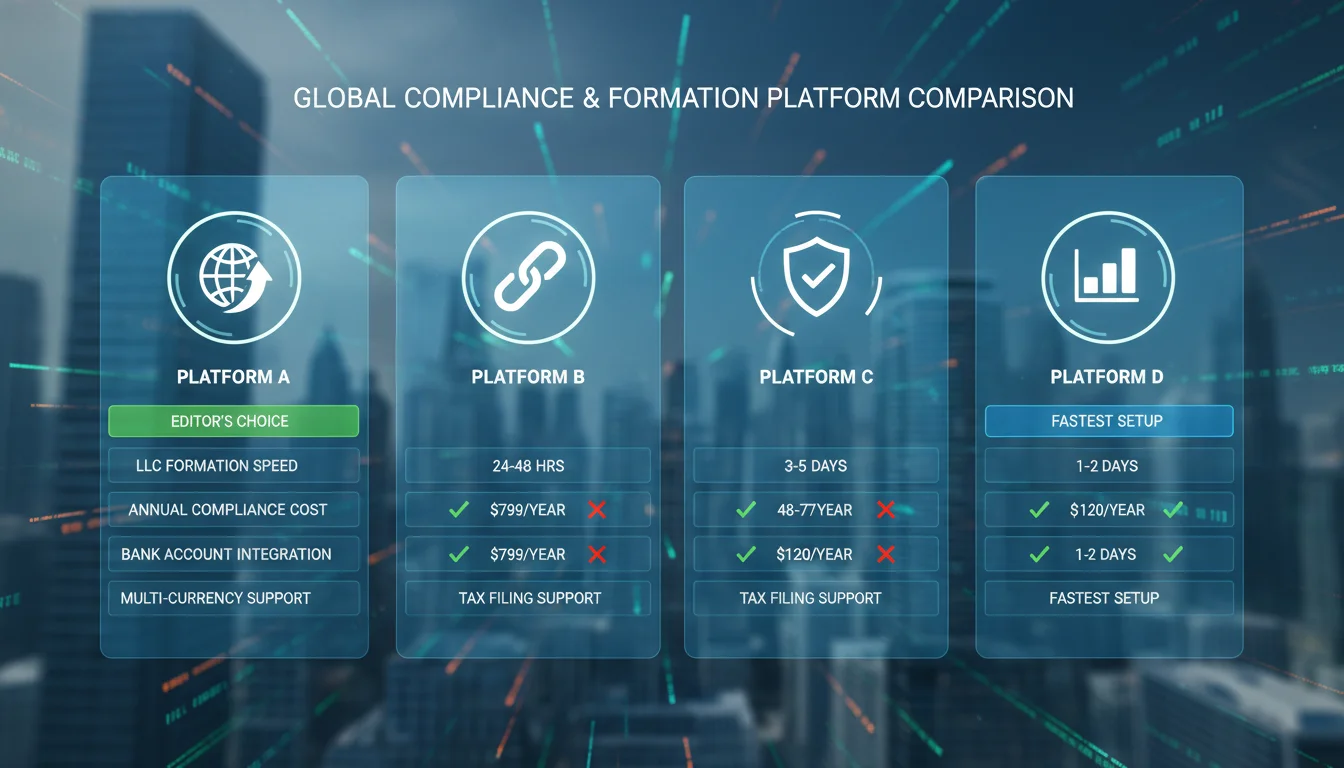
The profound friction involved in managing Registered Agents, EIN applications, state franchise taxes, bookkeeping, and the lethal Form 5472 requirement has spawned a massive, highly competitive ecosystem of “Business-in-a-Box” platforms and specialized tax compliance SaaS providers. The landscape is distinctly segmented into three categories based on target demographic, technological approach, and service depth.
Category 1: Tech-Led Formation & Automation Aggregators
These platforms prioritize speed, software integration, and a bundled, subscription-based approach to business management. They cater heavily to digital nomads, solo SaaS founders, and venture-backed startups seeking rapid deployment.
Doola
Positioning itself aggressively as a “Business-in-a-Box” explicitly tailored for global entrepreneurs, Doola heavily targets non-residents navigating the U.S. system. The platform manages the entire lifecycle, from Wyoming or Delaware formation and EIN acquisition without an SSN, to ongoing IRS filings and bookkeeping.
- Pricing Model: Doola operates on a premium, tiered subscription model. Its base compliance tier is $1,999/year, which covers essential annual state filings and crucial IRS tax forms like the 5472 and 1120 pro-forma. The comprehensive “Business-in-a-Box” tier, which integrates dedicated human bookkeeping, scales to $2,999/year. Assistance with ITIN acquisition is billed as a standalone service for $499.
- Strategic Profile: While Doola excels at centralizing operations and providing a hands-off, guided experience for foreign founders, its primary weakness lies in its financial infrastructure. It relies on a proprietary bookkeeping system rather than integrating natively with standardized software like QuickBooks or Xero, presenting potential scaling and data portability risks for high-growth firms.
Firstbase
Another high-growth, tech-forward platform, Firstbase focuses intensely on frictionless incorporation and immediate access to the U.S. banking and payments ecosystem, acting as a gateway to partners like Stripe and Payoneer.
- Pricing Model: Firstbase utilizes a modular, add-on pricing architecture. While initial formation is cost-effective, full compliance requires layering services. To address this, the “Firstbase One” bundle offers mailroom services, automated registered agent compliance, full accounting, and tax filing (including Form 5472) for $199/month (billed annually at $2,388). For founders only requiring tax filing for foreign-owned SMLLCs, the standalone package is $899/year. The dedicated accounting module operates on a sliding scale based on monthly expenses, reaching $4,800 annually for higher-volume businesses.
- Strategic Profile: Firstbase provides a highly polished, aesthetic user interface and robust startup rewards. However, it has faced public criticism on review platforms regarding extended customer support delays during complex foreign setups. Similar to Doola, it utilizes a proprietary, AI-driven accounting interface, prioritizing a simplified founder experience over standardized accounting flexibility.
Stripe Atlas
Backed by the global payments giant, Stripe Atlas remains the absolute gold standard for rapid Delaware C-Corp and LLC formation. It provides immediate, seamless integration with Stripe’s financial infrastructure and payment processing rails.
- Pricing Model: Atlas charges a flat $500 one-time setup fee, which includes state filing fees, followed by a $100/year registered agent fee.
- Strategic Profile: Atlas is fundamentally a formation and payment infrastructure tool, not a comprehensive back-office tax solution.
While it partners with premier firms like PwC to provide extensive tax guides, it places the burden entirely on the founder to secure independent tax and bookkeeping counsel. It is an exceptional tool for VC-backed founders with existing accounting teams, but highly dangerous for novice non-residents who might erroneously assume Stripe automatically handles their annual Form 5472 filings, leading to severe penalties.
-
Clemta: Targeting early-stage startups and e-commerce merchants, Clemta offers aggressive pricing and a highly integrated AI-copilot dashboard for compliance alerts, document storage, and invoicing.
- Pricing Model: The “Essentials” plan is highly accessible at $29/month ($349/year), covering the registered agent, mailing address, and basic financial tracking. The “Pro” plan at $89/month ($1,068/year) includes full IRS and state tax filings, making it one of the most cost-effective full-service options in the market.
- Strategic Profile: Clemta successfully occupies a strong middle ground, offering a robust software interface alongside managed tax filings at a significantly lower entry cost than premium platforms like Doola or Globalfy.
Category 2: CPA-Led and Specialized Advisory Platforms
These providers differentiate themselves from tech aggregators by prioritizing tax strategy, audit defensibility, and personalized, human-in-the-loop support over pure software automation.
-
Entity.inc (by Online Taxman): Born directly out of a seasoned CPA firm focusing exclusively on expatriate and non-resident tax scenarios, Entity.inc takes a highly consultative, tax-first approach to business formation.
- Pricing Model: An integrated bundle encompassing LLC setup, EIN acquisition, registered agent, and the first year of tax compliance costs approximately $1,578 (one-time). For established businesses, the ongoing tax and compliance package for a foreign-owned SMLLC is $799/year.
- Strategic Profile: Unlike tech-first competitors that rely heavily on chatbots or generalized support, Entity.inc provides direct, scheduled access to IRS-enrolled agents and CPAs. They offer active guidance through difficult bank account setups and complex tax treaty optimizations, making them ideal for founders with bespoke, high-value tax scenarios who require expert human oversight. Furthermore, their bookkeeping services are offered separately and utilize standard platforms like QuickBooks, ensuring data ownership.
-
Globalfy: Designed expressly to service non-resident e-commerce operators, dropshippers, and cross-border service providers, Globalfy blends robust software automation with dedicated human account management.
- Pricing Model: The “Essential” plan ($1,308/year) covers the registered agent, U.S. address, state renewals, and vital IRS tax returns (Form 5472 and 1120 pro-forma). The “Scale” plan ($5,028/year) elevates the service by adding full-service monthly bookkeeping and advanced financial oversight.
- Strategic Profile: A defining structural strength of Globalfy is its native integration with Xero for accounting purposes. This critical feature ensures the client retains an industry-standard general ledger, effectively sidestepping the proprietary software lock-in risks associated with Doola or Firstbase while still receiving white-glove support.
Category 3: Niche Tax and Document Preparation Software
For founders who already have their LLC established, possess clean bookkeeping, and simply require specific software intervention to generate complex cross-border tax forms, dedicated solutions fill a critical gap in the market.
- Sprintax: Historically dominating the market for international students and non-resident alien employees (J-1/F-1 visas), Sprintax offers robust, institutional-grade modules for Form 1040-NR preparation. Their “Sprintax Calculus” engine is highly effective for organizations managing complex multi-jurisdictional withholding and tax treaty analyses. Individual federal and state filings are priced efficiently, generally around $50-$60 per return.
- Form5472.online & 5472Direct: These platforms act as highly specialized, self-service portals explicitly designed to mitigate the friction of the 5472 and 1120 pro-forma filing process. Priced between $150 and $399, they guide users through the complex disclosure questionnaires and generate IRS-ready PDF documents, allowing founders to bypass the heavy annual retainers of full-service CPA firms.
- Mass-Market Software (FreeTaxUSA, TurboTax, H&R Block): While standard domestic software providers are highly capable for U.S. citizens, they are fundamentally inadequate for foreign founders. These platforms broadly lack native support for non-resident alien returns (1040-NR) and do not support the unique fax/mail submission mechanics required for a disregarded entity’s Form 5472. FreeTaxUSA explicitly states it does not support 1040-NR filings. Foreign founders attempting to utilize these domestic tools risk catastrophic non-compliance and severe IRS penalties.
Comparative Matrix of Leading Tax Compliance Ecosystems
| Provider | Target Demographic | Core Tax / Compliance Pricing (Annual) | Bookkeeping Architecture | Strategic Differentiator |
|---|---|---|---|---|
| Doola | Global tech founders | $1,999 (Compliance) / $2,999 (Box) | Proprietary platform | Deep integration of formation, banking, and tax. |
| Firstbase | Fast-scaling startups | $899 (Tax only) / $2,388 (Bundle) | Proprietary, AI-driven | Speed of setup, strong startup rewards network. |
| Entity.inc | Complex cross-border | $799 (Tax & Compliance) | Agnostic (QuickBooks) | CPA-led advisory, audit defense, treaty optimization. |
| Globalfy | E-commerce / Nomads | $1,308 (Essential) / $5,028 (Scale) | Xero Integration | Standardized accounting, broad operational support. |
| Clemta | Budget-conscious | $1,068 (Pro Plan) | Integrated Dashboard | Highly competitive pricing for full federal/state filing. |
| Stripe Atlas | VC-backed developers | $100 (Registered Agent only) | Bring-Your-Own | Instant Stripe access, superior legal document templates. |
Enterprise Solutions for Scaling Non-Resident Businesses
As a foreign-owned U.S. LLC scales beyond the startup phase, the compliance requirements multiply exponentially. High-volume e-commerce platforms, globally distributed SaaS companies, and firms processing payroll across multiple jurisdictions quickly outgrow basic “Business-in-a-Box” solutions. At this juncture, the integration of enterprise-grade compliance software becomes essential to maintain operational continuity and avoid debilitating audit risks.
Multi-State Nexus and Sales Tax Automation
The transition from a single-state operation to a multi-state enterprise triggers the complex mechanics of economic nexus. A foreign-owned LLC selling digital products or physical goods will inevitably cross revenue thresholds in multiple states, necessitating the collection and remittance of sales tax.
To manage this, enterprise tools such as Avalara AvaTax and TaxCloud are deployed. Avalara, for instance, provides a global tax engine that integrates directly into ERPs, e-commerce platforms (like Shopify and Adobe Commerce), and billing systems. It delivers highly accurate, real-time tax calculations across city, county, state, and international jurisdictions, automating the determination of whether a specific digital product is taxable in Texas versus California. TaxCloud offers similar localized capabilities, focusing heavily on U.S. state and local compliance, managing multi-state nexus tracking and exemption certificate management.
Cross-Border Withholding and Advanced Tax Determination
For LLCs that mature into partnerships or corporations, or those that hire a globally distributed workforce, managing international withholding taxes (such as dividend withholding tax or DWT) becomes a significant operational hurdle. Payments to foreign vendors, contractors, and non-resident employees require rigorous analysis to ensure compliance with IRS regulations and bilateral tax treaties.
In these scenarios, platforms like Thomson Reuters ONESOURCE International Tax Navigator and Sprintax Calculus are critical. ONESOURCE analyzes complex immigration, tax, and treaty rules to automate the production of required IRS withholding certificates, 1042 tax returns, and 1042-S reporting forms. Sprintax Calculus serves a similar function, offering a cloud-based engine that simplifies tax residency determination (conducting the substantial presence test) and ensures accurate tax withholding at the source before funds are dispersed to non-resident stakeholders.
These enterprise solutions require significant capital investment but are fundamentally necessary to mitigate the severe liabilities associated with cross-border payroll and multi-jurisdictional tax evasion.
Future Outlook and Strategic Recommendations
The regulatory environment governing foreign capital operating within the United States is characterized by tightening enforcement mechanisms offset by rapidly evolving technological solutions. The IRS is increasingly utilizing advanced data analytics and cross-border financial data sharing (mandated under the Foreign Account Tax Compliance Act, FATCA) to proactively identify non-compliant foreign-owned entities. The aggressive, uncompromising $25,000 penalty associated with Form 5472 reflects a zero-tolerance federal policy for informational opacity regarding foreign ownership.
Simultaneously, the dramatic 2025 rollback of FinCEN BOI requirements for domestic entities removes a significant administrative and privacy burden from the shoulders of U.S.
This regulatory divergence—easing AML compliance for domestic formation while maintaining excruciatingly strict IRS tax disclosures—requires foreign founders to maintain a highly nuanced, multifaceted understanding of the varying federal agencies governing their businesses.
Strategic Imperatives for the Foreign Founder
- Acknowledge the Supremacy of Form 5472: Founders must permanently decouple the concept of “tax liability” from “reporting requirements.” Even if an LLC operates at a net loss, generates exclusively foreign-sourced income, or acts merely as a dormant holding shell, any nominal movement of capital triggers the Form 5472 filing mandate. Budgeting for professional tax preparation or specialized software is not an optional luxury; it is the absolute baseline cost of utilizing the U.S. financial system.
- Reject Vendor Lock-In for Accounting Data: Startups anticipating rapid growth, outside venture investment, or future acquisition should strictly avoid tech platforms that rely entirely on proprietary, closed-ecosystem bookkeeping software. Integrating a U.S. business bank account directly into an open-architecture general ledger (like Xero or QuickBooks) ensures that critical financial records remain portable, auditable, and transparent to external stakeholders and CPAs.
- Optimize Jurisdictional Architecture: E-commerce operators and SaaS founders must vigilantly monitor state-level economic nexus thresholds to avoid cascading, multi-state sales tax liabilities. Furthermore, the selection of the formation state (Wyoming for ongoing cost reduction and privacy, Delaware for institutional capital raising) should align tightly with the company’s 36-month operational roadmap, as rectifying a suboptimal state selection via foreign qualification or corporate dissolution is excessively costly and time-consuming.
Ultimately, the technological democratization of U.S. business formation has vastly outpaced the simplification of cross-border tax law. While SaaS platforms have effectively reduced the friction of launching a U.S. LLC to a few clicks, the burden of perpetual compliance remains heavy. Foreign entrepreneurs who treat their U.S. tax infrastructure as a strategic operational pillar, rather than an administrative afterthought, will effectively mitigate enterprise risk, navigate the complexities of the IRS, and secure their long-term commercial viability in the American market.