The Flipped Classroom in Nepal: Can It Work Without Fast Internet?
The standard way we teach in Nepal has been the same for 50 years:
- In Class: Teacher talks for 45 minutes. Students take notes silently.
- At Home: Students try to solve difficult problems alone. They get stuck. They give up.
This is backwards. We are sending students home to do the hardest part (application) without help, while we spend the precious class time doing the easiest part (delivery).
graph TD
    subgraph Traditional Model
        T1["In Class: Lecture"] --> T2["At Home: Problems"];
        T2 --> T3["Stuck / Give Up"];
    end

    subgraph Flipped Model
        F1["At Home: Watch Video"] --> F2["In Class: Group Work"];
        F2 --> F3[Teacher Guides];
    end
Figure 1: Traditional vs. Flipped Classroom Process
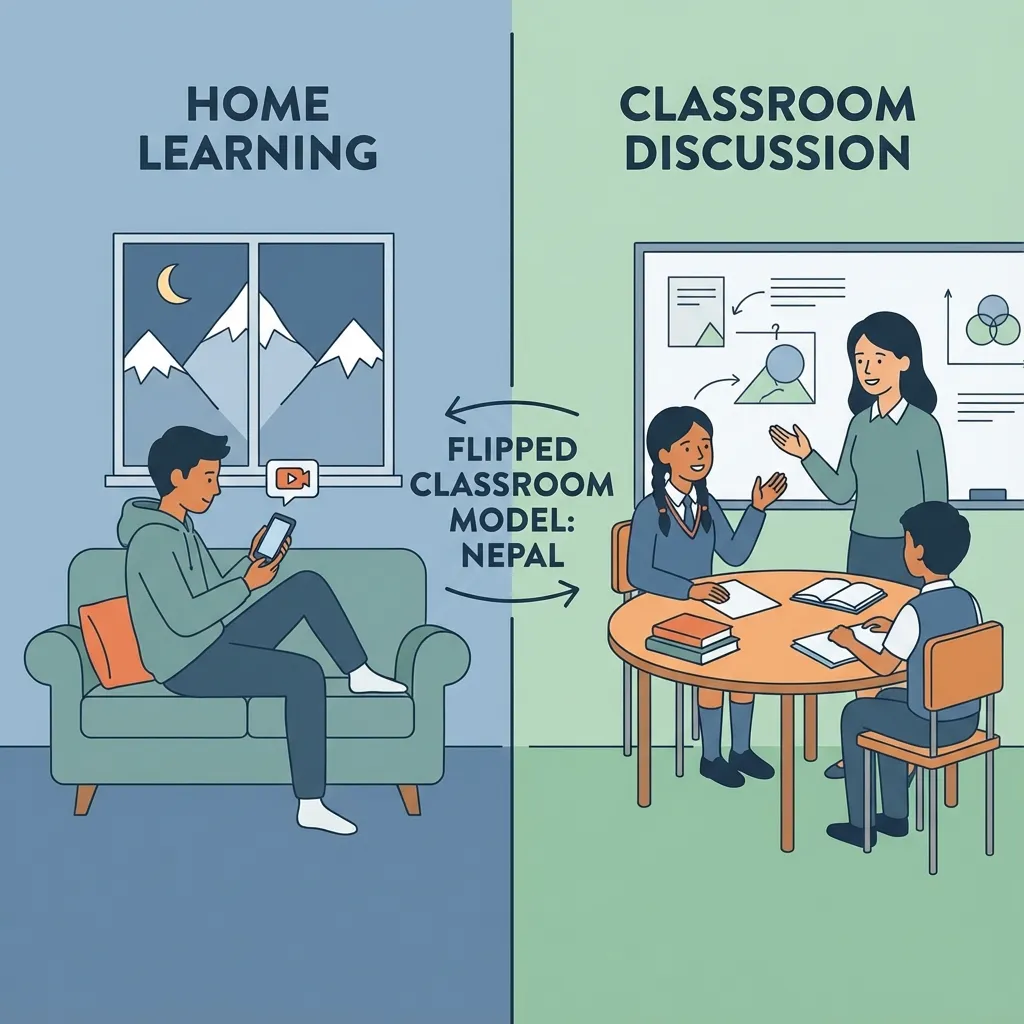
Enter The Flipped Classroom.
How It Works
- At Home: The student watches a 10-minute video explaining the concept (e.g., Newton’s Laws).
- In Class: The teacher doesn’t lecture. Instead, students work in groups to build a balloon rocket. The teacher walks around helping those who are stuck.
“But Sir, Data Pack is Expensive!”
This is the #1 objection. “My students don’t have WiFi.”
Here is how the Teacher Developer solves this:
- Don’t Stream, Share: Don’t send a YouTube link. Download the video. Put it on the student’s phone via SHAREit or Bluetooth before they go home.
- Audio Only: A 5MB audio file is cheaper than a 100MB video. Record a voice note on WhatsApp creating a “Podcast Lecture.”
- The “In-Class Flip”: If homework is impossible, divide the class. Group A watches the video on a laptop in the corner while you help Group B. Then switch.
mindmap
  root((Low Internet Solutions))
    Don't Stream, Share
      Download Video
      Use SHAREit/Bluetooth
    Audio Only
      WhatsApp Voice Notes
      "Podcast Lecture"
      Lower Data Cost
    "In-Class Flip"
      Divide Class
      Rotate Groups
      Laptop for Content
      Teacher for Help
Figure 2: Strategies for Flipped Classroom with Limited Internet
Why Flip?
Because passive listening is not learning. When you lecture, you are the “Sage on the Stage.” When you flip, you become the “Guide on the Side.”
You stop being a broadcaster and start being a mentor. And isn’t that why you became a teacher?
Related Posts and Resources
- Low-Tech, High-Impact Teaching in Nepal
- Coding for Teachers in Nepal
- Data-Driven Grading for Educators
- Open-Source Schools in Nepal
- Gamification in Nepali Classrooms
- Cyber Hygiene for Students and Teachers
- CS Unplugged Activities in Nepal
- School Wi-Fi Budget Planning
- AI-Based Assessment in Nepal
- Digital Marketing in Nepal (Complete Guide)