Facebook Organic Reach Decay 2026: Study & Analysis
The Decay of Facebook Organic Reach in 2026: Analyzing 10,000 Agency Posts
The Epoch of Algorithmic Curation and the End of the Social Graph
The digital marketing landscape of 2026 is defined by a fundamental paradigm shift: the irrevocable transition of social media networks from chronological social graphs into artificial intelligence-driven discovery engines. Nowhere is this transformation more pronounced, or its effects more deeply felt by digital agencies and global brands, than on Meta’s flagship platform, Facebook. For over a decade, marketing professionals have observed a consistent, precipitous attenuation in organic visibility. However, empirical data synthesized in 2026 illustrates that organic reach on Facebook has not merely declined; it has been fundamentally engineered out of the default public broadcasting model. This is not an accident of platform architecture, but a deliberate, sophisticated maturation of a network balancing the dual imperatives of user retention and aggressive revenue maximization.
Through the rigorous analysis of benchmark datasets—often standardized around cohorts of 10,000 agency and brand posts—it becomes undeniably evident that traditional metrics of volume and follower accumulation no longer correlate with content distribution. In the contemporary ecosystem, the concept of “10,000 posts” serves multiple pivotal roles in understanding the platform’s mechanics.
- First, it represents the absolute upper limit of the content pool the Facebook algorithm scans during a single user session, illustrating the sheer scale of content saturation.
- Second, it serves as a robust benchmark for quantitative studies analyzing the epistemological shift from legacy impressions to modernized view metrics.
- Third, it operates as a psychological trigger in the broader social media environment; agencies frequently leverage the data-driven hook “We analyzed 10,000 posts and found this” to instantly establish credibility, halt user scroll velocity, and capture attention in an era where visibility is fiercely contested.
This comprehensive research report exhaustively examines the structural decay of Facebook organic reach in 2026. By synthesizing platform mechanics, algorithmic filtering parameters, format-specific performance metrics, user behavioral shifts across generations, and advanced omnichannel attribution modeling, the ensuing analysis provides a nuanced, strategic blueprint for navigating a digital ecosystem where visibility must be either surgically optimized through deep relevance or explicitly purchased through media expenditure.
The Quantitative Reality of Facebook Organic Reach in 2026
To truly comprehend the magnitude of the organic reach decay, one must first confront the baseline mathematical realities governing the platform. The historical era in which a brand could predictably reach a double-digit percentage of its Page audience without capital investment is definitively over. Current global benchmark data, compiled through the analysis of over 70 million posts across major platforms, indicates that organic reach for Facebook Pages has collapsed to a terminal baseline ranging between 2% and 5% of a Page’s total follower count per post, with some studies placing the median even lower at under 2.5%. Some granular analyses of specific industries suggest that average Facebook Page post reach has eroded to approximately 2.6%, meaning that perhaps only one in forty of a Page’s acquired fans will see an update organically.
The practical implications of these percentages for day-to-day agency operations are stark. For a digital agency managing a brand Page with precisely 10,000 followers, achieving an organic reach of 300 unique users on a standard post is no longer considered a failure; it is considered performing perfectly “on-benchmark”. When translated from raw reach into actionable, verifiable engagement, the numbers become even more sobering. The median engagement rate across all Facebook Pages in 2026 sits at an extraordinarily low 0.15%, a figure that has remained functionally flat year-over-year after declining gradually from historical highs.
Consequently, a post distributed to an audience of 10,000 followers will yield, on average, a mere 2 to 7 total interactions. As industry analysts have poignantly noted, a brand could theoretically generate higher engagement by simply texting a small group of personal acquaintances. This statistical reality represents a massive differential when contrasted with paid social distribution. A modest expenditure of $100 in Facebook advertising reliably guarantees a targeted reach of 8,000 to 25,000 users, whereas organic efforts yield approximately 150 to 210 organic viewers per 10,000 followers. This calculates to a factor difference of 40 to 120 in reach efficiency, cementing the platform’s status as a pure “pay-to-play” environment for standard commercial broadcasting.
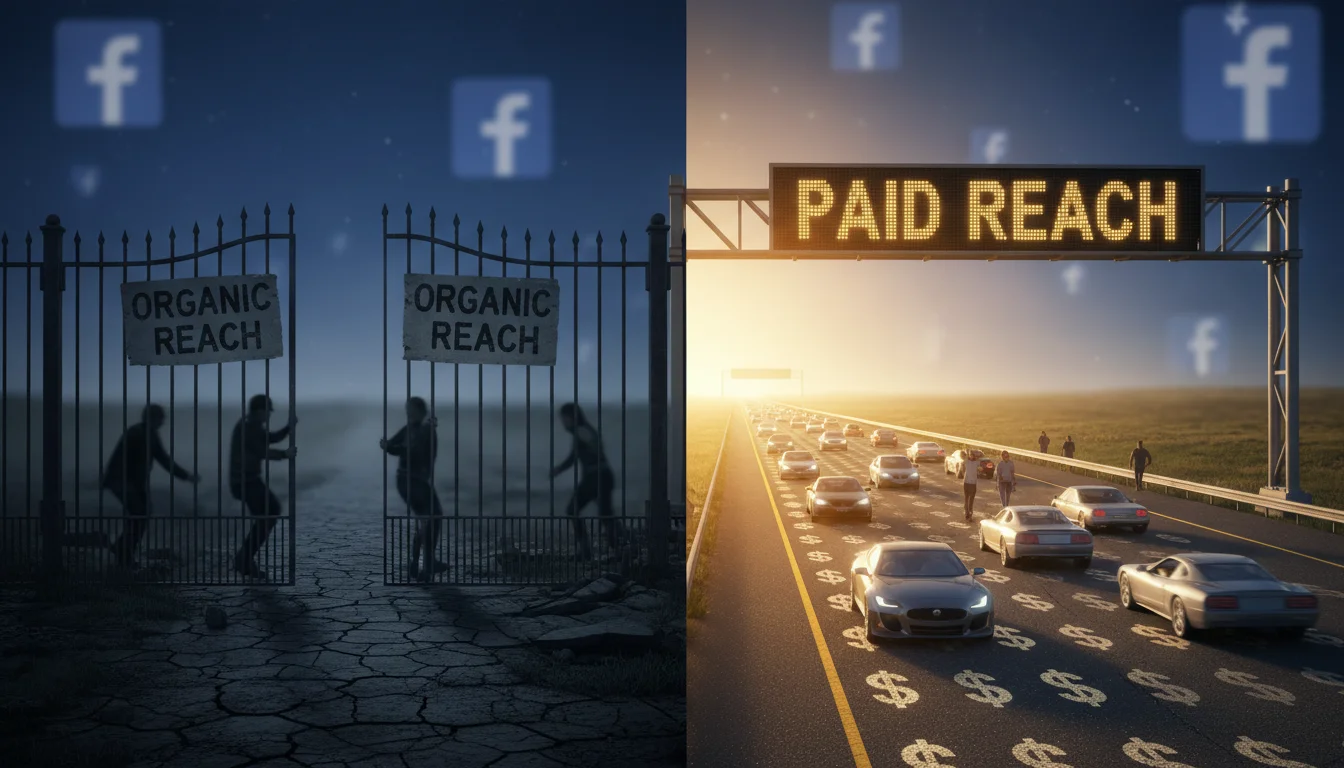
To contextualize the performance metrics of an average Facebook Page in 2026, the following table aggregates the primary key performance indicators across the industry:
| Facebook Performance Metric | 2026 Industry Benchmark | Strategic Context and Agency Implication |
|---|---|---|
| Average Organic Reach | 2.0% - 5.0% | The terminal baseline for non-paid public broadcasting; reaching 300 users per 10,000 followers is standard. |
| Median Engagement Rate | 0.15% | Indicates a total transition from active brand interaction to passive consumption across the network. |
| Average Likes per Post | 255 | A vanity metric heavily skewed by viral anomalies and massive legacy accounts, rendering it an unreliable daily target. |
| Average Comments per Post | 22 | Reflects a broader, multi-platform industry decline in public conversational participation in favor of private sharing. |
| Average Shares per Post | 28 | Represents the single most heavily weighted metric for extending algorithmic distribution beyond the initial seed audience. |
| Reels Engagement Rate | 0.22% | Demonstrates the algorithmic prioritization of short-form video, driven by dedicated discovery feed placements. |
Despite this fractional engagement rate, the underlying paradox that keeps agencies tethered to the platform is that Facebook’s raw, absolute distribution potential remains utterly massive. The platform continues to support over three billion monthly active users. Furthermore, Meta’s corporate filings for the fourth quarter of the preceding year confirmed continued increases in both total users across its Family of Apps and a significant jump in overall revenue, underscoring its dominant market position. Because the user base is so large, a single algorithmic signal cascading into a viral threshold can still push a post into hundreds of thousands of feeds instantaneously. Therefore, the metrics that matter on Facebook have fundamentally bifurcated. Agencies can no longer optimize for superficial metrics; they must optimize explicitly for shares, saves, and distribution triggers.
The Architecture of the Algorithmic Engine: Analyzing the 100,000-Factor Machine
The decay of organic reach is not an accidental byproduct of user growth; it is the deliberate, mathematically unavoidable outcome of an increasingly sophisticated, machine-learning-driven filtering engine designed to combat extreme content saturation. Every minute, an insurmountable volume of content is published across the network. To prevent user churn caused by feed overload, Facebook relies heavily on artificial intelligence to aggressively curate the user experience.
The Inventory Scan and the 10,000-Post Predictive Funnel
The architecture of the Facebook algorithm operates through a massive predictive funnel that initializes the moment a user opens the application. The system immediately identifies the total possible “inventory”—all posts published in the past week by the user’s friends, followed creators, joined Groups, and liked business Pages. For the average active user, this initial inventory pool typically comprises between 1,500 and 10,000 unique pieces of content.
To rank these 10,000 potential posts in the fraction of a second before the feed renders, the artificial intelligence engine springs into action, utilizing an estimated 100,000 distinct ranking factors. This constantly updating mathematical formula is influenced by both automated machine learning models and qualitative human feedback. Meta actively taps into a cohort of over 700 human reviewers distributed across the United States who provide ongoing, manual feedback on how well the platform is delivering genuinely interesting and relevant posts to their feeds, ensuring the algorithm does not become entirely detached from human sentiment.
The Triad of Algorithmic Signals
The ruthless reduction of up to 10,000 posts down to a curated, highly engaging feed relies on three primary categories of algorithmic signals:
- Post-Specific Signals: The algorithm evaluates the inherent metadata of the content in real-time. This includes identifying the publisher, the timestamp, the format (video, image, external link, text status), and critically, the initial velocity of engagement it has received from its early seed audience. If a post fails to generate immediate dwell time from the first fraction of a percent of followers who see it, its distribution is instantly halted.
- Relationship Mapping and Affinity: The system deeply analyzes the historical relationship between the user and the publishing entity. It measures the frequency of past interactions, the recency of those interactions, and the qualitative nature of the engagements. Because the system weights actions differently, a user who frequently shares a Page’s content will almost certainly see their next post, whereas a user who only scrolled past the last ten posts will be algorithmically severed from that Page’s organic distribution.

Predictive Behavioral Modeling
Machine learning algorithms analyze a user’s micro-behaviors, including dwell time patterns and content type affinities. If a user consistently pauses to watch short-form video but immediately scrolls past external links, the algorithm mathematically deprioritizes link posts for that specific user, entirely regardless of the publisher’s follower count or brand authority.
The Relevancy Score and the Meaningful Social Interaction Directive
Every piece of content evaluated in the 10,000-post inventory is assigned a dynamic “relevancy score.” Content with high predictive value for specific users is elevated to the top of the feed, while generic brand broadcasting is actively suppressed. This dynamic explains why a drop in organic reach is not strictly a “failure” of the marketing team, but rather a reflection of the network rewarding hyper-relevance over high-volume publishing.
The genesis of this specific suppression architecture can be traced directly back to January 2018, when Meta CEO Mark Zuckerberg announced a major News Feed overhaul pledging to promote “Meaningful Social Interactions” (MSI). This directive explicitly mandated that the algorithm prioritize personal content from friends and family over branded posts and publisher content. In the years following this directive, the platform also began severely penalizing “engagement baiting”—the practice of explicitly asking users to vote, react, or share to artificially inflate reach. Agencies that attempt to circumvent the MSI directive through artificial engagement tactics find their organic reach throttled to near zero.
Furthermore, the algorithm has shifted aggressively toward becoming an AI-curated discovery feed, emulating the highly successful behavioral mechanics of its primary competitor, TikTok. In Meta’s major updates late in the previous year, the company reported that its refreshed recommendation engine now surfaces approximately 50% more Reels from unconnected creators—specifically those who published within the last 24 hours—directly into the default user feed. This massive injection of unconnected, highly engaging video content inherently crowds out organic posts from followed brand Pages, mathematically ensuring the continuous decay of traditional Page reach. The inclusion of user-controlled negative feedback loops, such as the “Not Interested” button, further refines this AI curation, actively filtering out product-centric brand content in favor of authentic, creator-led narratives.
The Epistemological Transition from Impressions to Views
In response to the algorithmic evolution favoring short-form video and active visual consumption, Meta implemented a profound structural change to its analytics dashboard in 2026, transitioning the primary currency of visibility from “Impressions” to “Views”. This is not merely a semantic or superficial update; it represents a fundamental epistemological shift in how digital agencies measure the decay and potential of their organic reach, and it requires a complete recalibration of historical benchmarking data.
Historically, the distinction between reach and impressions caused significant friction in campaign reporting and ROI calculations. “Reach” represents an estimated metric measuring the absolute number of unique human accounts that viewed a post, whereas “Impressions” represent the total number of times a post was rendered on a screen, encompassing multiple viewings by the exact same individual. This distinction creates the concept of frequency. For example, a campaign with 10,000 reach and 10,000 impressions indicates zero repetition (a frequency of exactly 1.0), meaning it reached a wide audience but lacked repetition. Conversely, a campaign with 1,000 reach and 10,000 impressions indicates extremely high audience penetration and repetition (a frequency of 10.0), but severely limited audience expansion.
The introduction of the unified “Views” metric was ostensibly designed to streamline reporting across diverse content formats, putting static images and text on a comparable playing field with video content. However, an empirical analysis of 10,000 posts conducted by Fanpage Karma reveals that this transition artificially inflated baseline reporting metrics due to how the platform technically registers visual consumption.
Quantitative discrepancies between the new Views metric and legacy Impressions are massive:
- Short-Form Video (Reels): Saw a staggering 50% increase in reported Views compared to legacy Impressions.
- Carousel Posts: Experienced a highly significant 44% increase in reported volume.
- Static Images: Saw a 23% increase in reported volume.
While Meta’s technical documentation asserts that views for static images and carousels should theoretically match historical impressions, the algorithmic reality of repeat scrolling, nuanced dwell time tracking, and auto-looping mechanics dictates otherwise. Consequently, agencies must completely recalibrate their historical reporting dashboards. A post that achieved 10,000 impressions in 2024 cannot be directly or honestly compared to a post achieving 10,000 views in 2026; the latter actually represents significantly less absolute human reach due to the mathematically inflated nature of the new metric. Understanding this discrepancy is vital for agency analysts to prevent false-positive reporting regarding the stabilization of their organic reach efforts.
Format-Specific Performance: Anomalies in the Content Hierarchy
As the algorithm becomes increasingly stringent and the inventory pool of 10,000 posts becomes more competitive, the structural format of the content published strictly dictates its probability of survival in the News Feed. Analyzing engagement data across millions of posts reveals surprising counter-narratives to popular digital marketing assumptions. While short-form video dominates the broader cultural conversation, legacy text and image formats exhibit unique behavioral triggers that clever agencies successfully exploit to bypass algorithmic decay.
The Paradoxical Dominance of Status Posts
In an ecosystem seemingly obsessed with high-production video and visual stimuli, purely text-based “Status” posts have miraculously emerged as the top-performing content format for sparking meaningful conversations. While they rarely generate the highest raw reach or viral distribution, Status posts absolutely dominate engagement metrics, particularly for mid-to-large-sized Facebook accounts.
The underlying reasoning for this anomaly is deeply tied to algorithmic dwell time and the aforementioned Meaningful Social Interactions (MSI) mandate. A compelling, well-copywritten text post forces the user to stop scrolling, read, and cognitively process the information. This extended dwell time sends a powerful signal to the machine learning engine that the user is actively consuming the content rather than passively swiping. Furthermore, Status posts naturally invite debate, questions, and replies, yielding the highest density of comments among all formats. Because the algorithm weights comments and heavily threaded replies exponentially higher than passive likes, a Status post that generates 50 localized comments will ultimately achieve far greater organic distribution than a highly produced image that receives 500 passive likes.
The Resurgence of the Photo Album for Small Pages
Conversely, for smaller Pages—specifically those struggling with fewer than 10,000 followers—the traditional Photo Album represents the absolute highest-performing asset class. The utility of the Album format lies in its interactive friction. Albums naturally encourage, and physically require, users to click into the collection and actively swipe through multiple images to consume the narrative. Each individual swipe and image click is registered by the algorithm as a distinct, active engagement signal. Therefore, a single user looking at ten photos generates ten micro-engagement signals, rapidly accumulating a massive relevancy score for that specific post. Furthermore, data indicates that Albums lead the way across all Page sizes in generating organic shares, making them a critical, underutilized tool for penetrating new audience networks beyond a Page’s stagnant, decaying follower base.
The Severe Penalty for Outbound Links
Conversely, the most heavily and consistently penalized content format in 2026 remains the external link post. Facebook’s entire economic model relies on maximizing and retaining user attention within its walled garden in order to serve paid advertisements. Therefore, the algorithm actively and aggressively suppresses any organic content designed to pull users away from the ecosystem to an external website or blog. Agencies attempting to drive web traffic through organic link posts experience the most severe reach decay imaginable.
The prevailing strategy to circumvent this structural penalty involves posting high-value native content—such as infographics, native video, or deep-dive text posts—and placing the external link within the first comment of the post. This allows the primary post to accrue native reach unhindered by the link penalty, directing interested users to the comment section for further reading. However, even this tactic yields diminishing returns as the machine learning models increasingly learn to identify and suppress the intent behind “link in comments” behavior.
The Ascendance of Facebook Reels and the Economics of Video
While Status posts and Albums drive deep, meaningful engagement with a brand’s existing follower base, Facebook Reels represent the sole reliable, scalable mechanism for expanding organic reach to completely new, non-follower audiences.
The shift toward video is absolute; video content now represents an astounding 60% of the total time users spend on the Facebook platform globally. While that time is distributed across live streams and long-form native video, Meta has explicitly confirmed that “Reels remains the primary driver of that growth”.
The algorithmic treatment of short-form Reels is completely distinct from the treatment of static Page posts. Reels bypass the traditional, decayed follower graph entirely and are injected directly into the main feed via the AI recommendation engine, operating on an interest-graph model rather than a social-graph model. Consequently, the median engagement rate for Reels sits at 0.22%, which is noticeably higher than the 0.15% average for overall static Page content.
Interestingly, Reels engagement rates fundamentally invert the traditional follower-size decay curve. In traditional social media mechanics, as an account’s follower base grows larger, its average engagement rate proportionally drops due to audience dilution. For non-Reels content, this historical rule still holds true. However, for Reels, larger accounts (those with more than 50,000 followers) achieve an average engagement rate of 2.18%, compared to just 1.55% for small accounts with under 2,000 followers. This counter-intuitive data suggests that once an account achieves a critical mass of algorithmic authority and historical trust, the AI engine acts as a massive distribution multiplier for its short-form video content, heavily favoring established creators over unproven entities. Furthermore, for accounts operating in these “bigger leagues,” Reels absolutely dominate when it comes to comment counts, pulling in far more audience reactions than both Carousels and static images.
The economic incentives driving this algorithmic preference are clear. We exist in a mature content economy, and Meta is aggressively doubling down on its role as a central marketplace for creators. The financial opportunities have scaled proportionally; recent data indicates that the number of content creators generating over $10,000 monthly from the platform grew by an astonishing 88% year-over-year. Meta has facilitated this by introducing expansive new monetization avenues. Creators can now earn revenue from short-form video ads (pre, mid, post-roll, and image ads on videos as short as one minute), whereas previously only videos exceeding three minutes were eligible. The platform has also loosened eligibility requirements, allowing Pages with 600,000 total minutes of video viewed to qualify for in-stream ads, and expanding live video ad eligibility to creators with just 60,000 live minutes viewed in the last 60 days. This economic architecture guarantees that Meta will continue to algorithmically prioritize the video formats that directly generate ad inventory.
Volume vs. Relevance: Redefining Posting Frequency and the Spam Penalty
A profound second-order effect of the organic reach collapse is the fundamental shift in content production volume by professional agencies. Historically, agencies combated low reach by artificially inflating their posting frequency, operating under the flawed assumption that publishing five times a day would aggregate into a meaningful daily reach figure. In the 2026 algorithmic environment, this strategy is not only ineffective but actively detrimental to long-term account health.
The current algorithm views rapid-fire, low-engagement posts as technical spam. When a Page publishes multiple times a day and receives negligible engagement, the system subsequently lowers the overall “Page Quality” score. This internal demotion ensures that future posts are algorithmically suppressed before they even enter the 10,000-post inventory evaluation pool. Recognizing this severe penalty, brands and agencies have significantly reduced their raw output. Year-over-year data indicates a massive 22.00% reduction in brand posting volume on Facebook, with the average Page currently publishing approximately 39 posts per month.
This reduction in volume reflects a strategic, industry-wide pivot toward quality over quantity. Agency resources previously allocated to churning out daily, generic graphics are now consolidated into producing high-value, highly resonant content designed specifically to trigger saves, shares, and extended watch time. The updated, data-backed consensus on optimal frequency dictates a significantly reduced cadence. Hootsuite’s exhaustive 2026 findings recommend a publishing frequency of just 1 to 2 Facebook posts per day. Other industry analysts suggest an even leaner approach of 3 to 5 highly curated posts per week. The era of posting merely to maintain a pulse is over; every piece of content must justify its existence through relevance.
The Omnichannel Ecosystem and Cross-Platform Benchmarks
To fully contextualize the decay of Facebook’s organic reach, one must examine it against the broader omnichannel ecosystem. The fragmentation of user attention across multiple highly specialized platforms requires agencies to deeply understand comparative benchmarks. Facebook does not operate in a vacuum, and the 0.15% engagement rate is particularly glaring when viewed alongside its competitors.
The following table provides a comprehensive overview of 2026 engagement benchmarks across the major social networks:
Social Platform: Average Engagement Rate, Optimal Posting Frequency, Strategic Core Format
TikTok: 3.70% (Up 49% YoY), 1 to 3 posts daily, Short-form video (Discovery focus)
Instagram: 0.48% to 0.50%, 3 to 5 posts weekly, Reels (60-70%) & Carousels (20-30%)
LinkedIn: High variance (B2B focus), 1 to 2 posts daily, PDF Carousels (21.77% median eng.)
Facebook: 0.15%, 1 to 2 posts daily, Status Posts, Reels, Albums
X (Twitter): 0.05%, 2 to 3 posts daily, Real-time text / Trending commentary
This data reveals critical shifts in consumer behavior. TikTok’s engagement rate sits at a staggering 3.70%, having grown by 49% year-over-year. This growth is mirrored by a 45% increase in shares per post on TikTok, indicating a highly active, culturally resonant user base. Conversely, while Facebook struggles at 0.15%, it still outperforms the 0.05% engagement rate observed on X (formerly Twitter).
A highly notable trend across almost all platforms—specifically noted on TikTok (down 24%) and Instagram (down 16%)—is a universal drop in the average number of comments per post. This suggests a macro-level shift toward more passive engagement and private sharing via Direct Messages (DMs) rather than public dialogue. The only major exception is LinkedIn, which is experiencing a renaissance in professional engagement. Driven by the introduction of AI-assisted messaging—which users accept 44% more often than standard messages—and the massive success of PDF carousels, 85% of B2B marketers now report that LinkedIn delivers their highest social media ROI.
The Evolution of Social Search
Perhaps the most critical cross-platform behavioral shift impacting organic reach is the evolution of social search. Social media platforms are rapidly becoming the primary discovery engines for younger demographics. According to Sprout Social’s 2024 Social Content Strategy Report, over a quarter of social users from every generation turn to Instagram to find their next purchase, and TikTok operates as a primary search engine for Gen Z seeking real-world experiences and peer reviews. Furthermore, massive shifts in consumer purchasing behavior indicate that 1 in 7 global shoppers plan to primarily shop directly on social media within the next five years.
This reframes what organic visibility means. Winning organic reach now depends entirely on how accurately a brand’s content matches what people are actively searching for, rather than what they passively scroll past. Consequently, the optimization of content for Social SEO (Search Engine Optimization) and AEO (Answer Engine Optimization) is paramount. With Google now actively indexing public Instagram content and short-form videos from diverse platforms, agencies must pivot to keyword-rich, highly descriptive copy.
This is particularly evident in modern hashtag strategies. A small, hyper-targeted hashtag strategy is now the key to unlocking latent organic reach. Agencies have discovered that utilizing a niche tag containing roughly 10,000 total posts is exponentially more valuable than utilizing a generic tag with 10 million posts. The highly specific tag guarantees placement in front of a high-intent user actively searching for that niche, combining broad discoverability with targeted relevance.
The Sanctuary of Micro-Communities: The Facebook Group Imperative
As the traditional Facebook Business Page morphs into an ineffective broadcasting tool, the center of organic gravity and community building has migrated heavily toward Facebook Groups. Groups operate on a fundamentally different algorithmic architecture compared to public Pages, optimized explicitly for deep community engagement, shared identity, and peer-to-peer interaction rather than commercial broadcasting.
The divergence in baseline reach is staggering and mathematically undeniable. While Business Page posts languish at an organic reach of 2% to 5% of their followers, posts published within active Facebook Groups routinely achieve an organic reach of 30% to 60% of total group members.
The Psychology and Mechanics of Group Algorithm Dominance
This tenfold increase in visibility is rooted entirely in user intent. When an individual actively chooses to join a Group, they provide a definitive, high-confidence signal to the algorithm regarding their specific interests.
The AI engine subsequently prioritizes Group content in the primary News Feed because empirical, historical data proves that users dwell longer, comment more frequently, and report significantly higher platform satisfaction when interacting within these curated micro-communities.
For brands and agencies, the strategic response has been the rapid engineering and deployment of “branded communities.” Rather than attempting to push product messaging through a dead Page feed, forward-thinking marketers are establishing niche, value-driven Groups tailored to their target demographics. However, executing a Group strategy requires nuanced, labor-intensive community management. The algorithmic rewards of 60% reach dissipate instantly if a Group devolves into a thinly veiled promotional channel. Success requires brands to show up consistently with helpful insights, foster organic peer-to-peer discussions, and strictly moderate spam.
Furthermore, advanced social listening tools—such as Hootsuite’s extensive tracking capabilities—are increasingly deployed to monitor public Groups for positive brand mentions, allowing agencies to capture and amplify user-generated advocacy without resorting to hard sales tactics.
Redefining ROI: Advanced Attribution Modeling in a Low-Reach Era
The most critical operational challenge facing digital agencies in 2026 is not merely navigating the technical algorithmic decay, but justifying the ongoing expenditure of resources to clients on a platform that yields a 0.15% median engagement rate. Communicating true business impact requires moving entirely away from rudimentary vanity metrics (likes and followers) and embracing highly sophisticated social media attribution models. When a post reaches only 300 out of 10,000 followers, the agency must be able to prove the exact, fractional financial value of those 300 impressions. This requires a transition from isolated, platform-specific channel reporting to holistic omnichannel attribution mapping.
Linear vs. Time Decay Attribution Frameworks
Tracking the modern consumer journey requires acknowledging the complex reality that a Facebook organic post is rarely the sole, final driver of a conversion; rather, it is a single touchpoint operating within a massive, interconnected ecosystem. Agencies rely on distinct, data-driven attribution models to distribute credit appropriately:
- Linear Attribution: This model assigns equal mathematical credit to every interaction a user has prior to a conversion. If a user views a Facebook post, subsequently watches an Instagram Story, and finally clicks a LinkedIn ad to make a $1,000 purchase, the Facebook organic post, the Instagram Story, and the LinkedIn ad each receive exactly 33.3% of the conversion credit. This model is highly beneficial for establishing baseline utility for organic efforts, demonstrating to stakeholders that even low-reach, top-of-funnel posts maintain a necessary presence in the customer journey.
- Time Decay Attribution: A significantly more sophisticated model that algorithmically weights touchpoints based on their temporal proximity to the final conversion. Under this specific framework, an interaction occurring within 24 hours of a conversion may receive 40-50% of the credit. Interactions occurring within 7 days receive 20-30%, interactions within 30 days receive 10-20%, and older interactions receive 5-10%. If a user liked an organic Facebook post three weeks prior to clicking a highly targeted retargeting ad, the organic post still registers fractional financial credit, mathematically validating the agency’s long-term brand awareness efforts.
- First-Touch and Last-Touch Models: These legacy models assign 100% of the credit to either the very first interaction (validating pure discovery) or the absolute final interaction (validating the final closing asset). While less nuanced, they are frequently utilized by specialized reporting tools like Agency Analytics to establish the specific value of final conversion points.
The Implementation of Organic Value Configuration
To further solidify the ROI of organic social media, enterprise-level agencies have universally adopted “Organic Value Configuration” frameworks within their analytics suites. Rather than reporting to corporate stakeholders that a campaign generated “10,000 likes,” agencies calculate specific, localized monetary values for distinct engagement types. These values are derived directly from the enterprise’s historical customer acquisition costs (CAC) and lifetime value (LTV) metrics. By assigning a tangible, defensible dollar value to a comment, a share, or a save within reporting platforms like Socialinsider, the agency can confidently generate a report stating that a month of organic Facebook content generated “$12,000 in organic value”. This methodology completely shifts the client conversation away from algorithmic decay and toward definitive, measurable business impact.
Paid-Organic Synergy and the Pay-to-Play Imperative
The decay of organic reach serves a highly strategic dual purpose for Meta: preserving the user experience from overwhelming commercial spam, while simultaneously enforcing a strictly “pay-to-play” economic model for businesses seeking reliable distribution. The realization that organic social is now primarily a trust-building exercise and a qualitative testing ground, rather than a reliable primary acquisition engine, necessitates a profound strategic realignment within agency structures.
In 2026, organic and paid social media operations can no longer exist in disparate silos; they must be completely integrated. The most effective digital agencies utilize organic posts exclusively as low-cost, high-velocity testing grounds for creative concepts. Because the organic algorithm is mercilessly efficient at determining true audience relevance, a post that miraculously manages to break the 5% organic reach threshold provides an undeniable signal of immense creative resonance. Agencies systematically isolate these algorithmic anomalies and immediately amplify them with heavy paid media budgets, guaranteeing high engagement rates and significantly lowering the Cost Per Click (CPC) on the resulting advertisements.
Furthermore, the advanced integration of tools such as the Facebook Conversions API (CAPI) creates a direct, server-to-server data bridge. This ensures that the fractional, highly qualified organic traffic a Page does manage to generate is instantly captured, categorized, and deployed into highly efficient, automated paid retargeting funnels. This synergistic, closed-loop approach dictates that organic reach is no longer expected to drive direct, last-click sales; its primary, highest-value function is to feed high-intent, first-party behavioral data directly into the paid advertising engine. Platforms that seamlessly merge paid and organic reporting, such as Agorapulse and Hootsuite, have become indispensable for tracking this synergy from a single dashboard.
The Trust Arbitrage: Influencer Economics and the Voice of the Customer
As organic brand broadcasting fades into irrelevance, agencies are seeking alternative pathways to infiltrate the News Feed. Because the algorithm explicitly prioritizes personal content and meaningful human interactions, content featuring actual human faces systematically and comprehensively outperforms faceless, highly polished brand graphics. To circumvent the severe Page reach penalty, agencies are reallocating massive portions of their media budgets from traditional digital display ads toward targeted influencer marketing. In 2026, industry projections indicate that brands will actually spend more capital on influencer marketing than on standard digital ads, representing a monumental shift in how corporate trust is built and distributed.
The Dominance of Nano and Micro-Influencers
Crucially, the ecosystem has shifted entirely away from exorbitant, mega-celebrity endorsements. The focus is now hyper-targeted toward nano-influencers (defined as creators with 1,000 to 10,000 followers) and micro-influencers (10,000 to 50,000 followers). These smaller, niche creators command highly engaged, specialized audiences and interact with their followers at a frequency and intimacy that larger accounts simply cannot physically sustain.
Because these creators are perceived by the user base as peers rather than commercial broadcasters, their content naturally generates the extended dwell time, organic shares, and deep conversational comments that the Facebook AI engine aggressively looks to promote. Partnering with a decentralized network of micro-influencers allows a brand to infiltrate the News Feed organically, effectively leveraging the algorithmic favorability granted to individual creator profiles over sterilized business Pages. The pricing models for these influencers are highly variable, often calculated based on expected reach, historical conversions, or guaranteed engagement rates, making them a highly cost-effective arbitrage opportunity for agencies.
Harnessing the Voice of the Customer (VoC)
When agencies do post natively on brand channels, they must bridge the trust gap by explicitly utilizing the “Voice of the Customer” (VoC). Building a VoC program is a highly strategic method for extracting the exact language, pain points, and desires of the target audience and mirroring it back in the organic copy.
Content that utilizes relatable, jargon-free language derived directly from customer interviews performs exceptionally well in search rankings and algorithmic distribution. With Google continuously tightening its content standards to reward genuine authority, agencies face immense pressure to move beyond generic, AI-generated filler and create authentic, VoC-driven content that builds immediate credibility and drives customer action.
Strategic Frameworks and Agency Operations in 2026
Adapting to the profound decay of organic reach requires more than just understanding the data; it requires the implementation of systematic, highly disciplined execution frameworks. Agencies successfully operating within the unforgiving 2026 algorithm employ specific content modeling rules to maximize their probability of algorithmic selection.
The 5:3:2 Content Ratio
To balance the algorithm’s unyielding demand for genuine value against the brand’s inherent need for commercial promotion, the 5:3:2 rule has been widely adopted as an operational industry standard. For every ten posts published on a Facebook Page, the ratio dictates the following distribution:
- Five posts must consist of highly valuable, curated outside content (such as industry news, educational resources, or thought leadership) that establishes the Page as a hub of objective authority without any direct selling intent.
- Three posts should be proprietary, educational content native to the brand (such as VoC-driven infographics, deep-dive Status posts, or instructional Reels) that sparks specific conversations and generates saves.
- Two posts should be explicitly humanizing, lighthearted, or highly entertaining content designed entirely to trigger shares and emotional reactions, which are the highest-weighted algorithmic signals for broad distribution.
Strict, unwavering adherence to this ratio prevents the machine learning models from classifying the Page as a low-value promotional spam entity, thereby preserving its baseline relevancy score for when the agency eventually does need to push a commercial message.
Automated Workflows, AI Reporting, and Visual Identity
Finally, operational speed, aesthetic consistency, and analytical agility are non-negotiable in the modern social arena. The integration of artificial intelligence extends far beyond the Facebook News Feed; it is now central to internal agency workflows. Agencies leverage AI-powered predictive analytics tools to conduct rapid experimentation at scale, continuously testing multiple variations of content hooks, visual identities, and typography to identify what resonates before ever committing precious paid budgets.
Establishing a ruthlessly consistent visual identity—utilizing recognizable color schemes and repeatable layout templates—is critical for reducing effort and creating instant visual familiarity as users rapidly scroll. Furthermore, the complexity of modern attribution requires agencies to utilize advanced reporting tools like Socialinsider, Agorapulse, and AgencyAnalytics to automate the extraction of insights. These platforms handle the repetitive data pulling and visual formatting, allowing agency analysts to focus entirely on adding real, actionable insights to client reports, turning raw, depressing metrics into meaningful, forward-looking strategies.
Conclusion
The decay of Facebook organic reach in 2026 is not a temporary algorithmic fluctuation; it is a permanent, structural reality of the mature digital landscape. The empirical data tracking the decline of organic visibility—from the generous double-digit percentages of the previous decade to the terminal 2% to 5% baseline observed universally today—charts the deliberate transformation of a chronological social network into a hyper-efficient, AI-driven discovery and advertising engine.
The exhaustive analysis of 10,000-post benchmarks reveals that continued success on the platform requires the complete and immediate abandonment of legacy broadcasting strategies. Vanity metrics such as raw follower counts and passive likes must be discarded entirely in favor of optimizing for complex algorithmic triggers: the extended dwell time of text-heavy Status posts, the unparalleled discovery potential of Facebook Reels, and the peer-to-peer interactive friction of Photo Albums.
Furthermore, brands must fundamentally recognize that community intent now supersedes public broadcasting. The migration of organic vitality to Facebook Groups dictates that modern marketers must transition from broadcasters to community engineers, fostering highly moderated niche environments where organic reach still regularly exceeds an astonishing 30%. Concurrently, the absolute necessity of the “pay-to-play” economic model requires that organic content serve primarily as a qualitative testing ground and a behavioral data source for sophisticated, multi-touch paid attribution funnels.
The Facebook algorithm is an apex predator of human attention, ruthlessly filtering an inventory of up to 10,000 potential posts down to a hyper-relevant, highly curated feed in milliseconds. To survive and thrive within this environment, digital marketers must cease fighting the system with outdated volume tactics and spam-like frequency. By aligning content production with the platform’s stringent demand for meaningful interactions, leveraging the peer-to-peer trust of micro-influencers, and utilizing robust, mathematically sound ROI attribution models, agencies can continue to extract profound, measurable business value from an ecosystem where traditional organic reach has officially ceased to exist.