Eurojackpot Ziehung Results & Next Draw: Statistical Analysis
Comprehensive Analysis of the Eurojackpot Matrix: Statistical Outcomes, Pan-European Market Dynamics, and Pari-Mutuel Dispersion for the April 2026 Cycle
Introduction to the Transnational Lottery Ecosystem
The Eurojackpot represents a pinnacle of coordinated transnational financial mechanisms, operating as a centralized pari-mutuel wealth redistribution engine across a highly diversified coalition of European sovereign states. Designed to leverage economies of scale that surpass the capacity of isolated national lotteries, the Eurojackpot aggregates micro-investments from millions of participants into colossal liquidity pools, subsequently redistributing this capital governed by strict mathematical probability and audited kinetic entropy. As of April 2026, the syndicate of participating nations forms a vast geographic and economic footprint, comprising eighteen distinct territories: Croatia, Czechia, Denmark, Estonia, Finland, Germany, Greece, Hungary, Iceland, Italy, Latvia, Lithuania, the Netherlands, Norway, Poland, Slovakia, Slovenia, Spain, and Sweden.
By synchronizing consumer demand across these disparate economies, the consortium creates a unified market capable of generating astronomical prize pools while simultaneously subsidizing national treasuries and state-sponsored public welfare initiatives. The drawing event executed on Friday, April 3, 2026, serves as an optimal focal point for dissecting the operational, probabilistic, and socio-economic complexities of this system. This specific temporal snapshot is highly instructive because it represents a “baseline reset”—a structural deflation of the primary prize pool to exactly 10,000,000.00 € following a massive jackpot capture in the immediately preceding cycle. Analyzing the market’s behavior, the tier-specific disbursements, and the geographic locus of winning tickets during this baseline phase provides critical insights into the underlying elasticity of lottery demand, the fidelity of the drawing apparatus, and the systemic resilience of pan-European digital gaming infrastructure.
Structural Architecture and the Evolution of the Matrix
To comprehensively interpret the statistical results generated on April 3, 2026, it is necessary to first understand the structural evolution of the Eurojackpot’s mathematical matrix. The matrix is the immutable foundation of the lottery; it dictates the exact parameters of probability, the expected return on investment, and the frequency of jackpot rollovers.
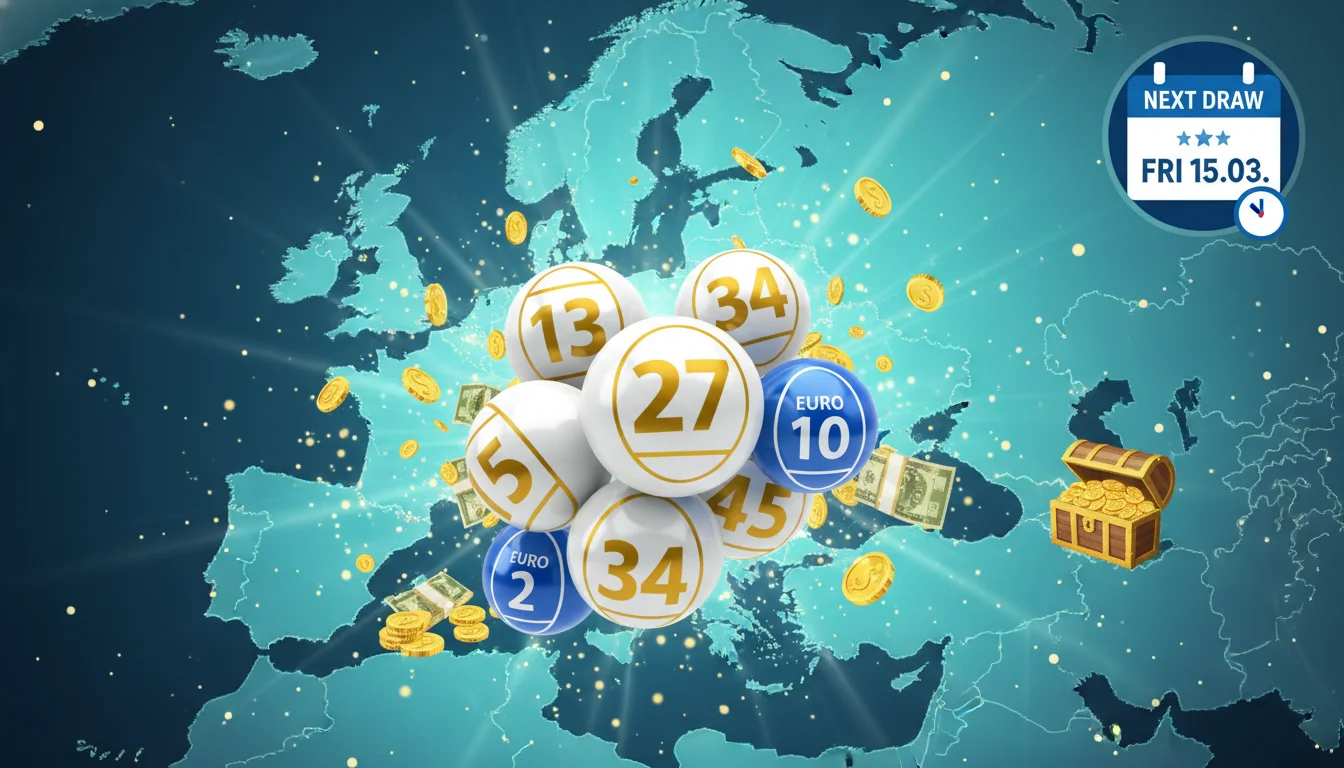
Initially, the Eurojackpot utilized a primary matrix of 5 from 50 combined with a secondary matrix of 2 from 10. However, in response to shifting consumer expectations and the necessity for the lottery to remain competitive against aggressive global counterparts, a fundamental architectural overhaul was implemented beginning in the final week of March 2022. This systemic modification altered the secondary sequence, expanding the so-called “Euro Numbers” pool from 10 to 12 integers. By increasing the sample size of the secondary pool, the governing body intentionally suppressed the absolute probability of securing a top-tier Class 1 victory. This mathematical friction was designed to induce longer rollover streaks, thereby accelerating the accumulation of the jackpot to highly marketable, headline-generating thresholds.
Concurrent with the matrix expansion, the operational cadence of the Eurojackpot was doubled. Prior to March 2022, the event was constrained to a single weekly draw occurring on Fridays. The restructuring introduced a bi-weekly schedule, situating synchronized drawing events on both Tuesday and Friday evenings. This temporal acceleration exponentially increased the revenue-generating velocity of the consortium, halving the time required to aggregate capital between events. Furthermore, the legislative and regulatory ceiling capping the primary prize pool was simultaneously elevated. The historical maximum limit of 90 million euros was abolished in favor of a 120 million euro absolute cap.
This cap serves a vital economic function within the pari-mutuel system. Once the 120 million euro saturation point is achieved, any supplementary capital generated by continued ticket sales is barred from entering the Class 1 pool. Instead, this surplus liquidity cascades downward into the Class 2 tier (matching 5 primary numbers and 1 Euro Number), thereby inflating the secondary prizes to multi-million euro sums and profoundly altering the expected value equation for sophisticated syndicates and institutional participants. Conversely, the absolute minimum floor—the baseline jackpot—remains structurally anchored at 10 million euros. It was exactly within this baseline environment that the April 3, 2026, draw was executed, testing the foundational demand of the market absent the psychological momentum of a swelling jackpot.
Cryptographic Security and Physical Verification Protocols
The legitimacy of a transnational financial entity that routinely disperses tens of millions of euros is entirely predicated on the infallibility and transparency of its randomization mechanisms. Despite the extensive digital transformation of the user interface and ticket purchasing pathways, the core entropy generation of the Eurojackpot remains staunchly physical. The April 3, 2026 draw, like all standard events, was executed under rigorous kinetic and auditing protocols in Helsinki, Finland. Helsinki was selected as the geographic hub for the drawing apparatus precisely due to Finland’s advanced technological infrastructure, robust regulatory environment, and neutral positioning within the broader European consortium.
The mechanical extraction of the winning numerical sequence occurs bi-weekly at 20:00 local time, corresponding to 19:45 Central European Time (CET). The apparatus does not rely on algorithmic Pseudo-Random Number Generators (PRNGs), which can be theoretically compromised or subjected to cryptographic vulnerabilities. Instead, the Eurojackpot utilizes specialized drawing spheres engineered from a proprietary synthetic polymer.
These polymer spheres are explicitly manufactured to possess a structural density and physical pliability that renders them tangibly softer than standard ping-pong balls.
This specific material science application is critical for standardizing the physical variables within the mixing chamber. The polymer composition mitigates the accumulation of static electricity, which could otherwise cause the spheres to cluster or adhere to the chamber walls, thereby skewing the probability distribution. Furthermore, it normalizes aerodynamic drag and kinetic rebound, ensuring that each numbered sphere is subjected to identical chaotic forces during the mixing phase. The operational tolerances of these physical drawing machines, along with the instantaneous digital broadcast of the results, are subjected to independent, third-party oversight by the VTT Technical Research Center of Finland. The VTT acts as the supreme auditing authority, continuously calibrating the apparatus to confirm absolute statistical randomness. This dual-layered methodology—relying on kinetic physics for entropy while utilizing institutional auditing for verification—guarantees the unimpeachable validity of the sequences generated, ensuring that the April 3, 2026 outcome was free from manipulation or mechanical bias.
Combinatorics and Mathematical Probability Modeling
To accurately evaluate the payout distribution of the April 3, 2026 event, one must rigorously apply combinatorial mathematics to calculate the precise probabilities defining each of the twelve prize classes. The Eurojackpot’s 5/50 + 2/12 matrix necessitates the use of a compound hypergeometric probability distribution formula, as the draw consists of two entirely independent sample spaces that must converge to satisfy the highest winning criteria.
The probability of accurately forecasting the five primary integers drawn from the pool of 50 is calculated utilizing standard combinations without replacement. The mathematical expression is:
C(n, k) = n! / (k!(n-k)!)
Substituting the parameters for the primary matrix:
C(50, 5) = 50! / (5!(50-5)!) = 50! / (5!45!) = 2,118,760
This establishes that there are 2,118,760 unique combinations possible within the primary sphere mixing chamber.
Concurrently, the secondary matrix requires participants to select two Euro Numbers from a discrete set of 12. The combinatorics for this independent event are calculated as:
C(12, 2) = 12! / (2!(12-2)!) = 12! / (2!10!) = 66
This yields 66 unique pairings within the secondary chamber.
Because a Class 1 jackpot requires the simultaneous satisfaction of both discrete events, the total sample space of unique Eurojackpot ticket permutations is the product of these two combinatorics:
2,118,760 * 66 = 139,838,160
Consequently, the mathematical odds of securing the Class 1 jackpot (matching 5 primary numbers and 2 Euro Numbers) are exactly 1 in 139,838,160. This probability is absolute and remains mathematically constant irrespective of the aggregate Spieleinsatz (total stakes) or the historical frequency of specific numbers.
For secondary and tertiary payout tiers, the probability expands significantly, requiring complex polynomial modifications to account for partial matches.
For example, to calculate the probability of achieving a Class 2 payout (matching all 5 primary numbers but only 1 of the 2 Euro Numbers), one must multiply the probability of the primary success by the combinatorial likelihood of selecting exactly one correct Euro Number and one incorrect Euro Number.
The number of ways to choose 1 correct Euro Number from the 2 drawn is
The number of ways to choose 1 incorrect Euro Number from the 10 not drawn is
Therefore, the number of successful secondary matrix combinations for Class 2 is
The total probability equation becomes:
This rigorous combinatorial structure cascades down through twelve designated prize classes, culminating in Class 12 (matching 2 primary numbers and 1 Euro Number), which mathematically guarantees a high frequency of minor payouts, thereby engineering a positive feedback loop for consumer retention.
Empirical Analysis of the April 3, 2026 Draw
At the conclusion of the VTT-audited mixing phase on the evening of Friday, April 3, 2026, the official winning sequence was confirmed and permanently recorded into the consortium’s central ledger. The primary sequence extracted from the pool of 50 consisted of the integers 9, 10, 18, 22, and 37. The secondary sequence, extracted from the pool of 12, yielded the Euro Numbers 1 and 11.
Because the overarching jackpot had been successfully breached in the immediately preceding draw on Tuesday, March 31, the contractual algorithm governing the prize pool dictated an absolute reset. Consequently, the advertised and realized Class 1 jackpot for the April 3 draw rested precisely at the baseline floor of 10,000,000.00 €.
Despite the astronomical 1 in 139.8 million mathematical barrier facing participants, the April 3 draw witnessed a definitive Class 1 victory. The centralized data reconciliation systems confirmed that a singular ticket had successfully captured all seven sequential variables. As a result of this solitary success, the entirety of the 10,000,000.00 € capital reserve assigned to the first tier was directed to this individual ticket holder.
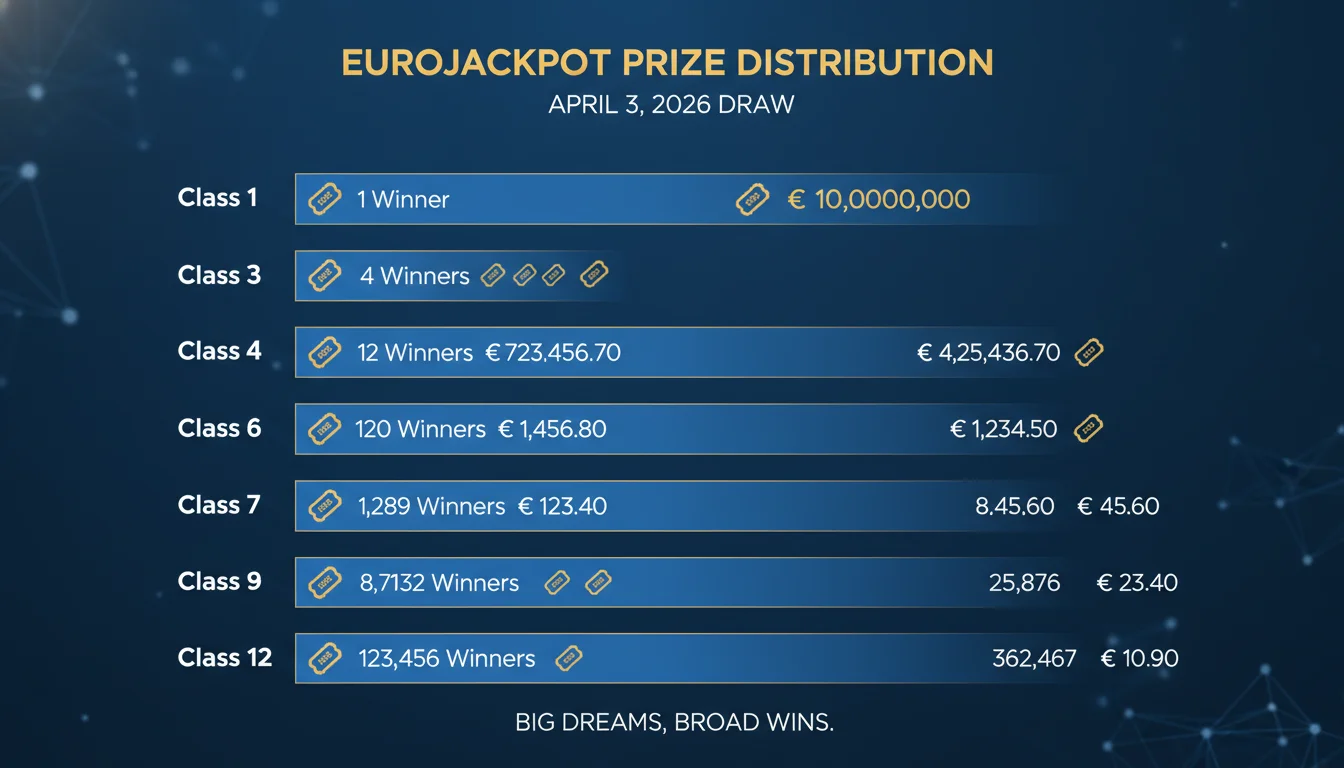
The sheer scale of the Eurojackpot’s capital dispersion can only be truly grasped by analyzing the granular, tier-by-tier distribution of the pari-mutuel fund. Below is the exhaustive compilation of the successful ticket volumes and their proportional fiscal rewards across all twelve prize classes for the April 3, 2026 draw:
| Prize Tier (Klasse) | Sequential Match Criteria | Total Winning Tickets | Individual Payout Allocation (€) |
|---|---|---|---|
| Klasse 1 | 5 Primary + 2 Euro Numbers | 1 | 10,000,000.00 |
| Klasse 2 | 5 Primary + 1 Euro Number | 5 | 337,733.90 |
| Klasse 3 | 5 Primary + 0 Euro Numbers | 7 | 136,047.30 |
| Klasse 4 | 4 Primary + 2 Euro Numbers | 21 | 7,480.20 |
| Klasse 5 | 4 Primary + 1 Euro Number | 579 | 339.10 |
| Klasse 6 | 3 Primary + 2 Euro Numbers | 971 | 222.40 |
| Klasse 7 | 4 Primary + 0 Euro Numbers | 1,632 | 96.20 |
| Klasse 8 | 2 Primary + 2 Euro Numbers | 14,688 | 34.00 |
| Klasse 9 | 3 Primary + 1 Euro Number | 25,443 | 21.90 |
| Klasse 10 | 3 Primary + 0 Euro Numbers | 74,653 | 15.80 |
| Klasse 11 | 1 Primary + 2 Euro Numbers | 76,293 | 15.80 |
| Klasse 12 | 2 Primary + 1 Euro Number | 362,467 | 10.90 |
This dispersion matrix highlights the extreme variance inherent in the Eurojackpot’s algorithmic payout structure. In Class 2, five distinct tickets narrowly missed the absolute jackpot by failing to accurately forecast the second Euro Number. For this fractional deviation, these tickets were awarded 337,733.90 € each. While a substantial windfall, the absence of that singular secondary digit equated to an opportunity cost (or capital forfeiture) of more than 9.66 million euros relative to the Class 1 victor. This disparity perfectly encapsulates the steep volatility curve that defines hyper-scaled lottery economics.
Furthermore, the macro-volume of the April 3 event is vividly illustrated within the lower echelons of the tier system. While mainstream media narratives predominantly focus on the singular multi-million-euro victor, the underlying economic engine is sustained by the base. An immense volume of 362,467 separate tickets qualified for the Class 12 minimum payout of 10.90 €. Additionally, 76,293 tickets secured 15.80 € in Class 11, and 74,653 tickets claimed 15.80 € in Class 10. Cumulatively, these tertiary tiers absorbed millions of euros of the total pari-mutuel distribution. This deliberate structural flattening of the lower tiers serves a crucial psychological function; by ensuring that hundreds of thousands of participants recoup their initial entry stake (often coupled with a marginal surplus), the lottery framework engineering a frictionless path toward reinvestment in subsequent draw cycles.
Contextualizing Market Elasticity: The March 31, 2026 Precedent
To effectively measure the true statistical and economic implications of the April 3 baseline event, one must juxtapose it against the preceding draw executed on Tuesday, March 31, 2026. The consumer dynamics governing lottery participation are highly elastic and profoundly reactive to the publicized scale of the jackpot pool.
Leading into the March 31 session, the Eurojackpot had experienced a period of sustained rollover phases, accumulating a formidable capital reserve. The sequence generated during that Tuesday evening draw consisted of the primary integers 5, 15, 18, 20, and 35, accompanied by the Euro Numbers 7 and 8. This specific permutation successfully matched a ticket originating from the densely populated German state of Nordrhein-Westfalen. The resulting Class 1 payout for this individual ticket was a colossal 70,718,366.90 €.
The sheer volume of the Spieleinsatz (total stakes wagered) for the March 31 event exceeded 43.64 million euros (43,647,572.00 €). This immense influx of capital allowed for highly inflated secondary payouts. Three tickets (originating from Finland, Poland, and Hungary) secured Class 2 victories, commanding 625,615.20 € each. Another three tickets (traced to Berlin, Nordrhein-Westfalen, and Czechia) achieved Class 3 status, claiming 352,817.80 € apiece.
To illustrate the sharp juxtaposition in market participation between a highly inflated jackpot and a baseline reset, the payout tier matrix for the March 31, 2026 event is presented below:
| Prize Tier (Klasse) | Sequential Match Criteria | Total Winning Tickets | Individual Payout Allocation (€) |
|---|---|---|---|
| Klasse 1 | 5 Primary + 2 Euro Numbers | 1 | 70,718,366.90 |
| Klasse 2 | 5 Primary + 1 Euro Number | 3 | 625,615.20 |
| Klasse 3 | 5 Primary + 0 Euro Numbers | 3 | 352,817.80 |
| Klasse 4 | 4 Primary + 2 Euro Numbers | 40 | 4,364.70 |
| Klasse 5 | 4 Primary + 1 Euro Number | 759 | 287.50 |
| Klasse 6 | 3 Primary + 2 Euro Numbers | 1,709 | 140.40 |
| Klasse 7 | 4 Primary + 0 Euro Numbers | 1,608 | 108.50 |
| Klasse 8 | 2 Primary + 2 Euro Numbers | 23,241 | 23.90 |
| Klasse 9 | 3 Primary + 1 Euro Number | 36,903 | 16.80 |
| Klasse 10 | 3 Primary + 0 Euro Numbers | 74,030 | 15.90 |
| Klasse 11 | 1 Primary + 2 Euro Numbers | 115,973 | 12.70 |
| Klasse 12 | 2 Primary + 1 Euro Number | 496,063 | 8.90 |
The comparative analysis between the March 31 and April 3 datasets explicitly confirms the “Baseline Reset Phenomenon.” When a 70.7 million euro pool is captured, the subsequent regression to a 10 million euro baseline triggers a precipitous contraction in aggregate ticket sales. Speculative or casual participants, who exhibit highly elastic demand and only enter the lottery market when the jackpot crosses arbitrary psychological thresholds (e.g., 50 million or 100 million euros), immediately exit the purchasing pool.
The participants who remained active in the April 3 cycle represent the “inelastic core” of the Eurojackpot market. This demographic consists of habitual players, institutional syndicates, and structural subscribers whose participation is generally decoupled from the mathematical expected value of a specific draw. Comparing the Class 12 volume between the two dates serves as a reliable proxy for total participation: the March 31 draw yielded 496,063 Class 12 winners, while the April 3 draw yielded only 362,467. This represents a roughly 27% contraction in total market participation over a mere 72-hour period, driven entirely by the deflation of the advertised jackpot. Despite this statistically predictable contraction in volume, the immutable 1:139,838,160 probability still yielded a definitive Class 1 winner on April 3, demonstrating that while macro-level jackpot sizing dictates overall market liquidity, the micro-level realization of the winning sequence remains utterly detached from the scale of the Spieleinsatz.
Geospatial Wealth Extraction and Demographic Disparities
A comprehensive assessment of the Eurojackpot’s operational history necessitates an evaluation of its geospatial distribution patterns. While the lottery acts as an ostensibly unified European mechanism with equal mathematical odds applied to every generated ticket, the ultimate extraction of its capital pools is subject to profound regional disparities. These deviations are largely driven by population density, localized purchasing power, historical affinities for state-sponsored gaming, and sophisticated syndication infrastructure.
In the case of the April 3, 2026 draw, the singular ticket capturing the baseline 10,000,000.00 € Class 1 prize was conclusively verified as originating from Denmark.
This localized capital capture operates as an intriguing macroeconomic event, effectively draining liquidity wagered across 17 other European sovereign territories and consolidating it entirely within the Danish consumer economy.
The Danish victory on April 3 contextualizes itself within a broader, longitudinal continuum of Eurojackpot disbursements. An exhaustive analysis of the macro-level dataset (accurate up to April 4, 2026) reveals that the Eurojackpot top tier has been successfully breached 161 times. However, due to instances of simultaneous multi-ticket successes (where the jackpot is fractionally divided), these 161 breaches have generated 191 unique jackpot-winning tickets.
The geographical mapping of these 191 ultimate successes reveals a starkly asymmetrical distribution across the consortium:
| Sovereign State | Cumulative Jackpot Winners (As of April 2026) |
|---|---|
| Germany | 96 |
| Finland | 25 |
| Denmark | 14 (pre-April 3) / 15 (inclusive) |
| Sweden | 10 |
| Norway | 9 |
| Poland | 8 |
| Spain | 6 |
| Slovenia | 6 |
| Italy | 4 |
| Hungary | 4 |
| Czechia | 3 |
| Netherlands | 2 |
| Lithuania | 2 |
| Slovakia | 1 |
| Croatia | 1 |
| Greece, Estonia, Latvia, Iceland | 0 |
Data accurately compiled to reflect historical distributions up to the early April 2026 temporal window.
This dataset highlights the overwhelming dominance of the Federal Republic of Germany, which accounts for approximately 50.2% of all historical Class 1 victories. This massive overrepresentation is a direct corollary of two primary factors. First, Germany possesses the largest population block within the consortium, fielding roughly 83 million residents. Second, and more critically, Germany boasts a highly mature, heavily integrated domestic lottery infrastructure (e.g., LOTTO 6aus49, GlücksSpirale), which has preconditioned the populace for consistent, high-volume participation via a vast network of physical kiosks and robust digital syndicates. The March 31, 2026 win of 70.7 million euros in Nordrhein-Westfalen is a textbook execution of this demographic advantage.
Following Germany, the Nordic bloc exhibits an anomalously high extraction rate relative to its population densities. Finland claims 25 historical jackpot winners. Given its population of merely 5.5 million, Finland’s per capita success rate dwarfs that of Germany. This localized intensity is intrinsically linked to Helsinki serving as the physical and operational epicenter of the draw. The domestic media coverage and cultural integration of the VTT-audited draws generate hyper-concentrated ticket purchasing behaviors.
Similarly, Denmark’s acquisition of the April 3, 2026 jackpot solidifies its position as the third most successful participating nation, moving to 15 historical victories. This allows Denmark to comfortably outpace significantly larger economies, such as Spain (6 winners) and Italy (4 winners). Nations like Sweden (10 winners) and Norway (9 winners) further cement the Nordic region’s disproportionate capitalization of the European pool. Conversely, the complete absence of jackpot captures in Greece, Estonia, Latvia, and Iceland over a 14-year operational timeline suggests much lower rates of market penetration, potentially restricted by lower per capita discretionary income or less frictionless digital brokerage systems.
Statistical Anomalies, Frequencies, and the Norwegian Precedent
Beyond the macro-level geographic dispersion, the empirical frequency of the numerical extractions provides fertile ground for statistical analysis. While combinatorial mathematics insists that every single one of the 50 primary spheres holds an identical 1-in-50 probability of extraction during the first draw phase, longitudinal tracking reveals distinct empirical deviations.
According to archival tracking metrics, certain primary integers have exhibited elevated extraction frequencies over the operational lifespan of the lottery. For instance, the number 34 is identified as the most historically frequent, having been extracted 107 times. This is closely followed by the numbers 17 (106 extractions), 21 (105 extractions), and 35 (104 extractions). Other highly active integers include 11, 49, and 18. The appearance of 18 in the April 3, 2026 sequence (9, 10, 18, 22, 37) aligns with these high-frequency tracking metrics. However, it is vital to emphasize that these deviations represent observational variance within a finite dataset; they do not imply a structural bias or a predictive advantage, as kinetic entropy lacks memory. The Gambler’s Fallacy remains a persistent cognitive bias among participants who heavily leverage these historical metrics when configuring their sequences.
The necessity for absolute rigor in the Eurojackpot’s mathematical execution is highlighted by historical institutional errors that threaten the integrity of pari-mutuel confidence. A critical incident documented in the broader lottery continuum occurred regarding a June 27 draw, wherein a systemic mathematical error resulted in Norwegian players being distributed “excessively high” payout ratios. While the core entropy (the physical extraction of the spheres) was not compromised, the software algorithm responsible for calculating the fractional distribution of the Spieleinsatz across the secondary and tertiary tiers failed. This anomaly underscores the inherent fragility of processing millions of localized wagers through disparate national gateways before synthesizing them into a centralized ledger. It is precisely due to such vulnerabilities that the overarching authority heavily relies on the VTT Technical Research Center of Finland to audit not just the kinetic machines, but the cryptographic synchronization of the participating 18 state lotteries.
Inter-Lottery Cannibalization and the Competitive European Ecosystem
The Eurojackpot does not exist within an economic vacuum; it operates amid a highly saturated, fiercely competitive environment of domestic and regional gaming offerings. State licensing authorities must execute a delicate balancing act to maximize gross gaming revenue without precipitating internal market cannibalization. The timeline immediately surrounding the April 3, 2026 draw perfectly illustrates the complex consumer choice matrix facing European, and specifically German, participants.
While the Eurojackpot reset to its 10 million euro baseline on Friday, April 3, the premier German domestic lottery, LOTTO 6aus49, was aggressively competing for the same discretionary capital. During its Wednesday, April 1, 2026 session, LOTTO 6aus49 offered a jackpot of 6,000,000 € (with a winning sequence of 8, 10, 11, 14, 22, 48, and Superzahl 1). By its subsequent draw on Saturday, April 4, 2026, the LOTTO 6aus49 Class 1 jackpot had matched the Eurojackpot parity, reaching exactly 10,000,000 €.
This parity fundamentally alters the marketing dynamic. When the Eurojackpot is at 120 million euros, it possesses an insurmountable competitive advantage. However, at a 10 million euro baseline, it must compete evenly with LOTTO 6aus49, which possesses nearly identical primary odds of 1 in 139,838,160.
Furthermore, the ecosystem is heavily layered with localized supplementary draws that offer superior probability metrics in exchange for reduced maximum yields. For example, the Spiel 77 supplementary game operating on April 4 offered a Class 1 jackpot of 4,000,000 € attached to vastly superior odds of 1 in 10,000,000.
- TOTO 13er Ergebniswette (April 4): A 300,000 € jackpot with odds of 1 in 1,594,323.
- TOTO 6aus45 Auswahlwette (April 4): A 70,000 € jackpot with odds of 1 in 8,145,060.
- GlücksSpirale (March 28 / April 4 cycles): Offering a static top prize of 1,200,000 € supplemented by a perpetual monthly annuity of 5,000 €.
- KENO: A daily numerical extraction offering rolling jackpots up to 1,000,000 €.
- BINGO! (April 5): An environmental lottery offering a 350,000 € jackpot with highly favorable odds of 1 in 1,299,780.
- SUPER 6: A passive numerical sequence game (e.g., winning sequence 784065 from April 1) offering fixed-tier payouts.
To sustain participation amidst this overwhelming density of gaming options, the Eurojackpot relies on its transnational identity and the promise of its rolling cap. State operators utilizing portals like Lotto-BW (Baden-Württemberg) and Lotto-SH (Schleswig-Holstein) seamlessly integrate all these offerings into unified dashboards, allowing consumers to dynamically shift their liquidity between games based on real-time expected value calculations.
Digital Brokerage and the Maturation of Financial Technology Infrastructure
The execution of multi-national lottery participation has undergone a profound digital transformation. By the time of the April 2026 draws, the reliance on traditional, physical paper slips at regional kiosks has been heavily augmented, if not fundamentally supplanted, by sophisticated digital brokerage platforms and native mobile applications. Entities such as Clever Lotto, WEB.DE Lotto, Lottoland, and direct state-sanctioned portals operate as the primary conduits for user liquidity.
Applications like Clever Lotto (maintaining a 4.6 user rating) have gamified the data entry process, allowing participants to instantly verify numerical sequences against historical databases, calculate their precise Class 1 to Class 12 odds, and execute wagers entirely via encrypted mobile interfaces. These platforms process massive volumes of micro-transactions utilizing modern financial pipelines, including SEPA bank transfers, Visa, Mastercard, and PayPal.
Crucially, these digital interfaces facilitate complex participation strategies that were previously inaccessible to casual players. The foremost among these is the “Tippgemeinschaft” (digital syndicate).
Through algorithmic pooling, digital platforms allow hundreds of disjointed users to automatically amalgamate their capital, purchasing vast, mathematically hedged combinatorial arrays of Eurojackpot numbers. This syndication inherently flattens the variance of the 1:139,838,160 matrix, allowing users to claim fractional shares of secondary and tertiary tiers.
Furthermore, offshore derivative platforms like Lottoland operate in parallel to the official state monopolies. These entities do not purchase physical tickets; rather, they offer synthetic derivative betting mechanisms where users wager on the outcome of the Helsinki draws. Lottoland publishes the VTT-certified results instantaneously to their user base (e.g., confirming the April 3 draw) and utilizes private insurance frameworks to match the official payouts. Through this synthetic mechanism, European consumers can also participate in foreign extraction games, as Lottoland interfaces simultaneously offer access to US PowerBall, MegaMillions, Cash4Life, and Brazil Quina, creating a truly borderless, globalized lottery speculation market.
Consumer Protection, ESG Governance, and Regulatory Oversight
As the digital friction associated with lottery participation approaches zero, the regulatory bodies governing the Eurojackpot consortium have been forced to implement stringent consumer protection mechanisms to align with modern Environmental, Social, and Governance (ESG) standards. The capacity to instantly deploy capital via smartphones creates a heightened risk profile for compulsive behavior, necessitating automated interventions.
Within the primary German market, digital platforms and regional licensing authorities are heavily monitored by federal entities, including the newly centralized Glücksspielbehörde (Gaming Authority). State-sanctioned brokers, such as the LOTTO24 service operating via the WEB.DE portal, are strictly forbidden from processing transactions from individuals under the legal age threshold of 18.
Furthermore, all promotional literature, interface designs, and digital purchase receipts are legally mandated to feature prominent warnings regarding the pathological risks associated with gaming. The April 2026 data dissemination explicitly integrates these mandates. Operators continually broadcast that the fundamental probability of the Eurojackpot is 1:140 million and that participation carries inherent addiction risks. To counteract these risks, state monopolies fund comprehensive, anonymous support infrastructures. Participants exhibiting distressed behavior are algorithmically or manually directed to the Bundesinstitut für Öffentliche Gesundheit (BIÖG) via toll-free crisis hotlines (e.g., 0800 1 37 27 00) or directed to specialized digital intervention portals. This systemic integration of mental health safety nets demonstrates the maturation of the pan-European lottery from a simple taxation instrument into a highly regulated, socially conscious financial sector.
Forecasting the Subsequent Cycle: Tuesday, April 7, 2026
The immediate culmination of the April 3 draw sets the deterministic parameters for the subsequent event, scheduled for Tuesday, April 7, 2026. Because the Class 1 jackpot was successfully captured by the Danish participant, the capital pool for the primary tier cannot undergo a rollover accumulation. Consequently, statistical models and regional state lottery operators officially forecasted the expected top-tier prize for April 7 to remain entirely flat, stagnating at the regulatory baseline of 10,000,000 €.
From a predictive macroeconomic standpoint, a secondary, consecutive baseline draw typically encounters the lowest trough in aggregate participant volume. The psychological momentum generated by escalating rollover phases is entirely absent. The market must rely solely on the inelastic core: automated digital subscriptions, habitual demographic actors, and institutional syndicates. The expected variance in the Class 1 outcome remains identical—a 1 in 139,838,160 probability space.
The velocity of wealth accumulation in the Eurojackpot will only begin to accelerate if the April 7 draw fails to produce a Class 1 match. A failure to match the primary and Euro numbers on April 7 would finally trigger the compound-interest-like rollover effect, swelling the pool toward 20 million euros for the subsequent Friday event, and re-initiating the climb toward the eventual 120-million-euro mathematical ceiling.
Conclusion
The Eurojackpot drawing event of Friday, April 3, 2026, serves as an exemplary case study in the execution of transnational, pari-mutuel probabilistic finance. The kinetic extraction of the precise numerical sequence—9, 10, 18, 22, 37, accompanied by Euro numbers 1 and 11—resulted in the immediate diversion of 10,000,000 € into the Danish economy. This capital capture punctuated a highly volatile weekly cycle that had just witnessed over 70 million euros flow into the German state of Nordrhein-Westfalen a mere 72 hours prior.
Beyond the headline-generating Class 1 figures, the systemic distribution of capital across the 12 meticulously structured tiers reveals an architecture designed not merely for singular wealth transfers, but for the sustained, micro-level reinforcement of hundreds of thousands of participants. By ensuring that over 362,000 distinct tickets qualified for the 10.90 € minimum return on April 3 alone, the consortium engineers perpetual market liquidity and robust consumer retention.
Operating under the rigorous physical verification standards monitored by the VTT Technical Research Center of Finland, and facilitating participation through highly regulated, digitally encrypted application gateways spanning 18 sovereign borders, the Eurojackpot has solidified its position as an immensely stable mathematical and economic engine. The events of early April 2026 ultimately reaffirm that while individual outcomes within the complex 5/50 + 2/12 matrix remain entirely subject to kinetic entropy and mathematical fate, the overarching financial mechanics, behavioral demand elasticity, and structural integrity of the European lottery ecosystem remain highly predictable, deeply entrenched, and expertly engineered.