Best Dropshipping Payment Gateways 2026: A Strategic Guide
Global Payment Infrastructure for Dropshipping and E-commerce: A 2026 Strategic Analysis
The global e-commerce landscape in 2026 is defined by a transition from traditional transactional processing to a sophisticated ecosystem of “agentic commerce,” where automated artificial intelligence agents increasingly manage the procurement and payment lifecycle for consumers. For dropshipping enterprises—businesses characterized by decentralized supply chains, cross-border fulfillment, and inherently higher risk profiles—the selection of a payment gateway has evolved beyond a simple technical requirement into a core strategic determinant of operational stability and profit margin preservation. The current environment demands that payment infrastructures act as a “secure digital bridge,” facilitating the movement of sensitive data from the consumer’s interface to the complex world of acquiring banks and processors with near-instantaneous finality.
As global commerce pushes toward the “always-on treasury” model, dropshippers must navigate a regulatory and technological landscape where liquidity management is as critical as marketing. The integration of real-time payments (RTP), digital identities, and blockchain-based settlements has created a framework where the speed of fund movement can significantly mitigate the traditional cash-flow constraints of the dropshipping model. However, this progress is counterbalanced by the tightening of fraud monitoring programs, such as the Visa Acquirer Monitoring Program (VAMP), which has introduced more aggressive thresholds for dispute management and enumeration attacks as of April 2026.
The Technical Foundation: Gateways, Processors, and the Digital Handshake
To understand the 2026 payment ecosystem, it is essential to distinguish between the various layers of financial technology that facilitate a sale. The payment gateway serves as the “messenger,” capturing and encrypting sensitive cardholder data before transmitting it to the financial world. Parallel to this is the payment processor, the “worker” that physically moves the money between accounts. In the current market, leading providers have consolidated these roles, offering a unified “stack” that simplifies the merchant’s technical overhead.
In the high-stakes world of international dropshipping, this “digital handshake” must be faster and more secure than ever. Modern gateways in 2026 support FaceID checkouts and “one-tap” biometric payments to minimize friction, as 65% of consumers now expect a frictionless, one-click experience. Yet, a significant gap remains between consumer expectations and merchant capabilities; only 45% of merchants currently view frictionless checkout as a necessity, often prioritizing fraud prevention over user experience. This tension defines the competitive landscape for gateways, as they strive to balance conversion-supporting tools like 3D Secure 2.2 with the rigorous demands of anti-fraud protocols.

Core Gateway Performance Benchmarks
Performance in 2026 is measured not just in uptime, but in latency and authorization success rates. The Strawhecker Group’s (TSG) 2026 Real Transaction Metrics report identifies critical leaders in the field based on transaction activity across 35 global locations.
| Performance Category | Winner | Runners-Up |
|---|---|---|
| Best Performing Gateway | Elavon (Fusebox) | Bank of America, Worldpay |
| Best Gateway Uptime | REPAY | Elavon, PNC |
| Best Transaction Speed | Elavon (Fusebox) | JPMorgan Chase, Worldpay |
| Highest Authorization Rate | PNC (Tempus Tech) | Bank of America, Elavon |
| Global Reliability | Worldpay (Access) | Bank of America, Worldpay |
These benchmarks indicate that established players like Elavon and Worldpay have invested heavily in global “access” points to ensure that a transaction originating in Sydney or Singapore experiences the same latency as one in New York. For dropshippers, these milliseconds are vital; studies in 2025 indicated that an average acceptance rate increase of just 0.35% could be achieved simply by ensuring that metadata fields like IP addresses were correctly populated in the payment request.
The Primary Market Leaders: Stripe, PayPal, and Shopify Payments
The selection process for global dropshippers typically begins with a trifecta of dominant platforms: Stripe, PayPal, and Shopify Payments. Each offers a unique value proposition tailored to different stages of business growth and geographic focus.
Stripe: The Infrastructure for Global Scalability
Stripe remains the “all-around champion” in 2026, valued at over $75 billion and processing trillions in total payment volume. Its reputation is built on providing developers with elegant APIs and growth teams with a checkout experience that feels local across 45+ countries. Stripe supports payments in over 135 currencies, a critical feature for dropshippers who target diverse international markets.
One of Stripe’s most significant advantages is its “Stripe Radar” fraud detection system, which uses machine learning to score every transaction based on millions of data points across the Stripe network. For dropshippers, who often face “card testing” attacks, Radar’s ability to adjust risk thresholds dynamically is a crucial defense. Furthermore, Stripe’s integration with platforms like WooCommerce and its native “WooPayments” extension makes it the default choice for businesses prioritizing technical flexibility.
However, Stripe’s conservative risk appetite in certain regions can be a hurdle. The platform has been noted for its “High Risk” labeling of dropshipping businesses in the APAC and EMEA regions, often citing higher chargeback risks as a reason for restricted access or sudden account holds. Payout speeds also vary, with initial payouts often held for 7–14 days before transitioning to a 2–7 day rolling basis, depending on the merchant’s country of operation.
PayPal: The Trust Accelerator
In 2026, PayPal continues to dominate the “trust” segment of the market. With over 400 million active users, seeing the PayPal logo at checkout acts as a psychological “trust badge” that can lift conversion rates by several percentage points. This brand recognition is particularly valuable for new dropshipping stores that have yet to establish their own consumer credibility.
PayPal’s reach is arguably the widest in the industry, operating in more than 200 countries and supporting 25+ currencies. Its “One-Click” checkout and “Pay Later” (BNPL) options are highly favored by younger demographics, though merchants must contend with a fee structure that is often described as confusing and expensive. International transaction fees can exceed 4.4%, and currency markups often range from 3% to 4%, making PayPal one of the costlier paths for global commerce.
| PayPal Fee Component | Typical Rate (U.S. to Intl) | Implications for Dropshippers |
|---|---|---|
| Standard Credit Card Fee | 3.49% + $0.49 | Higher base cost than Stripe |
| International Surcharge | +1.50% | Erodes margins on global sales |
| Currency Conversion | 3.0% - 4.0% | Significant hidden cost in FX |
| Fixed Fee | Varies by currency | Adds up for low-ticket items |
Despite the costs, PayPal’s “Seller Protection” remains a unique selling point. If a dropshipper can provide tracking data showing delivery to the address on the transaction, PayPal often covers the cost of “item not received” claims, a rare perk in the gateway space.
Shopify Payments: The Native Convenience
For merchants utilizing the Shopify platform, Shopify Payments is the most logical starting point. Its primary benefit is the elimination of the additional 0.5% to 2.0% transaction fee that Shopify charges when a third-party gateway is used. This native integration allows store owners to manage orders, payments, and fraud analysis within a single dashboard, simplifying operations significantly.
Shopify Payments also supports “Shop Pay,” an accelerated checkout that has become a dominant force in 2026. By remembering customer details across millions of stores, Shop Pay reduces checkout time and increases conversion. Furthermore, Shopify has integrated “Checkout Extensibility,” allowing for more secure and standardized customizations compared to the fragile scripts of previous years.
The main limitation of Shopify Payments is its geographic restriction, being available in only approximately 25 countries. International sellers in unsupported regions are forced to use third-party gateways and pay the associated platform fees, which can eat into the typically thin 15% to 25% profit margins of a dropshipping store.
Enterprise Solutions and Orchestration: Adyen and Checkout.com
As dropshipping businesses scale toward the mid-market and enterprise levels, the focus shifts toward “interchange++” pricing and direct acquiring connections.
This is where Adyen and Checkout.com provide a distinct advantage.
Adyen: The Global Enterprise Standard
Adyen is positioned as a “titan” in the 2026 fintech hierarchy, serving global giants like Uber and Spotify. Unlike aggregators, Adyen connects directly to card schemes, which often results in higher authorization rates and lower transaction costs for high-volume merchants. Their “unified commerce” approach allows a business to manage online, mobile, and in-store payments through one infrastructure.
Adyen’s “RevenueProtect” suite uses real-time machine learning data to prevent chargebacks before they occur. However, Adyen is known for a conservative risk appetite and a high barrier to entry, often requiring a minimum monthly invoice of €1,000, making it unsuitable for smaller or newly launched dropshipping ventures.
| Feature | Adyen Performance | Merchant Impact |
|---|---|---|
| Authorization Rates | Industry-Leading | Maximizes revenue on global traffic |
| Settlement Speed | 2–3 Days | Excellent for inventory turnover |
| Pricing Model | Interchange++ | Full transparency on cost components |
| Uptime SLA | 99.99% | High reliability for scaling brands |
Checkout.com: Data-Driven Optimization
Checkout.com has emerged as a favorite for “ambitious brands” that require modular, API-first payment solutions. Its 2026 strategy emphasizes the value of “data quality” in payment requests. In April 2026, Visa launched the Digital Commerce Authentication Program (VDCAP), which rewards merchants who provide granular data—such as Device ID, IP, and Email—with fee reductions of up to 0.10%.
For dropshippers, Checkout.com’s “Intelligent Acceptance” service uses AI to automatically retry failed payments through the most likely successful routes, recovering millions in potentially lost revenue for enterprise-scale operations. Their focus on “single stack” architecture means that improvements to performance or security are deployed instantly across all merchants, avoiding the fragmentation seen in competitors that grew through acquisitions.
The FinTech Convergence: Airwallex, Payoneer, and Wise Business
A critical challenge for global dropshippers is the “hidden cost” of currency conversion when dealing with international suppliers and customers. Specialized fintech providers have moved into this space to offer “like-for-like” settlement.
Airwallex: The End-to-End Money Movement Platform
In 2026, Airwallex is widely considered the superior option for cross-border businesses, supporting 160+ local payment methods and payouts to 200+ countries. Its standout feature is “like-for-like” settlement in 14+ currencies. This allows a merchant to collect USD from a customer and hold it in a USD wallet, then pay a supplier in USD without ever paying a currency conversion fee.
This model effectively compresses a multi-vendor stack into a single platform. While Airwallex has faced some criticism in 2025 regarding inconsistent customer support and account verification delays, its ability to offer interbank FX rates (+0.5% to 1.0%) makes it significantly more cost-effective than traditional gateways for international operations.
Payoneer: The Marketplace and Global Payout Specialist
Payoneer remains a powerful tool for receiving payments from global marketplaces and international clients. It provides virtual bank accounts in multiple currencies (HKD, SGD, AUD, GBP, USD), which is essential for dropshippers who need to receive payouts from platforms like Amazon or TikTok Shop in their local currency.
However, Payoneer’s gateway fees—typically around 3% for credit card payments—are higher than Stripe’s, and it lacks the extensive “card acquiring” depth of Adyen or Checkout.com. Its primary strength lies in its network of global payment partners and the ease with which funds can be withdrawn to local bank accounts.
Wise Business: Transparency in FX
Wise Business has solidified its position as the industry benchmark for transparent international transfers. While not a traditional “gateway” in the sense of a checkout form, it allows dropshippers to receive global payments via local account details in 9 different currencies. By using the mid-market exchange rate, Wise helps businesses avoid the hidden “spreads” that banks and gateways typically charge on international settlements. Many merchants link their Stripe accounts to Wise to receive international funds more efficiently.
High-Risk Realities: Reserves, Holds, and VAMP Compliance
Dropshipping is inherently categorized as a “high-risk” industry by most payment processors due to the physical distance between the merchant, the product, and the customer. In 2026, this classification carries heavy operational implications, specifically regarding fund stability and monitoring thresholds.
The Visa Acquirer Monitoring Program (VAMP) 2026
One of the most significant changes in 2026 is the full activation of the Visa Acquirer Monitoring Program (VAMP), which consolidated the older VDMP and VFMP programs. This program monitors two primary metrics: the VAMP Ratio (Disputes/Sales) and the Enumeration Ratio (Card Testing).
| VAMP Metric | 2026 Threshold | Penalty / Action |
|---|---|---|
| VAMP Ratio (Excessive) | 1.5% | $8 fine per dispute; enrollment in monitoring |
| Enumeration Ratio | 20% of Transactions | Immediate fines and remediation required |
| Chargeback Threshold (Shopify) | 1.0% | Immediate account suspension or termination |
| Early Warning (Visa) | 0.65% | Heightened scrutiny and potential reserves |
These thresholds are lower than in previous years, reflecting a “zero tolerance” policy for fraudulent or poorly managed businesses. For a dropshipper, a single “viral” week with high order volume and subsequent shipping delays can easily push the dispute ratio above 1.5%, triggering automatic penalties and potential fund freezes.
The Mechanics of Reserves
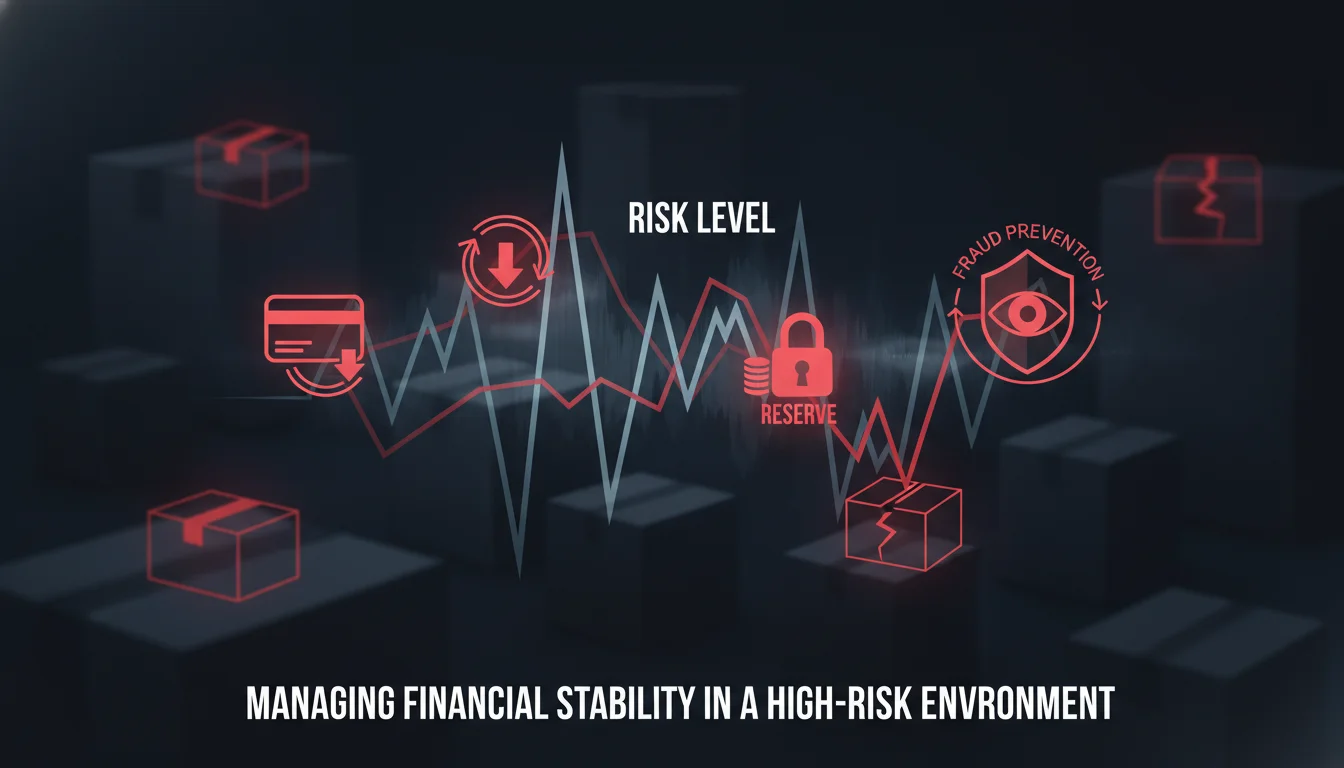
To mitigate risk, gateways frequently implement “Reserves,” which are temporary holds on a portion of a business’s funds to ensure that refunds and chargebacks can be covered. In 2026, there are three primary reserve models that dropshippers must account for in their cash flow planning:
- Rolling Reserves: A set percentage (typically 10% to 25%) of each new transaction is held for a rolling window (e.g., 30, 60, or 90 days). Stripe and Checkout.com frequently use this for high-risk merchants.
- Fixed Reserves: A specific amount is held in a separate account until a predetermined date or milestone is reached.
- Termination Holds: If an account is closed due to high risk, gateways often hold the entire balance for 120 to 180 days to cover potential late-arriving chargebacks.
Research indicates that the average retailer chargeback rate sits at 0.52%, meaning many dropshippers are operating dangerously close to the 0.65% “Early Warning” threshold. Friendly fraud—where a customer falsely claims an item wasn’t received—costs merchants up to $35 to dispute for every $100 in lost revenue, making proactive dispute resolution a financial necessity.
The Future of Payments: Agentic AI and Digital Identity
The 2026 landscape is not just about cards and wallets; it is increasingly about how identity and AI interact with the financial system.
Agentic AI Commerce: The New Shopper
Agentic commerce refers to AI agents—automated shopping assistants—that make purchase decisions and execute payments on behalf of human users. This shift is “industry-changing,” with several key protocols emerging to allow agents to interface with online stores, including Google’s AP2, IBM’s ACP, and Visa’s Trusted Agent Protocol.
For dropshippers, this creates a profound fraud-detection challenge. Legacy systems often flag non-human “bot-like” behavior as fraudulent. In 2026, merchants must distinguish between “good bots” (legitimate agents) and “bad bots” (automated fraud scripts). Ravelin research shows that 65% of fraud experts are already being targeted by AI-enabled fraud, and 63% of merchants are actively exploring agentic AI payments to keep up with consumer demand.
Digital Identity as the New Passport
As transactions move toward real-time clearance, verifying identity has become the primary defense against fraud. In 2026, digital IDs are becoming as essential to e-commerce as passports are to travel. The European Union is introducing its digital ID wallet in 2026, while India’s Aadhaar scheme already powers over 2 billion monthly authentications. For dropshippers, using gateways that support these digital ID systems (such as FaceID and biometric verification) can significantly reduce the risk of authorized push payment (APP) scams and deepfake-based fraud, which now accounts for 40% of biometric fraud.
Blockchain Realized: Stablecoins and Settlement Agility
Blockchain has transitioned from a niche asset class to a foundational settlement infrastructure in 2026, with 60% of Fortune 500 companies implementing blockchain initiatives.
Stablecoin Settlement
For global dropshippers, the primary utility of blockchain is the use of stablecoins (USDC, USDT) for settlements.
Traditional banking rails are subject to holidays, cutoff times, and multi-day delays. Specialized providers like TODA Pay allow merchants to accept fiat from customers and receive settlement in stablecoins with “T+0” (same-day) speed.
This settlement agility is critical for dropshippers who need to pay suppliers instantly to keep order fulfillment moving. Furthermore, stablecoins offer a lower-fee alternative for cross-border transfers, bypassing the expensive currency conversion markups of traditional gateways.
Decentralized Gateways
Gateways like NOWPayments and CoinGate have emerged as leaders in the crypto space, allowing merchants to accept over 70 types of digital assets with transaction fees as low as 0.5%. While crypto remains a secondary payment option for mainstream consumers, it is gaining popularity among tech-savvy buyers and in regions with unstable fiat currencies.
Platform-Specific Implementation: Shopify vs. WooCommerce
The technical integration of a gateway is heavily influenced by the underlying e-commerce platform.
Shopify Strategy for 2026
- Native Setup: Shopify Payments is the preferred choice for stores in supported countries to avoid extra fees.
- External Setup: If Shopify Payments is unavailable, the merchant must connect a third-party gateway (like Stripe or Airwallex) through Shopify’s settings, accepting the 0.5% to 2.0% platform markup.
- High-Risk Alternatives: For restricted categories (CBD, supplements), merchants often need dedicated high-risk merchant accounts and compatible gateways like Authorize.net.
WooCommerce Strategy for 2026
WooCommerce provides greater freedom but places more responsibility on the merchant. In 2026, WooCommerce stores typically rely on “WooPayments” (powered by Stripe) for simplicity or direct Stripe/Braintree integrations for more complex API needs.
- Plugin Compatibility: Most gateways are added via official plugins from the WordPress repository.
- Omnichannel Sync: For businesses with physical locations, the Square extension for WooCommerce is the leader, syncing online and in-person inventory and sales in real-time.
- Subscription Management: WooCommerce Subscriptions is the standard for recurring revenue, but it requires gateways that support stored credentials and tokenization.
Regional Analysis and Localized Payment Methods
The key to global dropshipping success in 2026 is “local acquiring”—processing payments in the same region where the customer is located to maximize authorization rates and minimize fees.
| Region | Dominant Payment Methods | Strategic Advice |
|---|---|---|
| Asia-Pacific (APAC) | Alipay, WeChat Pay, GrabPay, UPI (India) | Focus on digital wallets; 68% abandonment if local method is missing. |
| Europe (EMEA) | Klarna, iDEAL, SEPA Instant, Sofort | 3D Secure is mandatory; optimize for frictionless SCA flows. |
| Latin America (LATAM) | PIX (Brazil), MercadoPago | PIX adoption is critical; it allows for instant settlement and higher liquidity. |
| North America | Apple Pay, Google Pay, Amazon Pay, ACH | Prioritize mobile, one-tap checkouts and biometric security. |
The Rise of A2A in Europe
Account-to-Account (A2A) payments have entered the top three most popular ways to pay in Germany and the Netherlands. For dropshippers, A2A is attractive because it avoids the high transaction fees of credit card networks. However, the rise of A2A has also led to a rise in RTP (Real-Time Payment) fraud, necessitating the use of advanced AI-powered fraud monitoring.
Conclusion: Orchestrating the 2026 Payment Stack
The global dropshipping environment of 2026 requires a shift from a “single-gateway” mindset to one of “payment orchestration”. A resilient infrastructure must balance the high conversion rates of trusted brands like PayPal with the cost-efficiency of interchange++ providers like Adyen and the FX agility of platforms like Airwallex.
Merchants must remain hyper-vigilant regarding their VAMP ratios, ensuring they stay below the 1.5% dispute threshold to avoid the existential threat of account termination. This is achieved through a combination of high-quality data in payment requests, the use of network tokens to reduce avoidable declines, and proactive dispute resolution tools.
Ultimately, the most successful dropshippers of 2026 will be those who view their payment stack not as a static utility, but as a dynamic data engine that optimizes for authorization rates, settlement speed, and customer trust. By integrating agentic AI readiness and blockchain-enabled liquidity, these businesses can navigate the complexities of global commerce with the agility and resilience required to sustain long-term profitability in a rapidly evolving digital economy.