Digital Marketing for Indian Vehicle Dealerships: Cars & EVs
Industry Overview
The Landscape of Vehicle Dealerships in India
The Indian vehicle dealership sector represents a foundational pillar of the national economy and one of the most vibrant mobility markets globally. Acting as the critical interface between original equipment manufacturers (OEMs) and end consumers, the industry spans multiple distinct segments, most notably passenger vehicles (PVs), internal combustion engine (ICE) two-wheelers (motorcycles and scooters), and a rapidly accelerating electric vehicle (EV) segment. The architecture of this market is highly diverse, featuring everything from single-location, family-operated showrooms in tier-three cities to massive, multi-brand corporate dealership networks that operate hundreds of touchpoints across various states. Operating a successful dealership requires orchestrating a complex operational model that balances high-value inventory management, aggressive localized marketing, financing facilitation, and comprehensive post-sale servicing.
The scale of the Indian automotive market is staggering. Supported by a robust domestic supply chain, localized manufacturing, and favorable demographics, India currently stands as the fourth-largest automobile producer in the world. The two-wheeler industry alone accounts for 15% of the total automotive industry, generating direct and indirect employment for approximately 4.5 to 5 million individuals. This sector essentially functions as the backbone of Indian mobility, driven by rapid urbanization, economic development, and the expansion of quick-commerce and food delivery networks.
Current Market Size, Growth, and Trends
The growth trajectories across different vehicle categories underscore a market in active transition. The two-wheeler segment manufactured over 24 million units in the 2025 fiscal year, reaching an estimated market valuation of USD 21.14 billion. Of these manufactured units, approximately 20 million were absorbed by the domestic market, solidifying India’s position as the world’s largest two-wheeler manufacturing base. Between FY2021 and FY2025, the ICE two-wheeler industry advanced at a compound annual growth rate (CAGR) of 7%, with scooters outperforming motorcycles at a 13% CAGR compared to 5%. Notably, the second quarter of the 2025-2026 fiscal year saw domestic sales of 5.56 million two-wheelers, registering a 7.4% year-over-year growth. This expansion was supported by resilient rural mobility demand, improved affordability, and a reduction in GST rates implemented in late 2025.
While ICE vehicles continue to command 88.15% of the two-wheeler market share, the electric vehicle segment is aggressively capturing market territory. Electric scooters alone dominated 60% of the scooter market in 2024, supported by the availability of models across various speed ranges and their viability as cost-effective alternatives to conventional gasoline-driven mopeds. The broader electric two-wheeler market is forecasted to experience explosive growth, surging from an estimated USD 1.12 billion in 2025 to USD 14.48 billion by 2030, representing an extraordinary 66.4% CAGR.
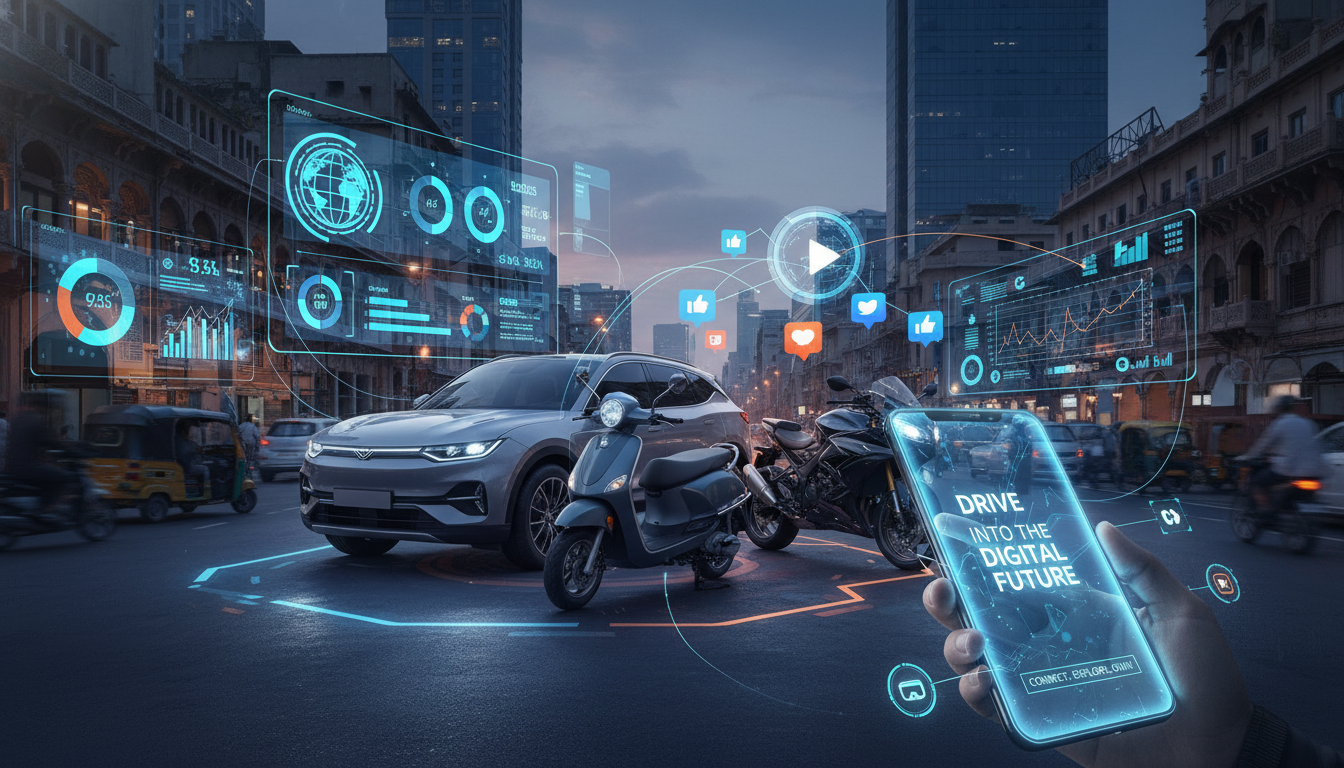
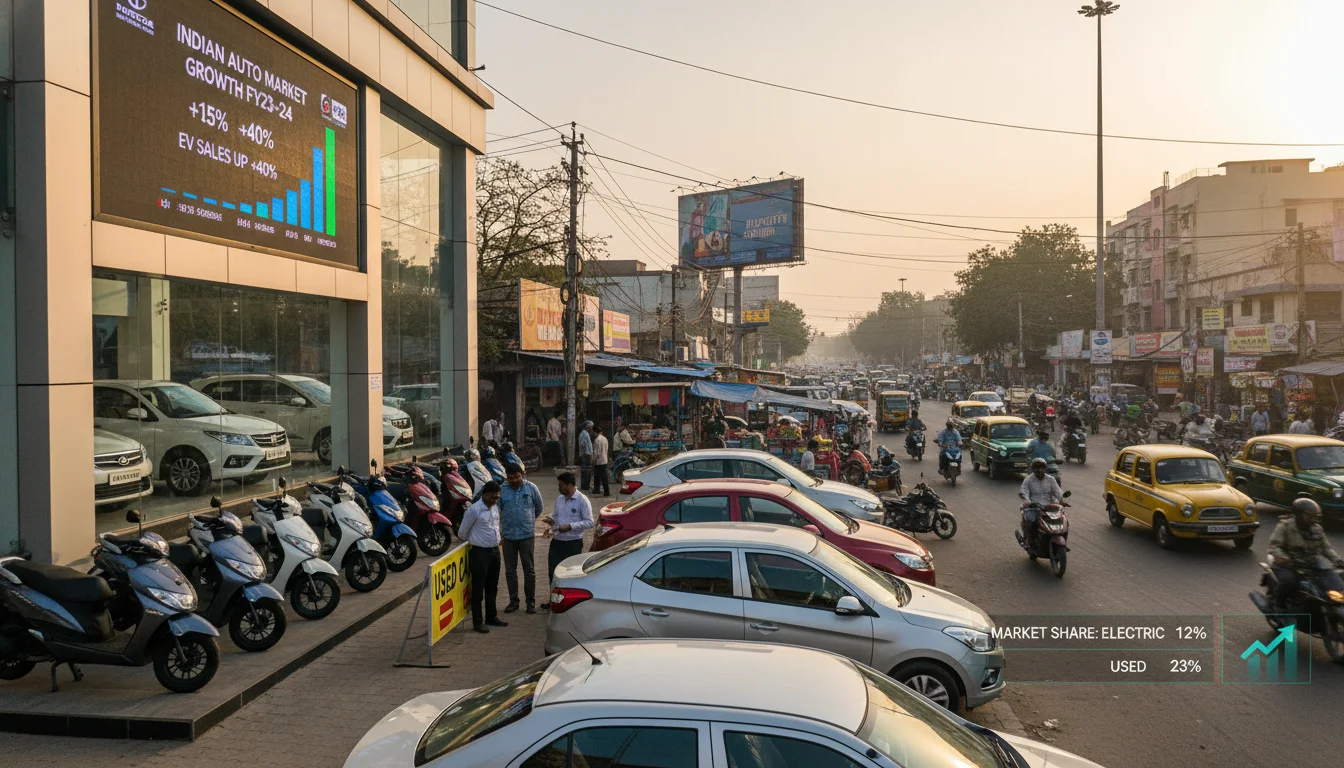
In the four-wheeler passenger vehicle segment, domestic sales reached an all-time high of 4.2 million units in FY2024, marking an 8% year-over-year growth. However, the most profound structural shift within the broader automotive market is occurring in the pre-owned vehicle sector. In CY2024, India’s pre-owned car market outpaced new car sales with a ratio of 1.3:1. Industry projections indicate that by CY2030, this ratio will widen to 1.7:1, meaning that for every 10 new cars purchased, 17 used cars will be sold. This segment is driven by a 13% CAGR that will elevate the used car market volume from 4.6 million units in CY2023 to 10.8 million units by CY2030, highlighting an enduring consumer preference for affordable, dependable mobility.
To understand the competitive hierarchy, the market shares of top manufacturers dictate the supply flow to the dealership networks.
| Rank | Two-Wheeler OEM | FY2025 Sales (Units) | Market Share FY2025 (%) |
|---|---|---|---|
| 1 | Hero MotoCorp | 5,445,251 | 28.84% |
| 2 | Honda Motorcycle and Scooter India | 4,789,283 | 25.37% |
| 3 | TVS Motor Company | 3,301,781 | 17.49% |
| 4 | Bajaj Auto | 2,154,467 | 11.41% |
Data reflecting the dominance of legacy ICE manufacturers in the Indian two-wheeler space.
Conversely, the passenger vehicle segment has witnessed significant disruptions, with Tata Motors overtaking Maruti Suzuki as the market leader following four decades of dominance.
| Car Name | Vehicle Type | Units Sold | Key Highlights |
|---|---|---|---|
| Tata Punch | Compact SUV | 2.02 Lakh | ICE, CNG, and pure EV variants available; strong safety ratings. |
| Maruti Wagon R | Hatchback | 1.91 Lakh | High fuel efficiency, low maintenance, spacious family car. |
| Maruti Ertiga | MUV | 1.90 Lakh | Practicality, CNG options, long-distance comfort. |
| Maruti Brezza | SUV | 1.88 Lakh | Robust design, widespread service network. |
| Hyundai Creta | SUV | 1.87 Lakh | Premium features, advanced technology, stylish design. |
Data reflecting the top-selling car models in India during 2024.
Key Challenges Faced by Dealerships
Despite the robust macro-level growth of the Indian automotive sector, individual dealerships operate under severe, systemic pressures that threaten their operational sustainability. The current landscape presents a complicated mix of financial and operational obstacles.
The most critical challenge is chronic inventory imbalance and stock mismanagement. By mid-2024, PV inventory holdings at dealerships escalated to 62-67 days, severely misaligned with the traditional industry average of 30-35 days. Excessive stocking causes massive capital blockage, forcing dealerships into high working capital dependency. Consequently, dealerships are compelled to offer excessive discounts to clear aging stock, which systematically suppresses operating margins by an estimated 40-100 basis points. This capital strain is compounded by delayed payments, long credit cycles, and rising overhead costs associated with operating modern, digitally equipped showrooms.
Technological evolution and the transition to electric vehicles have introduced acute skill shortages. The rapid integration of EVs and Advanced Driver Assistance Systems (ADAS) requires a highly trained workforce that many regional dealerships currently lack. Concurrently, dealerships are struggling with digital transformation. There is a pronounced lack of integration between Customer Relationship Management (CRM) tools and Dealer Management Systems (DMS), leading to the poor utilization of customer data and missed sales opportunities. Dealerships also face slow adoption rates for AI-driven customer support and automated service scheduling, leaving them vulnerable to new, tech-agile market entrants.
Finally, consumer expectations have fundamentally changed. Modern buyers demand a seamless omnichannel experience bridging the physical showroom and the digital interface. Dealerships are facing intense pressure from online retailers and aggregators, forcing traditional businesses to rethink their entire sales and marketing architecture or risk obsolescence. Furthermore, dealer satisfaction with OEMs remains a complex issue; while dealers rate OEMs highly on product quality, the “Business Viability & Policy” factor consistently scores the lowest in national dealer satisfaction indices, highlighting the friction between dealership profitability and manufacturer demands.
Digital Landscape in India (Contextual to the Industry)
Internet and Social Media Usage
India’s digital ecosystem has fundamentally rewired the automotive path to purchase. The traditional automotive buying paradigm—where a consumer physically visited four to five showrooms over several weeks to gather brochures, compare prices, and negotiate—has been entirely supplanted by digital discovery. Current industry data indicates that 92% of car buyers conduct extensive online research before finalizing a purchase. More strikingly, 73% of automotive buyers complete their entire research phase before ever stepping foot in a physical dealership, and 64% express a willingness to purchase a vehicle without a physical test drive if they can acquire the necessary information online.
The digital sphere is no longer merely a supportive advertising channel; it is the primary arena for brand interaction, vehicle comparison, and transactional intent. However, the search landscape itself is evolving. Search engine optimization stands at a critical crossroads due to the rise of “zero-click searches.” Nearly 60% of global Google searches now end without a single click to a website, as AI Overviews and rich snippets provide immediate answers directly on the search engine results page (SERP). Automotive brands and dealerships that fail to optimize for this new reality risk having their organic traffic evaporate.
Popular Platforms Among the Target Audience
The modern Indian vehicle buyer utilizes a fragmented matrix of digital platforms, requiring dealerships to adopt an omnipresent marketing approach.
Search engines, primarily Google, remain the foundational pillar for high-intent discovery. Search engine optimization (SEO) is critical because high-intent queries drive the most efficient conversion rates.
Analysis indicates that organic search generates 1,000% more traffic to dealership websites than organic social media, making it the most cost-effective customer acquisition method available. Organic customer acquisition consistently costs 50-70% less than paid acquisition channels, representing a sustainable competitive advantage for well-optimized dealerships.
The Meta ecosystem, encompassing Facebook, Instagram, and WhatsApp, dominates mid-funnel engagement and communication. Approximately 72% of automotive buyers discover vehicles through Meta platforms. Instagram is heavily leveraged for visual storytelling, short-form reels (such as vehicle walkarounds), and influencer marketing, which are critical for engaging younger demographics. WhatsApp has emerged as the definitive communication tool in India, boasting over 500 million active users. Dealerships widely adopt the WhatsApp Business API for test-drive bookings, price negotiations, trade-in appraisals, and automated post-sale service reminders.
YouTube serves as the primary educational channel. Video content is paramount for detailed vehicle reviews, real-world mileage tests, and feature explanations. It heavily influences the consideration phase, with top OEMs like Hero MotoCorp amassing nearly 1.9 billion total views on their channels by leveraging user-generated content and influencer vloggers. Additionally, automotive portals and aggregators (e.g., CarWale, AutoCar India, Team-BHP) provide vital peer validation, with 84% of buyers utilizing these digital channels to compare prices and evaluate dealership credibility.
Consumer Online Behavior
The modern Indian vehicle buyer is highly discerning, impatient, and heavily reliant on peer reviews. Online consumer behavior is fundamentally review-driven; 98% of consumers read online reviews occasionally, and 85% trust them as much as personal recommendations. However, local search visibility remains a massive failure point for the industry. Shockingly, 4 out of 5 interested buyers never contact a dealership simply because they cannot find them on Google Maps or local search results.
Consumer personas within the digital landscape have become highly stratified. In the booming pre-owned market, buyers are categorized into distinct profiles: “Value Seekers” driven by practical ROI, “Social Climbers” seeking the status of premium badges at lower costs, and “Ceiling Breakers” looking for independence and safety. In the two-wheeler segment, online behavior focuses intensely on fuel efficiency, brand perception, and real-world performance as demonstrated by online vloggers. For the emerging EV scooter market, buyers exhibit a deep need for educational content; their online research is dominated by queries regarding battery range, home charging infrastructure, government subsidies, and total cost of ownership comparisons against traditional ICE vehicles.
Impatience is a defining trait of the modern digital consumer. The average response time to dealership digital leads is currently over two hours. In the modern digital economy, this is a window large enough for the consumer to abandon the inquiry entirely and contact a competitor. Consumers demand instant gratification, expecting chatbots or automated WhatsApp agents to answer questions regarding vehicle availability and financing outside of regular business hours.
Digital Marketing Opportunities
Solving Key Challenges Through Digital Marketing
Digital marketing provides structural solutions to the core challenges of inventory imbalance, margin compression, and customer attrition. By leveraging predictive analytics and full-funnel digital attribution, dealerships can transition from passive inventory holding to active demand generation.
For instance, to combat the 62-67 day inventory pileup, targeted Pay-Per-Click (PPC) and programmatic display campaigns can be deployed specifically for slow-moving models. These campaigns utilize geo-targeting to reach users within a specific radius who have shown relevant search intent. Digital CRM integration ensures that the high capital expenditure of lead generation is not wasted. By utilizing AI-led lead scoring and unified digital dashboards (like Ottopilot or Intellsys.ai), leads are prioritized based on purchase intent and routed instantly to sales teams, combating the aforementioned two-hour delay drop-off.
Furthermore, post-sale service marketing directly addresses margin compression. Dealerships can utilize automated email sequences and WhatsApp broadcasts to promote highly profitable fixed operations (parts, accessories, and servicing) to their existing customer base, transforming one-time buyers into recurring revenue streams.
Best Strategies for Vehicle Dealerships
A robust digital marketing matrix for Indian dealerships must operate harmoniously across multiple interconnected disciplines:
- Local SEO and Search Engine Optimization: Since 35% of Indian dealerships fail to rank on Google’s first page for local searches, Local SEO is the most lucrative low-hanging fruit. Dealerships must claim and rigorously optimize their Google Business Profiles (GBP). This involves uploading current inventory photos, publishing monthly offers, and utilizing structured data (schema markup) on their websites so search engines can easily index vehicle descriptions, VINs, and pricing.
- Social Media, Video Marketing, and Omnipresence: Social media strategies must pivot from static, generic corporate posts to hyper-localized, inventory-specific content. Platforms like Facebook Marketplace provide broad visibility to active shoppers, while localized Instagram Reels and TikTok videos featuring raw, authentic vehicle walkarounds generate massive engagement. The goal is “Omnipresence Marketing”—showing up consistently across all feeds and search results so the dealership remains top of mind as the consumer navigates a long, multi-month buying cycle.
- Paid Advertising (PPC and Meta Ads): Google Search Ads capture bottom-of-the-funnel, high-intent traffic (e.g., “car dealer open now” or “Honda City test drive Mumbai”). Meanwhile, Meta Dynamic Ads excel at mid-funnel retargeting. By connecting the dealership’s live inventory feed to Facebook, if a user views a specific Tata Nexon on the website, Meta automatically serves an ad for that exact vehicle, driving highly qualified traffic back to the landing page.
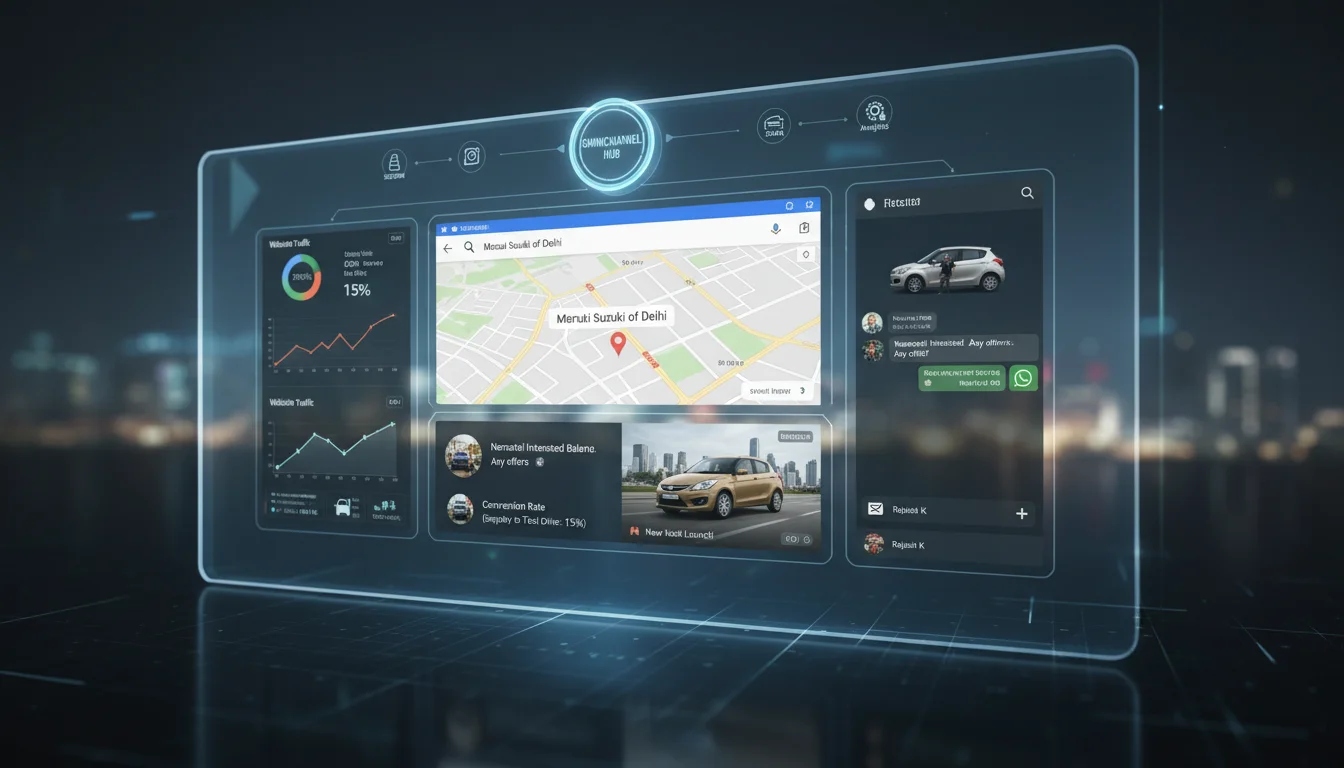
- WhatsApp Marketing and Agentic AI: WhatsApp Business API integration is revolutionizing the Indian automotive sales funnel. Rather than relying on scattered personal inboxes, dealerships use AI agents integrated with their CRM to capture ad replies. These agents operate 24/7, qualifying buyers via conversational flows, providing automated trade-in appraisals, and routing only high-intent, appointment-ready leads to human representatives, ensuring no inquiry falls through the cracks.
- Influencer and Content Marketing: Particularly effective for two-wheelers and EVs, partnering with local micro-influencers and automotive vloggers builds authentic trust. Content marketing supports SEO by answering customer questions through long-form blogs, such as “Best Cars for Winter Driving” or detailed breakdowns of hybrid technologies.
Local and Global Case Studies
The efficacy of these strategies is demonstrated by top OEMs and dealership networks operating in India:
- Maruti Suzuki: The market leader executed a comprehensive digital strategy to transition the buyer journey online. Through their “Digital Showroom,” they replicated the physical experience using 360-degree views and online configurators. They utilized high-intent SEM for model names, retargeting based on site visits, and deployed the MyNexa app specifically for after-sales loyalty and service booking, effectively bridging the gap between digital discovery and the offline showroom.
- Hero MotoCorp: To capture both the mass-market commuter and growing premium segments, Hero combined rigorous SEO with influencer marketing. Their strategy targeted specific organic queries (e.g., “Hero Splendor mileage”), while deploying macro-influencers like bikewithgirl and celebrities like Virat Kohli to build aspirational value. This dual approach captured both logical (search-driven) and emotional (social-driven) buyers, resulting in 1.9 billion YouTube views and dominating market share.
- Honda Motorcycle and Scooter India: Honda instituted an “Omnichannel Digital Journey” allowing buyers to complete up to 90% of the purchasing process online, drastically reducing in-showroom time and elevating digital conversion rates. Their marketing heavily featured hybrid-tech messaging to appeal to eco-conscious demographics.
- MG Motor India: Upon entering the highly competitive Indian market, MG partnered with Cognizant to build an end-to-end ERP and marketing engagement platform using SAP and Adobe. This integration allowed digital marketing data to flow directly into inventory and production pipelines, ensuring highly targeted campaigns and rapid execution.
- Tejpal MG Motors: A localized case study of a specific dealership demonstrated the impact of CRM-based follow-ups and digital lead generation on consumer decision-making. The dealership successfully utilized technology-driven sales practices to shape consumer perception and establish brand trust at the local level.
Competitive Analysis
Current Digital Presence of Top Dealerships in India
The Indian market features a mix of massive, publicly listed dealership chains and localized entities. Top-tier networks such as CarTrade Tech Ltd., Landmark Cars Ltd., Popular Vehicles & Services Ltd., and Competent Automobiles Company Ltd.
dominate the landscape. These entities represent top OEMs including Maruti Suzuki, Hyundai, Tata, Mahindra, Honda, and premium brands like Mercedes-Benz, Porsche, and Jaguar Land Rover.
| Company | Current Market Price (CMP) | Profit After Tax (PAT TTM) | ROCE Last Year (%) |
|---|---|---|---|
| CarTrade Tech Ltd. | 1764 | 219 | 8.4% |
| Landmark Cars Ltd. | 415 | 25 | 9.2% |
| Popular Vehicles & Services Ltd. | 96.4 | -21 | 7.4% |
| Competent Automobiles Company Ltd. | 344.4 | 19 | 9.5% |
Data highlighting the financial footprint of major publicly listed Indian dealership networks.
An analysis of Popular Vehicles & Services—a premier Maruti Suzuki dealer network with over 150 touchpoints across Kerala, Chennai, Bangalore, and Telangana—reveals a highly sophisticated digital footprint indicative of top-tier market players.
What Top Dealerships Are Doing Well
Leading dealership networks excel by creating comprehensive, integrated digital ecosystems that serve the customer at every stage of the lifecycle:
- Comprehensive Digital Ecosystems: Sites like Popular Vehicles offer end-to-end digital services. Users can browse highly detailed digital catalogs that distinctly separate mass-market brands (Arena) from premium segments (Nexa) and commercial/CNG fleets. The sites integrate robust dealer/service locators powered by Google Maps and offer digital finance inquiry forms customized by city and model.
- Pre-Owned Vehicle Integration: Recognizing the 1.3:1 used-to-new car ratio, top dealers operate dedicated pre-owned portals (e.g., Popular TrueValue). These portals offer detailed 376-point inspection checklists, transparency regarding RC transfers, and hassle-free return policies, directly combating the historical mistrust associated with the unorganized used car market.
- Digital After-Sales and Fixed Operations: Successful dealerships have fully digitized their fixed operations. They offer online service booking forms with precise location and slot selections, insurance renewal portals, and digital requests for emergency breakdown assistance (MSRS).
- Omnichannel Customer Support: High-performing dealers provide 24/7 toll-free support intertwined with verified WhatsApp business accounts, seamlessly capturing users who prefer instant messaging. They actively manage their social media to showcase business milestones, customer testimonials, and localized cultural celebrations (e.g., Onam deliveries).
Gaps and Opportunities to Outperform
Despite the sophistication of top-tier chains, the broader ecosystem of mid-sized and regional dealerships suffers from critical digital and operational gaps, creating opportunities for agile competitors to outperform them:
- The Follow-Up Failure and Lead Attribution: A massive gap exists in tracking digital leads through to offline sales. Many dealerships run digital ads but lack the CRM integration to measure ROI. Consequently, leads sit untouched because showroom staff fail to contact prospects promptly, resulting in high drop-off rates. Implementing Agentic AI chatbots can instantly solve this bottleneck.
- Generic Content vs. Unique Descriptions: Dealership websites frequently rely on manufacturer-provided stock images and thin content. Dealerships that write unique, keyword-rich descriptions for specific vehicles on their lot and upload actual photos gain a massive SEO and consumer trust advantage over those using generic templates.
- Underutilized Fixed Ops Marketing: While vehicle sales are heavily marketed, high-margin service and parts marketing is often neglected. Dealerships can vastly outperform competitors by running targeted local SEO and PPC campaigns specifically for service queries (e.g., “oil change [city]” or “genuine OEM parts near me”).
- Disconnect Between Sales and Service Reality: A persistent gap exists between a dealership’s digital promises and the physical showroom reality. Consumer forums (such as Team-BHP and Reddit) are replete with complaints regarding pathetic delivery experiences, denial of test drives, forced purchase of useless accessories, and post-sale service centers refusing to honor warranties. Dealerships that use their digital platforms to guarantee transparent pricing, zero forced accessories, and guaranteed test-drive availability can easily siphon market share from legacy competitors relying on outdated bait-and-switch tactics.
Recommended Strategy for Vehicle Dealerships in India
Target Audience Personas
To maximize digital efficiency, dealerships must segment their audience and tailor their messaging architecture to specific psychographic and demographic profiles.
The Urban Value Seeker (Ages 22-35)
Focused primarily on budget, fuel efficiency, low maintenance costs, and utility. This demographic targets entry-level hatchbacks, commuter motorcycles, and affordable electric scooters.
- Digital Behavior: High search volume for mileage comparisons, low EMI options, and real-world reviews on YouTube. They are highly active on social media and responsive to WhatsApp marketing.
The Premium Upgrader / Social Climber (Ages 30-50)
Focused on brand prestige, safety features, advanced technology, and comfort. This segment targets SUVs, premium sedans, and luxury two-wheelers.
- Digital Behavior: Heavy engagement with Instagram lifestyle content. They value seamless digital booking, demand highly responsive customer service, and expect a premium omnichannel experience bridging the website and the showroom.
The Eco-Conscious EV Pioneer (Ages 25-45)
Focused on sustainability, total cost of ownership, and cutting-edge software integration.
- Digital Behavior: Conducts deep, methodical research on battery range, charging infrastructure, battery-as-a-service models, and government subsidies. They require heavy educational content and trust-building touchpoints to overcome range anxiety.
Recommended Channels and Campaign Types
A successful strategy requires a full-funnel approach, balancing immediate lead generation with long-term brand building.
- Bottom-Funnel (Conversion): Hyper-Local Google Search Ads. Capture high-intent buyers utilizing radius targeting around the dealership. Campaigns must be segmented tightly into “New Inventory,” “Used Inventory,” and “Fixed Operations (Service/Parts)”.
- Mid-Funnel (Consideration): Meta Dynamic Inventory Ads. Connect the dealership’s live inventory catalog to Facebook and Instagram. Utilize retargeting pixels so that if a user views a specific Hyundai Creta on the website, Meta automatically serves an ad for that exact vehicle across their social feeds, drastically lowering the cost per acquisition.
- Direct Engagement: WhatsApp API Lifecycle Marketing. Deploy “Click-to-WhatsApp” ads on social media. Instead of redirecting to a slow-loading landing page, the user enters a WhatsApp chat where an AI bot qualifies the lead (budget, desired model, trade-in status) before seamlessly routing them to a human salesperson.
Content Ideas Specific to Dealerships
Content must move beyond generic manufacturer brochures to provide localized, actionable value:
- Educational SEO Blogs: Articles targeting local geographic and infrastructural concerns, such as “Best High-Ground-Clearance SUVs for Mumbai Monsoons” or “Comprehensive Guide to Electric Scooter Charging Stations in Bangalore”.
- Video Walkarounds: Short, unpolished, authentic smartphone videos of new arrivals. Highlighting specific features, trunk space, or tech interfaces, optimized for Instagram Reels and YouTube Shorts, builds immediate authenticity.
- Digital Transparency Tools: Implement interactive digital calculators on the website for EV range vs. ICE cost savings, transparent EMI calculators, and instant online trade-in valuation forms to build trust early in the buyer journey.
Budget-Friendly Digital Marketing Approaches
For smaller or regional dealerships with restricted budgets, expensive programmatic ads are not required to generate leads.
- Google Business Profile (GBP) Mastery: Completely free, a fully optimized GBP with weekly photo updates, comprehensive Q&A sections, and aggressive review generation can dominate local search and drive massive footfall.
- Local Community Engagement: Distributing pre-owned inventory listings into local Facebook Marketplace buy/sell/trade groups relies on organic reach and community trust, driving sales without ad spend.
- User-Generated Content (UGC): Photographing or filming happy customers during vehicle delivery (with their permission) and tagging them on social media creates viral, free organic reach as customers proudly share the content with their personal networks.
Keywords & SEO Opportunities
A scientifically structured SEO strategy relies on capturing the search demand curve. Short-tail keywords provide massive search volume but lack specific intent, resulting in lower conversion rates. Conversely, long-tail keywords have lower individual search volumes but articulate a highly specific search intent, yielding exponentially higher conversion rates because the user is further down the purchasing funnel.
High-Intent Keywords for Ranking (Bottom of Funnel)
These keywords signify a user who has completed their research phase and is actively looking for a local transaction point. Dealerships must ensure their landing pages are optimized for these exact phrases.
| Keyword Category | Example Queries | Search Intent | Est. |
|---|---|---|---|
Competition
-
Core Dealership
“car dealership near me”, “bike showroom in [City]”, “electric scooter dealers”
Immediate local physical visit.
High
-
Specific Inventory
“used Tata Nexon for sale [City]”, “buy Ola S1 Pro online”
High intent to purchase a defined model.
Medium
-
Promotional / Deals
“Maruti Swift Diwali offers [City]”, “[Model] lease deals [City]”
Price-sensitive transactional intent.
Medium
-
Fixed Operations
“authorized Honda service center near me”, “oil change [City]”, “genuine OEM parts”
Post-sale maintenance, repair, and parts acquisition.
Medium to High
Long-Tail Keyword Opportunities (India-Specific)
Long-tail queries mimic natural conversational language. They are increasingly critical due to the rise of voice search and Google AI Overviews, which thrive on answering highly specific queries that broad “head terms” cannot satisfy.
-
Financing & EMI
“zero down payment bike loan in [City]”, “how to get car loan with low Cibil score”
Captures users requiring financial facilitation prior to finalizing vehicle selection.
-
EV Specific
“best electric scooter for daily 50km commute”, “cost of replacing EV battery in India”
Addresses specific anxieties inhibiting the transition from ICE to EV; highly educational.
-
Hyper-Local / Geo
“used car dealers in [Neighborhood/ZIP code]”, “open now bike repair shop [City]”
Bypasses intense city-wide competition to dominate specific geographic sub-sectors.
-
Comparative
“Kia Seltos vs Hyundai Creta maintenance cost”, “best mileage bikes under 1 lakh”
Intercepts users in the final stages of the consideration phase, guiding their ultimate choice.
7. Implementation Roadmap
A phased approach ensures that dealerships build a robust, leak-proof digital foundation before scaling aggressive paid acquisition strategies.
Short-Term Quick Wins (Month 1–3: The Foundation)
The primary objective in the first quarter is to optimize existing digital assets, plug lead leakages, and capture immediate local demand.
- Month 1: Digital Asset Audit & Local SEO Setup: Claim, verify, and fully optimize the Google Business Profile (GBP). Ensure operating hours, contact numbers, and inventory links are accurate. Implement a systematic physical process requiring sales staff to request a Google review at the moment of vehicle delivery. Concurrently, audit the dealership website to ensure mobile-first responsiveness, fast load times, and a streamlined navigation menu (restricted to a maximum of 8 items to prevent user fatigue).
- Month 2: Lead Routing & WhatsApp Integration: Transition customer communication from scattered personal staff numbers to a centralized WhatsApp Business API. Set up basic automated responses for after-hours inquiries and integrate Web-to-Lead forms directly into the dealership’s CRM. The goal is to reduce the initial lead response time from hours to under 10 minutes.
- Month 3: High-Intent Paid Media Launch: Launch highly targeted Google Search campaigns focusing strictly on bottom-of-funnel, localized keywords (e.g., “ dealer [City]” or “Used [Model][City]”). Implement Meta pixel tracking on the website and initiate basic retargeting campaigns to re-engage users who abandoned the test-drive booking form.
Long-Term Strategy (Month 6–12: Advanced Scaling)
The objective in the latter half of the year is to implement full-funnel marketing, autonomous systems, and data-driven personalization to secure market dominance.
- Month 6: Content Marketing & Video Syndication: Roll out a dedicated, consistent content calendar focusing on long-tail SEO blog posts and video walkarounds. Establish a localized YouTube and Instagram Reels presence featuring dealership staff explaining vehicle features, financing tips, and EV charging tutorials. This builds an emotional connection and establishes the dealership as a local authority.
- Month 9: Agentic AI and Predictive Analytics: Deploy autonomous AI agents capable of engaging leads 24/7. Unlike basic chatbots, these systems monitor customer behavior across channels, engaging autonomously based on real-time buying signals, and nurturing the lead over days until they are appointment-ready. Integrate predictive analytics platforms (like Ottopilot) to score leads based on purchase intent, maximizing sales team efficiency.
- Month 12: Full-Funnel Omnipresence & Retention: Expand advertising budgets to upper-funnel awareness campaigns (YouTube Ads, Google Display Network) to build long-term brand familiarity. Shift the strategic focus to Customer Lifetime Value (CLTV) by automating the post-sale lifecycle—deploying personalized email and WhatsApp triggers for service intervals, insurance renewals, and eventual trade-in upgrades.
8. Conclusion
The Indian automotive dealership ecosystem is undergoing an irreversible structural transformation. Driven by the near-total proliferation of digital discovery, the explosive evolution of the pre-owned vehicle market, and the rapid national adoption of electric mobility, the traditional dealership model—reliant solely on localized foot traffic and traditional print media—is effectively obsolete. Today, dealerships face acute, systemic pressures from inventory pileups, margin contraction, shifting consumer expectations, and an increasing skills gap. In this environment, digital marketing is no longer a peripheral advertising strategy; it is the central nervous system of modern automotive retail.
By embracing an omnichannel digital strategy, dealerships can systematically solve their most pressing operational challenges. Local SEO and dynamically targeted advertising align physical inventory with active, localized demand, mitigating the high depreciation costs of idle stock. WhatsApp automation and Agentic AI ensure that expensive digital leads are engaged instantaneously, drastically reducing acquisition costs and preventing prospect abandonment. Furthermore, data-driven post-sale marketing transforms one-time vehicle buyers into lifelong, highly profitable service and parts customers. The dealerships that will dominate the next decade are those that seamlessly blend an intuitive, data-rich digital discovery process with a transparent, frictionless offline delivery experience.
Call to Action: Partnering for Digital Excellence
Executing a sophisticated, full-funnel digital strategy requires deep technical expertise, specialized enterprise tools, and an intimate understanding of South Asian market dynamics. Gurkha Technology, a leading digital marketing and technology company based in Nepal, provides the exact cross-border expertise required to digitize, optimize, and scale vehicle dealerships in the region.
With demonstrated excellence in Search Engine Optimization, tailored Social Media Management, and high-conversion Paid Advertising across Google, Meta, and TikTok, Gurkha Technology engineers digital ecosystems that drive tangible revenue. Beyond standard digital marketing, their profound capabilities in custom web development, highly secure hosting, and sophisticated CRM and WhatsApp API integrations ensure that dealerships not only generate massive lead volumes but possess the automated infrastructure required to convert them flawlessly.
For dealerships ready to modernize their operations, lower acquisition costs, and leave competitors in the rearview mirror, Gurkha Technology offers the strategic consultation and technical execution necessary to lead the digital automotive frontier.