Digital Marketing for Indian Solar: Strategies & Growth
Industry Overview
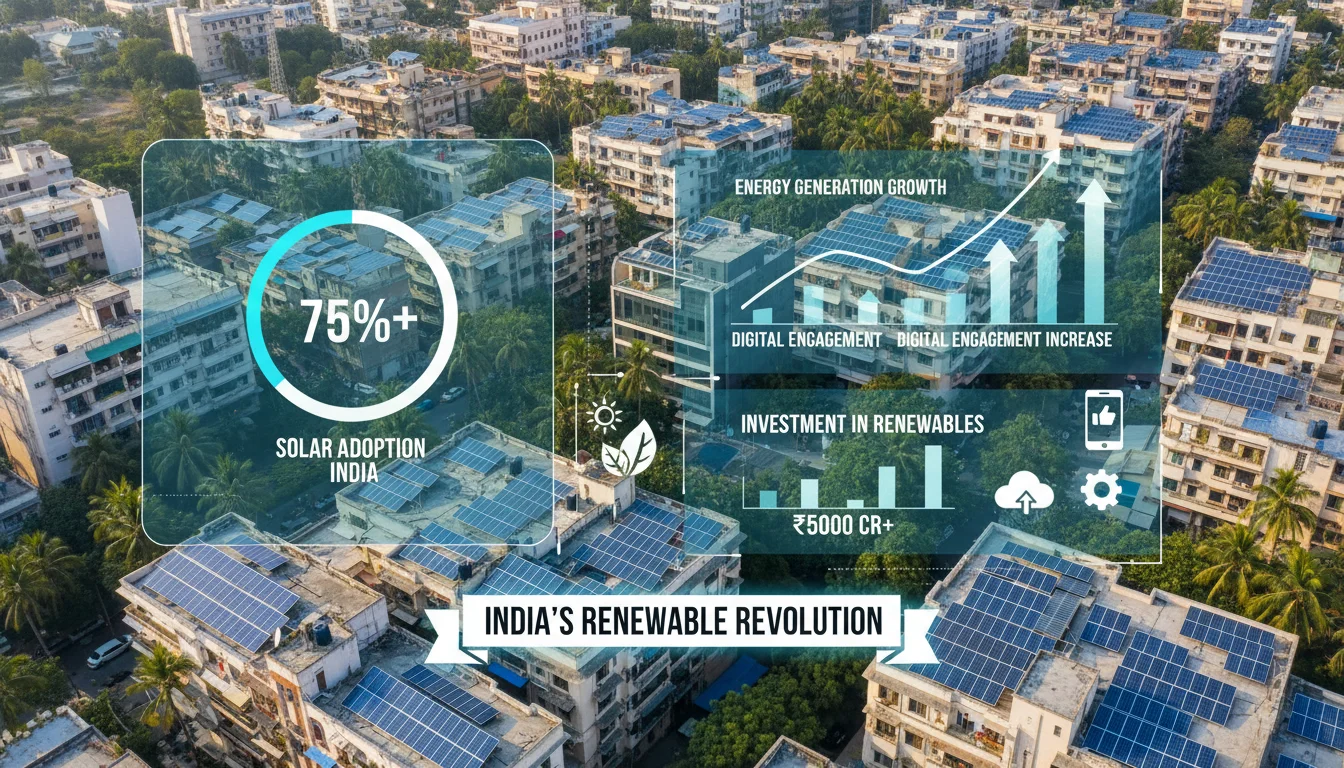
The renewable energy and solar power sector in India is currently navigating a period of unprecedented scale, characterized by aggressive national targets, rapid technological deployment, and complex structural challenges. As the nation maneuvers to fulfill its commitment to achieving 500 gigawatts (GW) of non-fossil fuel capacity by 2030 and net-zero emissions by 2070, the industry has transitioned from a supplementary energy source to the primary engine of India’s macroeconomic and environmental strategy. The solar power market, in particular, represents the vanguard of this transition, demanding sophisticated market intelligence and agile business models to capitalize on the profound economic opportunities it presents.
Current Market Size, Growth, and Trends
The sheer magnitude of the Indian solar power market is reflected in its extraordinary valuation and growth projections. The market size is anticipated to expand by a staggering $1,413.3 billion, accelerating at a Compound Annual Growth Rate (CAGR) of 49.5% between the years 2025 and 2030. In the near term, the sector is experiencing high-momentum growth, with a projected year-over-year expansion of 43.1% from 2025 to 2026. By the end of 2025, India’s installed non-hydro renewable capacity surged past the 203 GW threshold, with solar energy establishing absolute dominance by contributing approximately 53% of this total. In 2025 alone, the country recorded its highest-ever annual additions, deploying nearly 37.9 GW of solar and 6.3 GW of wind capacity.
This explosive growth is underpinned by several macro-trends and strategic government interventions that define the current commercial landscape. The most consequential of these is the PM Surya Ghar: Muft Bijli Yojana, a monumental initiative launched with an allocated budget of ₹75,021 crore (approximately $9 billion). This scheme aims to solarize one crore (10 million) households, shifting the paradigm of energy consumption. It provides up to 300 units of free electricity per month for middle and lower-income families while allowing them to generate an annual income of ₹17,000 to ₹18,000 by feeding surplus electricity back into the grid. This policy has effectively transformed millions of passive consumers into active “prosumers,” driving rooftop solar additions to 7.9 GW in 2025, a 72% year-over-year increase.

Simultaneously, the industry is experiencing a massive resurgence in domestic manufacturing, strategically designed to insulate the nation from global supply chain vulnerabilities. By the conclusion of 2025, India’s domestic solar module manufacturing capacity crossed the 175 GW mark, accompanied by 30 GW of cell manufacturing capacity. This localization of the supply chain is heavily supported by government mandates, notably the Approved List of Models and Manufacturers (ALMM), which forces developers to source domestically. Consequently, domestic module prices have seen significant compression; by early 2026, domestic TOPCon modules were priced at ₹14.8/Wp, and Mono PERC modules fell to ₹14.3/Wp, making solar power consistently cheaper than conventional coal-fired generation.
Furthermore, the integration of grid-scale storage has transitioned from theoretical modeling to commercial reality. Recognizing the intermittency of solar generation, tendering agencies have pivoted toward Battery Energy Storage Systems (BESS) and wind-solar hybrid projects. Viability gap funding (VGF) has supported standalone BESS tenders, which achieved record-low tariffs of ₹1.48 lakh/MW/month in recent auctions. Parallel advancements in green hydrogen and green ammonia—evidenced by SECI’s tender achieving price parity with grey ammonia at ₹49.75 per kg—further solidify the sector’s diversification into deep decarbonization for commercial and industrial applications.
- Market Growth: $1,413.3 Billion - Reflects 49.5% CAGR, indicating hyper-growth phase.
- Total RE Capacity (Dec 2025): 258 GW - Solar accounts for 53%, highlighting sector dominance.
- Annual Additions (CY 2025): 37.9 GW Solar, 6.3 GW Wind - Highest-ever recorded annual deployment in India.
- Domestic Module Capacity: 175+ GW (Modules), 30 GW (Cells) - Mass localization of supply chain; reduction in import reliance.
- Grid-Connected Segment: $143.6 Billion (2024 Valuation) - Utility-scale remains the largest revenue generator.
- Module Pricing (Early 2026): ₹14.3/Wp (Mono PERC) - Continuous price drops force competition on service and brand.
Key Challenges Faced by Businesses in this Industry
Despite the extraordinary metrics defining the sector’s expansion, renewable energy and solar power companies operate within a highly constrained environment fraught with structural, regulatory, and market-driven bottlenecks. Understanding these friction points is imperative, as they dictate the required operational pivots and necessary digital marketing interventions.
The most critical bottleneck threatening the trajectory of India’s solar ambitions is the severe deficit in grid integration and power evacuation infrastructure. The deployment of solar generation assets has vastly outpaced the expansion of the transmission network. In renewable-rich states such as Rajasthan, Gujarat, and Tamil Nadu, developers reported devastating curtailment levels ranging from 10% to 30% in late 2025. In Rajasthan alone, curtailment rates for certain installations spiked from 8.5% in March to nearly 51.5% by August 2025, resulting in massive financial losses for independent power producers (IPPs) who find their assets functionally stranded due to transmission unavailability.
This infrastructural deficit directly exacerbates the “42 GW Challenge”—a crisis of stranded capacity. As of late 2025, approximately 42 to 44 GW of awarded renewable capacity remained in limbo, paralyzed by a backlog of unsigned Power Purchase Agreements (PPAs) and Power Sale Agreements (PSAs). The aggressive push by the government to meet annual tendering targets (exceeding 93 GW tendered since FY2024) flooded the market faster than distribution companies (DISCOMs) could absorb. Offtakers have delayed signing PSAs in anticipation of further tariff reductions, creating a massive pipeline bottleneck that ties up developer capital and stalls project execution.
Regulatory instability presents another formidable challenge. Solar developers frequently face “policy flip-flops” at the state level. Abrupt regulatory changes concerning net metering, energy banking provisions, and open-access surcharges—such as the confusion generated by the Maharashtra Electricity Regulatory Commission in mid-2025—erode investor confidence and complicate long-term financial modeling. Additionally, the looming June 2026 deadline for the Approved List of Cells and Manufacturers (ALCM) creates artificial commissioning pressure, raising concerns that capacity additions may sharply moderate post-deadline unless policy extensions are granted.
At the consumer level, the market suffers from severe fragmentation and a profound trust deficit. The rapid growth of the rooftop sector has invited thousands of unverified engineering, procurement, and construction (EPC) contractors into the market. Consumers are frequently subjected to substandard installations, exaggerated generation claims, and poor after-sales service. For legitimate solar enterprises, differentiating their brand from fly-by-night operators and establishing verified technical credibility has become the primary barrier to customer acquisition.
Digital Landscape in India (Contextual to the Industry)
India’s digital ecosystem has evolved into a hyper-connected, data-rich environment that fundamentally dictates how commerce is conducted. The Indian digital marketing industry expanded remarkably to a valuation of $6.46 billion in FY24, fueled by ubiquitous smartphone penetration and affordable data. For the renewable energy sector, this digital maturation means that the traditional avenues of solar procurement—reliant on localized offline networking, door-to-door solicitation, and physical trade shows—have been superseded by a digital-first research and evaluation paradigm.
Internet & Social Media Usage Relevant to Solar Companies
The modern era of digital marketing in India is characterized by granular data capture, omni-channel integration, and the pervasive application of Artificial Intelligence (AI). For the solar industry, this means consumer behavior is no longer opaque; it can be meticulously tracked across multiple touchpoints. A Harvard Business Review survey embedded in regional marketing analysis reveals that 73% of Indian shoppers utilize multiple channels during their purchase journey, emphasizing the necessity of a cohesive, cross-platform digital presence.
Video consumption is the dominant force shaping consumer education and trust. As predicted by CISCO studies, video has surpassed all other content forms in consumption metrics. In the context of solar energy, where the product is highly technical and requires significant capital outlay, video serves as the ultimate medium for demystification. Consumers demand visual proof of installations, clear explanations of photovoltaic efficiency, and transparent breakdowns of return on investment (ROI). Furthermore, influencer marketing, projected to reach a $400 million valuation in India by 2026, has transitioned from lifestyle brands to the B2B and high-value B2C sectors. Solar companies are increasingly partnering with “eco-influencers,” green architects, and local community leaders to build localized trust and validate sustainability claims.
The integration of AI and Machine Learning is fundamentally altering lead qualification and customer service.

According to a PWC report, 77% of Indian businesses have recorded tangible improvements in customer satisfaction after implementing AI. In the solar sector, AI-driven chatbots and automated WhatsApp flows are deployed to instantly qualify leads based on electricity consumption and roof ownership, drastically improving sales efficiency and response times.
Popular Platforms Among the Target Audience
- Google (Search and Google My Business): Google remains the absolute foundation of high-intent discovery. When an Indian consumer or procurement officer actively searches for “5kW solar panel price” or “rooftop solar subsidy Gujarat,” they are displaying immediate commercial intent. For local EPCs, Google My Business (GMB) is arguably more critical than a website, acting as the primary digital storefront where proximity, reviews, and MNRE certifications drive local conversions.
- LinkedIn: The undisputed platform for B2B engagement and corporate OEM growth. Utility-scale developers, EPC contractors, and module manufacturers utilize LinkedIn to execute account-based marketing (ABM). This involves optimizing executive profiles, publishing thought leadership on grid integration, and directly messaging infrastructure planners and corporate sustainability officers via Sales Navigator.
- YouTube: The engine for education and trust-building. Because solar adoption requires overcoming significant technical intimidation, YouTube serves as a repository for long-form explanatory content. Explainer videos, unboxing of inverters, and documentary-style case studies of commercial installations thrive here, functioning as a long-term SEO asset that builds authority over years.
- Meta Platforms (Facebook, Instagram, WhatsApp): Meta platforms govern top-of-funnel awareness and visual branding. Instagram, with its grid layouts and Reels, is ideal for showcasing the aesthetic appeal of modern residential installations and engaging eco-conscious millennials. Facebook remains deeply influential in Tier 2 and Tier 3 Indian cities, where community groups and localized boosted posts drive significant inquiry volume. Crucially, WhatsApp has evolved from a communication tool into a primary CRM and lead-nurturing environment for the Indian market.
- X (formerly Twitter): Functions as the primary channel for policy engagement, PR, and B2B networking. Solar brands utilize X to disseminate updates from the MNRE and IREDA, engage with energy journalists, and participate in industry-wide conversations around tariffs and grid policies, establishing the brand as a macro-level authority.
Consumer Online Behavior Related to Solar Power
The decision architecture for purchasing a solar energy system is fundamentally different from fast-moving consumer goods. It is a high-friction, high-consideration purchase with a typical sales cycle spanning 6 to 12 months. Understanding this timeline is crucial; companies that attempt to force an immediate sale inevitably fail.
The consumer journey navigates three distinct digital phases:
- Awareness (The Educational Phase): The journey is usually triggered by external pain points, such as a severe summer electricity bill or news of a government subsidy. At this stage, behavior is exploratory. Consumers search for broad informational terms like “how do solar panels work” or “solar vs grid power.” They rely heavily on YouTube tutorials and high-level blog posts. They are not yet ready to speak to a sales representative.
- Consideration (The Validation Phase): The consumer has decided solar is viable and now seeks financial and technical validation. Online behavior shifts toward intensive research. They interact with ROI calculators, download subsidy eligibility guides, and compare the merits of monocrystalline versus TOPCon panels. During this phase, buyers average interactions with 3 to 5 different installers, utilizing multiple digital touchpoints to verify legitimacy. Social proof, such as Google reviews and video testimonials, becomes the primary deciding factor.
- Decision (The Trust and Logistics Phase): The focus narrows to execution. Search behavior becomes hyper-localized (e.g., “best solar installer in Ahmedabad”). The consumer meticulously scrutinizes the installer’s Google Business Profile, verifies their MNRE registration status, and investigates warranty terms and post-installation maintenance policies. A fast-loading website, transparent pricing communication, and immediate responsiveness on WhatsApp are critical to preventing the lead from defecting to a competitor at the final hurdle.
Digital Marketing Opportunities
The intersection of India’s solar energy boom and its rapid digitalization creates profound opportunities. When executed correctly, digital marketing is not merely a promotional tool; it is a strategic mechanism capable of mitigating the industry’s most severe structural challenges while driving exponential revenue growth.
How Digital Marketing Can Solve Key Challenges
The most pressing issues facing the Indian solar sector—stranded capacity, market fragmentation, and consumer trust deficits—can be directly addressed through sophisticated digital strategies.
- Bypassing Grid Bottlenecks via Targeted B2B Marketing: Utility-scale developers suffering from grid curtailment and unsigned PPAs can utilize digital marketing to pivot toward the Commercial and Industrial (C&I) sector. By deploying highly targeted LinkedIn programmatic ads and Account-Based Marketing (ABM) directed at factory owners, data center managers, and corporate parks, developers can secure private, open-access corporate PPAs. This allows them to bypass the congested state DISCOM networks and unlock the value of their stranded generation assets.
- Overcoming the Trust Deficit with EEAT: In a market flooded with unreliable vendors, building Experience, Expertise, Authoritativeness, and Trustworthiness (EEAT) is the ultimate competitive advantage. A robust digital footprint acts as a verifiable ledger of a company’s competence. By consistently publishing detailed case studies, showcasing third-party certifications (e.g., NABCEP, MNRE), and maintaining a flawless portfolio of verified customer reviews, legitimate EPCs can systematically eliminate low-quality competitors from the consumer’s consideration set.
- Deciphering Policy Complexity: With varying state-level regulations and central schemes like the PM Surya Ghar Yojana, consumers are often paralyzed by confusion. Solar companies that use content marketing to act as educational “concierges”—creating simplified, vernacular-language guides that explain exact subsidy entitlements and net-metering rules for specific states—capture high-intent leads simply by providing clarity.
Best Strategies for Renewable Energy Companies
To capitalize on these opportunities, solar enterprises must deploy a multifaceted, integrated digital ecosystem rather than relying on isolated tactics.
- Hyperlocal SEO and GBP Dominance: Because solar installation is a geographically constrained service, dominating local search is paramount. National brands with massive budgets often fail to capture hyperlocal traffic because they lack specific, regional depth. Regional EPCs can exploit this by creating city-specific landing pages and aggressively optimizing their Google Business Profiles (GBP). Highlighting MNRE registration, defining precise service areas, and posting weekly updates with specific project data (e.g., “Commissioned 10kW system in Whitefield, Bangalore with projected savings of ₹15,000/month”) signals immense local relevance to Google’s algorithms, ensuring top placement in “near me” searches.
- Friction-Optimized Lead Generation via WhatsApp: The solar industry suffers from a high volume of low-quality leads (e.g., individuals without roof rights seeking free electricity). The most effective strategy to improve ROI is to introduce strategic friction at the top of the funnel. Instead of directing Meta or Google ad traffic to a generic contact form, companies should direct users to an automated WhatsApp flow or a highly specific landing page form. By requiring the user to input their average monthly electricity bill, roof ownership status, and connection type (residential/commercial) before speaking to a human, the company instantly filters out unqualified traffic, allowing the sales team to focus exclusively on high-probability conversions.
- Conversion-Driven Content Architecture: Content must be engineered to answer the buyer’s primary financial and logistical questions. The highest-converting digital assets in the solar industry are interactive ROI and subsidy-adjusted payback calculators. By allowing a user to input their local tariff and roof size to instantly receive a personalized financial projection, companies capture contact information at the exact moment of highest intent. Complementary content, such as comprehensive FAQs, step-by-step installation guides, and detailed explanations of AMC (Annual Maintenance Contracts), serves to nurture leads through the extended 6-12 month buying cycle.
- Omni-Channel Paid Advertising: Paid advertising must be meticulously targeted. Google Search Ads should be deployed strictly for high-intent, bottom-of-funnel keywords (e.g., “solar EPC contractors in Gujarat”). Conversely, Meta (Facebook and Instagram) ads should focus on top-of-funnel education and visual proof.
Rather than static images of solar panels, successful campaigns utilize carousel ads showing before-and-after electricity bills, time-lapse installation videos, and customer testimonials to build emotional resonance and brand recall.
Local and Global Examples/Case Studies
The Loom Solar Organic Phenomenon: Loom Solar, an Indian startup focused on residential solar and lithium batteries, provides a masterclass in digital-first growth.
Entering a highly competitive market, Loom bypassed expensive traditional distribution by focusing entirely on organic digital education. They produced over 500 high-quality videos explaining solar technology, installation processes, and environmental benefits. By 2019, this content had amassed 25 million global views, resulting in 30,000 monthly organic brand searches on Google. This strategy allowed them to acquire over 100 customers in their first 30 days of operation, proving the viability of a purely digital customer acquisition model in the Indian solar sector.
Digitalzone’s B2B Syndication for Loom:
Recognizing a gap in their commercial pipeline, Loom partnered with Digitalzone to target high-value enterprise accounts. Traditional advertising was failing to reach C-suite decision-makers. By utilizing adaptive B2B content syndication and targeted email marketing, the campaign successfully bypassed lower-level employees, delivering 1,200 highly qualified enterprise leads with an exceptional 45.15% email open rate and a 21.02% click-through rate, demonstrating the power of hyper-targeted B2B digital marketing.
Unilux Solar LLP’s Budget Optimization:
Demonstrating that massive capital is not required for digital success, Unilux Solar LLP executed a highly structured 1-year digital marketing strategy targeting South India with a strict budget of just ₹17,000 per month. By focusing ruthlessly on organic SEO, social media community engagement, and localized lead generation tactics, they effectively established brand visibility and customer retention in a crowded regional market without relying on exorbitant paid ad spend.
Competitive Analysis
The competitive landscape of the Indian solar industry is highly stratified, featuring massive integrated conglomerates, specialized module manufacturers, and agile, digital-first retail startups. An analysis of their digital footprints reveals their strategic positioning, highlighting both their formidable strengths and the critical gaps that smaller, localized players can exploit.
Current Digital Presence of Top Solar Companies
-
Competitor: Tata Power Solar
Core Market Focus: Integrated Utility, EPC, Rooftop
Digital Marketing Strengths: Unmatched brand equity and domain authority. Excellent corporate PR aligning with Net Zero goals. Dominant search presence for broad industry terms.
Noted Digital Gaps: Overly corporate messaging. Struggles to rank for hyper-localized “near me” searches against focused regional EPCs.
-
Competitor: Adani Solar
Core Market Focus: Utility-Scale PV, Cell/Module Mfg.
Digital Marketing Strengths: High-end B2B and investor-relations digital presence. Strong LinkedIn authority targeting government entities and large IPPs.
Noted Digital Gaps: Significant lack of granular B2C educational content. Digital presence is heavily weighted toward macro-level scale rather than retail empathy.
-
Competitor: Waaree Energies
Core Market Focus: Module Manufacturing (21% Share), EPC
Digital Marketing Strengths: Massive production scale communication. Consistent digital advertising for brand awareness. Strong B2B distributor network portals.
Noted Digital Gaps: Content often leans too technical for the average homeowner; missing opportunities for simplified, top-of-funnel educational marketing.
-
Competitor: Vikram Solar
Core Market Focus: High-Efficiency Modules (TOPCon)
Digital Marketing Strengths: Strong focus on R&D and global export credentials on digital platforms. Positions as a premium, Tier-1 manufacturer.
Noted Digital Gaps: Similar to Waaree, digital focus is heavily B2B; underutilizes localized retail marketing strategies.
-
Competitor: Loom Solar
Core Market Focus: Retail, D2C, Lithium Batteries
Digital Marketing Strengths: Absolute dominance in YouTube video marketing, influencer partnerships, and educational SEO. Exceptional D2C e-commerce interface.
Noted Digital Gaps: Primarily focused on the residential/retail segment; less digital authority in the large-scale utility and C&I EPC space.
What They Are Doing Well
The market leaders, particularly Tata Power and Adani Green Energy, excel at macro-level corporate branding. They effectively utilize digital PR, robust corporate websites, and LinkedIn to communicate massive scale, financial stability, and diverse technological capabilities. Their digital assets are designed to assure institutional investors, government procurement bodies, and large-scale IPPs that they possess the capacity to execute multi-gigawatt projects. Conversely, startups like Loom Solar have mastered the modern D2C digital playbook. They understand that the residential consumer requires education before conversion, and they have built massive, highly engaged audiences through relentless organic video content and SEO optimization.
Gaps and Opportunities to Outperform Them
Despite the overwhelming financial resources of national conglomerates, severe structural gaps exist in their digital strategies. Agile regional EPCs and mid-sized manufacturers can exploit these vulnerabilities to capture significant market share:
- 1. The Hyperlocal Vulnerability: National brands rely on broad, high-volume keywords. They lack the agility to mass-produce the hyper-specific, localized content required to dominate queries like “rooftop solar subsidy in Gurgaon” or “solar installer for residential societies in Noida”. Local installers who construct robust, data-rich Google Business Profiles and city-specific landing pages consistently outrank national conglomerates for high-intent regional traffic, as Google’s algorithms prioritize local relevance and proximity.
- 2. The Empathy and Education Gap: The websites of major corporations are frequently dense with technical jargon and investor data, making them intimidating for the average homeowner seeking simple answers about their electricity bill. Competitors can easily outperform them by building “human-first” digital experiences. By offering interactive ROI calculators, simplified vernacular guides to state subsidies, and transparent pricing models, smaller companies can bridge the empathy gap and capture leads who feel alienated by corporate monoliths.
- 3. Tier 2 and Tier 3 Market Neglect: Major players typically concentrate their digital advertising budgets and operational focus on Tier 1 metropolitan hubs. However, Tier 2 and Tier 3 cities offer superior rooftop availability and are experiencing rapid increases in electricity demand. Developing targeted digital campaigns optimized for regional languages, utilizing Facebook community groups, and highlighting local installations presents a massive, untapped arbitrage opportunity for regional growth.
- 4. The Evidence Gap (EEAT): While massive brands rely on their name for trust, many mid-tier companies make unsubstantiated claims about savings. A significant competitive advantage exists for companies that provide verifiable, granular proof. Publishing actual before-and-after electricity bills, live generation data from previous installations, and unedited customer video testimonials creates an insurmountable trust advantage over competitors relying purely on generic marketing copy.
Recommended Strategy for Renewable Energy Companies in India
To succeed in this complex, high-consideration market, a solar company must abandon the traditional transactional mindset and construct a continuous, value-driven digital ecosystem. This ecosystem must be engineered to intercept prospects at the precise moment of their pain point, educate them relentlessly, and nurture them through a long sales cycle using hyper-targeted messaging.
Target Audience Personas
Effective digital marketing requires precise segmentation. The “Indian Solar Buyer” is a multifaceted demographic; messaging must be tailored to distinct psychological, financial, and geographical drivers.
-
The Residential Homeowner (Metropolitan & Tier 1):
- Characteristics: Highly informed, skeptical of greenwashing, and motivated primarily by rising electricity costs (“bill shock”) and environmental consciousness. Aesthetics are a factor; they often prefer premium, all-black panel designs.
- Preferences: Demands a seamless digital experience. Requires extensive hand-holding regarding complex DISCOM approvals, desires easy financing (zero-down EMIs), and values comprehensive, long-term warranties.
-
The Tier 2 & Tier 3 Adopter:
- Characteristics: Resides in expanding cities with ample, unshaded rooftop space. Highly motivated by financial pragmatism and government initiatives like the PM Surya Ghar Yojana.
- Preferences: Deeply values direct human interaction and localized trust. Responds best to vernacular language content, WhatsApp communication, and local social proof (e.g., seeing a co-branded installation at a nearby recognizable business).
-
The Commercial and Industrial (C&I) Decision Maker:
- Characteristics: A B2B persona encompassing C-Suite executives, Procurement Officers, and Factory Owners. Crucially, this segment represents 70-80% of total rooftop installations in India.
- Preferences: A purely logic-driven buyer. Their decision matrix focuses strictly on ROI, cash flow impact, tax incentives (such as accelerated depreciation), ESG compliance, and scale efficiency. They require highly technical documentation, performance guarantees, and assurances of long-term O&M capabilities.
Recommended Channels and Campaign Types
The deployment of digital channels must be dictated by the target persona to maximize return on ad spend (ROAS).
For Residential (B2C):
-
Google Local Service & Search Ads: Deploy exclusively for high-intent, bottom-of-funnel traffic.
- Utilize strict geotargeting to limit ad spend to serviceable zip codes, preventing budget drain from out-of-territory clicks.
- Meta (Facebook/Instagram) Ads: Utilize for top-of-funnel awareness and retargeting. Deploy visual carousel ads highlighting tangible financial benefits (before-and-after bills) rather than technical specifications of the panels.
- Google My Business (GMB): The absolute foundation of local trust. Maintain weekly updates featuring photos of recent local installations, explicit mentions of MNRE registration, and aggressively solicit customer reviews.
-
For Commercial (B2B):
- LinkedIn Promoted Content & Sales Navigator: Target facility managers, architects, and sustainability officers. Distribute high-value technical assets, such as whitepapers on C&I grid integration, tax depreciation benefits, and case studies of large-scale factory installations.
- Programmatic Display Advertising: Geofence specific industrial parks, SEZs, and corporate hubs, serving customized display ads specifically to devices operating within those high-value commercial zones.
Content Ideas Specific to Solar Companies
Content is the fuel that moves prospects through the 6-to-12-month buying cycle without relying on aggressive, high-pressure sales tactics.
Top-of-Funnel (Awareness):
Content designed to capture broad interest and demystify the technology.
- Ideas: Blog posts like “How Solar Panels Work During the Indian Monsoon” or “Monocrystalline vs. TOPCon: Which is Best for Your Roof?”. Short-form video reels debunking common solar myths.
Middle-of-Funnel (Consideration):
Content engineered to provide financial validation and build deep trust.
- Ideas: Comprehensive, downloadable guides such as “The Ultimate Step-by-Step Guide to the PM Surya Ghar Subsidy 2026.” The deployment of interactive ROI calculators where users input their local utility tariff and roof size to receive instant, personalized savings projections.
Bottom-of-Funnel (Decision):
Content that eliminates final objections and proves localized competence.
- Ideas: Hyperlocal case studies detailing exact system sizes, capital outlays, and verified generation metrics for specific local properties. Video testimonials from recognizable local business owners. Detailed FAQs addressing maintenance timelines, inverter replacement costs, and warranty claim procedures.
Budget-Friendly Digital Marketing Approaches
Massive capital expenditure is not a prerequisite for digital dominance if strategies are highly optimized and friction-based:
- WhatsApp Conversational Qualification: Instead of paying premium CPC rates to direct users to generic contact forms, direct Meta and Google ad traffic to an automated WhatsApp chatbot. The bot asks qualifying questions (e.g., “Is your electricity bill over ₹3,000?” and “Do you have exclusive roof rights?”). This filters out non-buyers instantly, ensuring the sales team only invests time in highly qualified leads, drastically reducing the effective Cost-Per-Acquisition (CPA).
- Organic Video on YouTube: Creating educational content requires minimal capital—often just a smartphone and a knowledgeable technician. An installer explaining how to read a net meter or demonstrating the durability of a panel structure can generate thousands of highly qualified, localized views over years without recurring ad spend, creating a perpetual lead generation engine.
- Review-Driven Referral Loops: Implement automated post-installation email and WhatsApp sequences requesting Google reviews. High review volumes naturally boost local SEO rankings, generating free, high-converting organic leads. Furthermore, offering digitized referral incentives turns existing customers into an active sales force.
Keywords & SEO Opportunities
In 2026, Search Engine Optimization (SEO) remains the most critical, high-ROI long-term investment for a solar company. Organic leads consistently demonstrate superior conversion rates because the user is actively seeking a solution, and organic rankings inherently convey a level of trustworthiness that paid ads cannot replicate. However, a successful SEO strategy must transcend broad volume and obsess over search intent.
High-Intent Keywords for Ranking
Broad keywords offer massive volume but possess exceptionally low commercial intent. A query like “Solar Panels” (823,000 monthly searches globally) is purely informational; the user might be a student researching a science project. Conversely, high-intent keywords signify immediate commercial readiness.
| Keyword Category | Examples | Intent Profile | Monthly Volume Indicator |
|---|---|---|---|
| Transactional / Pricing | solar panel cost, solar installation near me, solar financing options | High (User is ready to compare quotes and evaluate budgets) | 135,000 (Global/Cost), 3,600 (Near Me) |
| B2B / Commercial EPC | commercial solar solutions, photovoltaic system design, solar EPC companies in India | High (Signifies large capital deployment and B2B procurement) | 390 to 60,500 |
| Time-Sensitive / Subsidy | solar incentives 2025, PM Surya Ghar eligibility | Medium/High (Driven by policy deadlines and financial urgency) | Niche, but highly converting |
Long-Tail Keyword Opportunities (India-Specific)
The absolute highest ROI in SEO is achieved by capturing localized, long-tail queries. National competitors ignore these due to their granular nature, allowing local businesses to dominate. Strategies must incorporate regional languages, specific city modifiers, and hyper-local policy terms.
- Localized Pricing & Review Queries: Solar Panel Price in Chennai per kW , Best 5kW Solar Installer Reviews Ahmedabad.
- Policy-Specific Queries: Rooftop Solar Subsidy Maharashtra 2026 Eligibility, How to apply for PM Surya Ghar in Gujarat.
- Component-Specific Queries: Luminous solar inverter price in Delhi, Top TOPCon module manufacturers in India.
To effectively rank for these terms, solar businesses must utilize tools like SEMrush, Ahrefs, or Surfer SEO to optimize on-page content and identify backlink opportunities from local business directories, regional real estate blogs, and renewable energy associations, thereby boosting the domain authority of their localized landing pages. Furthermore, optimizing content with specific entity attributes (like MNRE registration numbers and exact project coordinates) ensures visibility in emerging AI-driven search overviews.
Implementation Roadmap
Transitioning a solar enterprise to a high-performance digital marketing ecosystem requires a disciplined, phased approach. Attempting to scale advertising spend before solidifying foundational digital infrastructure results in massive capital waste and lead leakage. The following roadmap outlines the critical path to digital maturity over a 12-month horizon.
Short-Term Quick Wins (1–3 Months)
The initial phase focuses ruthlessly on establishing a professional digital baseline, capturing existing local demand, and eliminating technical barriers that impede conversions.
-
Month 1: Digital Foundation, Security, and Auditing
- Website Optimization: Conduct a rigorous technical SEO audit. Ensure the website loads in under 3 seconds and is flawlessly mobile-responsive, as over 50% of solar searches occur on mobile devices. Implement SSL certificates (HTTPS) to avoid “Not Secure” warnings, which instantly destroy consumer trust.
- GMB Overhaul: Claim, verify, and hyper-optimize all Google My Business locations. Upload high-definition images of recent installations, list MNRE certifications prominently, and standardize the business name, address, and phone number (NAP) across all local directories.
-
Month 2: Content Architecture and Friction-Based Qualification
- Landing Page Creation: Develop highly specific, dedicated landing pages for distinct services (e.g., Residential Rooftop, Commercial EPC, Agricultural Pumps) and target cities. Ensure these pages contain clear Call-to-Action (CTA) buttons.
- Implement WhatsApp Flow: Set up automated qualification bots on the website and link them to Meta ads. Configure the bot to filter leads by asking for average monthly electricity bills and roof ownership status before passing the lead to the sales team.
-
Month 3: Paid Campaign Testing and Pixel Integration
- Google Search Ads: Launch tightly scoped Google Ads targeting hyper-specific, bottom-of-funnel keywords (e.g., “5kW solar installation [City]”). Allocate roughly 20% of the initial ad budget to A/B testing ad copy variants to determine the highest conversion messaging.
- Retargeting Infrastructure: Install Meta and Google tracking pixels. Begin building audience lists of users who visited the site or engaged with the ROI calculator but did not submit an inquiry, setting the stage for future retargeting campaigns.
Long-Term Strategy (6–12 Months)
With the foundation secured, the subsequent phase focuses on scaling organic traffic, building deep topical authority, and dominating the extended 6-to-12-month customer decision cycle.
-
Months 4-6: Organic Authority and Video Scaling
- Content Production Engine: Roll out a consistent publishing schedule of long-form, SEO-optimized blog content answering specific regional solar questions. Fully integrate and promote interactive ROI and subsidy-adjusted payback calculators on the site.
- YouTube Dominance: Launch a localized YouTube channel featuring explainer videos in Hindi and regional vernacular languages. Publish time-lapses of installations and in-depth customer interviews to establish visual trust and capture video SEO traffic.
-
Months 7-9: Omnichannel Nurturing and B2B Outreach
- Automated Lead Nurturing: Implement sophisticated email and SMS drip campaigns.
When a user downloads a subsidy guide, they should receive a series of 5-12 educational touchpoints over the next three months, keeping the brand top-of-mind and systematically addressing common objections.
- LinkedIn B2B Expansion: For commercial EPCs, activate targeted LinkedIn InMail campaigns and publish thought leadership articles directed at facility managers, demonstrating expertise in accelerated depreciation and commercial grid integration.
Months 10-12: Systematized Referrals and Advanced Optimization
- Referral Engine Activation: Launch a digitized referral program where existing customers receive automated incentives for bringing in new leads. Word-of-mouth remains highly potent; digitizing it amplifies its reach and tracks attribution seamlessly.
- Data-Driven Refinement (CRO): Conduct a deep analysis of Conversion Rate Optimization (CRO). Analyze which specific keywords and platforms yield the lowest Customer Acquisition Cost (CAC). Reallocate budgets ruthlessly, shifting funds away from underperforming campaigns into high-yield local SEO and specific programmatic ad sets to maximize total ROI.
Conclusion
The Indian renewable energy and solar power sector stands at a historic inflection point. Propelled by the monumental national target of 500 GW of non-fossil capacity by 2030 and unprecedented government backing through initiatives like the PM Surya Ghar scheme, the sheer volume of market demand is staggering. However, as the industry scales with breathtaking speed, it faces critical, structural bottlenecks. Issues ranging from severe grid curtailment and policy volatility to intense market fragmentation and profound consumer trust deficits threaten to derail underprepared enterprises.
In this complex landscape, conventional offline sales tactics and generic advertising are fundamentally insufficient. Digital marketing has evolved far beyond an auxiliary promotional tool; it is a critical, integrated business operations strategy. It provides the exact mechanisms required to solve the industry’s most pressing challenges: bridging the credibility gap through verifiable EEAT content, filtering unqualified leads through intelligent friction, and allowing agile, localized businesses to outmaneuver massive national conglomerates through hyper-targeted, data-driven engagement. Companies that fail to establish a robust digital ecosystem—characterized by mobile-optimized infrastructure, localized SEO, interactive financial tools, and transparent social proof—will inevitably face rising acquisition costs and lose market share to more technologically sophisticated competitors. The modern Indian solar buyer demands transparency, immediate answers, and verifiable proof; a comprehensive digital architecture is the only mechanism capable of delivering this at scale.
Architecting and executing a high-performance, omnichannel digital strategy requires specialized expertise that bridges the gap between complex energy markets and dynamic algorithmic marketing. Partnering with a specialized digital marketing firm, such as Gurkha Technology, provides renewable energy businesses with the competitive edge necessary to thrive. Operating with deep expertise in comprehensive SEO, advanced social media management, automated lead generation funnels, and sophisticated B2B/B2C conversion strategies, Gurkha Technology is uniquely positioned to build and scale the digital growth engines detailed in this report. By aligning marketing execution with revenue goals, they ensure that solar enterprises can efficiently capture, nurture, and convert the massive demand generated by India’s green energy transition.