Digital Marketing for Indian Logistics: Strategy & Growth
Industry Overview

Description of Transport and Logistics Companies in India
The transport and logistics industry in India functions as the central nervous system of the nation’s rapidly expanding economy. This multifaceted sector encompasses a broad spectrum of critical services, including freight forwarding, full truckload (FTL) and less-than-truckload (LTL) transportation, warehousing, third-party logistics (3PL), fourth-party logistics (4PL), cold chain management, and courier, express, and parcel (CEP) operations. Historically, the Indian logistics ecosystem has been characterized by deep fragmentation, a heavy reliance on unorganized, independent fleet operators, and highly manual coordination processes. However, the landscape is currently undergoing a profound structural metamorphosis. Accelerated by aggressive government-led infrastructure modernization, the exponential rise of omnichannel e-commerce, and the integration of digital supply chain solutions, logistics companies in India are evolving from traditional transport vendors into sophisticated, technology-driven supply chain partners.
Current Market Size, Growth, and Trends
Quantitative analyses of the Indian logistics sector reveal a trajectory of aggressive and sustained expansion. Depending on the specific sub-sectors included in the economic models, the overall logistics market generated a revenue of approximately USD 228.4 billion to USD 349.37 billion in 2024 and 2025. Projections indicate that this market will reach between USD 357.3 billion and USD 592.36 billion by the period of 2030 to 2031, exhibiting a robust Compound Annual Growth Rate (CAGR) ranging from 7.7% to 9.07%.
Within this broader ecosystem, specific segments are experiencing even more dramatic growth. The freight transportation market, valued at USD 1.6 billion in 2024, is projected to surge to USD 6.5 billion by 2033, representing a remarkable CAGR of 16.50%. Road freight continues to dominate the modal mix, holding a massive 69.97% market share, although air freight is rapidly emerging as the fastest-growing mode with an anticipated 10.67% CAGR through 2031. Furthermore, specialized logistics verticals are attracting unprecedented capital. The Indian cold chain market, valued at USD 6.56 billion in 2025, is forecasted to reach USD 18.26 billion by 2033, driven heavily by the pharmaceutical and processed food sectors. Concurrently, the warehouse robotics market soared to INR 1,271.5 billion in 2024 and is projected to reach INR 10,146.45 billion by 2034, signaling a massive shift toward automated inventory management.
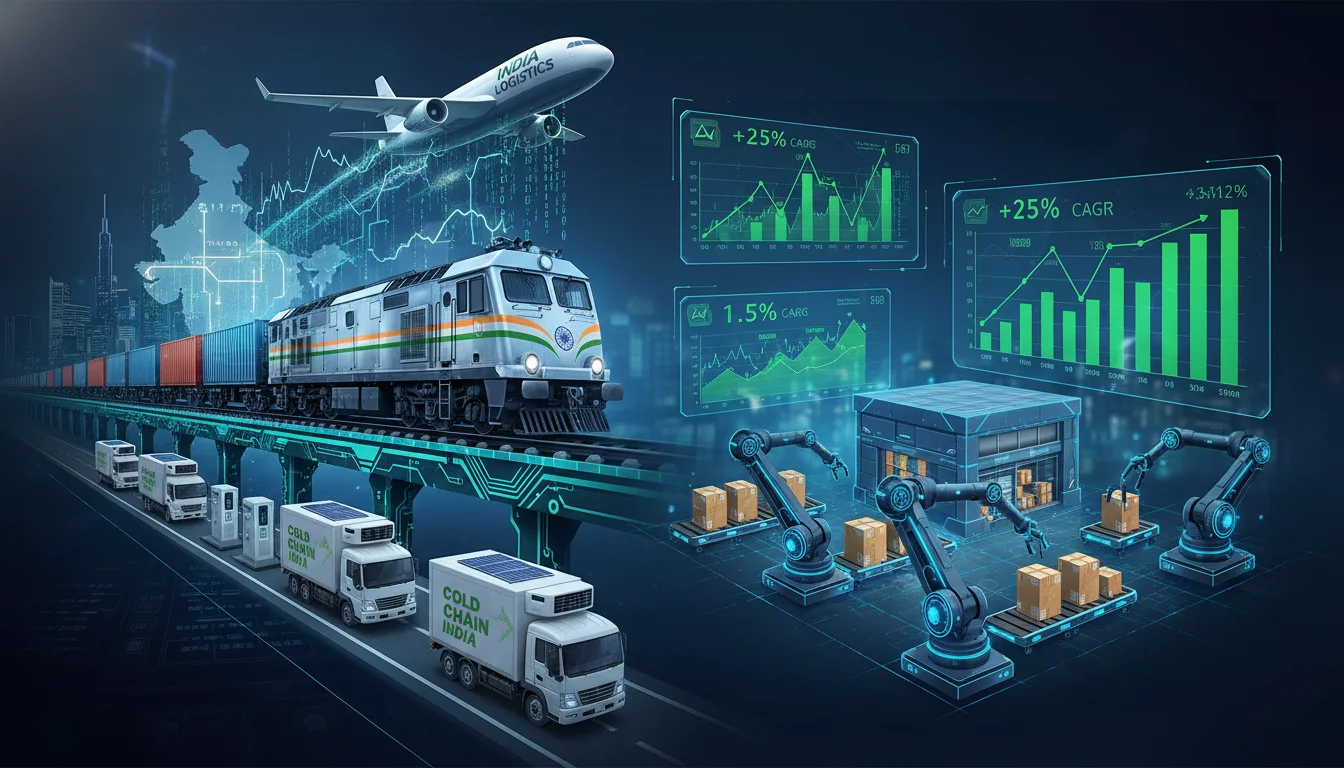
Several macro-trends are currently defining the sector’s trajectory. Government initiatives, particularly the PM Gati Shakti National Master Plan and the National Logistics Policy (NLP) of 2022, are acting as primary catalysts for growth. These frameworks aim to reduce India’s overall logistics costs—which currently hover between 8% and 14% of the GDP—to a target of sub-9% by the end of 2025, thereby enhancing India’s global export competitiveness. Digital infrastructure projects such as the Unified Logistics Interface Platform (ULIP) and the Logistics Data Bank (LDB) are further streamlining operations by providing end-to-end visibility for Export-Import (EXIM) cargo. Additionally, the industry is witnessing a significant push toward sustainability and green logistics, with major players integrating electric vehicles (EVs) into their last-mile delivery fleets and exploring alternative fuels to decarbonize the supply chain.
Key Challenges Faced by Businesses in this Industry
Despite the strong macroeconomic tailwinds, transport and logistics enterprises in India must navigate a complex labyrinth of operational, systemic, and infrastructural bottlenecks that persistently threaten margins and scalability.
The most prominent challenge remains the severe infrastructural deficits that plague both urban centers and rural corridors. While massive investments have been poured into national highways and Dedicated Freight Corridors (DFCs), the reality of ground-level execution presents a different picture. Urban areas, which serve as crucial hubs for last-mile e-commerce delivery, are heavily congested, and the lack of dedicated truck lanes in loading zones leads to severe delays. Non-urban and rural regions continue to suffer from pothole-ridden service lanes and inadequate connectivity, which cause significant vehicle wear-and-tear and inflate fuel consumption. Over 60% of freight movement in India still relies on road transport, which remains structurally less efficient and costlier than rail or inland waterways.
Internal logistics and inventory coordination present another massive financial drain. Research indicates that India’s organized retail sector loses over INR 2,000 crore annually due to internal logistics inefficiencies. While retailers have highly optimized their delivery to the end consumer, the movement of inventory between internal warehouses and retail storefronts remains sluggish. Delays in internal logistics tie up critical working capital—sometimes locking up 8% to 12% in potential sales during peak festive seasons—largely because 85% of brands still rely on manual spreadsheets and emails to manage these complex movements.

The sector is also highly fragmented, characterized by a vast ecosystem of small fleet operators who suffer from a severe technological lag. The upfront capital required to adopt advanced Transportation Management Systems (TMS), Artificial Intelligence (AI) routing, or Internet of Things (IoT) sensors is prohibitive for these smaller entities. This lack of technology results in a lack of real-time supply chain visibility, making it difficult for small operators to integrate with larger, modern logistics networks.
Human capital and workforce issues further exacerbate operational strains. The industry faces a chronic shortage of skilled drivers and delivery personnel. Truck driving in India is often subjected to long hours without adequate rest stops, poor medical coverage, and low social respect, leading to high attrition rates. This shortage places immense pressure on existing staff, increasing absenteeism and degrading overall service quality.
Finally, businesses must grapple with systemic law and order issues, inconsistent regulatory implementations, and the commoditization of logistics services. Transport vehicles frequently face irregular toll charges and delays at interstate checkposts despite the implementation of the Goods and Services Tax (GST). Furthermore, many end-consumers and businesses continue to undervalue logistics as a strategic asset, viewing it merely as a cost center. This perception leads to a race to the bottom in pricing, forcing many unorganized movers to cut corners on packaging and safety, ultimately resulting in high rates of cargo damage and client disputes.
Digital Landscape in India (Contextual to the Industry)
Internet and Social Media Usage Relevant to Transport and Logistics
India’s digital economy has achieved a scale that fundamentally alters how industries operate and market themselves. As of early 2025, the country recorded 1.12 billion cellular mobile connections, equating to an adoption rate of 76.6% of the total population. Internet penetration has surged, with 806 million active users representing 55.3% of the populace. Crucially, the social media landscape has expanded to encompass 491 million user identities, meaning that over 43% of the adult population is actively engaged on social platforms.
This digital ubiquity is not restricted to urban, affluent demographics. The proliferation of affordable 4G and 5G networks, combined with low-cost smartphone availability, has driven massive digital adoption in Tier-2, Tier-3, and rural markets. For the logistics industry, this represents a paradigm shift. Procurement officers, supply chain managers, warehouse operators, and independent fleet owners are all continuously connected. The traditional offline methods of building transport networks—relying heavily on localized brokers, physical trade events, and word-of-mouth—are being rapidly augmented, and in many cases replaced, by digital discovery and online vendor validation.
Popular Platforms Among the Target Audience
The digital platforms utilized by the Indian transport and logistics sector vary distinctly based on the objective, ranging from operational coordination to enterprise-level B2B marketing.
WhatsApp has transcended its origins as a simple messaging application to become the most critical operational and conversational commerce platform in India. With its massive user base, WhatsApp is heavily utilized by logistics companies for real-time order tracking, sharing Proof of Delivery (POD), managing Cash on Delivery (COD) workflows, and conducting initial B2B sales inquiries. The platform yields extraordinary engagement, boasting open rates between 90% and 98%, far eclipsing traditional email marketing.
LinkedIn serves as the primary battleground for B2B brand building, Account-Based Marketing (ABM), and enterprise lead generation. It is the platform of choice for reaching high-level decision-makers, such as Chief Operating Officers (COOs), Directors of Supply Chain, and Procurement Heads. Logistics companies utilize LinkedIn to publish thought leadership, distribute whitepapers, and share complex case studies that demonstrate their technological maturity and reliability.
Google Search (and the broader Google ecosystem, including Google My Business) remains the ultimate destination for capturing high-intent, bottom-of-the-funnel demand. When a business urgently requires freight forwarding services or a manufacturer is looking for localized warehousing, their journey almost invariably begins with a Google search.
Furthermore, YouTube has emerged as a powerful tool for visual trust-building, allowing logistics firms to provide video demonstrations of their warehouse automation, fleet safety standards, and corporate infrastructure.
Consumer Online Behavior Related to Transport and Logistics
Understanding online behavior within the logistics sector requires a clear delineation between Business-to-Consumer (B2C) and Business-to-Business (B2B) expectations, as the digital journeys for each are vastly different.
The B2C logistics consumer journey is defined by impatience, a demand for hyper-transparency, and the expectation of frictionless service. Driven by the standards set by global e-commerce giants and quick-commerce platforms, individual consumers expect same-day or next-day delivery, free shipping options, and granular, real-time tracking. Their online behavior involves checking tracking links multiple times a day and expecting proactive SMS or WhatsApp notifications the moment a package is delayed. They are highly sensitive to the last-mile delivery experience, and a single failed delivery often results in vocal brand abandonment on social media.
Conversely, the B2B logistics buyer journey is characterized by complexity, multiple stakeholders, and rigorous digital research. B2B freight involves high volumes, bulk orders, strict Service Level Agreements (SLAs), and the need for sophisticated integrations, such as connecting a client’s Enterprise Resource Planning (ERP) software with the logistics provider’s systems. B2B buyers no longer rely solely on sales representatives. Research indicates that modern B2B buyers prefer a self-guided digital experience, completing between 61% and 70% of their decision-making process before ever initiating direct contact with a vendor. The average buying committee now consists of up to 11 individuals, meaning that a logistics firm must digitally persuade marketing directors, procurement officers, and C-level executives simultaneously.
Furthermore, the B2B online journey has been heavily influenced by the rise of Artificial Intelligence. Approximately 73% to 94% of B2B buyers now utilize Large Language Models (LLMs) and AI-powered search tools to synthesize vendor information, compare complex service offerings, and analyze market sentiment during their research phase. This means that a logistics company’s digital footprint must be structured and authoritative enough to be favorably cited by AI search overviews.
Digital Marketing Opportunities
How Digital Marketing Can Solve Key Challenges
The systemic challenges facing Indian transport and logistics companies—ranging from the commoditization of services and severe trust deficits to the inefficiencies of fragmented operations—can be strategically mitigated through intelligent digital marketing architectures.
The industry’s pervasive issue of being undervalued by clients, who often seek the lowest possible price at the expense of quality, can be countered by building strong digital brand authority. Through content marketing, a logistics firm can educate the market on the hidden costs of cheap transport, showcasing how investments in predictive analytics, green logistics, and superior packaging actually save money by reducing cargo damage and delivery delays. Digital marketing shifts the conversation from price to value.
The reliance on manual, erratic lead generation—such as word-of-mouth, physical trade events, and cold calling—has created structural pipeline problems for many firms. Digital marketing transforms lead generation into a predictable, scalable system. By establishing inbound marketing channels, logistics firms can continuously capture demand from buyers actively searching for solutions online. Furthermore, deploying digital tools like WhatsApp chatbots and self-service customer portals directly addresses the industry’s workforce shortages by automating routine customer inquiries, thereby freeing up human personnel to handle complex operational tasks.
Best Strategies for Transport and Logistics Companies
To capitalize on the digital economy, transport and logistics firms must adopt a multi-channel orchestration strategy that aligns with the modern B2B buying journey.
Search Engine Optimization (SEO) and Content Architecture: SEO is the cornerstone of logistics discoverability. Firms must move beyond basic “brochure” websites and construct deep, service-specific landing pages. For example, a company offering cold chain solutions must have dedicated, search-optimized pages detailing their temperature-controlled infrastructure, compliance with pharmaceutical standards, and specific regional coverage. Local SEO, executed through highly optimized Google My Business profiles, is essential for capturing localized intent, such as businesses searching for “3PL warehousing in Pune” or “FTL transport near me”.
Performance Marketing and Paid Ads: Pay-Per-Click (PPC) advertising, particularly Google Search Ads, is critical for capturing immediate, high-intent demand. Because B2B logistics contracts possess high lifetime value (LTV), investing in targeted keywords yields substantial returns. Campaigns should be highly localized and integrated with dynamic retargeting, ensuring that a procurement officer who visits a freight forwarding page continues to see the firm’s advertisements across business news sites and LinkedIn.
Social Media and Account-Based Marketing (ABM): While platforms like Instagram are useful for employer branding and showcasing company culture, LinkedIn is the vital engine for B2B logistics marketing. Utilizing an Account-Based Marketing (ABM) strategy, logistics marketers can pinpoint ideal client profiles (e.g., the top 200 automotive parts manufacturers in India) and serve highly tailored content directly to their supply chain decision-makers. This hyper-personalized approach cuts through the noise of generic advertising.
WhatsApp Automation and Conversational Commerce: Given India’s reliance on WhatsApp, logistics firms must integrate the WhatsApp Business API into their marketing and operational funnels. WhatsApp can be utilized to push automated freight quotes, schedule pick-ups, and proactively notify clients of transit delays. This not only serves as a powerful retention tool by enhancing the customer experience but also acts as a lead generation mechanism when integrated with click-to-WhatsApp digital ads.
Local and Global Case Studies
Delhivery: Delhivery exemplifies how a logistics firm can leverage digital marketing and technology to capture market dominance. Evolving from an e-commerce delivery startup to a comprehensive supply chain solutions giant, Delhivery allocates massive budgets (approximately ₹77 crores in FY 2022) to digital marketing. Their strategic shift, marked by the ‘Delhivery for Bharat’ campaign, utilized localized digital content in regional languages and partnered with local micro-influencers to target emerging Tier-2 and Tier-3 cities. By heavily marketing their proprietary technology stack and leveraging their vast data lake to personalize client offerings, they achieved a 40% increase in client acquisition from these regions.
Blue Dart Express: Blue Dart has consistently used digital platforms to reinforce its premium positioning in the express logistics space. They execute large-scale multimedia campaigns, such as #WEMOVESOYOURWORLDCANMOVE, utilizing platforms like YouTube, Facebook, and news aggregators. More importantly, Blue Dart seamlessly integrates lead generation tools directly into its website. By offering highly functional digital APIs (ShopTrack and PackTrack) and interactive transit time and pricing calculators, they attract B2B clients who require sophisticated digital integrations, effectively turning their website into a high-converting digital asset.
Porter: As an intra-city logistics disruptor, Porter faced the challenge of low organic search visibility and rising Customer Acquisition Costs (CPA) amidst fierce competition. To overcome this, Porter executed a highly aggressive Google Ads strategy focused on high-intent search terms. They integrated dynamic retargeting to capture users who abandoned the booking process. Furthermore, by utilizing location-based, geo-fenced advertising, they ensured their marketing spend was heavily concentrated in specific operational cities, allowing them to rapidly scale and become a household name in urban logistics.
AWL India: Demonstrating the power of organic search, AWL India, a major logistics and supply chain management firm, recognized that their strong offline reputation was not translating to digital visibility. By partnering with an SEO agency, they executed a data-driven strategy to target critical supply chain keywords. This focused approach resulted in a 145% growth in organic traffic, proving that structured SEO is a sustainable, high-ROI method for generating qualified B2B leads in the logistics space.
Competitive Analysis
Current Digital Presence of Top Logistics Businesses in India
The Indian transport and logistics market is intensely competitive, featuring a mix of legacy government-backed institutions, established private sector giants, and highly capitalized tech-driven startups. An analysis of the market leaders reveals varying degrees of digital maturity and strategic focus.
| Company Name | Core Competencies | Market Scale & Valuation | Digital Marketing Posture |
|---|---|---|---|
| Delhivery | E-commerce fulfillment, Tech-Logistics, PTL/FTL | Market Cap: ~₹35,192 Cr. Dominant in B2C and growing in B2B. | Highly sophisticated. Focuses on data-driven personalization, SEO, and marketing its massive data analytics capabilities. |
| Container Corporation of India (CONCOR) | Rail Freight, Dry Ports, Intermodal transport | Market Cap: ~₹36,291 Cr. Government-backed enterprise. | Traditional. |
Digital presence is heavily institutional, focused on corporate disclosures and operational portals rather than aggressive inbound B2B marketing.
Blue Dart Express
Premium Air Express, Time-sensitive Courier
Market Cap: ~₹11,951 Cr. High brand trust.
Strong omnichannel presence. Excels in digital utility marketing (providing APIs and cost calculators as lead magnets) and multimedia brand campaigns.
Transport Corporation of India (TCI)
Multimodal Integrated Logistics, Cold Chain, FTL
Market Cap: ~₹7,705 Cr. Legacy leader.
Focuses on thought leadership and enterprise trust. Publishes digital joint study reports, video interviews, and robust investor relations content.
Mahindra Logistics
3PL, Automotive Logistics, Green Logistics
Market Cap: ~₹3,775 Cr. Corporate-backed.
Excellent content marketing ecosystem. Utilizes an “Insights” portal for blogs on digital twins, publishes detailed case studies, and aggressively markets its sustainable “eDeL” fleet.
Allcargo Logistics
Global LCL Consolidation, Multimodal Transport
Annual Revenue: ~₹16,000 Cr+. Largest private player by revenue.
Global digital footprint. Focuses on international freight forwarding visibility and cross-border digital compliance tools.
TVS Supply Chain Solutions
Integrated Global Supply Chain, Contract Logistics
Market Cap: ~₹4,778 Cr.
Focuses heavily on omnichannel distribution marketing and highlighting its global logistics network capabilities.
What They Are Doing Well
The industry leaders have recognized that digital marketing in logistics must go beyond superficial advertising; it must integrate with operational excellence.
Companies like Mahindra Logistics and Delhivery excel at establishing topical authority. They do not merely state they offer services; they publish exhaustive whitepapers, detailed blogs on warehouse digitization, and highly specific case studies (e.g., demonstrating a 97% efficiency achievement in pharma distribution) to prove their competence. This content strategy perfectly aligns with the modern B2B buyer’s desire for deep, independent research prior to engaging a sales representative.
Furthermore, leaders like Blue Dart and TCI leverage digital utility as a conversion tool. By providing comprehensive online portals where users can seamlessly integrate tracking APIs, calculate volumetric weights, and estimate shipping costs without speaking to a human, they capture high-quality leads organically. Additionally, these top-tier companies are highly adept at utilizing LinkedIn to promote their Corporate Social Responsibility (CSR) initiatives, diversity programs, and green logistics goals, which are increasingly vital metrics for securing enterprise-level contracts.
Gaps and Opportunities to Outperform Them
While the mega-corps possess massive marketing budgets, a vast segment of the Indian logistics market—comprising mid-sized 3PLs, regional freight forwarders, and specialized transport firms—suffers from severe digital myopia. This creates distinct opportunities for agile companies to capture market share:
- Exploiting the Long-Tail SEO Vacuum: Many large logistics websites are bloated and difficult to navigate, focusing heavily on broad, highly competitive keywords (e.g., “logistics company India”). Mid-sized firms can easily outperform them by dominating long-tail, highly specific, and localized search queries (e.g., “temperature-controlled chemical transport in Gujarat” or “affordable PTL services Delhi to Mumbai”). Large firms frequently ignore these niche searches, leaving high-converting traffic available for the taking.
- Modernizing the Quoting Experience: A shocking number of logistics websites still rely on static, friction-heavy “Contact Us” forms, where a prospect must wait days for a response. Companies that implement automated, dynamic pricing engines or instant AI-driven chatbots on their landing pages can intercept frustrated buyers seeking immediate answers.
- Leveraging WhatsApp as a Lifecycle Tool: While major players use WhatsApp for operational updates (like OTPs for delivery), few utilize it as a proactive B2B lead nurturing channel. Implementing conversational marketing flows on WhatsApp allows smaller firms to build deeper, more immediate relationships with potential clients.
- Creating Hyper-Relevant Content: Many logistics websites feature generic copy that focuses entirely on their own infrastructure (e.g., “We have 500 trucks”). The opportunity lies in shifting the narrative to address the specific pain points of the target audience. By publishing content that speaks directly to a D2C founder’s struggle with RTOs or a manufacturer’s need for strict GST/e-Way bill compliance, a firm can rapidly build trust and authority.
Recommended Strategy for Transport and Logistics Companies in India
To successfully navigate the digital ecosystem and drive measurable revenue growth, transport and logistics companies must adopt a highly targeted, inbound-focused digital strategy.
Target Audience Personas
Effective B2B marketing demands absolute clarity regarding the target audience. The messaging required to close a multinational corporate contract is entirely different from the messaging needed to secure a fast-growing e-commerce account.
Persona 1: The Enterprise Supply Chain Director
- Demographics & Location: Age 40–55. Based in major metropolitan corporate hubs (Mumbai, Delhi NCR, Bangalore, Chennai).
- Role & Mindset: Holds titles such as VP of Operations, Chief Supply Chain Officer, or Head of Procurement. They manage multi-million rupee budgets and are highly risk-averse.
- Pain Points: Geopolitical supply chain disruptions, fluctuating fuel costs, lack of end-to-end visibility, stringent regulatory compliance, and pressure to meet corporate ESG (Environmental, Social, and Governance) and carbon-reduction targets.
- Preferences & Digital Behavior: Does not respond to aggressive sales pitches. Conducts extensive research via industry reports (McKinsey, Gartner), attends virtual webinars, and is highly active on LinkedIn. They require seamless API integration between their internal ERP systems (like SAP or Oracle) and the logistics provider.
- Strategic Approach: Engage them through Account-Based Marketing (ABM) on LinkedIn. Provide deep-dive whitepapers, robust case studies demonstrating SLA adherence, and data on how your green logistics fleet can reduce their carbon footprint.
Persona 2: The Scaling E-commerce / D2C Founder
- Demographics & Location: Age 28–40. Located across Tier-1 and emerging Tier-2 tech hubs (Pune, Hyderabad, Ahmedabad).
- Role & Mindset: Founder, CEO, or Head of Growth at a digital-first brand. They are focused on rapid scaling, customer acquisition, and protecting thin profit margins.
- Pain Points: Exorbitant shipping costs eroding customer acquisition ROI, high rates of Return to Origin (RTO), managing Cash on Delivery (COD) reconciliations, and slow delivery times leading to poor customer reviews.
- Preferences & Digital Behavior: Highly mobile-native. Searches Google for immediate solutions and tools. Expects consumer-grade software experiences, instant onboarding, and fast customer support via WhatsApp.
- Strategic Approach: Capture their intent through targeted Google Search Ads. Ensure the website highlights seamless integration with platforms like Shopify and WooCommerce. Emphasize speed, automated tracking features, and robust reverse logistics capabilities.
Recommended Channels and Campaign Types
A robust logistics marketing strategy must orchestrate multiple channels to cover the entire buying journey.
- High-Intent Search Engine Marketing (SEM): Deploy Google Ads targeting specific, bottom-of-the-funnel queries (e.g., “3PL warehouse for electronics in Noida”). Ensure these ads direct users to highly relevant, localized landing pages featuring clear, instant Call-to-Actions (CTAs) rather than generic homepages.
- LinkedIn Account-Based Marketing (ABM): For enterprise acquisition, utilize LinkedIn’s advanced targeting to reach specific roles within a predefined list of dream client companies. Run Sponsored Content campaigns featuring high-value thought leadership pieces, inviting them to exclusive industry webinars.
- WhatsApp Conversational Commerce: Integrate the WhatsApp Business API across all digital touchpoints. Run “Click-to-WhatsApp” ads on Meta platforms. Once a user initiates a chat, utilize an automated bot to pre-qualify the lead by asking for pickup/drop-off locations and shipment volume before routing them to a live sales representative.
- Local SEO & Directory Optimization: Maintain meticulously updated profiles on Google My Business (GMB) for every physical office, depot, and warehouse. Ensure active presence on major Indian B2B marketplaces like IndiaMART and TradeIndia, which frequently dominate organic search results for SME procurement.
Content Ideas Specific to Transport and Logistics
Content must serve as a 24/7 digital salesperson, answering complex questions and building trust before a human interaction occurs.
- “How-To” Compliance Guides: Create exhaustive, downloadable guides on navigating India’s complex logistics regulations, such as “A Step-by-Step Guide to Flawless e-Way Bill Generation” or “Navigating Customs Clearances at JNPT.”
- Vertical-Specific Case Studies: Publish detailed success stories that focus on specific industries. For example, “How We Reduced Spoilage by 15% for a Leading Pharmaceutical Brand Using IoT Temperature Tracking.”
- Interactive ROI Calculators: Develop embedded website tools where prospects can calculate their potential savings on freight forwarding or estimate their carbon emission reductions by switching to your EV fleet.
- Video Facility Tours: Produce high-quality video content showcasing the security protocols, robotics, and scale of your warehousing facilities.
Visual proof is highly persuasive for distant buyers.
Budget-Friendly Digital Marketing Approaches
For mid-sized operators with limited marketing budgets, high-impact, low-cost tactics are essential:
- Hyper-Local SEO Domination: Optimizing a Google My Business profile is entirely free and incredibly effective for capturing local transport searches. Regularly posting photos of the fleet and actively soliciting 5-star reviews from satisfied clients builds massive local credibility.
- Content Repurposing: Maximize the ROI of content creation. A single, comprehensive industry report can be broken down into a month’s worth of LinkedIn posts, Twitter threads, infographic snippets, and short-form YouTube videos.
- Micro-Influencer Collaboration: Instead of sponsoring expensive physical trade shows, collaborate with supply chain academics or regional logistics micro-influencers on LinkedIn for joint webinars or podcast interviews. This leverages their established credibility and audience at a fraction of the cost.
Keywords & SEO Opportunities
In the rapidly evolving digital landscape, the advent of AI-powered search overviews (such as Google’s SGE) is fundamentally changing how users find information. AI tools are increasingly summarizing answers to broad, top-of-the-funnel questions directly on the search results page, driving down organic click-through rates for generic queries. Consequently, competing for broad terms like “logistics company India” is highly resource-intensive and yields poor conversion rates.
To succeed, logistics companies must pivot their SEO strategy to focus heavily on long-tail, high-intent keywords. These are specific phrases used by buyers who have already completed their preliminary research and are actively looking to hire a vendor.
High-Intent Keywords for Ranking
These keywords should be targeted with dedicated, highly optimized service and location landing pages. The architecture of these pages must be designed for conversion, featuring clear service descriptions, social proof, and instant contact mechanisms.
| Keyword Cluster | Search Intent | Target Audience Profile | Strategic Application |
|---|---|---|---|
| 3pl logistics companies in [City] | Very High | SMEs, E-commerce Brands | Localized Landing Pages linked to Google My Business profiles. |
| freight forwarding services | High | EXIM Traders, Large Manufacturers | Service-specific pages detailing international network and customs expertise. |
| temperature-controlled warehousing near me | Very High | Pharmaceuticals, Food & Beverage | Specialized facility pages highlighting IoT and cold chain infrastructure. |
| b2b express logistics pricing India | High | Corporate Procurement Officers | Transparent pricing or “Request a Quote” portal pages. |
| heavy machinery transport services | High | Construction, Engineering Firms | Niche service pages featuring specialized fleet capabilities (e.g., flatbeds, ODC transport). |
Long-Tail Keyword Opportunities (India-Specific)
Long-tail keywords are conversational, highly specific queries. While they possess lower individual search volumes, they face significantly lower competition, accumulate to form massive traffic pools, and exhibit the highest conversion rates. They are perfectly suited for educational blog posts, deep-dive articles, and Frequently Asked Questions (FAQ) sections.
| Long-Tail Keyword / Phrase | Content Strategy Application |
|---|---|
| how to reduce RTO in e-commerce logistics India | Educational Blog Post / Downloadable Whitepaper targeting D2C founders. |
| affordable part truck load transport from Delhi to Mumbai | Highly specific Route Landing Page outlining schedules and LTL capacity. |
| best logistics partner for D2C clothing brands in India | Industry-specific Solutions Page detailing apparel fulfillment workflows. |
| cross-border customs clearance process at Nhava Sheva port | Comprehensive Compliance Guide / Knowledge Base article. |
| electric vehicle last mile delivery companies in Bangalore | Sustainability Page emphasizing ESG compliance and green logistics initiatives. |
Implementation Roadmap
Digital transformation in marketing cannot be achieved overnight. It requires a disciplined, phased approach to build a sustainable lead generation engine.
Short-Term Quick Wins (1–3 Months)
The immediate focus must be on capturing existing market demand, patching “leaky” digital funnels, and establishing baseline performance metrics.
-
Month 1: Digital Foundation and Local Domination
- Conduct a comprehensive technical SEO audit of the existing website. Resolve issues related to page load speed, mobile responsiveness, and broken links to ensure a seamless user experience.
- Claim, verify, and aggressively optimize Google My Business (GMB) listings for all corporate offices, depots, and warehouses to immediately boost local search visibility.
- Implement robust analytics infrastructure (Google Analytics 4, Google Tag Manager) to accurately track user journeys and conversion events.
-
Month 2: Conversion Rate Optimization (CRO) and Instant Communication
- Revamp the highest-traffic service pages. Replace lengthy, static “Contact Us” forms with dynamic, frictionless Call-to-Actions (CTAs) such as “Get an Instant Freight Quote.”
- Deploy the WhatsApp Business API directly on the website. Program an intelligent chatbot capable of capturing initial client requirements (e.g., origin, destination, load type) before routing the query to a live sales agent.
- Publish 3 to 5 highly detailed, data-backed case studies to serve as immediate social proof for inbound visitors.
-
Month 3: High-Intent Paid Acquisition
- Launch strictly geo-fenced Google Search Ads targeting the high-intent keywords identified in Section 6. Ensure budget is allocated strictly to exact-match and phrase-match queries to prevent wasted spend.
- Initiate basic retargeting campaigns on the Google Display Network and LinkedIn, ensuring that prospects who visited the site but did not convert are continuously reminded of the brand.
Long-Term Strategy (6–12 Months)
The long-term objective is to build insurmountable topical authority, automate the lead nurturing pipeline, and execute highly targeted enterprise acquisition.
-
Months 4–6: Content Ecosystem and Marketing Automation
- Launch a disciplined content marketing engine. Commit to publishing weekly blogs, regulatory updates, and market trend reports targeting specific long-tail keywords.
- Integrate a comprehensive Customer Relationship Management (CRM) system (e.g., Salesforce, HubSpot) with the website and WhatsApp. Develop automated email and messaging workflows to nurture leads over the long B2B sales cycle.
- Develop interactive digital utility tools, such as automated volumetric weight calculators or carbon emission estimators, to drive organic, utility-based traffic.
-
Months 7–9: Account-Based Marketing (ABM) Execution
- Collaborate with the sales team to identify a “Dream 100” list of highly desirable enterprise clients.
- Execute highly targeted LinkedIn ABM campaigns. Serve bespoke, hyper-personalized content (such as tailored supply chain efficiency audits) directly to the specific decision-makers at those target accounts.
- Invest in high-production-value video content. Produce professional facility tours, executive interviews, and client testimonials to further establish corporate authority.
-
Months 10–12: Scale, Analyze, and Optimize
- Conduct a deep analysis of the data accumulated over the first three quarters. Identify the channels and keywords producing the highest Customer Lifetime Value (LTV) relative to Customer Acquisition Cost (CAC).
- Reallocate marketing budgets aggressively from underperforming tactics to proven winners.
- Initiate a Digital PR strategy. Secure guest posts, interviews, and feature articles in major Indian supply chain and business publications to build immense domain authority and secure high-quality backlinks.
Conclusion
The Indian transport and logistics industry stands at a historic inflection point. Projected to surpass USD 350 billion by 2030, the sector is experiencing a massive structural shift from a fragmented, manually coordinated ecosystem into a highly formalized, technology-driven powerhouse. Concurrently, the behavior of the B2B logistics buyer has fundamentally evolved. Procurement heads, supply chain directors, and SME founders now demand the seamless, transparent, and immediate digital experiences they have grown accustomed to in the B2C retail space. The modern buyer completes the majority of their vendor research digitally, utilizing AI tools and self-service portals long before they ever agree to speak with a sales representative.
In this environment, logistics companies that continue to rely solely on opaque pricing models, traditional offline broker networks, and outdated digital interfaces face an existential threat of commoditization and margin erosion. Digital marketing is no longer an ancillary support function or a digital brochure; it is the primary engine for revenue generation, brand trust, and competitive differentiation. By strategically deploying localized SEO, intent-driven performance marketing, WhatsApp automation, and authoritative, educational content, logistics firms can drastically lower customer acquisition costs, capture high-value enterprise contracts, and achieve scalable, predictable growth.
Call-to-Action: Partnering with Gurkha Technology
Executing a comprehensive digital transformation requires highly specialized expertise situated at the complex intersection of supply chain technology and modern marketing science. Attempting to navigate this transformation without dedicated digital proficiency often results in wasted ad spend and misaligned strategies.
This is where Gurkha Technology, a premier digital marketing and technology agency based in Nepal, serves as a vital strategic partner. With a deep understanding of the unique commercial nuances, infrastructure challenges, and digital adoption trends within the South Asian logistics landscape, Gurkha Technology provides the agile, high-impact digital solutions required by Indian logistics firms. From architecting high-converting, mobile-responsive websites and executing data-driven, long-tail SEO strategies, to deploying advanced WhatsApp CRM automation and highly targeted LinkedIn ABM campaigns, Gurkha Technology possesses the precise toolset to empower logistics companies to dominate their digital footprint. By partnering with Gurkha Technology, transport and logistics businesses can effectively bridge the gap between their physical operational excellence and their online visibility, ensuring they remain at the absolute forefront of India’s booming digital economy.