Combating Disinformation & Narrative Warfare: Analysis
Combating Disinformation & Narrative Warfare: Analysis
The Theoretical Framework of Information Disorder
The digital age has fundamentally altered the topology of human communication, transforming the public sphere into a contested domain where the primary currency is not truth, but narrative dominance. The phenomenon widely termed “fake news” is merely the visible surface of a profound structural shift in how reality is constructed, contested, and consumed. To understand the contemporary information environment, one must move beyond colloquialisms and engage with the precise taxonomy of information disorder: misinformation, disinformation, and malinformation. These distinct categories interact within a complex ecosystem of cognitive biases, algorithmic amplification, and strategic intent, forming the basis of what is now understood as narrative warfare.
1.1 Taxonomy and Definitions: The Precision of Language
In academic and operational contexts, the interchangeable use of terms like “fake news,” “rumors,” and “propaganda” obscures the mechanisms at play. A rigorous classification system is essential for diagnosis and counter-strategy. The distinctions hinge primarily on two variables: the veracity of the information and the intent of the distributor.
graph TD
    A[Information Piece] --> B{"Veracity?"};
    B -- False --> C{"Intent?"};
    C -- Malicious --> D(Disinformation);
    C -- Benign/Inadvertent --> E(Misinformation);
    B -- True --> F{"Intent?"};
    F -- Malicious --> G(Malinformation);
    F -- Benign --> H("True, Benign Information");
    style A fill:#f9f,stroke:#333,stroke-width:2px;
    style B fill:#add8e6,stroke:#333,stroke-width:2px;
    style C fill:#add8e6,stroke:#333,stroke-width:2px;
    style F fill:#add8e6,stroke:#333,stroke-width:2px;
    style D fill:#ffcccb,stroke:#333,stroke-width:2px;
    style E fill:#ffffe0,stroke:#333,stroke-width:2px;
    style G fill:#ffcccb,stroke:#333,stroke-width:2px;
    style H fill:#d3edc8,stroke:#333,stroke-width:2px;
Figure 1: Taxonomy of Information Disorder

| Concept | Veracity Status | Intent of Distributor | Primary Mechanism |
|---|---|---|---|
| Misinformation | False | Benign/Inadvertent | The sharer believes the information is true. Spread is driven by cognitive error, lack of verification, or emotional reaction. |
| Disinformation | False | Malicious/Strategic | Information is deliberately fabricated to deceive, manipulate, or obscure. Often involves coordinated campaigns (e.g., deepfakes, bot networks). |
| Malinformation | True | Malicious | Genuine information (e.g., private emails, sexual imagery) shared out of context to cause reputational or physical harm (e.g., doxxing, revenge porn). |
| Narrative Warfare | Mixed | Strategic | The systematic use of information to shape the perception of reality, focusing on meaning-making rather than isolated facts. It targets the cognitive domain to influence societal behaviors. |
Misinformation acts as a “cognitive contaminant” within the information ecosystem. Research likens it to a viral infection where individuals act as unwitting vectors. The spread is facilitated not by malice but by the human propensity to share novel or emotionally resonant content. It is often socially useful; sharing a rumor can solidify group identity or signal allegiance to a tribe, making the factual accuracy of the content secondary to its social function.
Disinformation, conversely, implies agency. It is the “lie uttered with malicious intent”. In the context of narrative warfare, disinformation is not an end in itself but a munition. State and non-state actors deploy disinformation to fracture social cohesion, erode trust in institutions, and paralyze decision-making processes. The distinction is critical: while misinformation can be countered with education and fact-checking, disinformation requires counter-intelligence and strategic disruption of the networks that disseminate it.
Malinformation represents the “Orwellian” evolution of information weaponization. It challenges the traditional defense that “the truth is the ultimate defense.” In narrative warfare, true facts—such as a leaked internal memo or a politician’s private medical record—are weaponized to destroy credibility or incite violence. This category underscores that the harm is not dependent on falsity, but on context and timing.
1.2 The Cognitive Paradigm: Why We Believe
The architecture of the human mind is the ultimate vulnerability exploited by narrative warfare. Research indicates that the spread of falsehoods is not merely a technological problem but a psychological one.

The Novelty Hypothesis: Empirical studies suggest that fake news travels faster and deeper than real news because it is inherently more novel. Human attention is evolutionarily wired to prioritize the unexpected. Falsehoods, unconstrained by reality, can be engineered to be more surprising, shocking, or emotionally stimulating than the mundane truth. This novelty triggers a dopamine response, incentivizing the sharing of the information to gain social capital—being the one to break “new” information to the tribe.
Cognitive Biases and Heuristics:
- Confirmation Bias: Individuals seek information that reinforces their pre-existing worldview. Disinformation narratives are often tailored to specific psychographic profiles, confirming the target’s fears or biases.
- Illusory Truth Effect: Repeated exposure to a false statement increases the likelihood that it will be perceived as true. This is the psychological basis for the “firehose of falsehood” strategy, where high-volume repetition overwhelms critical faculties.
- In-Group/Out-Group Dynamics: Information sharing is a performance of identity. Sharing a rumor that denigrates a rival political group (out-group) signals loyalty to one’s own group (in-group). The veracity is irrelevant; the signal is what matters.
1.3 Narrative Warfare: Beyond the Fact
Narrative warfare represents a shift from “information operations”—which might focus on specific tactical deceptions—to a strategic contest over the interpretation of reality itself. It is the dissemination of narratives by states to influence foreign populations and rival states, often using digitally-mediated platforms.
For instance, in the conflict between Russia and Ukraine, or the geopolitical tussles involving the US and China in South Asia, the goal is not just to lie about a specific event (e.g., “who bombed the hospital”), but to construct a metanarrative (e.g., “The West is in moral decline,” or “China is a neo-colonial power”). Individual pieces of disinformation serve as bricks in this larger edifice. If one brick is debunked, the wall remains standing because the narrative appeals to deeper emotional or historical truths held by the target audience.
Critical disinformation studies argue that this warfare is deeply tied to systems of power. Disinformation is not just “pollution” in a healthy ecosystem but a tool used to reproduce hierarchies, such as white supremacy or authoritarian control. By analyzing narrative warfare through this lens, we understand that “debunking” alone is insufficient because it addresses the symptom (the lie) rather than the cause (the power dynamic or grievance the narrative exploits).
The Psychology of Silence and Crisis Communication
In the hyper-accelerated environment of digital narrative warfare, the absence of communication—silence—is rarely interpreted as neutral. It is an active variable that is frequently weaponized by adversaries or misinterpreted by the public.
2.1 The “Silence Implies Guilt” Heuristic
When a crisis erupts or an accusation is leveled, an “information vacuum” is instantly created. Stakeholders, the media, and the public aggressively seek information to resolve the ambiguity. If the accused entity does not fill this vacuum, it is inevitably filled by speculation, rumors, and misinformation supplied by third parties.
Psychological research confirms a strong “silence implies guilt” heuristic. In the absence of a denial or clarification, the public default is to assume that the accused has no defense. Silence is viewed as an admission of culpability or incompetence. This is particularly acute in the digital age, where the expectation is for real-time responsiveness. “No comment” is functionally equivalent to “Guilty” in the court of public opinion.
2.2 Strategic Silence: Delaying vs. Avoiding vs. Hiding
Scholars distinguish between different types of silence, noting that their impacts vary significantly:
- Avoiding/Hiding Silence: This occurs when an organization hopes the issue will fade away without engagement. This strategy almost invariably intensifies the crisis. It is perceived as stonewalling or a cover-up. When the silence is eventually “forcefully broken” by external evidence (e.g., a leak or a lawsuit), the damage to the organizational image is catastrophic and often irreversible.
- Delaying Silence: This is a calculated, temporary pause used to verify facts before speaking. If this silence is short, explicitly communicated (e.g., “We are investigating and will report back in 30 minutes”), and then broken with a comprehensive, truthful response, it can help preserve credibility. However, this is a high-risk strategy that requires immense discipline and a pre-existing reservoir of trust.
- Strategic Silence: In rare cases, silence can be effective if the accusation is so meritless that responding would give it oxygen (the “Streisand Effect”). However, identifying these cases requires sophisticated sentiment analysis to ensure the narrative isn’t gaining traction on its own.
2.3 Cultural Interpretations: High-Context vs. Low-Context
The interpretation of silence is not universal; it is deeply culturally mediated. This distinction is vital for multinational organizations or governments operating in diverse informational environments.
- Western (Low-Context) Cultures: In the US and Europe, communication is typically “low-context,” meaning meaning is explicit in the words used. Silence is viewed negatively—as a void, a lack of engagement, or a sign of deception. The cultural expectation is for immediate, assertive, and transparent verbal feedback. A leader who remains silent during a crisis is seen as weak or absent.
- Eastern (High-Context) Cultures: In many Asian societies (e.g., China, Japan, Nepal), communication is “high-context,” relying heavily on implicit understanding and social relationships.
Silence can be a tool for maintaining social harmony (“face”), showing respect for hierarchy, or engaging in thoughtful introspection before speaking. In these cultures, a pause may signal wisdom rather than guilt.
The Global Convergence
However, research into crises like the Sanlu milk scandal in China suggests that globalization and the internet are eroding these cultural protections. Even in high-context societies, the digital public increasingly demands transparency similar to Western standards. The Sanlu case demonstrated that traditional strategies of cover-up and silence failed to protect the organization from economic ruin and public outrage, indicating that the “silence implies guilt” heuristic is becoming a global digital norm.
The Mechanics of Propagation: Lifecycle of a Rumor
To effectively counter narrative warfare, one must understand the anatomy of a rumor’s transmission. The lifecycle of media manipulation follows a predictable trajectory, moving from obscure origins to mainstream amplification.
The Five Stages of Media Manipulation
The lifecycle of a disinformation campaign can be mapped into five distinct points of action:
graph TD
    A["1. Planning & Seeding"] --> B[2. Trading Up the Chain];
    B --> C[3. Response by Intermediaries];
    C --> D[4. Changes to the Ecosystem];
    D --> E[5. Adjustments by Manipulators];
    E -- Feedback Loop --> A;
    style A fill:#f9f,stroke:#333,stroke-width:2px;
    style B fill:#add8e6,stroke:#333,stroke-width:2px;
    style C fill:#d3edc8,stroke:#333,stroke-width:2px;
    style D fill:#ffffe0,stroke:#333,stroke-width:2px;
    style E fill:#ffcccb,stroke:#333,stroke-width:2px;
Figure 2: The Five Stages of Media Manipulation
- Planning and Seeding: Manipulators (political operatives, state actors, trolls) plan the campaign. They “seed” content across peripheral platforms—4chan, Reddit, Discord, or closed messaging groups. A key tactic is the creation of unique “keywords” or hashtags to create a searchable data trail that can later be exploited.
- Trading Up the Chain: The objective is to move content from the fringe to the mainstream. Operatives use bot networks or coordinated volunteer groups to amplify the seeded content, making it trend on platforms like X (formerly Twitter). This forces the algorithm to display the content to a wider audience, moving it from a niche forum to the general public’s feed.
- Response by Intermediaries: Journalists, activists, and influencers discover the trending topic. If they react—even to debunk it—they amplify the narrative. This is the “oxygen of amplification”; by engaging with the falsehood, even negatively, they help it break out of its filter bubble and reach audiences who would otherwise never have seen it.
- Changes to the Ecosystem: Platforms may step in to moderate content (taking down posts, banning keywords). While intended to stop the spread, this often fuels “Streisand Effect” narratives, where the censorship itself becomes the story, fueling further conspiracy theories about “deep state” suppression or platform bias.
- Adjustments by Manipulators: Adapting to moderation, manipulators pivot tactics—altering keywords, creating new “deep state” narratives, or shifting to different platforms (e.g., from Facebook to Telegram) to restart the cycle. They may also use “visual disinformation” (memes, deepfakes) which is harder for AI moderation to detect than text.
The Role of “Patient Zero” and Automation
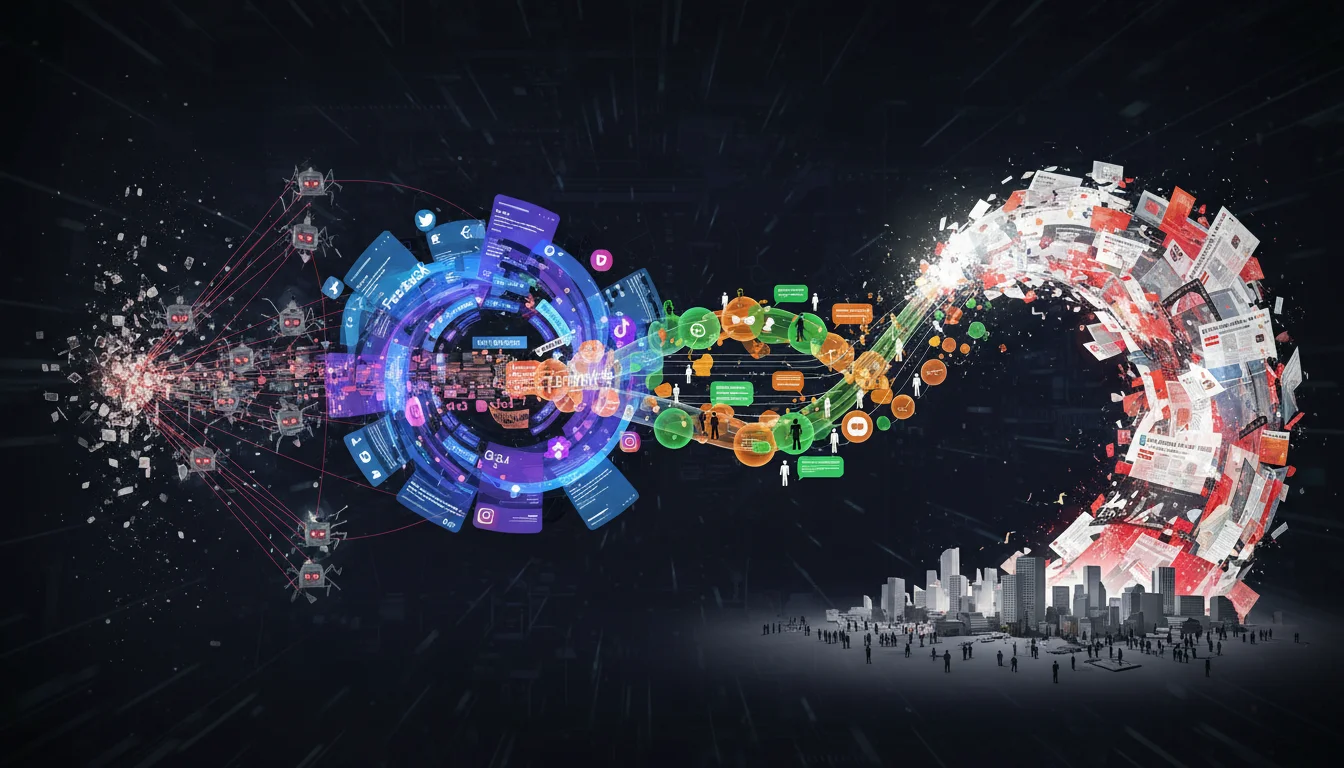
Identifying “Patient Zero”—the first account to post a piece of disinformation—is critical for attribution but increasingly difficult due to account deletion and anonymity. “Cyber troops” and bot networks play a crucial role in the early stages.
- Amplifier Bots: These automated accounts do not create content but purely retweet or share it to inflate engagement metrics (likes/shares), tricking algorithms into perceiving the content as popular and organic. They are the “clappers” in the audience that start the ovation.
- Cyborgs: Accounts that blend automated behavior with human curation are harder to detect than pure bots. They may post automated propaganda 90% of the time but engage in human-like arguments for the remaining 10% to evade detection systems.
The “Dark Social” Vector: WhatsApp and Private Messaging
A significant evolution in narrative warfare is the shift from public social media (Facebook walls, Twitter feeds) to “dark social”—closed, encrypted messaging apps like WhatsApp, Telegram, and WeChat.
- Intimacy and Trust: Misinformation on these platforms is often shared by friends, family, or community members. It arrives with a “seal of trust” that public posts lack. Because the sender is a known associate, the recipient is less likely to critically evaluate the content.
- The “Forwarded” Phenomenon: Features like “forwarding” allow messages to travel rapidly across unconnected groups. A rumor can jump from a diaspora community in the US to a village in India in minutes. To combat this, platforms like WhatsApp have introduced “Forwarded many times” labels and limits on forwarding (e.g., to only one chat at a time), though these are often circumvented by broadcast lists.
- Diaspora Networks: Immigrant communities often rely on these apps as lifelines to their home countries. This makes them vulnerable to transnational repression and disinformation campaigns, where state actors (e.g., China, Russia) target diaspora populations with specific narratives that are invisible to the host country’s mainstream media.
The Infrastructure of Influence: Digital War Rooms & Cyber Troops
To manage the velocity of modern narrative warfare, political campaigns and corporations have industrialized their response capabilities. The “Digital War Room” has emerged as the central command node for these operations.
The Digital War Room Concept
A digital war room is an integrated command center for real-time narrative monitoring and response. It is no longer just a physical location but a sophisticated workflow integrating data analytics, content creation, and legal compliance.
Workflow of a Modern War Room:
- Monitor: Use social listening tools (e.g., Talkwalker, Brandwatch, Hootsuite) to track keywords, sentiment, and emerging viral spikes.
- Assess: Triage threats based on reach and severity. Not every negative tweet requires a response; distinguishing between a “troll” and a “trend” is vital.
- Draft & Approve: Create content (visuals, videos, memes) designed for shareability. The approval process must be streamlined to allow for near-instant release, often bypassing traditional bureaucratic layers.
- Disseminate: Push content through official channels and allied volunteer networks to flood the zone with the counter-narrative.
IT Cells and Cyber Troops: The Workforce of Disinformation
In South Asia, particularly in India and Nepal, the “IT Cell” has become an institutionalized part of political machinery. These are organized groups tasked with manipulating public opinion online.
Structure and Recruitment:
- Core Staff: A small group of paid professionals (strategists, content creators, data analysts) who design the narratives and oversee operations.
- Volunteers: A vast periphery of unpaid volunteers recruited through ideological appeals. They are often motivated by nationalism, party loyalty, or the promise of future government employment.
- Salaries: While top-tier strategists are well-paid (comparable to corporate marketing roles), low-level operatives or volunteers may receive nominal stipends or no pay at all, relying on the “cause” for motivation.
Operational Tactics:
- Tasks of the Day: Volunteers receive daily instructions via WhatsApp groups (e.g., “Trend this hashtag at 2 PM”).
- Astroturfing: Creating the illusion of widespread grassroots support for a policy or leader.
- Harassment: Coordinated attacks on critics, journalists, or opponents to silence them through intimidation.
Controversies and Tools:
- “Tek Fog”: In 2022, The Wire published an investigative report alleging the existence of a sophisticated app called “Tek Fog” used by the BJP’s IT cell to automate harassment, hijack trending topics, and manage inactive WhatsApp accounts. However, this report was later retracted by The Wire after it was discovered that the evidence had been fabricated by a source, leading to significant controversy and internal reviews. This incident itself became a case study in the complexity of verifying claims about digital espionage.
- “Sulli Deals” & “Bulli Bai”: These were actual apps hosted on GitHub that “auctioned” Muslim women, including prominent journalists and activists, effectively using digital tools for targeted sexualized harassment and intimidation. The creators were young, radicalized individuals connected to online “Trad” groups, highlighting the decentralized and dangerous nature of these cyber troops.
The Economics of Disinformation Tools
The barrier to entry for conducting narrative warfare has lowered significantly due to the availability of cheap, off-the-shelf software.
| Tool Type | Function | Estimated Cost (India/Nepal Context) |
|---|---|---|
| Bulk WhatsApp Sender | Send thousands of messages, filter numbers, extract group contacts. | ₹500 - ₹5,000 INR per month ($6 - $60 USD). |
| Bulk SMS Services | Mass text messaging for campaigns. | Approx. $0.03 per message (US); cheaper in South Asia (~₹0.11 INR). |
| Automation Plugins | Browser extensions for auto-replies and contact management (e.g., WA Sender). | Free to ~$20 USD/month. |
| “Cloning” Software | Tools to bypass WhatsApp anti-spam restrictions. | As low as ₹1,000 INR (~$12 USD). |
This “democratization” of disinformation tools means that local politicians, small businesses, and even individual actors can launch sophisticated influence campaigns that were once the domain of state intelligence agencies.
Case Study Deep Dive: The 2025 Gen Z Protests in Nepal
The September 2025 protests in Nepal provide a vivid contemporary laboratory for analyzing how misinformation, geopolitical narratives, and digital suppression converge to destabilize a nation.
Context: The Trigger and the Ban
On September 4, 2025, the Government of Nepal imposed a sweeping ban on 26 social media platforms, including Facebook, WhatsApp, YouTube, and X (formerly Twitter).
The official justification was non-compliance with registration requirements and the need to curb “social disharmony”. However, the ban was widely perceived by the public, particularly the youth (“Gen Z”), as a draconian attempt to stifle dissent amidst growing frustration over corruption, nepotism (the #NepoBabies narrative), and economic stagnation.
5.2 The Event: From Online Outrage to Street Violence
The ban acted as a catalyst. Deprived of their digital public square, thousands of young Nepalis took to the streets on September 8, 2025. What began as peaceful anti-corruption marches quickly escalated into violence.
- Scale: Protests erupted in Kathmandu and major cities.
- Violence: Demonstrators targeted government symbols, setting fire to the Singha Durbar (central administrative complex) and residences of political leaders.
- Casualties: Reports indicate significant loss of life, with some sources citing over 70 deaths and thousands of injuries.
- Outcome: The unrest led to the resignation of Prime Prime Minister K.P. Sharma Oli and the collapse of the government.
5.3 The Disinformation Wave
The social media ban paradoxically fueled the spread of misinformation. By cutting off access to verified news sources and peer-to-peer verification channels, the government created a massive “information vacuum “ that was instantly filled by rumors.
Key Misinformation Vectors:
- Exaggerated Violence: Rumors spread that the wife of a former Prime Minister (Jhalanath Khanal) had died from burn injuries after her house was torched. Other rumors claimed security forces had “shoot on sight” orders.
- Recycled Content: Videos of violence from other contexts—such as protests in the Maldives or old footage from Sikkim and Karnataka—were circulated as “live” footage from Kathmandu, inciting panic and retribution.
- The “Skeleton” Rumor: A false claim circulated about a skeleton found at the Bhatbhateni supermarket, allegedly a victim of previous violence, further stoking anti-government sentiment.
Coordinated Inauthentic Behavior (CIB):
Analysis by the Israeli firm Cyabra found that approximately 34% of the online profiles discussing the protests on X (Twitter) were inauthentic. These accounts engaged in coordinated behavior to amplify hashtags like #NepalProtest and #SocialMediaBan. They worked in tandem with real users to amplify calls for action and, in some cases, violent rhetoric. However, local experts cautioned that while bot activity was present, the underlying grievances were genuine, and the “fake” accounts were often riding the wave of organic unrest rather than creating it.
5.4 Geopolitical Narratives: The Shadow of the MCC
The protests were also a battleground for competing geopolitical narratives involving the US, China, and India.
- The MCC Compact: The Millennium Challenge Corporation compact—a $500 million US grant for electricity and road projects—became a lightning rod. Disinformation narratives claimed the MCC was part of the US “Indo-Pacific Strategy” to use Nepal as a military base against China.
- Chinese Disinformation: Reports and US officials suggested that Chinese actors actively promoted these anti-MCC narratives to undermine US influence in the region. Meta’s threat reports identified and removed networks of fake accounts originating from China that targeted the Tibetan community in Nepal and India, further illustrating the active information operations in the region.
- Indian Media Role: Some Indian media outlets were accused of misrepresenting the protests, fueling anti-India sentiment within Nepal, which further complicated the narrative landscape.
6. Operational Defense: From Debunking to Prebunking
As the speed and volume of disinformation increase, the traditional method of “debunking” (fact-checking after the lie has spread) is proving insufficient. It is reactive, resource-intensive, and battles the “Continued Influence Effect ,” where a lie continues to influence memory even after correction. The field is shifting toward Prebunking (Inoculation).
6.1 Inoculation Theory: The “Mental Vaccine”
Psychological inoculation theory functions on the same principle as a medical vaccine. By exposing individuals to a “weakened dose” of a misleading argument and simultaneously providing a refutation (or explaining the manipulation technique), one can trigger the production of “mental antibodies”.
Mechanism: When the individual later encounters the full-strength disinformation, they recognize the manipulation technique (e.g., “fear-mongering,” “false dichotomy,” “emotional scapegoating”) and reject it.
Effectiveness: Studies show that prebunking is effective across the political spectrum and can reduce susceptibility to misinformation. It builds resilience against types of lies rather than just specific facts.
6.2 Prebunking vs. Debunking
| Feature | Prebunking (Inoculation) | Debunking (Fact-Checking) |
|---|---|---|
| Timing | Pre-emptive (Before exposure) | Reactive (After exposure) |
| Focus | Focuses on tactics (e.g., “This uses fear”) | Focuses on facts (e.g., “This data is wrong”) |
| Scalability | High: Can inoculate against broad narratives | Low: Must address each specific lie individually |
| Outcome | Builds long-term resilience | Often fails to erase the lie (Continued Influence Effect) |
Operational Examples:
- Google Jigsaw: Deployed prebunking campaigns in Europe to inoculate audiences against anti-refugee narratives by showing short video ads that explained manipulation techniques rather than refuting specific claims.
- Gamification: The “Bad News” game allows users to play as a disinformation tycoon, learning how to create fake news, use bots, and incite anger. This “active inoculation” has been shown to significantly improve the user’s ability to spot real-world misinformation.
6.3 Rapid Response: The “Golden Hour” is Now 15 Minutes
The operational timeline for crisis communication has collapsed. The traditional “Golden Hour “ (the first 60 minutes after a crisis) is now the “15-Minute Pulse “.
- The Lock-Screen Line : Audiences do not read press releases; they read push notifications. If the crisis response is not visible on the lock screen (i.e., in the headline or tweet), it does not exist.
- Holding Statements : Organizations must verify details and issue a “holding statement” within 15 minutes to fill the information vacuum. This statement acknowledges the issue (Concern), asserts action (Control), and promises updates (Clarity).
7. Conclusion and Strategic Outlook
The analysis of the current information landscape reveals a fundamental shift in the nature of conflict. We have moved from an era of information scarcity to one of narrative abundance, where the strategic objective is to hijack the cognitive processes of the target audience.
The case of the 2025 Nepal protests illustrates the catastrophic potential of this environment: a government policy (social media ban) intended to control information instead created a vacuum that was filled by lethal rumors and exploited by geopolitical adversaries. It demonstrates that silence and suppression are no longer viable strategies; they merely surrender the battlefield to those who are louder and faster.
For governments and organizations, the path forward requires a transition from reactive crisis management to proactive narrative resilience. This involves:
- Permanent Digital War Rooms: Continuous monitoring of the “dark social “ web to detect rumors before they viralize.
- Prebunking: Investing in education and campaigns that inoculate the public against the tactics of manipulation, not just the content.
- Radical Transparency: Adopting a communication posture that fills the information vacuum instantly, respecting the “15-minute” benchmark to prevent the “silence implies guilt “ heuristic from taking hold.
In the age of narrative warfare, reality is not what happens; it is what trends. The victor will not be the one with the most truth, but the one with the most resilient narrative architecture.
Related Posts and Resources
- Digital Marketing in Nepal (Complete Guide)
- Google Ads in Nepal: Practical Strategy
- SEO Analytics for Nepali Businesses
- eCommerce Analytics Setup in Nepal
- eCommerce Metrics That Matter
- Email Marketing Guide for Nepal
- Email Marketing ROI in Nepal
- Facebook Ads Budget Guide (Nepal)
- Cultural PPC Strategy for Nepal
- Competitor Analysis Framework for Nepal