Cloud EDI for B2B Procurement Automation: Modernize Supply Chain
Automating B2B Supply Chain Procurement with Cloud EDI Solutions

The Macroeconomic Imperative for Supply Chain Modernization
In 2026, the global business-to-business commerce ecosystem is navigating an era defined by persistent operational complexity, intense geopolitical volatility, and unprecedented technological acceleration. Supply chains are no longer viewed merely as logistical backbones; they have evolved into critical strategic levers for corporate resilience and competitive differentiation. The structural transformation of procurement operations is being driven by sweeping shifts in international trade, including tariff uncertainties and the transition from linear supply models to highly segmented, regionalized networks. To mitigate geographic concentration risks, multinational enterprises are rapidly diversifying their supplier bases, executing nearshoring strategies, and expanding sourcing footprints across Southeast Asia, India, and Latin America.
Operating within these fragmented, multi-jurisdictional networks requires flawless, real-time data synchronization. Traditional methods of procurement communication—relying on manual data entry, physical paper trails, emailed PDF invoices, and disconnected spreadsheets—have proven catastrophically inadequate. Manual procurement lifecycles are inherently prone to typographic errors, resulting in misaligned inventory levels, incorrect shipments, exorbitant penalty chargebacks, and delayed payments. Furthermore, the operational friction generated by manual processing significantly inflates administrative overhead. Industry benchmarks reveal that while top-performing organizations can generate and process a purchase order in approximately five hours, organizations relying on outdated manual workflows require up to forty-eight hours.
To eradicate these inefficiencies, enterprises are aggressively adopting cloud-native Electronic Data Interchange (EDI) solutions. Modern cloud EDI frameworks replace fragmented human interactions with standardized, machine-to-machine communication, automating the end-to-end procure-to-pay (P2P) and order-to-cash (O2C) cycles. The financial imperative for this modernization is stark: digitizing the source-to-pay cycle can reduce operational procurement costs by thirty to fifty percent while automating up to sixty percent of all manual administrative tasks. As the global cloud infrastructure market surpasses the one trillion dollar valuation threshold in 2026, the deployment of intelligent, scalable, and secure cloud EDI platforms has transitioned from an optional operational upgrade to an absolute mandate for enterprise survival.
Fundamentals of Electronic Data Interchange in Procurement
The Evolution from Legacy Mainframes to Cloud Architecture
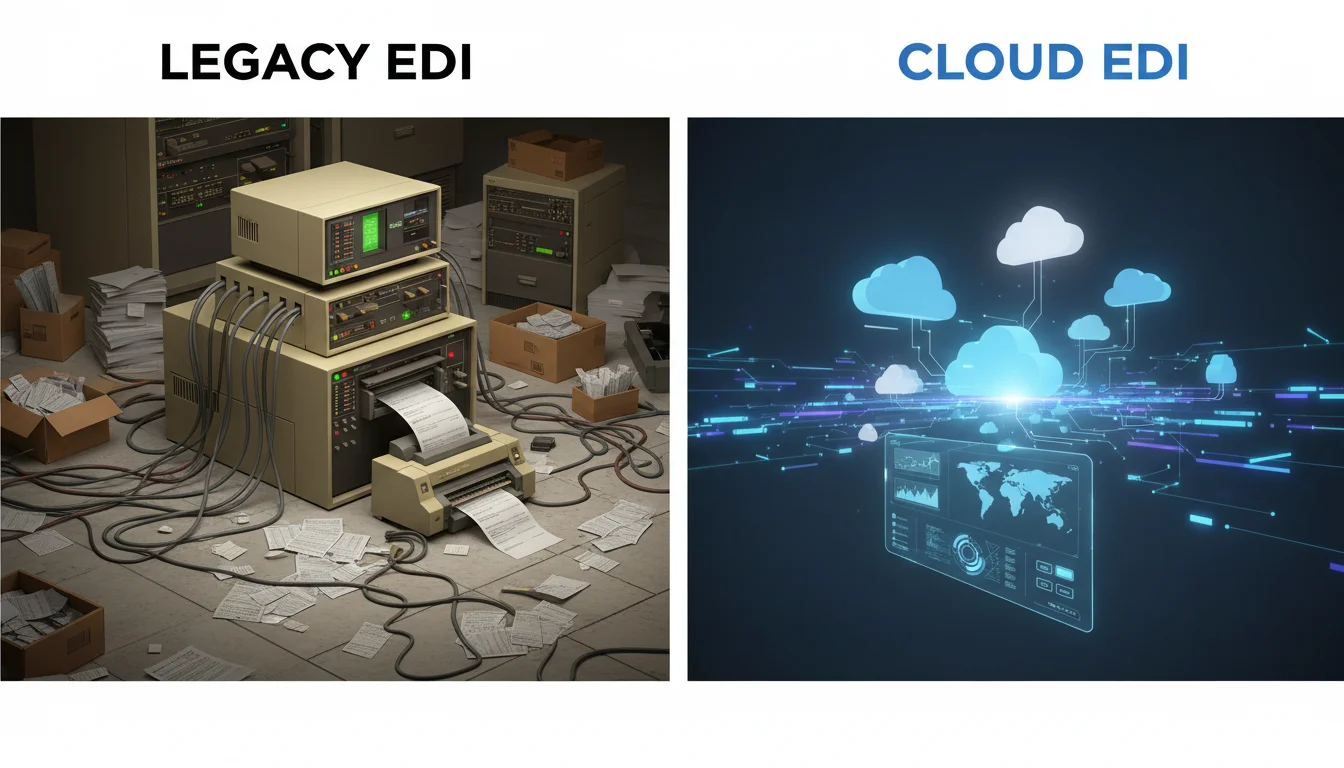
The conceptual foundation of Electronic Data Interchange traces its origins to the late 1960s, initially designed to help automotive manufacturers and their tier-one suppliers automate high-volume procurement processes. By establishing universally recognized data formatting standards—most notably the American National Standards Institute (ANSI) X12 standard in North America and the Electronic Data Interchange for Administration, Commerce and Transport (EDIFACT) standard globally—EDI enabled disparate enterprise computer systems to exchange complex business documents with absolute fidelity. For decades, this technology operated primarily through on-premise mainframe installations and localized servers, relying on expensive, proprietary Value-Added Networks (VANs) to route traffic between trading partners.
While these legacy on-premise systems provided early adopters with a competitive edge, their rigid architectures have become profound liabilities in the modern digital economy. Legacy EDI environments process data in asynchronous batches, introducing inherent latency that entirely obscures real-time inventory visibility. Moreover, on-premise systems require substantial capital expenditure for hardware procurement, exorbitant software licensing fees, and the continuous maintenance efforts of highly specialized, in-house integration developers. When a large retailer updates its compliance mandates or alters its data mapping requirements, organizations utilizing legacy systems are frequently forced into protracted, manual reprogramming cycles, causing severe disruptions to inbound revenue streams.
The advent of cloud-based EDI solutions has fundamentally resolved these infrastructural bottlenecks. Delivered via a Software-as-a-Service (SaaS) or Integration-Platform-as-a-Service (iPaaS) model, cloud EDI shifts the technological burden from the enterprise to the specialized service provider. This paradigm shift eliminates the need for localized hardware maintenance, converting unpredictable capital expenditures into transparent, usage-based operational expenditures. Furthermore, cloud architectures provide virtually infinite compute and storage scalability, enabling organizations to effortlessly absorb massive surges in transaction volumes during peak seasonal demand without experiencing system degradation.
The Automated Procure-to-Pay Workflow
The operational value of cloud EDI is most clearly demonstrated through the automation of the procure-to-pay lifecycle. This workflow is governed by the sequential exchange of highly structured, standardized transaction codes that eliminate ambiguity and enforce strict compliance between buyers and suppliers. The automated process generally follows a precise, five-step interaction framework, ensuring that data is securely extracted, translated, transmitted, integrated, and acknowledged.
The procurement cycle is initiated when an enterprise’s internal material requirements planning system detects a supply deficit and automatically generates an order. This internal data is pushed to the cloud EDI translation engine, which converts the proprietary data into an EDI 850 Purchase Order (or the EDIFACT ORDERS equivalent). The EDI 850 contains explicit, machine-readable instructions detailing the precise stock keeping units (SKUs), exact quantities, negotiated pricing, and required delivery windows.
Upon receiving the 850 Purchase Order, the supplier’s automated system immediately evaluates current inventory levels and production capacities. Without any human intervention, the system generates and transmits an EDI 855 Purchase Order Acknowledgment, legally confirming the supplier’s commitment to fulfill the order under the stipulated parameters. As the physical goods are picked, packed, and loaded onto outbound freight, the supplier’s warehouse management system triggers the creation of an EDI 856 Advance Shipping Notice (ASN). The ASN is a critical logistical document that provides the buyer with highly granular visibility into the shipment’s contents, packaging hierarchy, and carrier tracking data. Retail giants enforce strict compliance mandates regarding the timeliness and accuracy of the EDI 856; failure to transmit a flawless ASN frequently results in punitive financial chargebacks, as it severely disrupts the receiving warehouse’s labor allocation and cross-docking operations.
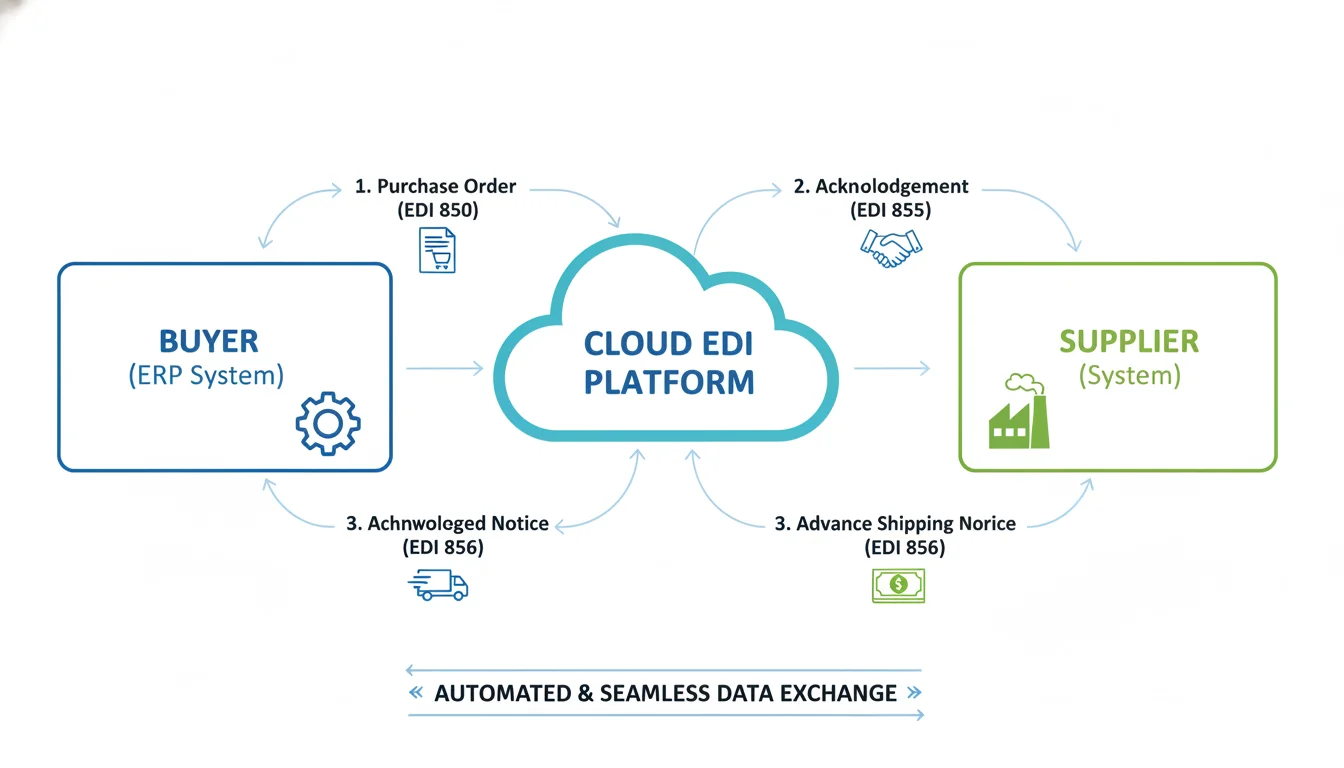
Following the physical dispatch of the goods, the supplier’s financial systems generate an EDI 810 Invoice (or EDIFACT INVOIC), requesting formal payment. Because the buyer’s enterprise resource planning system has already ingested the original EDI 850 Purchase Order and the EDI 856 Advance Shipping Notice, the arrival of the EDI 810 Invoice enables an automated three-way reconciliation match. If the quantities and prices across all three documents align perfectly, the ERP automatically authorizes the disbursement of funds. Throughout this entire lifecycle, systems continuously exchange EDI 997 Functional Acknowledgments, which act as cryptographic receipts confirming that each transmission was successfully received and structurally validated by the opposing party’s server.
Structuring Core B2B Transaction Data
To fully comprehend the operational mechanics of procurement automation, it is essential to understand the primary standardized document structures utilized across global supply chains.
| ANSI X12 Code | EDIFACT Equivalent | Document Nomenclature | Core Operational Function in Procurement |
|---|---|---|---|
| EDI 850 | ORDERS | Purchase Order | Initiates the procurement cycle by detailing required items, quantities, pricing, and delivery terms. |
| EDI 855 | ORDRSP | Purchase Order Acknowledgment | Confirms the supplier’s acceptance, rejection, or modification of the initial purchase order. |
| EDI 856 | DESADV | Advance Shipping Notice (ASN) | Provides critical, real-time logistical data regarding shipment contents, packaging, and expected arrival times. |
| EDI 810 | INVOIC | Invoice | Requests payment for goods rendered, facilitating automated three-way financial matching. |
| EDI 846 | INVRPT | Inventory Inquiry/Advice | Synchronizes stock levels between partners, enabling predictive ordering and preventing out-of-stock scenarios. |
| EDI 997 | CONTRL | Functional Acknowledgment | Serves as a digital receipt, confirming that an inbound EDI payload was successfully received and decoded. |
The Architectural Convergence of EDI and APIs
Overcoming the Constraints of Traditional Batch Processing
Despite its foundational role in global commerce, the architectural limitations of traditional EDI have become increasingly apparent in the context of modern, hyper-accelerated supply chains.
Traditional EDI environments are fundamentally reliant on batch processing methodologies. In a batch-oriented architecture, data is not transmitted the moment an event occurs; rather, transactions are accumulated over a predetermined period—often several hours or an entire business day—and transmitted collectively. While this approach efficiently conserves network bandwidth, it introduces severe operational latency. If a supplier updates their inventory levels at 9:00 AM, but the EDI batch window does not execute until 4:00 PM, the purchasing organization is operating on obsolete data for seven crucial hours, vastly increasing the risk of ordering depleted stock.
To achieve instantaneous operational synchronization, modern enterprise architectures have embraced Application Programming Interfaces (APIs). APIs facilitate synchronous, event-driven communication, allowing disparate software applications to query and exchange data in real-time. Unlike the rigid, highly regulated segment structures of ANSI X12 documents, APIs utilize lightweight, developer-friendly payload formats such as JavaScript Object Notation (JSON) and Extensible Markup Language. This inherent flexibility dramatically accelerates internal development cycles, allowing software engineering teams to seamlessly integrate procurement functions with cutting-edge microservices, responsive e-commerce storefronts, and dynamic cloud applications.
However, despite the technological superiority of real-time APIs, they cannot unilaterally replace EDI in the global B2B landscape. The global retail, healthcare, and automotive sectors are deeply entrenched in legacy compliance frameworks. Multinational conglomerates—including Walmart, The Home Depot, CVS Health, and Target—strictly mandate that all inbound and outbound supply chain communications adhere to established X12 or EDIFACT standards. These rigid standards are deeply intertwined with their internal automated receiving mechanisms, robotic warehouse sortation systems, and legal audit trails. For a mid-market supplier, attempting to substitute an EDI 856 Advance Shipping Notice with a proprietary API payload would result in immediate supply chain rejection and severe financial penalties.
Engineering the Hybrid Integration Layer
Recognizing that replacing EDI is commercially impossible, but relying solely upon it is operationally sluggish, enterprise architects in 2026 have universally adopted a hybrid integration methodology. The hybrid approach strategically blends the universally accepted compliance standards of EDI with the real-time agility and flexible connectivity of APIs, orchestrating both within a unified, cloud-native control plane.
In a mature hybrid architecture, the cloud EDI platform serves as the secure, partner-facing perimeter. When a massive retailer transmits a complex EDI 850 Purchase Order via an encrypted AS2 connection, the hybrid integration platform intercepts the transmission, cryptographically authenticates the sender, and decodes the rigid X12 segments. Instantly, the platform’s internal API engine transforms that structured data into a lightweight JSON payload and pushes it synchronously to the supplier’s internal ERP via RESTful API endpoints.
Conversely, when the supplier’s warehouse management system records that a pallet has been loaded onto a truck, it immediately triggers an internal API event. The hybrid integration platform instantly ingests this event data, formats it into a strictly compliant EDI 856 Advance Shipping Notice according to the specific retailer’s implementation guide, and transmits it outward. By utilizing APIs for all internal data movements and EDI exclusively for external compliance boundaries, organizations completely eliminate the latency of batch windows. This synchronization ensures that the outward-facing EDI documents always reflect the absolute, real-time reality of the enterprise’s inventory and operational status, thereby nullifying the timing mismatches that historically triggered chargebacks.
Integration Vector
-
Electronic Data Interchange (EDI)
- Core Architecture: Batch-oriented, standardized data segments.
- Data Payload Format: ANSI X12, EDIFACT, TRADACOMS, ODETTE.
- Primary Use Case: External compliance with major retail, logistics, and healthcare partners.
- Error Handling: Asynchronous detection post-transmission via 997 Functional Acknowledgments.
-
Application Programming Interface (API)
- Core Architecture: Event-driven, synchronous web services.
- Data Payload Format: JSON, XML, GraphQL.
- Primary Use Case: Internal system connectivity, real-time e-commerce, and microservices.
- Error Handling: Synchronous, immediate HTTP status code validation.
-
Hybrid Architecture Integration
- Core Architecture: API-driven internal data extraction feeding compliant EDI outputs.
- Data Payload Format: Automated, real-time payload transformation between formats.
- Primary Use Case: Eliminates operational latency while satisfying external mandates.
- Error Handling: Proactive API validation prevents non-compliant EDI generation.
Securing the Perimeter: AS2 Protocols and Cryptographic Connectivity
While APIs manage internal orchestration, the external transmission of sensitive EDI procurement data over the public internet requires impenetrable cryptographic security. In 2026, Applicability Statement 2 (AS2) remains the dominant, enterprise-grade protocol for secure B2B file transfers, widely mandated by apex retailers and defense contractors.
AS2 establishes a highly secure, point-to-point connection by enveloping the EDI payload in multiple layers of cryptographic defense. Before transmission, the data is encrypted utilizing Advanced Encryption Standard (AES) 256-bit cryptography, rendering it entirely unreadable to unauthorized interceptors. The sender then applies a digital signature using a private cryptographic key, which irrefutably authenticates the origin of the data and ensures absolute processing integrity. As the payload traverses the network, it is further shielded by Transport Layer Security (TLS) 1.3 protocols, protecting against sophisticated man-in-the-middle cyberattacks.
Upon successful receipt and decryption by the trading partner, the AS2 protocol automatically generates a Message Disposition Notification (MDN). This MDN serves as an undeniable, cryptographic receipt, confirming both the successful delivery and the structural integrity of the payload. Despite its robust security, managing AS2 connections presents significant operational challenges, primarily regarding the lifecycle management of digital certificates. If an organization fails to renew an expiring AS2 certificate, the cryptographic handshake will instantly fail, completely severing the supply chain connection and halting all procurement transactions. Consequently, modern cloud EDI platforms provide fully managed AS2 services, automating certificate renewals, managing complex firewall port configurations, and resolving connectivity issues proactively to ensure 99.998% infrastructure uptime.
Deep Enterprise Resource Planning (ERP) Integration
Establishing the Central Nervous System of Procurement
The raw technological capability of a cloud EDI platform is effectively neutralized if it is not seamlessly tethered to the organization’s Enterprise Resource Planning (ERP) system. The ERP functions as the central nervous system of the modern enterprise, maintaining the authoritative ledger for financial accounting, inventory valuations, manufacturing schedules, and human capital resources. If the EDI platform operates in isolation, procurement personnel are forced to manually download transaction files from a web portal and painstakingly re-key the data into the ERP. This manual intervention resurrects the exact inefficiencies, delays, and typographic errors that the EDI investment was intended to eradicate.
True procurement automation demands end-to-end ERP integration, enabling a frictionless, bidirectional data flow. When an inbound EDI 850 Purchase Order arrives, the integration layer must automatically translate the X12 format, map the specific data fields to the corresponding tables within the ERP’s relational database, and autonomously generate a native sales order record. This real-time synchronization ensures that the ERP always reflects the absolute latest inventory commitments, logistical movements, and financial liabilities, empowering executive leadership with context-rich, data-driven forecasting capabilities.
Navigating Global and Regional ERP Ecosystems
The integration strategy must be precisely tailored to the specific architectural nuances of the underlying ERP software.
The global ERP market is highly stratified, encompassing massive enterprise suites, agile mid-market platforms, and highly specialized regional solutions.
For massive, multinational conglomerates, SAP remains the undisputed market leader. Integrating cloud EDI with SAP environments—specifically the modern SAP S/4HANA Public Cloud Edition—requires profound technical expertise. Data must be meticulously mapped into SAP’s proprietary Intermediate Document (IDoc) structures or interfaced utilizing modern Simple Object Access Protocol (SOAP) APIs published on the SAP API Business Hub. To navigate these complexities, elite integration providers deploy specialized accelerators, such as the SAP Integration Content Advisor (ICA), which utilizes crowd-based machine learning to expedite the generation of B2B integration content.
In the mid-market segment, cloud-native platforms like Oracle NetSuite and Microsoft Dynamics 365 are experiencing explosive adoption due to their unified architectures and rapid deployment capabilities. Integrating EDI with NetSuite relies heavily on leveraging pre-built, certified native connectors and SuiteScript capabilities, allowing the EDI workflows to be managed directly within the NetSuite user interface without relying on external synchronization tools. This seamless embedded experience significantly accelerates the order-to-cash lifecycle and eliminates vendor queues.
Within the Asia-Pacific theater, global integration strategies must accommodate powerful regional ERP vendors that dominate local commercial ecosystems. In mainland China, enterprise software platforms developed by Kingdee and Yonyou are ubiquitous, deeply embedded in the region’s manufacturing and distribution networks. These systems are uniquely engineered to comply with the highly specific requirements of Chinese Generally Accepted Accounting Principles (China GAAP) and regional tax reporting frameworks. Multinational corporations operating in China frequently run SAP or Oracle as their global system of record while simultaneously maintaining Kingdee or Yonyou deployments for localized financial compliance. Consequently, top-tier cloud EDI providers expanding into the APAC region must architect native API connectors for these Asian ERPs, bridging the gap between localized Chinese accounting software and the global supply chain network.
Master Data Governance and Validation Checkpoints
A flawless technical connection between an EDI platform and an ERP is irrelevant if the underlying data being exchanged is inaccurate or obsolete. Procurement automation relies entirely on the absolute fidelity of Master Data—the core repository of product codes, unit measurements, pricing tiers, and vendor identification numbers. Before initializing any EDI integration, organizations must execute a comprehensive data cleansing initiative within their ERP. If a supplier transmits an invoice for item code “A-123,” but the buyer’s ERP database categorizes that item as “A-123-X,” the integration layer will throw a fatal exception, requiring immediate manual reconciliation.
To safeguard the integrity of the ERP database, cloud EDI architectures must implement rigorous data governance structures and automated validation checkpoints. As an inbound EDI document traverses the integration gateway, the system must execute programmatic validations to confirm that all mandatory fields are populated, date formats adhere to system logic, and pricing aligns with established contractual matrices. If an anomaly is detected, the integration layer acts as a digital quarantine, flagging the payload as an exception and preventing the corrupted data from polluting the ERP ledger. By maintaining stringent validation parameters, organizations ensure that their automated procurement pipelines remain reliable, auditable, and financially accurate.
The Paradigm Shift: Artificial Intelligence in B2B Integration
The Emergence of Agentic AI Workflows
By 2026, the application of artificial intelligence in supply chain procurement has evolved significantly beyond basic predictive analytics and rudimentary chatbots. The industry has definitively entered the era of Agentic AI. Unlike passive AI models that simply generate text or analyze historical trends upon request, Agentic AI systems are autonomous, goal-oriented software entities. These advanced agents can continuously monitor their digital environment, execute complex decision-making algorithms, and take multi-step actions across disparate enterprise applications without requiring human authorization.
Electronic Data Interchange provides the optimal foundational infrastructure for Agentic AI. Because EDI payloads (such as ANSI X12 and EDIFACT) are governed by universally standardized, highly structured data segments, they require minimal data cleansing or unstructured interpretation. AI models can effortlessly ingest this highly organized data, extracting deep, contextual patterns regarding trading partner behaviors, logistical inefficiencies, and network-wide procurement trends.
In modern procurement ecosystems, supply chain leaders are embedding these autonomous AI agents directly into the integration layer to act as intelligent orchestrators. For example, when an inbound EDI 855 Purchase Order Acknowledgment indicates that a critical raw material will be delayed by two weeks, an Agentic AI system does not simply generate an alert. Instead, it autonomously parses the severity of the delay, cross-references current warehouse buffer stocks, queries alternative pre-approved suppliers via API connections, evaluates dynamic market pricing, and automatically drafts an emergency EDI 850 Purchase Order to a secondary vendor to prevent a manufacturing shutdown. This transition from reactive troubleshooting to autonomous, intelligent orchestration drastically reduces administrative friction and empowers human procurement teams to focus entirely on high-level strategic negotiations.
Transforming Data Mapping and Partner Onboarding
Historically, the most excruciating bottleneck in scaling a B2B network has been the process of data mapping. When onboarding a new trading partner, integration specialists had to painstakingly write custom code to map the specific data fields of the partner’s unique EDI implementation guide to the corresponding fields within the host organization’s ERP database. This highly technical, manual endeavor frequently required weeks or even months of iterative testing, stalling revenue generation and delaying supply chain expansion.
In 2026, machine learning and generative AI have utterly revolutionized this process. AI-native integration platforms now utilize advanced semantic learning algorithms to analyze vast libraries of historical integration patterns and data schemas. When a new partner’s specifications are introduced, the AI model instantly comprehends the underlying semantic intent of the data fields and autonomously generates the requisite mapping logic. This zero-mapping architecture effectively eliminates the need for manual developer intervention, compressing trading partner onboarding timelines from several months to a matter of hours or days.
Furthermore, Generative AI is democratizing accessibility to complex integration environments. Leading platforms now incorporate conversational AI interfaces, leveraging advanced Large Language Models (LLMs) such as Claude 3.5 Sonnet or Gemini 1.5 Pro, to provide intuitive, natural language query capabilities. A non-technical procurement manager can simply type, “Why was the Home Depot invoice rejected yesterday?” and the AI agent will instantly parse thousands of lines of cryptographic AS2 logs and complex X12 segment codes, delivering a concise, plain-English summary of the missing data field and suggesting an immediate remediation action.
Machine Learning, Digital Twins, and Prescriptive Analytics
The massive repositories of historical transactional data generated by decades of EDI usage represent a treasure trove for advanced Machine Learning analysis. Modern supply chain platforms ingest this historical data to train highly sophisticated predictive models. By continuously analyzing patterns within EDI 856 Advance Shipping Notices and EDI 846 Inventory Inquiries, these ML models can anticipate demand fluctuations, identify subtle anomalies in supplier performance, and accurately predict inventory shortages long before they physically occur.
This predictive capability is rapidly evolving into highly actionable prescriptive analytics. Leading enterprises are utilizing these insights to construct “Digital Supply Chain Twins”—comprehensive, virtual simulations of their entire physical logistics network and supplier ecosystem. When global geopolitical tensions rise or a severe climate event threatens a major shipping lane, the AI system subjects the Digital Twin to countless stress-testing scenarios. The system then prescribes a highly specific, optimized contingency plan, advising executives on exactly how to rebalance inventory, reroute logistics, and leverage alternative sourcing channels to mitigate the financial impact of the impending disruption.
Evaluating the 2026 Cloud Integration Vendor Landscape
The Dominance of Global Hyperscalers
The rapid proliferation and advanced computational capabilities of modern cloud EDI platforms are fundamentally underwritten by the massive infrastructural investments of global cloud hyperscalers. As the total global cloud computing market (encompassing IaaS, PaaS, and SaaS) tracks toward an unprecedented one trillion dollar valuation in early 2026, the demand for elastic compute and GPU-intensive environments to support advanced AI integration models has reached record highs.
In the overarching cloud infrastructure market, Amazon Web Services (AWS) maintains its apex leadership position, capturing approximately 30 percent o
Of the global market share, AWS provides an unparalleled depth of services and a globally distributed network of Availability Zones, making it the foundational choice for hosting highly scalable B2B integration platforms. Microsoft Azure follows closely with a 20 percent market share, leveraging its profound entrenchment within enterprise IT environments and its aggressive deployment of advanced OpenAI integration capabilities to secure complex hybrid cloud workloads. Google Cloud Platform (GCP) captures roughly 13 percent of the market, differentiating itself through industry-leading innovations in data analytics, Kubernetes orchestration, and its proprietary Gemini AI ecosystem.
However, this Western-dominated narrative fractures significantly when examining the Asia-Pacific (APAC) theater. The APAC region is experiencing explosive cloud adoption, fueled by massive digital transformation initiatives in manufacturing and the rapid digitization of regional supply chains. Within mainland China, Alibaba Cloud operates as an absolute monolith, providing the highly specialized, regulatory-compliant infrastructure required to navigate the state’s stringent data localization laws. Across broader Southeast Asia, providers like Tencent Cloud and Huawei Cloud are aggressively expanding their regional data center footprints, offering low-latency, AI-ready compute capabilities optimized for fintech, gaming, and smart city deployments. For global enterprises orchestrating supply chains across Asia, deploying integration architecture on these regional hyperscalers is often a strategic necessity to ensure optimal performance and legal compliance.
Defining B2B Integration Platform Archetypes
The vendor landscape for Electronic Data Interchange and B2B integration software is highly diverse, with platforms purposefully engineered to address vastly different levels of organizational complexity, technical maturity, and regional requirements. Selecting the appropriate vendor necessitates a rigorous alignment of the platform’s core architectural archetype with the enterprise’s strategic procurement objectives.
| Vendor Archetype | Prominent Providers | Target Demographic & Core Competencies | Primary Deployment Scenarios |
|---|---|---|---|
| Legacy Global VANs & Complex Middleware | OpenText, IBM Sterling | Fortune 500 enterprises requiring massive, global Value-Added Networks. | Highly regulated, high-volume environments demanding strict governance, specialized security, and hybrid multi-cloud orchestration. |
| ERP-Centered Supply Chain Networks | TrueCommerce, Celigo, SPS Commerce | Mid-market to enterprise organizations prioritizing rapid time-to-value and ease of use. | Retail-focused compliance, embedded native ERP integrations (NetSuite, Dynamics), and unified omnichannel inventory management. |
| Cloud-Native & API-First Developer Platforms | Orderful, Stedi, MuleSoft | Technology-forward organizations with strong internal software engineering teams. | Leveraging modern RESTful APIs, JSON payloads, and machine learning to build highly customized, real-time integration stacks. |
| Regional & Specialized Asian Market Providers | Tangentia, Comarch, EDICOM | Enterprises executing complex supply chain operations across India, China, and Southeast Asia. | Navigating local APAC compliance laws, integrating with Asian ERPs (Kingdee/Yonyou), and providing localized multilingual support. |
Navigating Security, Compliance, and Data Residency
Zero Trust Principles in Multi-Tenant Cloud Environments
Migrating sensitive supply chain procurement data from isolated, on-premise mainframes to cloud-based multi-tenant architectures introduces sophisticated new threat vectors. In a multi-tenant cloud environment, numerous distinct organizations share the same underlying physical computing and storage infrastructure. While this significantly enhances scalability and reduces costs, it necessitates rigorous logical isolation to prevent tenant-to-tenant lateral attacks, inadvertent data leakage, and unauthorized access. Furthermore, the pervasive use of APIs to connect cloud platforms creates highly targeted communication channels that, if left unsecured, can be exploited by threat actors to exfiltrate vast quantities of transactional data.
To mitigate these severe vulnerabilities, modern cloud EDI deployments must strictly adhere to the principles of a Zero Trust Architecture. The Zero Trust paradigm fundamentally rejects the notion of a secure internal perimeter, operating instead on the axiom of “never trust, always verify”. Every user, application, and API request attempting to access the integration environment must be continuously authenticated and authorized.
The implementation of Zero Trust requires the mandatory enforcement of Multi-Factor Authentication (MFA) across all administrative and user access points. Identity and Access Management (IAM) protocols must be meticulously configured to enforce the principle of least privilege, ensuring that personnel and automated systems are granted only the absolute minimum access required to execute their specific functions. To safeguard data against interception, robust encryption standards are non-negotiable; all procurement data must be secured at rest utilizing Advanced Encryption Standard (AES) 256-bit cryptography, and heavily encrypted during transit across public networks using Transport Layer Security (TLS) 1.3 protocols. Advanced cloud platforms further bolster defenses by deploying Cloud Infrastructure Entitlement Management (CIEM) systems, which automatically scan for and remediate misconfigurations, dormant accounts, and excessive user permissions.
Compliance Mandates: SOC 2 and the 2026 HIPAA Overhaul
Beyond foundational architectural security, cloud EDI providers must demonstrate compliance with rigorous, industry-recognized certification frameworks to maintain enterprise trust. For any organization processing B2B data, System and Organization Controls 2 (SOC 2) Type II compliance serves as the baseline operational standard. Achieving and maintaining SOC 2 compliance requires the provider to pass exhaustive third-party audits assessing their adherence to five core Trust Service Criteria: security, availability, processing integrity, confidentiality, and privacy.
For supply chains intersecting with the medical, pharmaceutical, or healthcare sectors, adherence to the Health Insurance Portability and Accountability Act (HIPAA) is a strict federal legal requirement. The regulatory landscape surrounding healthcare data has intensified dramatically with the enforcement of the 2026 HIPAA Security Rule updates. Historically, certain technical safeguards within the HIPAA framework were classified as “addressable,” providing organizations with significant leeway to opt out of specific security controls if they deemed them operationally burdensome.
The 2026 mandates categorically eliminate this flexibility. All technical safeguards are now unequivocally mandatory for systems handling electronic Protected Health Information (ePHI). Cloud EDI vendors serving the healthcare sector must implement comprehensive MFA, enforce NIST-standard AES-256 encryption across all databases and backups, and conduct mandatory, automated vulnerability scanning on a biannual schedule. Most critically, the 2026 regulations enforce a stringent 72-hour data restoration capability; organizations must legally demonstrate their technical ability to fully restore critical infrastructure and ePHI data within 72 hours of a catastrophic disruption or ransomware incident.
The Geopolitics of Data: PIPL, DPDP, and PDPA
The most complex hurdle facing global supply chain integration in 2026 is the aggressively fragmented landscape of national data residency and localization laws. Data residency regulations legally dictate the geographical boundaries within which specific classifications of data must be physically stored, processed, and maintained. Non-compliance with these sovereign mandates can result in catastrophic financial penalties, forced business interruptions, and severe reputational damage.
Navigating data residency within the Asia-Pacific region requires highly specialized architectural planning.
Data Localization and Cross-Border Transfer Regulations
The People’s Republic of China enforces a famously rigid data localization framework, anchored by the Personal Information Protection Law (PIPL), the Data Security Law (DSL), and the Cybersecurity Law (CSL). Under these comprehensive mandates, any critical business data or personal information collected within mainland China must physically reside on servers located within Chinese borders. Transferring this regulated data outside of China is strictly prohibited unless the organization successfully navigates a grueling governmental security assessment. Consequently, multinational corporations rely heavily on providers like Alibaba Cloud and highly localized EDI services to maintain completely isolated, compliant infrastructure environments within the country. Penalties for violating these Chinese data export laws are severe, with fines escalating to RMB 500,000 (approximately $70,000 USD) for critical infrastructure operators.
In contrast, India’s newly enforced Digital Personal Data Protection (DPDP) Act of 2023 adopts a more economically balanced, yet highly regulated approach. Acknowledging the necessity of global cloud computing for its rapidly expanding digital economy, the DPDP Act permits the cross-border transfer of Indian digital personal data to foreign territories. However, the Indian government maintains the authority to explicitly “blacklist” specific nations, strictly prohibiting any data export to those territories based on geopolitical and security considerations.
Meanwhile, Singapore’s Personal Data Protection Act (PDPA) focuses less on the physical location of the server and heavily on strict accountability and extraterritorial enforcement. Organizations processing the data of Singaporean citizens are held legally responsible for maintaining rigorous security safeguards and obtaining explicit consent, regardless of whether the organization maintains a physical corporate presence within Singapore. To comply with these overlapping, highly complex regulations, cloud EDI vendors must offer extremely granular, region-specific deployment architectures, allowing enterprises to precisely geofence their procurement data to satisfy local authorities.
Executing the Cloud Migration and Implementation Strategy
Mitigating the Risks of Cloud Repatriation and FinOps Management
Transitioning an intricate, mission-critical supply chain from legacy on-premise infrastructure to a modern cloud integration platform is a highly sensitive undertaking fraught with operational risk. Without meticulous planning, organizations frequently encounter severe data corruption during extraction, API vulnerabilities, and catastrophic connectivity failures that can entirely paralyze procurement operations. Rushing the migration process under compressed timelines frequently results in incompatible data formatting, forcing costly rollbacks and prolonged system downtime.
Furthermore, as cloud adoption matures, organizations face a growing crisis in financial governance, specifically regarding cloud waste. According to 2026 data from CloudZero and Flexera, organizations are currently running cloud infrastructure at an alarming 32% to 35% waste rate. This inefficiency stems from the over-provisioning of server resources, poor scalability configurations, and a fundamental lack of visibility into complex, usage-based pricing models. To combat this, IT leaders must integrate rigorous Financial Operations (FinOps) disciplines into their migration strategy, utilizing tagging, automated resource scaling, and continuous consumption monitoring to ensure that the agility of the cloud does not trigger an uncontrolled explosion in operating costs.
The Phased Implementation Roadmap
To safeguard operational continuity and maximize the return on technological investment, industry leaders adhere to a highly structured, phased implementation roadmap when deploying cloud EDI solutions.
- Strategic Alignment and Business Case Development: A successful migration requires absolute alignment across IT, finance, and procurement departments. A dedicated integration steering committee must document current system dependencies, define strict data governance policies, and establish clear, quantifiable success metrics—such as specific targets for reducing order cycle times or minimizing chargebacks.
- Platform Selection and Security Architecture: The organization evaluates cloud EDI vendors based on their capacity to integrate natively with the existing ERP, support hybrid API/EDI workloads, and meet regional data residency constraints. During this phase, rigorous Zero Trust security frameworks, encrypted communication protocols (AS2, SFTP), and Identity and Access Management policies are definitively established.
- Data Mapping and System Integration: This highly technical phase focuses on establishing the bidirectional communication pipelines between the cloud EDI platform and the internal ERP or WMS. Development teams, increasingly aided by machine learning mapping tools, translate proprietary internal data structures into universally compliant EDI formats, establishing the rigid validation rules required to maintain data integrity.
- Controlled Pilot Testing: A ‘Big Bang’ deployment—attempting to migrate all suppliers and systems simultaneously—is highly discouraged due to extreme operational risk. Instead, organizations must construct a secure testing sandbox to process simulated transaction loads. Following internal validation, the enterprise executes a phased rollout, onboarding a tightly controlled pilot group of highly collaborative trading partners to validate the flow of critical documents (850 Purchase Orders, 810 Invoices) in a live environment.
- Production Go-Live and Continuous Orchestration: Following the successful resolution of any anomalies discovered during the pilot phase, the platform transitions to full production status. The strategic focus shifts from technical implementation to rapid partner network expansion and continuous optimization. Utilizing advanced observability dashboards, the steering committee monitors real-time transaction health, adjusts automation logic, and leverages AI-derived analytics to continually refine supply chain performance.
Conclusion: The Future of Autonomous Procurement
In 2026, the modernization of B2B supply chain procurement is no longer characterized by the simple digitization of paper documents; it is defined by the intelligent, real-time orchestration of massive global networks. The strategic convergence of cloud-native Electronic Data Interchange platforms, agile Application Programming Interfaces, and autonomous Agentic AI has fundamentally resolved the historical friction, latency, and fragility associated with legacy integration architectures.
As global supply chains continue to navigate intensifying geopolitical pressures and complex regulatory environments, organizations can no longer afford the inefficiencies of siloed, manual data processing. By adopting hybrid integration frameworks, ensuring deep native connectivity with Enterprise Resource Planning systems, and rigorously adhering to zero-trust security and data residency mandates, enterprises can achieve unprecedented visibility and operational velocity. Ultimately, the successful deployment of these advanced cloud technologies transforms procurement from a reactive, cost-center function into a highly resilient, autonomous engine for sustainable corporate growth.