Away, Monos, July: Best Carry-On Luggage Comparison 2026
Introduction and Market Context
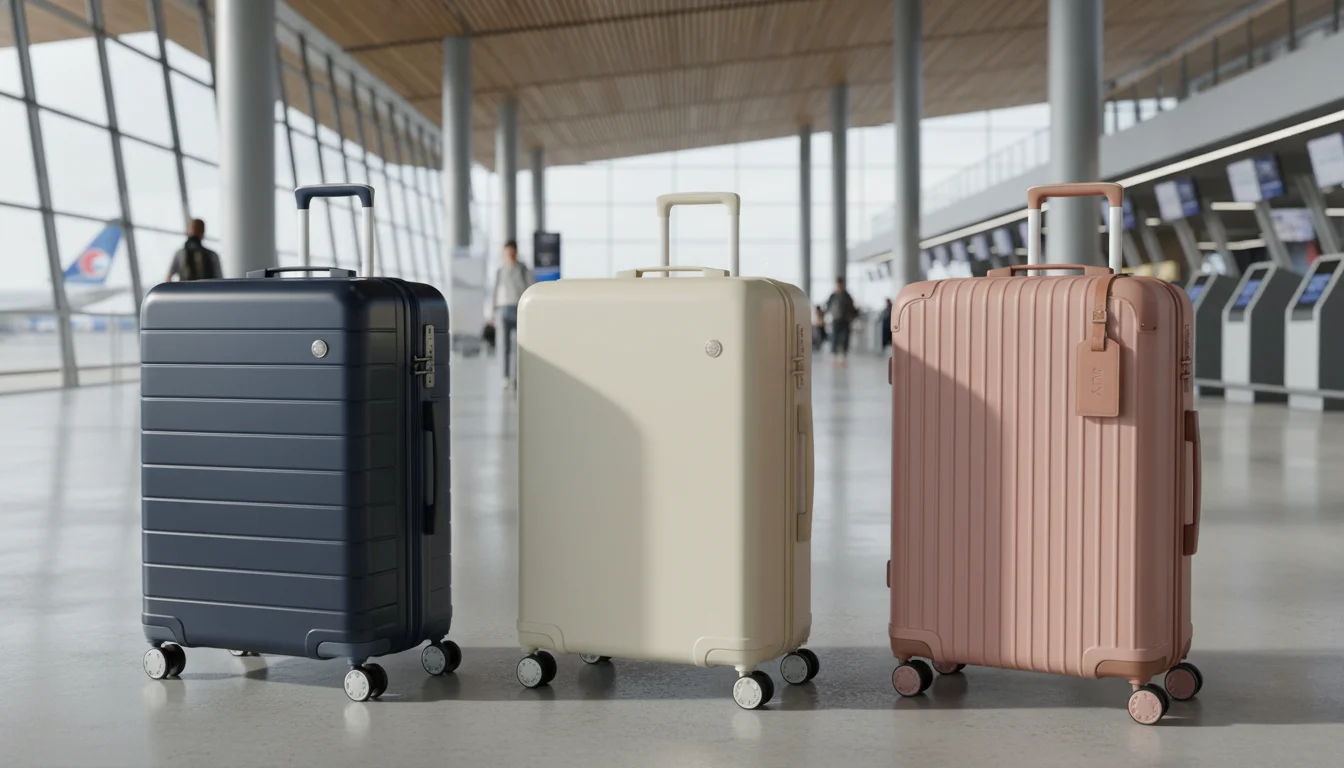
The premium direct-to-consumer luggage market has experienced a profound maturation phase as of 2026, driven by an evolution in traveler expectations, rapid advancements in polymer manufacturing science, and increasingly stringent international airline regulations regarding carry-on dimensions and smart technologies. Historically dominated by legacy brands utilizing softside ballistic nylon, the industry has been thoroughly disrupted by agile, digitally native entities that emphasize aesthetic minimalism, highly engineered mobility components, and integrated travel ecosystems. Among the most prominent market leaders in this highly contested sector are Away, Monos, and July. These three brands have established themselves as the primary contenders for modern consumers seeking durable, high-performance hardshell carry-on luggage, effectively dictating the design language and functional standards of the contemporary travel gear industry.
The competitive landscape in 2026 is defined by a delicate and unforgiving balance between volumetric efficiency, structural resilience, and absolute compliance with modern aviation security protocols. Airlines have transitioned toward draconian enforcement of baggage limits, utilizing sophisticated digital bag tracking algorithms, automated sizing mechanisms at boarding gates, and precise weight sensors to penalize non-compliant carry-ons. Concurrently, the Transportation Security Administration (TSA), the Federal Aviation Administration (FAA), and international aviation authorities such as the European Union Aviation Safety Agency (EASA) have imposed rigid restrictions on lithium-ion batteries and smart luggage capabilities, fundamentally altering the viability of integrated electronic features that were previously marketed as luxury conveniences. Within this highly regulated and heavily scrutinized environment, luggage is no longer merely a passive receptacle for personal garments; it functions as an actively engineered tool designed to mitigate the friction, financial penalties, and physical strain of modern transit.
This comprehensive strategic report evaluates the flagship carry-on models from Away, Monos, and July. By conducting an exhaustive comparative analysis of material science, dimensional architecture, mobility kinematics, internal spatial compression systems, regulatory compliance mechanisms, and the economics of post-purchase consumer ecosystems, this research identifies the underlying trends shaping the luxury travel gear sector. The subsequent analysis moves beyond superficial marketing specifications to extract critical second and third-order insights regarding how granular design choices impact long-term structural integrity, consumer risk profiles, and operational efficiency during high-stress travel scenarios.
Material Science and Structural Durability Engineering
The foundational element of any premium hardshell suitcase is its exterior shell architecture. The industry standard has universally shifted away from brittle acrylonitrile butadiene styrene (ABS) plastics toward 100% polycarbonate, a highly advanced thermoplastic polymer prized for its exceptional impact resistance, thermal stability across diverse climates, and unique ability to flex under immense kinetic pressure without fracturing. However, the specific chemical blends, surface treatments, texturing methodologies, and structural reinforcements utilized by Away, Monos, and July result in vastly different real-world durability profiles and cosmetic lifespans.
Polycarbonate Resilience and Cosmetic Degradation Profiles
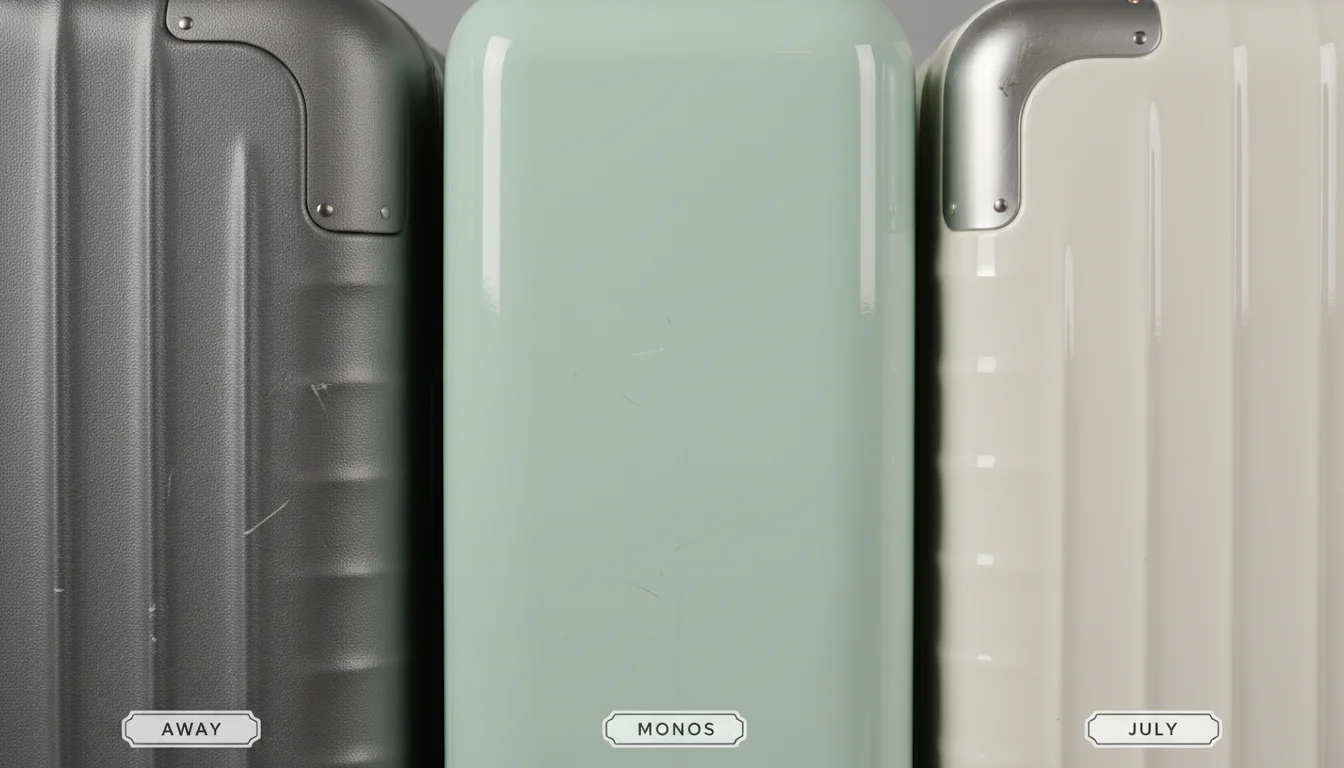
Away utilizes an extra-dense polycarbonate shell specifically engineered to absorb sudden kinetic impact through temporary mechanical deformation. When subjected to external blunt forces—such as being thrown onto a baggage carousel or dropped onto rough concrete—the Away shell flexes inward, dissipates the energy, and rebounds to its original geometric shape without structural compromise. Beyond baseline structural integrity, Away has prioritized cosmetic longevity by applying a heavily textured, granular matte finish to its polycarbonate exterior. Independent laboratory drop tests, alongside prolonged consumer usage patterns, indicate that this specific textured surface is highly effective at camouflaging the inevitable scuffs, scratches, and abrasive damage inherent to travel. The proprietary material formulation ensures that the Away carry-on degrades gracefully over extended periods, maintaining a utilitarian but polished aesthetic even after years of rigorous international transit across rough terrains like cobblestone streets and gravel roads.
Monos approaches material science with a slightly different philosophy, emphasizing the use of aerospace-grade, water-resistant polycarbonate derived partially from recycled polymeric materials. While this specific chemical composition aligns perfectly with the brand’s strong sustainability ethos and its coveted Certified B Corporation status, the execution of its exterior finish presents a significant and well-documented vulnerability regarding cosmetic degradation. Monos luggage is widely celebrated for its sleek, minimalist, pastel-toned aesthetic that initially presents as highly luxurious. However, independent laboratory drop tests and exhaustive consumer wear trials reveal that the shell is exceptionally susceptible to abrasive scuffing, distinct color transfer from conveyor belts, and visible surface denting. The perfectly smooth, ultra-matte finish acts as an unblemished canvas for every abrasive interaction, meaning that the visual premium of a Monos suitcase diminishes rapidly after only minimal use. While the underlying polycarbonate structure rarely suffers catastrophic cracking, the surface-level damage is a profound trade-off for its refined initial appearance, forcing consumers to rely heavily on the included melamine cleaning sponges (often referred to as magic erasers) to aggressively maintain the product’s aesthetic value post-transit.
July diverges significantly from both Away and Monos through a highly engineered hybrid structural approach. Utilizing 100% German aerospace-grade polycarbonate, July integrates a proprietary “curved eggshell” design geometry intended to optimize the multidirectional dissipation of kinetic energy during a high-velocity impact. Furthermore, July directly addresses the specific mechanical vulnerability of hardshell corners—the most common point of catastrophic failure in rigid luggage—by integrating thick, anodized aluminum bumpers directly into the polycarbonate chassis. This distinct architectural decision fundamentally alters the durability profile of the suitcase. While the flexible polycarbonate shell handles broad surface impacts, the rigid aluminum corner guards protect the highest-stress focal points from fracturing during hard drops. Independent durability testing confirms that July luggage ranks among the most structurally durable in the market, resisting deep scratches and scuffs exceptionally well due to the protective standoff created by the bumpers. However, a secondary insight reveals a cosmetic compromise inherent to this design: the anodized colored coating on these aluminum bumpers is itself prone to localized scratching when dragged against abrasive surfaces like concrete stairs or curbs, meaning that while the structural integrity of the corners is vastly superior, the bumpers will exhibit highly visible cosmetic wear over time.
The Aluminum Alternative and Hybridization
It is vital to note that all three brands offer specialized aluminum collections or hybrid models for consumers willing to sacrifice overall weight for absolute structural rigidity and a distinct industrial aesthetic. Aluminum suitcases eliminate the flexible, energy-absorbing characteristics of polycarbonate, instead absorbing kinetic impact through permanent plastic deformation, which manifests as visible dents. While Monos promotes a specialized Hybrid collection that merges a rigid aluminum frame with flexible polycarbonate panels to theoretically balance weight and strength, and Away offers a fully custom-made aluminum shell for maximum durability, these models represent a niche segment of the market. For the standard consumer, 100% polycarbonate remains the optimal material regarding the weight-to-strength ratio, and within that dominant category, Away and July demonstrate vastly superior resistance to the inevitable cosmetic and structural rigors of global travel compared to the easily scuffed Monos models.
Dimensional Analysis and Volumetric Efficiency Metrics
The practical utility of a carry-on suitcase is fundamentally constrained by strict airline overhead bin dimensions and automated sizing apparatuses utilized at boarding gates. Consequently, luggage engineers face a zero-sum geometric challenge: maximizing the interior storage volume (yield) while strictly adhering to non-negotiable external dimensional constraints set by aviation authorities.
The distinct spatial strategies employed by Away, Monos, and July highlight different corporate priorities regarding volumetric efficiency, functional accessibility, and adherence to international carrier standards.
Exterior Footprints versus Usable Interior Space
To understand the spatial efficiency of these products, a comparative analysis of their physical dimensions and measured capacities is required.
-
Away The Carry-On
- Advertised Exterior Dimensions (in): 21.7 x 14.4 x 9.0
- Measured Weight (lbs): 7.4 - 7.5
- Advertised Capacity (Liters): 41.0 L
- Independently Measured Capacity (Liters): 35.5 L
- Expansion Capability: None
-
Away The Bigger Carry-On
- Advertised Exterior Dimensions (in): 22.7 x 15.4 x 9.6
- Measured Weight (lbs): 8.4
- Advertised Capacity (Liters): 47.7 L
- Independently Measured Capacity (Liters): N/A
- Expansion Capability: None
-
Monos Carry-On
- Advertised Exterior Dimensions (in): 22.0 x 14.0 x 9.0
- Measured Weight (lbs): 7.0
- Advertised Capacity (Liters): 39.9 L
- Independently Measured Capacity (Liters): N/A
- Expansion Capability: None
-
Monos Carry-On Pro
- Advertised Exterior Dimensions (in): 20.0 x 14.0 x 6.5 (Measured)
- Measured Weight (lbs): 7.7
- Advertised Capacity (Liters): 36.0 L
- Independently Measured Capacity (Liters): 29.8 L
- Expansion Capability: None
-
July Carry On
- Advertised Exterior Dimensions (in): 21.5 x 15.0 x 8.5
- Measured Weight (lbs): 7.4
- Advertised Capacity (Liters): 42.0 L
- Independently Measured Capacity (Liters): N/A
- Expansion Capability: None
-
July Carry On Light Expandable
- Advertised Exterior Dimensions (in): 21.25 x 14.17 x 8.66
- Measured Weight (lbs): 4.9
- Advertised Capacity (Liters): 40.0 L
- Independently Measured Capacity (Liters): N/A
- Expansion Capability: Yes (Unzip to add 5L)
-
July Carry On Max Expandable
- Advertised Exterior Dimensions (in): 23.0 x 16.0 x 9.0 (10.6 Expanded)
- Measured Weight (lbs): 8.16
- Advertised Capacity (Liters): 50.0 L (62.0 L Expanded)
- Independently Measured Capacity (Liters): N/A
- Expansion Capability: Yes (12L via zipper)
Data aggregated from official manufacturer specifications and independent laboratory measurements. Note that independent volume measurements frequently differ from manufacturer claims due to varying methodologies in calculating usable internal space versus total geometric volume.
The data illustrates significant variances between manufacturer claims and independent volumetric testing. Away’s standard Carry-On represents a highly optimized baseline, offering an independently measured 35.5 liters of highly usable space within a dimensional footprint that is universally accepted by both major domestic and strict international carriers. The Away design is intentionally streamlined, deliberately eschewing external pockets to maximize the interior cavity and prevent any external bulging that might trigger an airline sizing dispute.
July’s standard Carry On presents a slightly wider profile (15.0 inches in width compared to Away’s 14.4 inches and Monos’s 14.0 inches) to achieve its claimed 42-liter capacity. This extra width allows for excellent packing efficiency, accommodating bulky items such as winter coats or large footwear with ease. However, secondary insights reveal a geometric vulnerability inherent to this broader design: when fully packed, the slightly wider and shallower footprint of the July bag noticeably alters its center of gravity. Furthermore, July’s dimensions strictly test the upper limits of rigid airline sizers. While perfectly compliant with major US airlines like Delta and United, strict international carriers known for aggressive dimension enforcement, such as Asiana Airlines, may challenge the depth parameters, requiring passengers to unexpectedly check the item at the gate. The psychological and operational friction of this uncertainty is a notable liability for the July standard Carry On on international routes.
The Laptop Compartment Paradox and Spatial Cannibalization
The most notable volumetric divergence and operational compromise occurs within the “Pro” models, specifically the Monos Carry-On Pro. Designed explicitly for the tech-heavy business traveler or digital nomad, this model integrates a rigid, zippered front compartment constructed from aerospace-grade polycarbonate, designed to securely house a laptop, tablet, and travel documents. While providing unparalleled accessibility during frantic TSA security screenings, this feature introduces a severe volumetric penalty to the user. Because the absolute external footprint of the suitcase cannot exceed rigid airline limits, the deep spatial volume required for the front pocket is directly subtracted from the internal packing cavity. Independent measurements indicate that the Monos Carry-On Pro offers a mere 29.8 liters of true internal space, a drastic reduction that severely limits its viability for trips exceeding two to three days.
Furthermore, integrating dense, heavy electronics into the extreme front exterior panel dynamically shifts the suitcase’s center of mass forward. This geometric imbalance renders the bag highly prone to tipping over when left freestanding, particularly if the internal main compartment is not packed densely enough to act as a counterweight. Therefore, the inclusion of a quick-access pocket, while theoretically beneficial for airport navigation, fundamentally compromises the primary function of the luggage as an efficient, stable storage vessel.
Expandability, Modular Capacity, and the July Ecosystem
For consumers constantly grappling with capacity constraints, expandable zippers have become a critical, highly sought-after feature. Away addresses this demand with the “Flex” iterations of its standard models, providing an additional 2.25 inches (5.72 cm) of depth via a secondary, heavily reinforced zipper track. Monos similarly offers an Expandable Collection to accommodate occasional overpacking.
However, July has pushed the boundaries of modular capacity to their absolute limits with the release of the Carry On Max Expandable in 2026. This specific model increases internal volume by an impressive 12 liters through physical zipper expansion. Beyond the zipper, July includes a hidden, packable nylon travel tote that rests securely on the telescopic handle via a trolley sleeve, yielding an additional 20 liters of external storage. This ecosystem approach allows a traveler to board an aircraft with a 62-liter expanded suitcase and a 20-liter personal item, yielding an astonishing 82 liters of total capacity without officially checking a bag. While maximizing utility for the traveler, passengers utilizing the fully expanded July Carry On Max must remain acutely aware of the strict 2026 airline weight limits and the severe risk of automated gate scanners or boarding agents flagging the expanded dimensions as non-compliant, necessitating an expensive gate-check fee.
Kinematics, Ergonomics, and Mobility Engineering
The primary advantage of four-wheeled spinner luggage lies in its ability to completely eliminate the musculoskeletal strain of bearing weight during transit. The true efficiency of a suitcase is dictated by the kinetic friction of its wheels and the structural rigidity of its telescopic handle. Across the luxury direct-to-consumer segment, the precision engineering of these critical mobility components separates adequate luggage from exceptional travel gear.
Wheel Architecture, Bearing Mechanics, and Rolling Resistance
The industry gold standard for luggage mobility has historically been Hinomoto, a highly respected Japanese manufacturer renowned for producing silent, polyurethane wheels with exceptionally low rolling resistance and superior durability. Monos historically differentiated itself in marketing materials by explicitly highlighting its use of Hinomoto wheels, which provided a buttery, whisper-quiet glide over both polished airport concourses and highly abrasive European cobblestones. However, market analysis and extensive consumer reports from the 2026 landscape indicate a significant and highly debated pivot in Monos’ supply chain. Recent iterations of Monos luggage have been observed utilizing wheels with noticeably thinner casters and completely absent Hinomoto branding, suggesting a quiet shift toward proprietary or alternative, lower-cost manufacturing sources. While these unbranded wheels still perform adequately, this unacknowledged substitution has generated profound skepticism among luggage purists and travel bloggers regarding the preservation of Monos’s legacy quality standards and long-term durability.
July, in stark contrast, explicitly engineered a proprietary mobility solution specifically designed to rival or exceed the performance of Hinomoto. Branded as the SilentMove Series 2 360° double spinner wheels, July’s components are heavily customized and designed in-house. The wheels feature sealed stainless steel ball bearings, an engineering choice that dramatically reduces internal friction and prevents the ingress of destructive dust, grit, and moisture that typically degrades wheel performance over time. Comparative field testing consistently demonstrates that July’s wheels operate with near-zero kinetic resistance, often cited as the absolute smoothest in the competitive set. A fascinating, albeit slightly problematic, second-order effect of this frictionless engineering is that the fully loaded luggage will autonomously roll away from the user on even microscopic inclines, such as the slight gradient of an airport tarmac or a sloped sidewalk.
Away utilizes custom-designed 360-degree spinner wheels that, while lacking the highly specialized branding of Hinomoto or SilentMove, consistently perform at a remarkably high level of reliability. Rigorous field tests indicate that Away’s slightly wider wheelbase provides superior geometric stability during rapid changes in direction, preventing the tall suitcase from overturning during sudden lateral movements—a common and frustrating issue when navigating crowded, unpredictable airport terminals. While perhaps marginally louder on rough terrain than the July SilentMove wheels, Away’s wheel chassis is exceptionally durable, absorbing severe impact and rarely succumbing to the sheer forces that cause cheaper, poorly engineered wheels to snap off at the stem during transit.
Telescopic Handle Extrusions and Locking Mechanics
The telescopic handle serves as the primary physical interface between the user and the luggage, making its ergonomics, grip comfort, and structural tolerances absolutely critical to the overall experience.
Telescopic Handles
Cheaper handles exhibit significant torsional play (wobbling) and limited height adjustments, leading to user fatigue.
Monos constructs its telescopic handle from high-grade extruded aluminum and features an adjustable release button mechanism positioned ergonomically underneath the grip. It offers four distinct, widely spaced height settings, catering to a broad range of user statures. The aluminum tracks are manufactured with extremely tight tolerances, resulting in a highly rigid feel with minimal lateral sway or rattling when fully extended. The handle feels distinctly premium and transmits very little vibration to the user’s hand.
July introduces a distinct paradigm with its twin-bar multi-stop telescopic handle, which features a remarkable 20 discrete height settings (with some lighter models featuring a 3-stop handle). In theory, this allows for absolute biometric customization, allowing the user to find the perfect ergonomic angle regardless of their height or footwear. However, the mechanical execution of this complex system presents noticeable functional friction. Users consistently report that the locking mechanism engages effectively in the upper parameters of the track, but at lower heights, the internal pins fail to lock upward, meaning the handle will slide freely upward if pulled, disrupting the user experience when abruptly transitioning from pushing the suitcase to pulling it over a curb.
Away employs a standard multi-stage telescoping handle that heavily prioritizes robust simplicity over hyper-adjustability. The Away handle is slightly more utilitarian in its design, utilizing a thick, durable aluminum extrusion that stubbornly refuses to bend or warp under heavy loads. This structural rigidity ensures the user can confidently leverage the handle to tip, maneuver, or hoist a fully packed 40-pound suitcase onto an escalator without any fear of mechanical failure or bending. While it lacks the 20-stop nuance of the July handle, its steadfast reliability aligns perfectly with Away’s broader ethos of frictionless durability.
Internal Architecture, Spatial Management, and Compression Systems
The transition from the chaotic act of packing a suitcase to efficiently unpacking at a destination is mediated entirely by the luggage’s internal architecture. Efficient interior design must simultaneously maximize the volumetric yield of the hardshell, provide distinct zones to separate clean garments from soiled ones, and forcefully compress air out of folded clothing to prevent items from shifting and wrinkling during transit.
Flat-Panel Cinching versus Y-Strap Systems
The most critical functional differentiator in internal design between Away, Monos, and July is the mechanical mechanism of garment compression. The thermodynamics and spatial geometry of packing dictate that eliminating trapped air between garments is the only way to significantly increase capacity within a fixed volume.
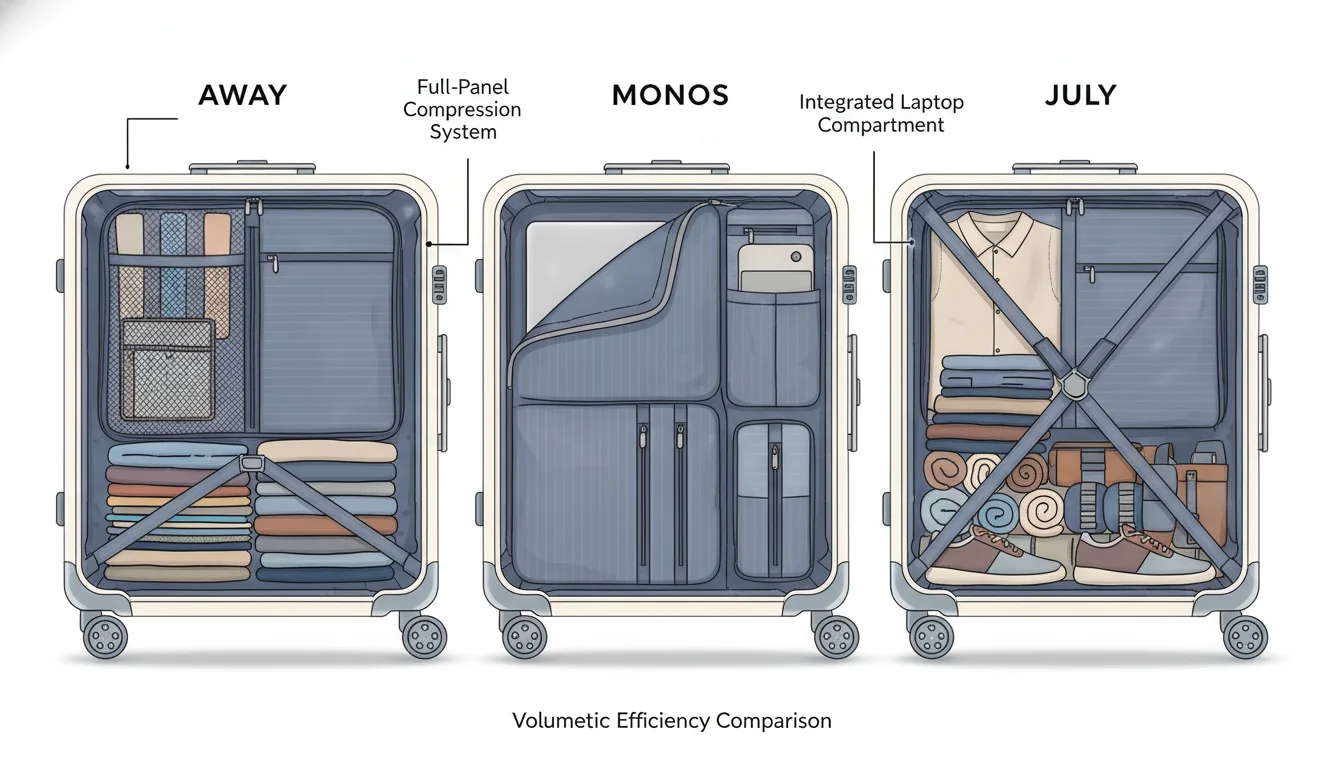
Away and Monos both utilize a highly effective full-panel compression system. In this architecture, one half of the clamshell is secured by a zippered mesh divider, while the other half relies on a rigid, floating fabric panel that sits directly atop the packed stack of clothing. Two heavy-duty nylon straps traverse this rigid panel, anchoring firmly to the base of the suitcase. By pulling downward on the straps, the traveler forces the rigid panel evenly across the entire surface area of the clothing stack, efficiently expelling air and perfectly flattening the load. This system is universally praised by travel experts for its unparalleled ability to condense bulky, air-filled items like heavy sweaters and down jackets, effectively increasing the usable capacity of the suitcase by up to 20% compared to uncompressed packing. Furthermore, both Away and Monos brilliantly integrate zippered mesh pockets directly into these compression panels, transforming what would otherwise be dead space into highly functional storage for flat items, undergarments, or charging cables.
July, conversely, relies on a Y-Strap compression system. Rather than utilizing a rigid panel to distribute downward force evenly, July uses a heavy-duty nylon strap configured in a “Y” shape that buckles over the center of the clothing stack and cinches down. While the strap itself is highly robust and features a small integrated pocket, the geometric reality of a strap-based system means that compression force is concentrated only directly beneath the webbing. Clothing situated at the periphery of the “Y” shape is uncompressed and tends to bulge upward, significantly mitigating the overall volumetric efficiency of the pack. Consequently, travelers find it markedly more difficult to overpack a July suitcase compared to an Away or Monos, as the lack of a distributed compression panel allows peripheral items to interfere with the closure of the main clamshell zipper, creating a frustrating packing experience for those pushing the capacity limits.
Linings, Antimicrobial Treatments, and Wet/Dry Zoning
The textile linings utilized within these luxury suitcases reflect distinct corporate philosophies regarding hygiene, maintenance, and the realities of modern travel.
Monos elevates its interior by utilizing a luxuriously soft, 350-denier silk-like fabric woven entirely from 100% recycled polyester. Crucially, Monos treats this lining with a highly advanced antimicrobial coating specifically designed to inhibit the proliferation of odor-causing bacteria. This is a profound functional benefit for travelers carrying soiled workout gear, damp swimwear, or worn shoes across multiple humid climates, ensuring the suitcase does not retain permanent odors over years of use.
July counters with a heavy-duty, water-resistant, and stain-proof nylon lining. This highly durable, slick surface prioritizes ease of maintenance over luxurious texture, allowing spilled cosmetics, leaking toiletries, or dampness to be easily wiped away without absorbing into the textile matrix. July also includes a hidden, odor-proof laundry bag to segregate worn items.
Away utilizes a standard, highly durable woven nylon fabric, focusing on abrasion and tear resistance rather than specialized antimicrobial chemical treatments. Away supplements its internal ecosystem with a highly functional, hidden, water-resistant laundry bag that compresses down when empty and expands to completely segregate soiled items, effectively solving the cross-contamination issue through physical zoning rather than chemical coatings.
The 2026 Regulatory Environment: Smart Luggage, Lithium Batteries, and Aviation Security Friction
The integration of lithium-ion power banks into carry-on luggage was once heralded by the industry as the ultimate convenience for the hyper-connected modern traveler. However, the strict regulatory environment implemented by global aviation authorities in 2026 has fundamentally neutralized the appeal of “smart luggage” due to the catastrophic fire risks associated with thermal runaway in lithium-ion batteries stored in unpressurized or inaccessible cargo holds.
Major global airlines, including Delta, United, and the Lufthansa Group, operating in strict conjunction with the TSA and the FAA, have implemented draconian bans on non-removable lithium batteries. Any piece of luggage containing an integrated battery that cannot be quickly and physically separated from the shell is strictly prohibited from entering the cargo hold and, by direct extension, is entirely banned from being gate-checked if overhead bins reach capacity during the boarding process. Furthermore, Lufthansa’s 2026 regulations explicitly state that power banks may neither be used nor charged on board, and they must be stored exclusively in carry-on baggage under the seat, not in overhead compartments.
July’s Operational Liability at the Boarding Gate
Among the three luxury brands evaluated, July is the only one that heavily features an integrated, ejectable 10,000 mAh battery bank with USB-C fast charging, strategically docked beneath the telescopic handle of its standard Carry On models. By engineering the battery to be easily removable, July remains technically compliant with 2026 FAA and TSA guidelines allowing the bag to be brought on board.
However, a critical third-order insight emerges regarding the immense friction this creates during the actual reality of travel. During the chaotic and rushed boarding process, passengers are frequently forced to “gate-check” carry-on bags due to unpredictable space limitations on crowded flights.
A passenger utilizing a July Carry On must possess the presence of mind—amidst the stress of boarding—to physically eject the battery from the luggage docking station and carry the loose battery into the passenger cabin. Failure to remember this critical step results in the immediate confiscation of the luggage, severe flight delays, or potential federal fines.
Furthermore, newly deployed 2026 AI-driven 3D CT scanners at TSA security checkpoints are highly calibrated to identify dense energy storage devices. The presence of the docked July power bank frequently triggers the algorithm, resulting in secondary manual searches of the luggage, significantly slowing the traveler down. In stark contrast, recognizing these mounting regulatory hurdles, both Away and Monos have largely abandoned integrated electronics in their core 2026 lineups, relying instead on the consumer to carry independent, loose power banks in their separate personal items. This conscious omission of technology by Away and Monos eliminates a massive failure point, ultimately yielding a far more seamless, frictionless transit experience that is fully insulated from the anxieties of sudden airline regulatory shifts and gate-check panics.
Post-Purchase Ecosystem, Warranty Economics, and Customer Service Friction
The true value proposition of a direct-to-consumer premium luggage brand extends far beyond the physical product; it heavily encompasses the post-purchase ecosystem. Away, Monos, and July all aggressively advertise variations of a “Lifetime Warranty” and a “100-Day Trial.” However, a rigorous analysis of the fine print, return shipping policies, logistical frameworks, and real-world customer service execution reveals vast disparities in consumer risk profiles and total cost of ownership.
The Illusion of the 100-Day Trial
The concept of testing premium luggage in real-world scenarios before fully committing to a $300 investment is a highly effective marketing tool designed to lower the barrier to entry. Yet, the financial mechanics of executing these trials differ drastically among the brands.
Away offers the most consumer-friendly and transparent policy in the industry. The brand provides a true 100-day return window, during which consumers are actually encouraged to test the suitcase (preferably on carpet) and pack it full. Most importantly, Away completely absorbs the steep cost of return shipping for consumers in the US, Canada, and the UK by providing prepaid shipping labels, and does not charge any hidden restocking fees. This frictionless, zero-cost return process establishes Away as the lowest-risk investment in the premium category, reflecting deep corporate confidence in their product.
Monos extensively advertises a 100-day trial but imposes severe punitive financial fees for returns. Consumers initiating a return are subjected to a mandatory flat return shipping fee ranging from $25 to $40, which is deducted directly from the final refund. Furthermore, Monos strictly mandates that the luggage must be in “brand new, unused condition with all original packaging intact”. The brand requires photographic evidence prior to issuing a return authorization, and consumers widely report that Monos will aggressively deny returns if the wheels show microscopic signs of transit or if the highly sensitive shell exhibits minor scuffs. Thus, the Monos “trial” is effectively voided the moment the suitcase leaves the consumer’s pristine living room, shifting all financial risk directly to the buyer.
July shares a similarly restrictive and costly philosophy. The brand mandates that returned products must be completely unused, in their original condition, and packed in original packaging. Critically, July imposes a punitive 10% return fee on the cost of the item, and the consumer is additionally responsible for funding the return shipping costs, which can be exorbitant for heavy, dimensionally large luggage boxes. This dual-fee policy effectively traps the consumer; the combined cost of the 10% fee and return shipping for a July suitcase often eclipses $50 or more, heavily deterring dissatisfied customers from actually exercising the advertised trial.
Warranty Claims, Airline Damage, and Resolution Efficiency
When structural failure inevitably occurs—such as a cracked polycarbonate shell from a tarmac drop, a shattered wheel bearing, or a seized telescopic handle—the efficiency, transparency, and generosity of the warranty claim process fundamentally defines brand loyalty.
| Warranty Feature | Away | Monos | July |
|---|---|---|---|
| Warranty Duration | Limited Lifetime | Limited Lifetime | Limited Lifetime (Hard parts), 5-Year (Bags) |
| Covers Manufacturing Defects | Yes | Yes | Yes |
| Covers Airline Damage (e.g., Cracks) | Yes (“No Questions Asked” approach) | No (Requires paid “Essential/Pro” upgrade) | Yes (Specific cracks in shell/bumpers) |
| Covers Cosmetic Damage | No | No | No |
| Customer Pays Repair Shipping | No (Away provides shipping assistance) | No | Yes (If outside original purchase region) |
Away operates with an industry-leading, highly acclaimed “no questions asked” limited lifetime warranty. The warranty explicitly covers the most common catastrophic failures: cracks in the shell, broken wheels, snapped telescopic handles, and non-functional zippers. Away’s customer service infrastructure is scaled to handle massive volumes, resulting in rapid, low-friction resolutions. The company routinely ships replacement components or entirely new suitcases with minimal back-and-forth, assuming the cost of shipping for warranty replacements within their primary operating regions. This supreme predictability makes Away the definitive choice for high-frequency travelers who view luggage as a consumable asset requiring occasional, inevitable replacement.
Monos provides a standard Lifetime Warranty covering basic manufacturing defects and functional failures. However, a deep analysis reveals that Monos aggressively attempts to monetize its warranty ecosystem by upselling paid “Essential” and “Pro” coverage tiers. These paid add-ons are required to cover airline-inflicted damage (such as cracks caused by baggage handlers), zipper blowouts from overpacking, and to provide lost luggage credits. The explicit exclusion of airline mishandling from the baseline warranty is a massive vulnerability for the consumer, as the vast majority of catastrophic luggage damage occurs precisely during the rough loading and unloading of aircraft, not from manufacturing flaws.
July offers a limited lifetime warranty covering manufacturing faults on hard components (wheels, zips, handles, aluminum bumpers) and a five-year warranty on soft travel bags. While the policy appears robust on paper, July’s execution is frequently plagued by severe logistical friction. July explicitly states that cosmetic damage is entirely ignored, and critically, the brand does not cover shipping costs for warranty repairs or replacement parts if the consumer no longer resides in the exact region of purchase, leaving the consumer entirely liable for expensive international shipping and customs duties on warranty parts. Furthermore, extensive consumer reports indicate that July’s customer service is notoriously difficult to reach, often requiring persistent, escalating follow-ups to resolve even straightforward warranty claims.
Brand Sustainability, Ethical Manufacturing, and Corporate Impact
As of 2026, the specific demographic purchasing luxury direct-to-consumer luggage heavily weighs environmental impact, supply chain transparency, and ethical manufacturing practices in their purchasing decision matrices. This represents a significant shift from pure utility toward value-aligned consumption.
Monos holds a distinct and highly verified competitive advantage in this sector as a Certified B Corporation. This rigorous, independently audited certification mandates the absolute highest standards of verified social and environmental performance, public transparency, and legal accountability to balance corporate profit with global purpose. Operationally, Monos actively utilizes aerospace-grade polycarbonate derived from partially recycled materials, lines its interiors exclusively with 100% recycled polyester, and utilizes ultra-microfiber vegan leather for all trim and detailing, entirely avoiding animal products. Furthermore, Monos operates as a climate-neutral brand, financially offsetting the entire carbon footprint of its manufacturing processes and global shipping logistics. For the strictly environmentally conscious traveler, Monos provides a highly verifiable, guilt-free ethical supply chain.
July similarly avoids animal products, ensuring that the PVC hinges, internal trimmings, and premium leather-like finishes on its luggage are 100% vegan-friendly. However, July lacks the comprehensive carbon offsetting programs, the integration of recycled polycarbonates, and the intensely verified B-Corp auditing that defines the Monos corporate operation.
Away has historically focused its brand messaging heavily on the democratization of travel, cultural access, and extreme product durability rather than overt ecological sustainability metrics. While Away luggage is highly durable—thus preventing the frequent, environmentally damaging disposal of cheap luggage into landfills—the brand does not currently match the aggressive use of recycled polymers, vegan material purity, or the institutional climate-neutral commitments championed so visibly by Monos.
Concluding Strategic Synthesis
The 2026 landscape of premium hardshell carry-on luggage demands that consumers rigorously align their purchasing decisions with their specific travel profiles, psychological risk tolerances, and aesthetic preferences.
A deep, comprehensive evaluation of Away, Monos, and July reveals that no single brand achieves absolute supremacy across all metrics; rather, each brand engineers its products to excel within distinct operational paradigms and traveler archetypes.
The Away Optimization
Away remains the most statistically reliable, functionally efficient, and lowest-risk choice for the high-frequency global traveler. Its core engineering strengths lie in its uniquely textured polycarbonate shell, which resists and camouflages cosmetic damage vastly better than its competitors, ensuring long-term aesthetic viability without constant maintenance. Internally, the flat-panel compression system drastically increases volumetric yield, making it structurally superior for chronic overpackers. Most importantly, Away’s frictionless, zero-cost return policy and highly responsive, no-questions-asked warranty replacement infrastructure completely eliminate post-purchase financial anxiety. Furthermore, the conscious omission of complex integrated electronics ensures perfect, stress-free harmony with draconian 2026 TSA and airline regulations. Away is the definitive utilitarian workhorse, brilliantly disguised as a luxury lifestyle product.
The Monos Proposition
Monos specifically caters to the meticulous, highly design-conscious traveler who heavily prioritizes ethical manufacturing, sustainability, and precise internal organization over rugged durability. The brand’s verified B-Corporation status, recycled antimicrobial interiors, and sleek, minimalist silhouettes provide a profound psychological and aesthetic appeal. However, consumers must accept significant operational trade-offs. The ultra-matte pastel polycarbonate is highly susceptible to abrasive scuffing and permanent denting, demanding constant cosmetic maintenance. Furthermore, the highly restrictive return policy—complete with punitive $40 shipping fees and stringent unused-condition clauses—transfers the financial risk of the much-advertised “100-day trial” entirely to the consumer. Finally, travelers opting for the tech-focused Monos Pro models must acknowledge the severe spatial cannibalization; the convenience of an external laptop pocket reduces internal packing volume to a mere 29.8 liters, rendering the bag viable only for the shortest, most efficient of itineraries.
The July Engineering Divergence
July represents the ultimate choice for consumers prioritizing absolute mobility kinematics and expansive modular capacity. The structural integration of anodized aluminum corner bumpers provides unparalleled, class-leading protection against catastrophic drops, successfully absorbing kinetic energy even as the bumpers themselves suffer inevitable cosmetic scratching. The proprietary SilentMove Series 2 wheels achieve the lowest kinetic friction in the entire market, allowing the heavy luggage to glide effortlessly across wildly diverse topographies. For travelers aggressively combating the strict dimensional limits of 2026, the July Carry On Max Expandable offers an unmatched 82-liter ecosystem capable of swallowing immense amounts of gear. However, this impressive engineering prowess is counterbalanced by internal compression mechanics (the Y-strap) that fail to maximize spatial efficiency compared to the flat panels of Away and Monos. Additionally, the inclusion of the 10,000 mAh ejectable battery bank introduces severe operational friction and potential confiscation risks at security checkpoints and crowded boarding gates, while the brand’s customer service infrastructure and punitive 10% return fees remain unnecessarily expensive and difficult to navigate.
Ultimately, the optimal carry-on luggage in 2026 is not defined by an isolated marketing specification or an aesthetic silhouette, but by its precise mechanical and economic alignment with the user’s specific transit reality. By intimately understanding the complex mechanics of material degradation, volumetric efficiency, regulatory compliance, and warranty friction, modern travelers can successfully deploy these highly engineered tools to effectively neutralize the inherent chaos of modern global aviation.