Best Travel Cards 2026: Maximize Points & Perks
The Strategic Landscape of Travel Credit Cards in 2026: Maximizing Points, Perks, and Global Mobility
Introduction to the 2026 Travel Rewards Ecosystem

The travel credit card industry in 2026 represents a highly sophisticated, hyper-segmented financial landscape where issuers compete aggressively for consumer spending through complex reward ecosystems, premium lifestyle integrations, and elite status acquisition models. Gone are the days when a simple cash-back percentage or a flat-rate airline mile accrual system dominated the market. Instead, the current paradigm is defined by proprietary flexible point currencies, expansive transfer partner networks, and closed-loop travel portals designed to capture both the consumer’s everyday spending and their aspirational travel bookings.
In 2026, the strategic deployment of travel credit cards requires an intricate understanding of point valuations, arbitrage opportunities across airline alliances, and the nuanced application of travel protections. Furthermore, the introduction of next-generation credit products—most notably the revamped Bilt 2.0 portfolio and the newly merged Alaska and Hawaiian Airlines loyalty program, Atmos Rewards—has disrupted the traditional oligopoly historically held by American Express and Chase. Consumers are no longer merely purchasing credit lines; they are subscribing to lifestyle ecosystems that offer airport lounge access, accelerated hotel elite status, and automated compensation for travel disruptions.
This comprehensive report analyzes the optimal strategies for maximizing points for free flights and luxury hotel stays in 2026. It dissects the competitive matrices of premium and mid-tier credit cards, evaluates the mathematical yield of various transfer partner networks, analyzes the friction introduced by capacity controls and blackout dates, and provides a granular case study on the infrastructural realities of utilizing travel credit cards in emerging international markets. The analysis highlights that maximizing return on spend requires transitioning from single-card reliance to a diversified, multi-card portfolio approach that leverages both flexible currencies and strategic co-branded assets.

The Premium Travel Card Oligopoly: High Fees and High Yields
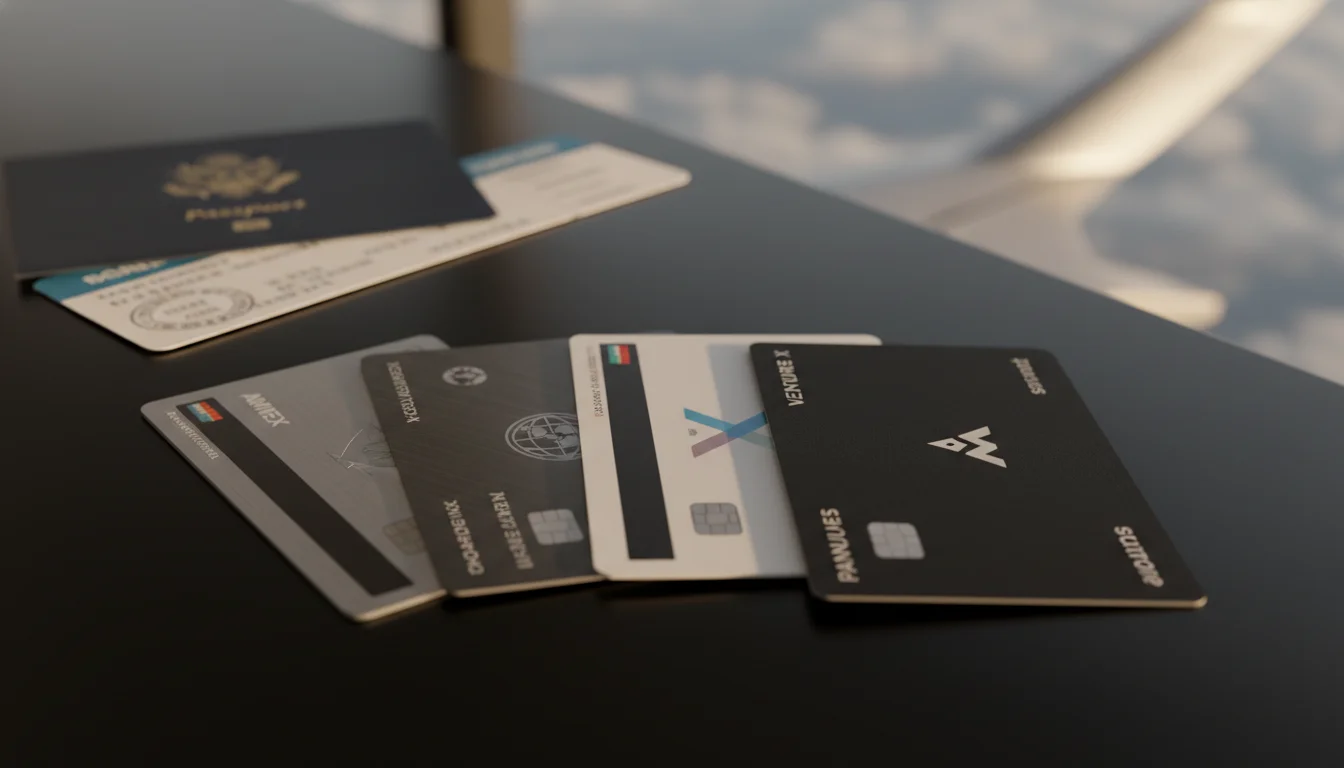
The Incumbent Giants: American Express and Chase
The Platinum Card® from American Express remains the industry standard for luxury travel perks, commanding a high $695 annual fee that is offset by an extensive, coupon-book style array of statement credits. The card’s value proposition relies heavily on the cardholder’s ability to organically utilize its specific benefits. The suite of credits includes a $600 Fine Hotels + Resorts credit, a $300 Digital Entertainment Credit (covering services like Disney+, a Disney Bundle, ESPN+, Hulu, the New York Times, Peacock, and the Wall Street Journal), a $155 Walmart+ credit, a $200 Airline fee credit, $200 in Uber Cash, a $100 Saks Fifth Avenue credit, a $120 Uber One credit, a $400 RESY credit, a $300 lululemon credit, a $209 CLEAR® Plus credit, a $200 Oura Ring credit, and a $100 credit for Global Entry or TSA PreCheck. For the affluent traveler, the true value of the Amex Platinum lies in its unparalleled airport lounge access, which includes proprietary Centurion Lounges, Priority Pass enrollment, and Delta Sky Club access when flying Delta on the same day. However, the Amex Platinum only earns 5x Membership Rewards points on flights and prepaid hotels booked through Amex Travel, meaning its everyday earning potential outside of these categories is a sub-optimal 1x point per dollar.
Conversely, the Chase Sapphire Reserve® positions itself as the optimal card for points valuation and flexible travel utility. Priced at a $550 annual fee, its primary advantage is the $300 annual travel credit, which is widely considered the most frictionless in the industry. Unlike the rigid, category-specific credits of the Amex Platinum, the Sapphire Reserve’s credit automatically applies to any travel-related purchase—including flights, hotels, transit, tolls, and campgrounds—without requiring portal bookings. Furthermore, it offers a guaranteed 1.5 cents per point redemption value through the Chase Travel portal, providing a stable floor for point valuations when award availability is scarce. The card also features exceptional travel insurance, offering primary rental car coverage and up to $100,000 in emergency medical evacuation.
The Capital One Venture X Value Proposition
Capital One disrupted the premium market with the Capital One Venture X Rewards Credit Card, which offers luxury perks at a more accessible $395 annual fee. The economic model of the Venture X is remarkably straightforward: it provides an annual $300 credit for bookings made through Capital One Travel, along with a 10,000-mile anniversary bonus. Valuing Capital One miles at a baseline of 1 cent each, the anniversary bonus is worth $100, which, combined with the $300 travel credit, mathematically offsets the entire annual fee before factoring in any additional perks. The card earns a flat 2x miles on all everyday purchases, making it an exceptional daily driver, while offering 5x miles on flights and 10x miles on hotels and rental cars booked through the Capital One portal. Additionally, cardholders gain access to Capital One Lounges, Capital One Landing locations, and participating Priority Pass lounges, establishing it as a highly practical choice for travelers who seek premium benefits without the requisite coupon-clipping associated with American Express.
The 2026 Market Disruptors: Bilt Palladium and Atmos Summit
The most significant structural shift in the 2026 landscape is the rollout of the Bilt 2.0 ecosystem and the Atmos Rewards program. These two products represent a strategic pivot toward integrating everyday mega-expenses (like housing) and unified airline loyalty into the credit card reward structure.
The Bilt Palladium Card, carrying a $495 annual fee, fundamentally alters everyday spending math by allowing cardholders to earn points on rent and mortgage payments without incurring standard processing fees. Issued by Column N.A. and serviced by Cardless, the Palladium Card elevates the Bilt portfolio into the ultra-premium tier. Beyond housing, it serves as a formidable everyday card by offering a flat 2x points on all non-housing purchases, effectively matching the Venture X while earning a more highly valued currency. To offset its fee, the Bilt Palladium provides a 50,000 Bilt Point welcome bonus, Bilt Gold status, and $300 in Bilt Cash upon approval. Annually, it issues $200 in Bilt Cash and a $400 Bilt Travel hotel credit (distributed as two $200 semiannual credits requiring a two-night minimum stay). It also grants Priority Pass lounge access, competing directly with the Capital One Venture X and Chase Sapphire Reserve in the global travel space.
Simultaneously, the Atmos™ Rewards Summit Visa Infinite® card emerges as the definitive premium airline co-branded card following the merger of Alaska and Hawaiian Airlines. Priced at $395, the card is packed with unprecedented travel benefits that blur the lines between co-branded and general premium cards. The card offers an initial two-part sign-up bonus of 80,000 Atmos Rewards points and a 25,000-point Global Companion Award after spending $4,000 within the first 90 days. Annually, cardholders receive the 25,000-point Global Companion Award with no spending requirement, and can unlock an additional 100,000-point Global Companion Award after spending $60,000 in a calendar year.
The Atmos Summit fundamentally redesigns airline lounge access and disruption management.
It awards eight Alaska Lounge passes and eight inflight Wi-Fi passes annually, distributed as two per quarter. It also features a groundbreaking $50 instant travel delay credit that automatically triggers after a two-hour flight delay or cancellation on an Alaska flight, providing a 48-hour voucher for airport dining. Furthermore, it shifts the paradigm of airline status acquisition by awarding 1 status point for every $2 spent on the card, capping off with a 10,000-point anniversary status boost. The earning rates are equally robust, offering 3x points on global dining, foreign purchases, and eligible Alaska/Hawaiian purchases, alongside a unique feature allowing cardholders to earn 3x points on rent payments for a standard 3% transaction fee, leveraging a partnership with Bilt.
Strategic Comparison of Premium Offerings
| Credit Card | Annual Fee | Primary Strengths | Notable Credits & Statement Allowances | Airport Lounge Access Networks |
|---|---|---|---|---|
| Amex Platinum Card | $695 | Luxury lifestyle integrations, broad transfer network | $600 FHR, $300 Digital Ent., $200 Uber Cash, $200 Airline Fee, $209 CLEAR Plus | Centurion, Priority Pass, Delta Sky Club |
| Chase Sapphire Reserve | $550 | Frictionless credits, premium travel insurance, 1.5c portal value | $300 flexible travel credit, TSA PreCheck/Global Entry credit | Priority Pass |
| Bilt Palladium Card | $495 | Flat 2x non-housing earning, rent/mortgage points, high-value currency | $400 Bilt Travel hotel credit, $200 Bilt Cash annually | Priority Pass |
| Capital One Venture X | $395 | Budget luxury, high ongoing ROI, flat 2x earning | $300 Capital One Travel credit, 10,000 anniversary miles | Capital One Lounges, Priority Pass |
| Atmos Summit Visa Infinite | $395 | Airline loyalty dominance, disruption compensation, status acceleration | 25k Global Companion Award, $50 instant delay credit, $12.50 partner fee waiver | 8 Alaska Lounge Passes annually |
Mid-Tier and No-Annual-Fee Earning Powerhouses
For consumers unwilling to assume the financial burden of ultra-premium annual fees, the mid-tier credit card market, typically characterized by annual fees ranging from $0 to $95, offers highly efficient point-earning vehicles. These cards rely less on lifestyle perks and more on aggressive category multipliers to drive long-term value.
The Standard Bearer: Chase Sapphire Preferred
The Chase Sapphire Preferred® Card remains the undisputed gold standard for introductory and mid-tier travel rewards. With a low $95 annual fee, it earns 5x points on travel booked through the Chase Travel portal, 3x points on dining (including eligible delivery services), and 2x points on general travel charges. Crucially, it provides a 10% anniversary points boost based on the total spend from the previous year, effectively increasing the baseline earning rate. The card also offers an annual $50 Chase Travel Hotel Credit and provides primary car rental coverage, an insurance benefit that is exceedingly rare at the sub-$100 price point. With a typical sign-up bonus of 75,000 Ultimate Rewards points, the Sapphire Preferred functions as the optimal gateway into the transferable points ecosystem.
The Culinary Optimizer: American Express Gold Card
American Express addresses the mid-tier market with the American Express® Gold Card, renowned globally as an earning powerhouse for food-centric consumers. Its high multipliers on global dining and U.S. supermarkets (4x points per dollar) make it one of the fastest vehicles for accumulating Membership Rewards points, seamlessly complementing the travel-focused perks of the Platinum Card. While its annual fee is higher than typical mid-tier cards, its ability to generate massive point reserves from mandatory household expenditures makes it a staple in any optimizer’s wallet. For business owners, the American Express Blue Business Card serves as a high-yield everyday companion, while the Business Gold Card optimizes road warrior spending.
The Bilt 2.0 Mid-Tier Expansion
In the Bilt 2.0 ecosystem, the Bilt Obsidian Card introduces a unique element of consumer choice at the $95 annual fee level. Issued by Column N.A., the Obsidian Card allows cardholders to select either dining or groceries to earn 3x points (with grocery spend capped at $25,000 annually), while earning 2x points on travel and 1x points on everyday purchases. This dynamic categorization permits consumers to tailor their primary earning vehicle to their specific domestic spending patterns. For absolute minimalists, the Bilt Blue Card provides a $0 annual fee gateway to earning points on rent, paired with a flat 1x earning rate on everyday purchases and a modest $100 Bilt Cash approval bonus.
Capital One and Citi Alternatives
For consumers preferring flat-rate simplicity without category tracking, the Capital One Venture Rewards Credit Card ($95 fee) generates 2x miles on every purchase, coupled with a TSA PreCheck or Global Entry statement credit. Capital One also offers the no-annual-fee VentureOne Rewards Credit Card, which earns a base rate of 1.25x miles per dollar and 5x miles on hotels and rental cars booked through the Capital One portal.
Citi contributes to this tier with the Citi Strata Premier® Card, recognized as an exceptional card for everyday spending. It provides robust multipliers across common household categories, feeding directly into the Citi ThankYou Points ecosystem, while the no-annual-fee Citi Strata℠ Card serves as an entry-level complement.
The Architecture of Transferable Currencies and Strategic Valuation
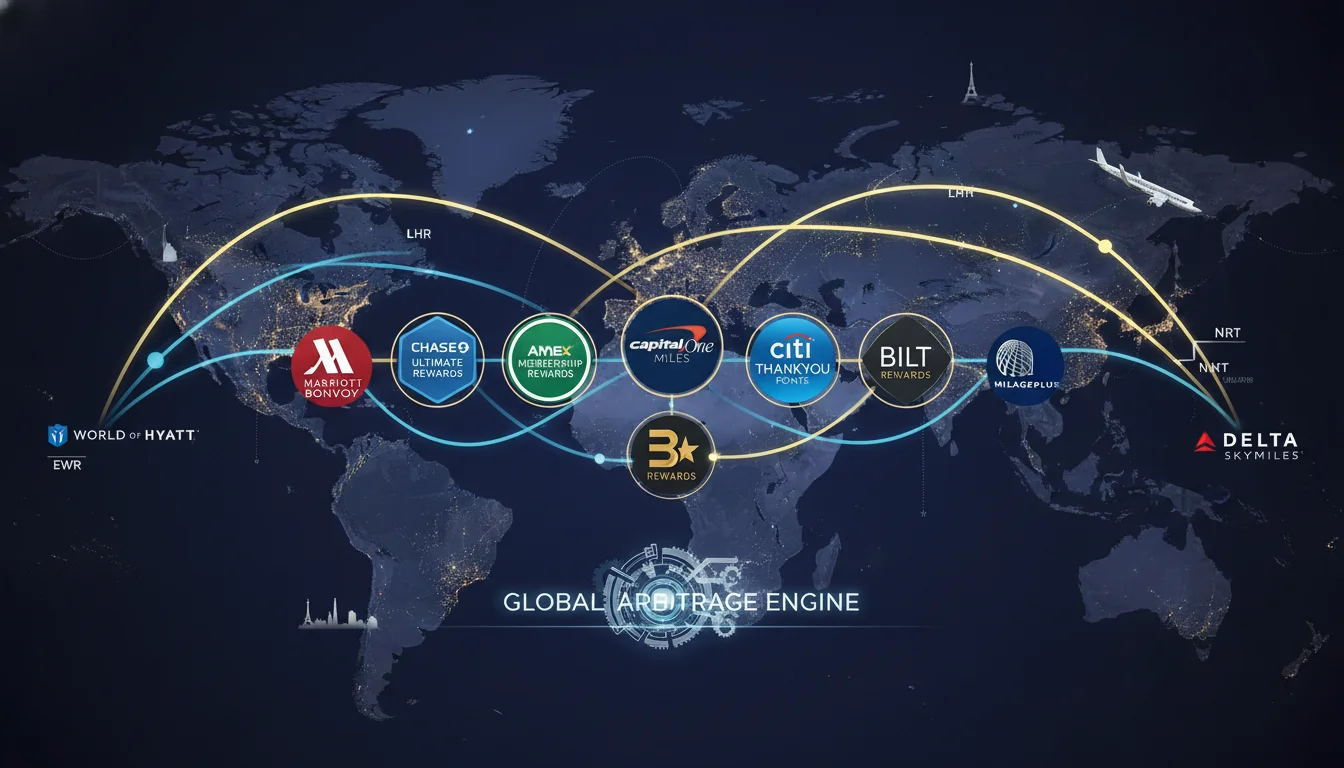
The foundational principle of travel reward optimization in 2026 is that points are inherently deflationary when left dormant in a bank portal, but highly elastic when transferred to airline and hotel loyalty programs. The ability to convert credit card points into frequent flyer miles at optimal ratios is the primary mechanism through which luxury travel becomes attainable. Bank currencies—specifically Chase Ultimate Rewards, Amex Membership Rewards, Capital One Miles, Citi ThankYou Points, and Bilt Rewards—act as clearinghouses, granting cardholders access to global airline alliances (Oneworld, Star Alliance, SkyTeam).
Chase Ultimate Rewards Transfer Mechanics
Chase Ultimate Rewards maintains its reputation as a highly liquid and valuable currency, largely due to its uniform 1:1 transfer ratio to 14 partners and the unparalleled strength of its exclusive relationship with World of Hyatt. Because Hyatt utilizes fixed award charts rather than pure dynamic pricing, point values frequently exceed 2.0 cents each when redeemed for luxury properties. Chase points typically transfer almost instantly or within one to two days depending on the partner.
Chase Airline Partners (1:1 Ratio)
| Airline Partner | Minimum Transfer | Transfer Time |
|---|---|---|
| Aer Lingus AerClub | 1,000 | Almost Instant |
| Air Canada Aeroplan | 1,000 | Almost Instant |
| Air France-KLM Flying Blue | 1,000 | Almost Instant |
| British Airways Executive Club | 1,000 | Almost Instant |
| Iberia Plus | 1,000 | Almost Instant |
| JetBlue TrueBlue | 1,000 | Almost Instant |
| Singapore Airlines KrisFlyer | 1,000 | 1-2 Days |
| Southwest Rapid Rewards | 1,000 | Almost Instant |
| United MileagePlus | 1,000 | Almost Instant |
| Virgin Atlantic Flying Club | 1,000 | Almost Instant |
Chase Hotel Partners (1:1 Ratio)
| Hotel Partner | Minimum Transfer | Transfer Time |
|---|---|---|
| IHG One Rewards | 1,000 | 1 Day |
| Marriott Bonvoy | 1,000 | 2 Days |
| World of Hyatt | 1,000 | Almost Instant |
American Express Membership Rewards Variances
American Express boasts the highest volume of airline transfer partners, making it exceptional for international first and business-class redemptions. However, the ecosystem demands careful navigation, as not all partners transfer at a 1:1 ratio. For instance, while transfers to Delta SkyMiles and Air Canada Aeroplan occur at a 1:1 ratio instantly, transfers to Emirates Skywards and Cathay Pacific Asia Miles may incur a 5:4 ratio for U.S. cardholders, introducing a 20% dilution of point value. Furthermore, Amex is widely considered sub-optimal for hotel transfers; converting points to Marriott Bonvoy or Hilton Honors usually results in poor cent-per-point yields, meaning cardholders should reserve their points exclusively for aviation partners. The best Amex transfer partners for maximum value generally include Air Canada Aeroplan, Air France KLM-Flying Blue, ANA Mileage Club, Avios programs, Delta SkyMiles, Singapore Airlines KrisFlyer, and Virgin Atlantic Flying Club.
Key Amex Airline Partners
| Airline Partner | Transfer Ratio (Amex > Partner) | Transfer Time | Minimum Transfer |
|---|---|---|---|
| Delta Air Lines SkyMiles | 1:1 | Almost Instant | 1,000 |
| Air Canada Aeroplan | 1:1 | Almost Instant | 1,000 |
| Air France-KLM Flying Blue | 1:1 | Almost Instant | 1,000 |
| British Airways Executive Club | 1:1 | Almost Instant | 1,000 |
| ANA Mileage Club | 1:1 | ~3 Days | 1,000 |
| Cathay Pacific Asia Miles | 5:4 (US Market) | Up to 1 Week | 1,000 |
| Emirates Skywards | 5:4 (US Market) | Almost Instant | 1,000 |
| Aeromexico Rewards | 1:1.6 | Variable | 1,000 |
| JetBlue TrueBlue | 250:200 (1:0.8) | Almost Instant | 250 |
Capital One Miles: The International Focus
Capital One has elevated its transfer network by standardizing the vast majority of its partners to a 1:1 ratio, pivoting heavily toward international carriers rather than domestic U.S.
airlines. Redemptions through Avianca LifeMiles and Air Canada Aeroplan allow for highly subsidized access to Star Alliance inventory without the burden of carrier-imposed fuel surcharges. For example, analysts value Avianca LifeMiles transfers at approximately 1.6 cents per point, while Virgin Red points frequently yield 1.4 cents per point. Notably, EVA Air transfers at a sub-optimal 2:1.5 ratio, and JetBlue TrueBlue at a 5:3 ratio, requiring strategic oversight when planning domestic trips.
Key Capital One Transfer Partners
| Transfer Ratio | Transfer Time | |
|---|---|---|
| Air Canada Aeroplan | 1:1 | Variable |
| Avianca LifeMiles | 1:1 | Variable |
| Air France-KLM Flying Blue | 1:1 | Almost Instant |
| British Airways Executive Club | 1:1 | Variable |
| Cathay Pacific Asia Miles | 1:1 | Variable |
| Emirates Skywards | 4:3 | Almost Instant |
| EVA Infinity MileageLands | 2:1.5 | Up to 36 hours |
| JetBlue TrueBlue | 5:3 | 2 to 5 days |
| Turkish Airlines Miles&Smiles | 1:1 | Up to 24 hours |
Citi ThankYou Points: Tier-Dependent Valuations
The utility of Citi ThankYou Points is highly contingent on the specific credit card held by the consumer. Premium cardholders (such as those holding the Citi Strata Premier, Citi Strata Elite, or the legacy Citi Prestige) enjoy a 1:1 transfer ratio to top-tier partners like American Airlines, Avianca LifeMiles, and Singapore KrisFlyer. However, entry-level cardholders (such as those holding the Citi Double Cash or Custom Cash) are penalized with sub-optimal ratios, frequently transferring at 1:0.7 for major airlines. The network excels in Oneworld and Star Alliance redemptions through programs like Qatar Airways Privilege Club and Turkish Airlines Miles&Smiles. For hotel transfers, Citi maintains a 1:2 ratio with Choice Privileges and a 1:4 ratio with Preferred Hotels & Resorts, creating distinct arbitrage opportunities not found in competing programs.
Key Citi Airline Partners
| Premium Ratio | Non-Premium Ratio | Transfer Time | |
|---|---|---|---|
| American Airlines AAdvantage | 1:1 | 1:0.7 | Instant |
| Avianca LifeMiles | 1:1 | 1:0.7 | Instant |
| Cathay Pacific Asia Miles | 1:1 | 1:0.7 | Instant |
| Emirates Skywards | 1:0.8 | 1:0.56 | Instant |
| JetBlue TrueBlue | 1:1 | 1:0.7 | Instant |
| Singapore Airlines KrisFlyer | 1:1 | 1:0.7 | ~1 Day |
| Turkish Airlines Miles&Smiles | 1:1 | 1:0.7 | 1-2 Days |
Bilt Rewards: The Arbitrage Engine
The Bilt Rewards program has rapidly aggregated an elite roster of transfer partners, distinguishing itself by bridging major domestic and international alliances. Bilt is the only major transferable currency to feature simultaneous 1:1 transfer partnerships with Alaska Airlines (Atmos Rewards), American Airlines, United MileagePlus, and World of Hyatt. Most airline transfers require a minimum of 2,000 points and occur almost instantly. Furthermore, Bilt frequently leverages its recurring “Rent Day” promotions to offer transfer bonuses—sometimes up to 200% for Hilton Honors or 75% for Southwest Rapid Rewards—available exclusively to members holding elite status within the Bilt ecosystem. This dynamic creates unparalleled arbitrage opportunities for engaged cardholders willing to time their redemptions strategically.
Key Bilt Transfer Partners
| Transfer Ratio | Minimum Transfer | Transfer Time | |
|---|---|---|---|
| Alaska Airlines Atmos Rewards | 1:1 | 2,000 | Instant to 48h |
| American Airlines AAdvantage | 1:1 | 2,000 | Instant |
| United Airlines MileagePlus | 1:1 | 2,000 | Almost Instant |
| Air France-KLM Flying Blue | 1:1 | 2,000 | Instant to 48h |
| World of Hyatt | 1:1 | 2,000 | Almost Instant |
| Marriott Bonvoy | 1:1 (Plus 5k bonus per 20k) | 2,000 | Almost Instant |
Overcoming Capacity Controls and Blackout Dates
A pervasive misconception in the travel rewards ecosystem is the absolute elimination of blackout dates. While major U.S. carriers (American, Delta, United, Alaska, Southwest, and Hawaiian) prominently advertise policies of “no blackout dates,” this marketing language obscures the modern reality of capacity controls and algorithmic dynamic pricing.
Dynamic Pricing vs. Fixed Award Charts
In 2026, loyalty programs increasingly utilize dynamic pricing algorithms, wherein the cost of an award ticket correlates directly with the cash price of the seat or anticipated flight load. Consequently, while a consumer can technically redeem miles for a flight during peak holiday seasons (satisfying the “no blackout dates” claim), the functional reality is dictated by exorbitant point requirements. An airline may withhold “saver” level inventory—the lowest priced, strictly capped award seats—during peak demand periods, rendering redemptions mathematically unviable despite nominal availability.
To combat capacity controls, financial analysts recommend accumulating flexible, transferable points rather than highly localized co-branded airline miles. If United Airlines prices a domestic flight at an irrational 80,000 miles due to dynamic pricing algorithms, a Chase Sapphire Reserve cardholder can pivot, utilizing their points at a fixed 1.5 cents each through the Chase Travel portal to purchase the same seat outright. This dual-strategy ensures that consumers are protected against sudden airline devaluations while retaining the optionality to exploit outsized value when saver award space is published. Using travel portals with fixed valuations allows travelers to bypass the airline’s capacity control constraints entirely.
Navigating Credit Expiration and Transferability
Beyond points, the statement credits attached to premium cards and airline vouchers face increasing friction through strict administrative policies. The distinction between “book-by” and “travel-by” deadlines significantly complicates redemptions. Many airline credits require the traveler to actively commence travel before the expiration date, rather than simply securing a reservation. This forces premature bookings and complicates round-trip travel planning.
Furthermore, airline credits are increasingly non-transferable and strictly name-matched, preventing users from applying unused flight credits to family members or companions. Airlines validate these credits by confirming the original ticket holder’s identity, where even minor discrepancies (such as a missing middle name or suffix) trigger manual reviews and denial of usage. Credits also frequently inherit the restrictions of the original fare class; if the credit originated from a basic economy ticket, the subsequent booking will bear similar punitive limits. Consequently, credit cards offering generalized, automated statement credits—such as the Chase Sapphire Reserve’s automatic $300 travel credit—carry a premium valuation due to their inherent flexibility, ease of transferability among household members, and lack of expiration friction.
The Economics of Luxury Hotel Co-Branded Cards
While transferable points are the ideal currency for aviation, co-branded hotel credit cards offer massive utility by bypassing the organic stay requirements for elite status. The strategic application of these cards hinges on evaluating the annual fee against the tangible monetary value of automatic status, free night certificates, and recurring statement credits. For frequent travelers, holding these cards provides a disproportionate return on investment relative to organic loyalty accumulation.
The Marriott Bonvoy Portfolio
The Marriott Bonvoy credit card ecosystem spans multiple tiers, from the entry-level Boundless card to the ultra-premium Brilliant card. The Marriott Bonvoy Boundless® Credit Card serves as the premier mid-tier option, often featuring generous sign-up bonuses like five Free Night Awards (valued up to 50,000 points each) after meeting initial spend requirements. It awards an annual Free Night Award (valued up to 35,000 points) and provides Silver Elite status, with the ability to earn up to $100 in statement credits for eligible airline purchases annually.
The Hilton Honors Portfolio
For the true loyalist, the Marriott Bonvoy Brilliant® American Express® Card ($650 annual fee) is designed to dominate the luxury segment. The primary value proposition is the immediate granting of Platinum Elite status, which organically requires 50 nights of stays. Platinum Elite yields tangible benefits such as free breakfast at select brands, executive lounge access, and suite upgrades. To offset the high holding cost, the card provides an 85,000-point free night award on every account anniversary, applicable to top-tier properties like the St. Regis or Ritz-Carlton. Additionally, it issues $300 in annual dining credits, conveniently structured as up to $25 per month at restaurants worldwide, making the credit remarkably easy to liquidate. For heavy spenders, accumulating $60,000 in annual purchases unlocks an additional Choice Benefit, and the card deposits 25 elite night credits into the user’s account annually, dramatically shortening the path to Titanium Elite status. The card offers an exceptionally high earning potential of 6x points at Marriott properties, yielding an effective 5.4 cents per dollar return when factoring in the value of Marriott points.
The Hilton Honors ecosystem directly rivals Marriott through aggressive status matching and high-yield multipliers. The Hilton Honors American Express Surpass® Card ($150 annual fee) provides automatic Gold status—which guarantees free breakfast or a food and beverage credit—and earns elevated rewards on everyday purchases at U.S.
restaurants, supermarkets, and gas stations.
At the apex of the portfolio sits the Hilton Honors American Express Aspire Card ($550 annual fee), which remains a formidable competitor by offering the highest level of organic status available via a credit card: Hilton Honors Diamond Status. Diamond status unlocks executive lounge access, premium room upgrades, and accelerated base point multipliers. The Aspire card offsets its fee through multiple avenues, notably an up-to-$400 annual Hilton Resort statement credit (allotted as up to $200 bi-annually). It functions as a powerful earning vehicle, yielding 14x points on eligible Hilton property spend. When accounting for the base points earned by Diamond members, the total return on property spend can reach an astonishing 8.4 cents per dollar, making it a mathematically superior card for direct hotel spend compared to Marriott’s offerings.
Other notable hotel cards include the IHG One Rewards Premier Credit Card and The World of Hyatt Credit Card, which provide Platinum Elite and Elite Discoverist status respectively. Hyatt’s offering remains particularly valuable due to the high intrinsic value of World of Hyatt points, often valued at 1.7 cents per point or higher.
Actuarial Value: Travel Protections, Insurance, and Disruption Compensation
Beyond points generation and lounge access, the underlying actuarial value of travel credit cards lies in their complimentary travel insurance policies. These protections act as financial risk mitigation against lost baggage, medical emergencies, and severe logistical disruptions. However, the exact phrasing of the policies exhibits immense variance across issuers, requiring careful scrutiny.
Auto Rental Collision Damage Waiver (CDW)
The distinction between primary and secondary rental car insurance is paramount for road warriors.
- Primary Coverage (Chase Sapphire Reserve & Atmos Summit Visa Infinite): Both cards offer primary rental car coverage. This dictates that in the event of theft or collision, the credit card’s insurance policy covers the damages directly, shielding the cardholder from filing a claim with their personal auto insurance and facing subsequent premium hikes. The Atmos Summit covers vehicles with an MSRP up to $75,000 for up to 15 consecutive days domestically and 31 days internationally. The Chase Sapphire Reserve covers rentals up to $75,000 broadly without restrictive country exclusions.
- Secondary Coverage (Amex Platinum Card): The Amex Platinum standard coverage is secondary, meaning it only pays out after the cardholder’s primary personal auto insurance has been completely exhausted, exposing the cardholder to potential rate increases.
Trip Delay and Interruption Compensation
Trip delay insurance reimburses consumers for necessary, unplanned expenses (such as hotels, meals, and toiletries) incurred during unexpected airline delays. The stipulations for activating this coverage vary widely.
- The Chase Sapphire Reserve sets the industry benchmark by activating its $500 maximum trip delay reimbursement after merely a 6-hour delay or an overnight stay requirement. It reimburses up to $10,000 per traveler (or $20,000 per trip) for severe trip cancellations and interruptions. Crucially, Chase covers delays on one-way flights, whereas the Amex Platinum explicitly requires a round-trip itinerary to trigger its travel protection benefits. Furthermore, Chase requires only a portion of the travel expense (such as taxes on an award ticket) to be charged to the card, whereas Amex typically requires the entire common carrier fare to be charged.
- The Atmos Summit Visa Infinite introduces a revolutionary, automated approach to minor delays: the $50 instant travel delay credit. If a primary cardmember experiences a departure delay of two or more hours or a cancellation on an Alaska flight, a $50 voucher is instantly issued via the app, valid for 48 hours to be used on airport merchants. For longer delays (six hours or overnight), the card mirrors the industry standard, providing up to $500 in delay coverage and $3,000 in lost luggage reimbursement ($2,000 for New York residents).
Emergency Medical Evacuation
International medical crises represent the highest potential financial liability for travelers. The Chase Sapphire Reserve provides up to $100,000 in emergency medical and dental coverage, a critical safety net that functions even when the cardholder is far from their home country. The Atmos Summit Visa Infinite matches this with up to $100,000 in emergency evacuation and transportation coverage. Conversely, while the Amex Platinum provides highly rated premium global assist and evacuation coordination, it does not include standard emergency medical or dental treatment coverage out-of-the-box, leaving travelers personally liable for exorbitant hospital bills incurred prior to the evacuation.
International Financial Mobility: Micro-Studies of the UK and Nepal
The theoretical benefits of premium credit cards must withstand the friction of real-world application, particularly across diverse international banking infrastructures. Analyzing the use of travel credit cards in the United Kingdom and developing tourism hubs like Kathmandu, Nepal, provides a profound case study on global financial mobility.
Zero Foreign Transaction Fees and European Optimization
When traveling internationally, the utilization of credit cards that impose foreign transaction fees (typically 3%) mathematically destroys the value of any points earned. In 2026, all competitive travel cards—including the Chase Sapphire Reserve, Amex Platinum, Capital One Venture X, and the Bilt Palladium—waive foreign transaction fees entirely. Furthermore, cards like the Atmos Summit specifically incentivize global mobility by offering 3x points on all foreign purchases.
In European markets such as the United Kingdom, travelers must navigate the nuances of dynamic currency conversion and localized banking challengers. British consumers frequently rely on specialized zero-fee debit and credit options like Starling, Monzo, Chase UK, and First Direct to avoid exchange markups. Challenger banks like Kroo and Virgin Money offer highly competitive Visa and Mastercard FX rates. When traveling through Europe, utilizing services like Revolut and Wise remains highly relevant for circumventing dynamic currency conversion screens at ATMs, ensuring the transaction is processed in the local currency rather than an inflated conversion rate. Travelers holding premium cards like the Lloyds Ultra Credit Card or Halifax travel cards can achieve similar fee-free spending while accumulating localized rewards.
The Nepal Case Study: Infrastructure and Surcharges
In Kathmandu, the acceptance of electronic payments is bifurcated. Major three-to-five-star hotels, international travel agencies, and upscale dining establishments in tourist enclaves like Thamel, Lakeside Pokhara, and Durbar Marg readily accept credit cards.
However, payment network dominance dictates utility. Visa and Mastercard enjoy near-universal acceptance at capable point-of-sale (POS) terminals in Nepal. American Express faces significantly higher friction. Due to historically higher merchant interchange fees, many mid-tier Nepalese retailers and regional airlines explicitly refuse Amex, preferring the lower overhead of Visa or Mastercard. Consequently, an Amex Platinum cardholder must travel with a Visa or Mastercard backup (such as a Chase Sapphire or Capital One card) to ensure basic liquidity. A specific regional anomaly also affects Indian travelers: credit cards issued in India possess strict foreign exchange disclaimers prohibiting their use for forex transactions in Nepal and Bhutan. Indian citizens must rely on local currency transactions, utilizing ATM withdrawals rather than POS terminal payments.
Despite the modernization of Kathmandu’s financial sector, Nepal remains a heavily cash-dependent economy, particularly for travelers embarking on trekking routes in the Himalayas. In remote villages, lodge owners lack POS terminals and face severe exchange rate penalties when attempting to convert foreign currency. Even within the capital, utilizing a credit card at budget-to-mid-range establishments often incurs a massive penalty. Merchants frequently pass the cost of POS processing directly to the consumer, adding a 3.5% to 4% surcharge to the final bill, alongside standard VAT and “plus-plus” service charges. When faced with a 4% processing surcharge, the mathematical yield of earning 2x or 3x points on a premium card is completely negated, making cash transactions the economically superior choice.
Travelers must therefore rely on local ATMs to generate Nepalese Rupees (NPR). ATM withdrawal limits in Nepal are notoriously low, generally restricting distributions to 10,000 NPR per transaction, though select machines may permit up to 35,000 NPR. Because local banks levy flat fees per withdrawal, travelers are advised to maximize the withdrawal amount per transaction to dilute the fee ratio. Technical failures at ATMs are rampant, further reinforcing the necessity of carrying multiple debit and credit cards across different banking networks.
Airport Lounge Infrastructure: Tribhuvan International Airport (KTM)
The final touchpoint of the international travel experience is airport lounge access.
Kathmandu Tribhuvan International Airport (KTM) Lounge Access
At Kathmandu’s Tribhuvan International Airport (KTM), lounge infrastructure is limited but highly valuable given the terminal’s historical crowding and chaotic departure halls. Travelers holding premium credit cards equipped with Priority Pass enrollment—including the Amex Platinum, Chase Sapphire Reserve, Capital One Venture X, and Bilt Palladium—gain access to the Executive Lounge located in the International Terminal (situated after immigration and before the second security check, on the second floor). Operating daily from 6:00 AM to 11:00 PM, the lounge provides air conditioning, complimentary snacks, flight monitors, smoking rooms, and standard alcoholic beverages (beer, wine, and spirits). A secondary option, the Horizon Lounge by Soaltee, is also accessible via Priority Pass, operating from 6:00 AM to 1:00 AM and allowing children under five free entry.
However, travelers must remain cognizant of localized Priority Pass restrictions that degrade the premium experience. At the KTM Executive Lounge, essential business amenities such as Wi-Fi, internet terminals, telephone calls, and fax facilities are not complimentary and require an additional out-of-pocket fee, diverging from the standard all-inclusive model expected in Western airport lounges. Furthermore, cardmembers are strictly limited to a maximum of two guests, and access is perpetually subject to space constraints, highlighting the limitations of premium card perks in emerging market infrastructures.
Strategic Conclusion and Portfolio Construction
The pursuit of maximizing points for free flights and luxury hotels in 2026 requires transitioning from single-card reliance to a highly diversified, multi-card portfolio approach. The structural evolution of the industry necessitates viewing credit cards not merely as payment instruments, but as strategic keys to unlocking global mobility, mitigating travel risk, and executing financial arbitrage through complex transfer partner networks.
The foundation of any optimization strategy must be a card earning flexible currency with strong baseline multipliers. The Chase Sapphire Preferred or Bilt Palladium serve as ideal core earners, shielding the consumer from unexpected airline devaluations through broad transfer partnerships like World of Hyatt, United MileagePlus, and Alaska Atmos Rewards. The introduction of Bilt 2.0 further ensures that even non-traditional expenditures, such as rent and mortgages, contribute to the rewards ecosystem.
The decision to hold a $395 to $695 ultra-premium card—such as the Amex Platinum, Capital One Venture X, or Atmos Summit Visa Infinite—should be strictly mathematical. If the cardholder’s organic travel patterns naturally consume the recurring statement credits (e.g., airline fee credits, Uber cash, automated $300 travel credits) and utilize the specified lounge networks (Priority Pass, Centurion, or Alaska Lounges), the effective annual fee approaches zero. The Atmos Summit, in particular, represents a new frontier by directly linking card spend to elite airline status generation and offering instant financial compensation for flight delays.
For consistent luxury accommodation, attempting to earn 50 to 60 nights organically is an inefficient deployment of capital. Deploying the Marriott Bonvoy Brilliant or Hilton Honors Aspire to instantly secure top-tier Platinum or Diamond status provides immediate dividends via free breakfasts, executive lounge access, room upgrades, and annual free night certificates that consistently outpace the card’s annual fee.
Ultimately, the optimization of travel rewards in 2026 demands a hybrid approach: accumulating transferable bank points for flexible, high-value aviation redemptions; leveraging co-branded hotel cards for instantaneous elite status; and prioritizing cards with primary travel protections (such as the Chase Sapphire Reserve) to mitigate international operational risk. By synthesizing earning velocity, transfer partner arbitrage, and rigorous risk management, the modern traveler can systematically deconstruct the high costs of global exploration, converting routine domestic financial expenditure into aspirational international luxury.