Automated Newsroom Media Pipelines: Scaling Content with AI
The Architecture of Scale: Programmatic Multi-Modal Asset Generation in the Modern Newsroom

The Algorithmic Distribution Imperative and Newsroom Transformation
The modern digital newsroom operates within a fundamentally disrupted distribution ecosystem. The traditional reliance on search engine optimization and social media referral traffic has been irrevocably altered by the proliferation of generative artificial intelligence interfaces and algorithmic feed structures. Major technology platforms are increasingly prioritizing native, zero-click retention models, generating story-like answers to user queries through large language models that eliminate the need for audiences to visit publisher websites. Concurrently, consumer attention has migrated decisively toward short-form, vertical video platforms, necessitating a complete reevaluation of how journalistic content is packaged, distributed, and monetized. To remain relevant and financially viable, news organizations must execute a high-volume, multi-platform distribution strategy that requires an unprecedented quantity of customized visual and auditory assets.
This operational reality renders manual, traditional post-production workflows obsolete. A modern newsroom cannot rely solely on text; a single investigative report, press conference, or breaking news update must be instantly fractionated into a matrix of platform-specific assets. This includes 9:16 vertical videos for TikTok and Instagram Reels, 1:1 social cards for LinkedIn, dynamically generated data infographics for X (formerly Twitter), and localized video iterations for distributed franchise or regional networks. Relying on human editors operating non-linear editing (NLE) software to manually stitch, resize, and render these variations creates an insurmountable production bottleneck. The economic and temporal constraints of modern publishing dictate that if content generation does not scale programmatically, it cannot scale at all.
Consequently, media conglomerates and agile digital publishers are transitioning toward automated, multi-modal asset generation pipelines. By integrating advanced machine learning models for script and storyboard drafting, neural text-to-speech (TTS) engines for voiceovers, and headless programmatic rendering environments for video and image assembly, publishers can generate hundreds of high-fidelity, brand-compliant assets in the time it previously took to export a single video. Organizations such as Reuters, The Associated Press, and Axel Springer have documented how automation increases reporting speed and expands total coverage volume, utilizing tools to automate earnings reports, generate bespoke graphics, and even deploy synthetic AI news anchors. This transformation represents a fundamental shift in editorial strategy, prioritizing continuous, algorithmic audience engagement driven by code-defined visual logic and robust application programming interfaces (APIs).
The Three-Layer Video Production Pipeline
Early attempts at artificial intelligence video generation relied on a naive, single-step methodology where users provided a text prompt directly to a diffusion model. In professional media environments, this prompt-only generation loop proved economically and practically unviable. Text is an inherently imprecise specification for camera direction, lighting, composition, and character continuity. Because every failed generation attempt costs the same as a successful one, the trial-and-error approach leads to massive cost overruns and unpredictable production schedules.
To optimize the cost-per-finished-video and guarantee visual consistency at scale, advanced production teams have converged on a strict three-layer architectural stack: the Storyboard Layer, the Generation Model Layer, and the Orchestration Layer.
The Storyboard and Image Generation Layer
The primary function of the storyboard layer is to resolve visual ambiguity upstream before committing a computational budget to expensive video generation models. Instead of prompting a video model directly, the pipeline utilizes highly efficient, low-cost image generation APIs to produce static frames. These frames lock down critical visual metadata, including the color palette, subject positioning, depth of field, and environmental lighting.
By separating the visual conceptualization from the temporal motion generation, newsrooms achieve deterministic control over the output. When the static frame is subsequently fed into a video generation model, it acts as a non-negotiable reference constraint. The video model is thereby relegated to the tasks it handles best: interpolating motion, calculating camera paths, and simulating temporal physics. The economic impact of this architectural split is profound. Industry benchmarks indicate that blind, prompt-only generation of ten-second clips requires an average of five retries, resulting in an effective cost of $5.00 per usable clip. Conversely, enforcing a storyboard-first pipeline increases the first-try success rate dramatically, reducing the effective cost to approximately $1.50 per usable clip using equivalent underlying models.

The Diffusion Transformer Generation Layer
The second layer consists of the core video generation models. The market for programmable video generation is dominated by several key frontier models, each possessing distinct operational characteristics that influence pipeline architecture.
| Model | Primary Input Modalities | Maximum Duration | Native Lip-Sync | Estimated Cost per 10s (1080p) |
|---|---|---|---|---|
| Seedance 2.0 | Text, Up to 9 Images, 3 Videos, Audio | 15 seconds | Yes (Parallel processing) | ~$0.60 |
| Kling 3.0 | Text, 1-2 Reference Images | 8-12 seconds | No | ~$0.50 |
| Sora 2 | Text, 1-2 Reference Images | 8-12 seconds | No | ~$1.00 |
| Veo 3.1 | Text, 1-2 Images, 1-2 Videos | 8-12 seconds | No | ~$2.50 |
The selection of the generation model is dictated by the specific requirements of the news asset. For cinematic, high-fidelity supplementary footage designed to accompany a voiceover, Google Veo 3.1 or Runway Gen-4 offer extensive creative control over camera motion and physical realism. However, for character-driven news explainers where a synthetic or cloned avatar must deliver information directly to the camera, highly multimodal models like Seedance 2.0 provide distinct advantages. By processing visual and auditory inputs through parallel branches, such models can achieve native lip-syncing across multiple languages without requiring a secondary, post-generation synchronization pass, thereby reducing both latency and pipeline complexity.
Other notable video generation APIs include Luma AI’s Dream Machine, which excels at spatial understanding and producing videos with consistent depth, perspective, and camera motion, making it ideal for architectural walkthroughs or product turntables. Pika offers an accessible entry point with rapid response times, typically returning results in 30 to 60 seconds for four-second clips, and includes native support for lip-sync and sound effects.
The Orchestration and Continuity Layer
Because a standard news explainer or short-form social video typically runs between 60 and 180 seconds, the final asset must consist of multiple sequentially generated clips. Without explicit programmatic management, sequential generations inevitably suffer from visual drift. A character’s attire may change color, or the environmental lighting may shift between cuts, destroying narrative immersion and triggering what researchers classify as consistency errors.
The orchestration layer operates as an automated agent that enforces constraints across the generation queue. It systematically manages reference images, utilizing the final frame of a preceding clip as the initialization frame for the subsequent generation, actively correcting against drift. Furthermore, the orchestrator handles parallelization. While a video generation API is asynchronously rendering the third scene, the orchestrator can simultaneously direct a large language model to refine the prompt for the fifth scene and instruct an image model to generate the storyboard for the sixth.
To manage this complex execution, engineering teams utilize visual node-based canvases or headless pipeline APIs. Platforms like Wireflow allow developers to connect text, image, and video models into reusable workflows, where each published workflow becomes a unique API endpoint triggerable via webhooks. Alternatively, Martini provides an infinite canvas that fans a single prompt across dozens of frontier image and video models simultaneously, skipping the need for local graphics processing unit (GPU) configurations.
Cloud-Native ComfyUI and Serverless Model Deployment
While commercial APIs provide rapid integration, media organizations requiring bespoke generative pipelines often deploy open-weight models using frameworks like ComfyUI. ComfyUI is a powerful, modular inference engine for diffusion models that utilizes a node-based architecture. By deploying ComfyUI in the cloud, developers can bypass consumer-facing graphical interfaces and execute complex multi-modal generations programmatically.
Deploying ComfyUI at scale requires sophisticated container orchestration to balance latency and computational costs. Cloud providers like SaladCloud allow developers to package ComfyUI workflows into Docker containers with customized base images. These deployments typically utilize a stateless REST API architecture, which is horizontally scalable and returns images or videos directly in HTTP responses or via asynchronous webhooks.
The architectural design of a ComfyUI endpoint depends heavily on the asset being generated. For image generation using models like Stable Diffusion 1.5, SDXL, or Flux, a Container Gateway approach is recommended.
This provides simple, synchronous HTTP responses but is restricted by hard timeout limits (typically 100 seconds), making it suitable for generations taking between 2 and 30 seconds. Conversely, video generation and long-running workflows necessitate a Job Queue architecture. This asynchronous pattern supports multi-minute generation tasks, implements automatic retries upon node interruption, and utilizes request buffering and autoscaling to handle burst traffic without encountering timeout constraints.
To optimize these serverless endpoints, developers implement warmup workflows within the Dockerfile. By configuring a reduced-step, low-resolution workflow to execute during container initialization, the system pre-loads the heavy tensor models into GPU memory before accepting external traffic, drastically reducing the cold-start latency for the first user request. Custom endpoints can also be configured using TypeScript or JavaScript to hide ComfyUI’s node-based complexity from downstream API consumers, providing input validation and sensible defaults for task-specific operations.
Programmatic Audio Synthesis and Neural Text-to-Speech
High-fidelity audio is critical to audience retention in automated media. The modern text-to-speech landscape has evolved far beyond robotic concatenation, leveraging advanced neural architectures to synthesize speech that includes micro-expressions, emotional prosody, and natural breathing patterns. For automated news pipelines, the TTS engine serves as the pacing mechanism for the entire video; the duration of the synthesized audio dictates the length of the visual assets and the timing of the subtitle overlays.
When selecting a TTS API for newsroom automation, architects must balance voice quality, latency, language support, and volumetric pricing.
| Provider | Key Strengths | Weaknesses | Estimated Cost per 1M Characters |
|---|---|---|---|
| ElevenLabs | Unmatched emotional realism, instant voice cloning, granular style controls, low-latency turbo model (~200ms TTFB). | Higher relative pricing, strict concurrency limits on conversational agents (30-agent cap). | ~$30.00 |
| OpenAI TTS | Seamless ecosystem integration, highly consistent, fast time-to-first-byte (TTFB), minimal configuration. | Limited to six predefined voices, no native voice cloning, minimal emotional control. | ~$15.00 |
| PlayHT | Advanced SSML controls, excellent voice cloning from minimal 30s samples, multiple voice engines. | API ergonomics are less refined, base voices slightly less natural than market leaders. | ~$20.00 |
| Inworld AI | Industry-leading real-time latency (<130ms), zero-shot cloning included, WebSocket streaming, on-premise deployment support. | Limited fully supported languages in production relative to legacy competitors. | Variable / Enterprise |
In practical implementation, the TTS API is integrated into the workflow immediately following script generation. An orchestration script transmits the LLM-generated text to the chosen provider, requesting a specific voice ID and defining parameters such as speaking rate. A speaking rate between 0.9 and 1.2 is generally optimal for short-form news content, striking a balance between energetic delivery and viewer comprehension. ElevenLabs’ models, such as eleven_multilingual_v2 and Flash v2.5, interpret emotional context directly from the text input; injecting descriptive text (e.g., “she said excitedly”) influences the output prosody natively without complex markup.
The resulting audio payload, returned as an MP3, PCM (S16LE), or Opus stream, must be accurately measured. Crucially, to support accessibility and algorithmic feed distribution, the audio must often be passed through an Automatic Speech Recognition (ASR) model, such as OpenAI’s Whisper, to generate word-level timestamped captions for subsequent video compositing. This dual pipeline—synthesis followed immediately by transcription—ensures that the programmatic renderer possesses precise millisecond markers to animate karaoke-style captions perfectly synchronized with the synthetic voice.
Dynamic Infographics and Programmatic Image Generation
While generative AI models excel at producing illustrative footage, they struggle with precise typography, complex data visualization, and strict brand compliance. For newsrooms, generating statistical charts, quotes, lower thirds, and social media carousels requires deterministic rendering engines where the output is guaranteed to align with brand guidelines. This is achieved through programmatic image generation APIs that separate the design layout from the underlying data payload.
API-Driven Template Engines
Platforms such as Canva, Pixelixe, Contentdrips, and Orshot provide infrastructure for parameterized visual generation. The workflow typically involves a design team creating a master template within a graphical user interface. Elements within the template—such as headline text, background images, numerical data points, and color variables—are flagged as dynamic parameters.
The Canva Connect API offers a highly robust environment for enterprise teams. Utilizing the Autofill feature, developers can integrate Canva’s rendering capabilities directly into proprietary content management systems. The integration process begins by authenticating via OAuth2 and ensuring the correct application scopes are configured, including design:content, brandtemplate:meta, and asset. All media utilized in the autofill process must be uploaded to the Canva asset library via a POST /asset-uploads request, utilizing a Base64-encoded filename inside the Asset-Upload-Metadata header. Once the asset returns a successful job status, the developer queries the brand template dataset to confirm the required data types, and then sends an asynchronous POST request to the /autofills endpoint. The payload maps specific strings or uploaded asset IDs to the designated fields within the brand template. The system returns a job ID that is polled until the customized design is generated and ready for programmatic export in various formats.
For organizations seeking alternatives without enterprise gating, APIs like Pixelixe’s Open Graph Image API, Contentdrips, and Orshot offer streamlined endpoints tailored for developers. Pixelixe allows developers to update specific properties via dot notation in the JSON payload (e.g., overriding headline.color, font-size, or author_avatar.image_url) without rebuilding the entire layout. Contentdrips excels at multi-slide carousel generation, allowing users to define intro slides, content slides, and ending slides independently within a single API call. Orshot allows developers to paste a public Canva share URL directly into its importer, automatically extracting layers and building a parameterized template that can be manipulated via REST endpoints, effectively circumventing Canva’s native API restrictions.
Code-Native Rendering and Data Visualizations
Alternatively, engineering-heavy teams may eschew visual editors entirely in favor of code-native definitions. Tools utilizing HTML and CSS rendering APIs allow developers to construct image layouts using standard web technologies, which are then rendered into static images via headless browsers like Puppeteer or Playwright. Frameworks like Satori (specifically for React and Vercel environments) generate images by converting JSX syntax directly into SVG representations. Furthermore, layer-based APIs like Iteration Layer allow developers to define images as a stack of typed layers in JSON, providing complete programmatic control over image composition with no graphical editor in the pipeline.
For complex data journalism, tools like Infogram and Venngage provide specialized charting APIs. These platforms allow editorial teams to push structured datasets via API, automatically generating interactive or static charts, graphs, and maps. This scalability is particularly beneficial for enterprise media producing a large volume of recurring reports, such as automated regional real estate insights or live election dashboards, ensuring brand consistency across hundreds of daily visual outputs. Systems like Ditto take this further for franchise and creator networks, ingesting a single approved template and thousands of rows of localized data to render highly personalized assets that adapt to conditional logic (e.g., hiding or displaying sponsor logos based on regional variables).
Code-Driven Video Assembly and Compositing
The culmination of the programmatic pipeline is the assembly phase, where generated voiceovers, AI video clips, dynamically rendered infographics, and timestamped subtitles are stitched together into a cohesive, publishable MP4 file. The industry relies on two primary paradigms for programmatic video assembly: higher-level, code-driven rendering engines (like Remotion and JSON-based APIs), and low-level processing frameworks (like FFmpeg).
React-Based Rendering: Remotion
For data-driven, highly animated content, developers increasingly utilize Remotion, a framework that allows engineers to construct genuine MP4 videos using React components. Remotion treats every frame of a video as a discrete React state. Animations are calculated as a function of the current frame, accessed via hooks like useCurrentFrame(), and values are mapped using interpolation functions (e.g., spring() for natural, physically modeled motion).
Because the entire video composition is defined in code, it integrates seamlessly with dynamic data payloads. A news application can pull live election results from an API, pass that data as properties to a Remotion component, and immediately render a broadcast-quality animated chart.
Every animation is a function of the timeline, meaning the entire video logic can be version-controlled in Git, reviewed in pull requests, and easily paired with LLM-generated scripts. An emerging alternative for artificial intelligence agents is HyperFrames, an open-source framework by HeyGen that turns plain HTML, CSS, and JavaScript into frame-accurate MP4s. Unlike Remotion, which relies on the React ecosystem, HyperFrames uses data attributes (data-start, data-duration) within standard HTML, operating on the premise that modern LLMs can write clean HTML more reliably than complex React animation architectures.
JSON-Driven Cloud Compositing APIs
For organizations that prefer managed infrastructure over writing rendering logic, cloud-native REST APIs like Creatomate, Shotstack, Json2Video, and Rendi provide powerful abstraction layers. These platforms allow developers to submit JSON payloads defining timelines, layer opacities, and transition timings, with the service handling the underlying compute.
| Provider | Core Methodology | Key Strengths | Limitations | Estimated Base Pricing |
|---|---|---|---|---|
| Shotstack | Cloud-based timeline API | Excellent scaling, multi-track timelines, advanced compositing, fast rendering. | Requires JSON template management. | $39/mo for 200 minutes |
| Creatomate | JSON & Template API | Native integrations with Zapier/Make, robust visual editor for non-developers. | Credit-based pricing climbs fast at volume. | $41/mo for ~1 hour (1080p) |
| Json2Video | Programmatic JSON | Dynamic output based on media input. | Poor UI, complicated documentation, length limitations. | $50/mo for 10 minutes (4K) |
| Rendi | Raw FFmpeg API | Full syntax and abilities of FFmpeg online, high scale. | Steep learning curve, no visual editor, potential vendor lock-in for storage. | $89/mo for ~75GB processing |
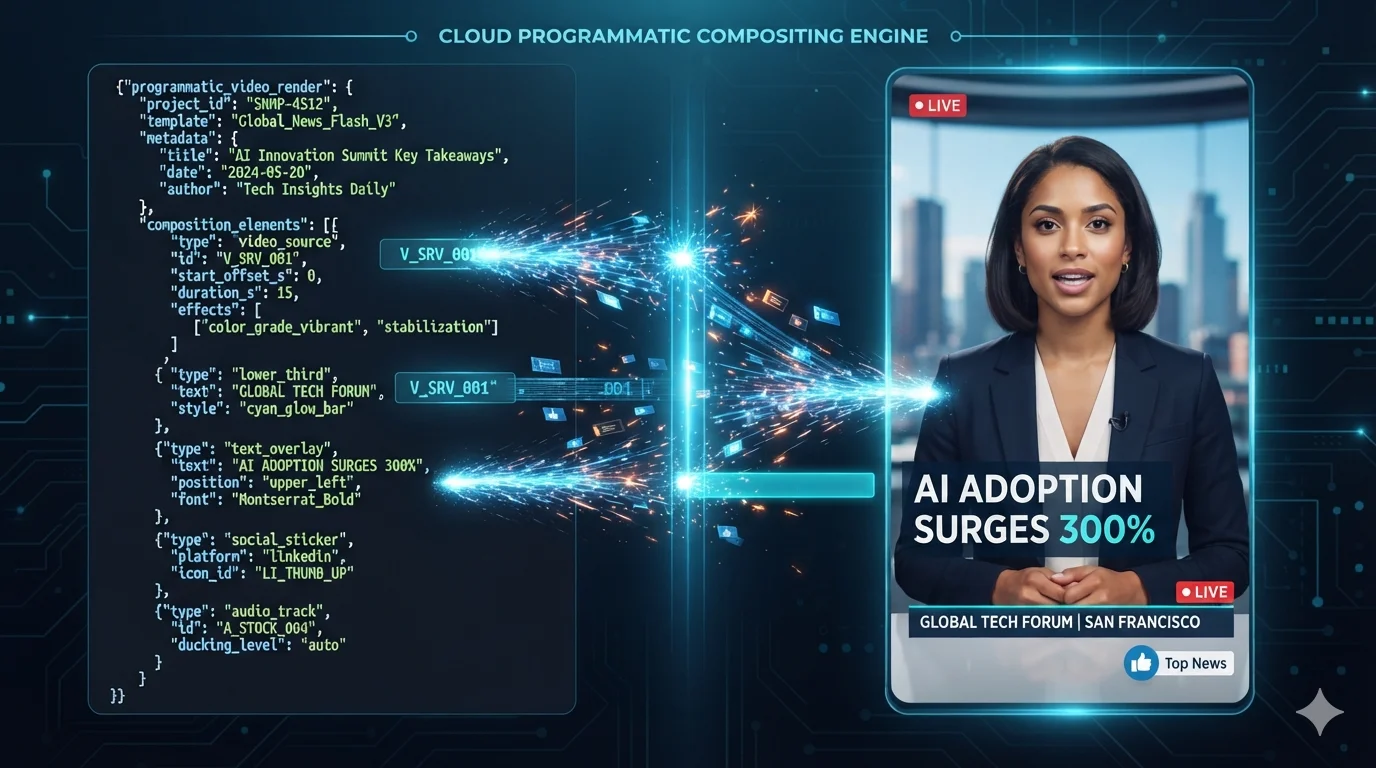
Shotstack, for example, provides a multi-track timeline where developers can layer video, audio, images, and text programmatically. By defining start times, durations, and transitions in JSON, the Shotstack rendering engine processes the video in the cloud with near real-time speeds, leveraging horizontal scaling to render thousands of videos simultaneously.
Low-Level Processing: FFmpeg and Hardware Acceleration
Beneath almost all video manipulation on the internet lies FFmpeg, the foundational open-source command-line tool. In a newsroom automation pipeline, FFmpeg is typically invoked as a subprocess by a primary orchestration script (often written in Python or Node.js) to perform precise compositing tasks that higher-level APIs abstract away. It is fundamentally built around libraries like libavformat (muxing/demuxing), libavcodec (encoding/decoding), and libavfilter (scaling, overlaying).
A critical application of FFmpeg in modern social media video is the “burning in” of hardcoded subtitles. Because a significant percentage of short-form video is consumed without audio, highly stylized, dynamic text overlays are essential for audience retention. Using the subtitles video filter, FFmpeg reads an SRT or ASS file and renders the text directly into the video pixels during the encoding process. The visual presentation can be extensively customized using the force_style parameter, allowing developers to inject Advanced Substation Alpha (ASS) override tags. For example, a command might define FontSize=24, PrimaryColour=&H00FFFFFF (white text), and BorderStyle=4 (to create an opaque background box for readability).
The complexity of FFmpeg commands scales with the sophistication of the output. Complex filtergraphs (invoked via -filter_complex) allow developers to manage multiple inputs and outputs simultaneously. When combining a static infographic slide with an audio track to create a video clip, developers must map the inputs correctly and instruct FFmpeg to loop the static image for the duration of the shortest input (the audio stream) using parameters like -loop 1, -tune stillimage, and -shortest.
Hardware Acceleration Architectures
Relying solely on central processing units (CPUs) for high-volume video transcoding is highly inefficient and creates severe processing bottlenecks. To achieve the throughput required by a global newsroom, FFmpeg must be compiled and configured to utilize hardware acceleration, offloading the computationally intensive encoding and decoding tasks to dedicated silicon blocks on graphics processing units (GPUs).
NVIDIA’s NVENC (encoding) and NVDEC (decoding) engines, available on Amazon EC2 instances such as the g4dn (featuring T4 GPUs) or p3 (featuring V100 GPUs), can process video streams orders of magnitude faster than CPU-only instances. To utilize this within the programmatic pipeline, developers pass specific hardware acceleration flags to FFmpeg, such as -hwaccel cuda and -hwaccel_output_format cuda. Furthermore, to optimize performance and prevent memory transfer bottlenecks between the system RAM and the GPU VRAM, operations like resizing or cropping must occur entirely within the GPU using filters like scale_cuda or scale_npp.
For environments utilizing Intel or AMD architecture, the Video Acceleration API (VA-API) provides equivalent hardware offloading. Dockerized deployments of FFmpeg with VA-API support allow developers to pass device nodes (e.g., –device=/dev/dri:/dev/dri) into the container, enabling near real-time encoding of H.264, HEVC, or AV1 streams using Intel Quick Sync or AMD Advanced Media Framework (AMF). This hardware-accelerated pipeline generally provides 3 to 5 times faster encoding compared to software-based processing, reducing power consumption and operational costs.
While FFmpeg is peerless for file-based processing, broadcast pipelines often integrate GStreamer for real-time operations. While FFmpeg utilizes a filter graph and command-line execution, GStreamer operates as a pipeline of distinct elements (e.g., rtspsrc, x264enc) connected via pads that negotiate capabilities. For live news ingestion, GStreamer’s robust state machine and API provide finer control over dynamic topology changes compared to FFmpeg’s isolated process execution.
Distributed Rendering, Concurrency, and Scale
The true capability of a programmatic pipeline is defined by its ability to scale horizontally during periods of high demand, such as election nights, major sporting events, or global crises. Rendering high-definition video sequentially on a single machine introduces unacceptable latency into the news cycle.
The solution is distributed cloud rendering, heavily utilized by frameworks like Remotion when deployed to serverless environments such as AWS Lambda. When a render request is initiated, rather than processing the video sequentially, the system partitions the video timeline into granular chunks. The architecture then invokes dozens or hundreds of parallel AWS Lambda functions simultaneously. Each ephemeral Lambda instance renders only a fraction of the total video (e.g., a two-second segment). Once all parallel functions complete their respective renders, a master Lambda function concatenates the chunks into the final MP4 file and deposits it into an Amazon S3 bucket.
Managing AWS Lambda Constraints and Economics
Architecting for AWS Lambda distributed rendering requires precise management of cloud infrastructure quotas and economic variables. AWS enforces a default global concurrency limit of 1,000 simultaneous Lambda executions per region per account. If a newsroom attempts to render multiple videos simultaneously and exceeds this pool, subsequent requests will be throttled (returning HTTP 429 errors), catastrophically failing the pipeline.
To mitigate this, infrastructure teams must manage concurrency allocation. Organizations can configure reserved concurrency for specific functions to guarantee availability, though this subtracts from the overall public pool. Remotion natively calculates the required number of Lambda instances based on the video’s total frame count and a designated framesPerLambda parameter. The system utilizes an interpolation function to determine this value dynamically, ensuring that shorter videos do not spawn an excessive number of functions (which incurs unnecessary cold-start latency) while guaranteeing that longer videos scale out sufficiently to minimize total render time. The minimum boundary is strictly enforced at 20 frames per Lambda, and maximum concurrency per render is generally capped at 200 functions to avoid diminishing returns.
From an economic perspective, serverless distributed rendering converts capital expenditure (maintaining idle render farms) into variable operational expenditure. Costs are calculated based on the memory allocated, execution duration, and data transfer. To optimize costs, engineers can reduce memory footprints, pre-compute data before invoking the Lambda functions, and avoid rendering videos within videos, which dramatically spikes processing time.
Orchestrating the Modern Newsroom Workflow
The synthesis of these diverse APIs and frameworks enables a highly automated, scalable distribution workflow. Advanced pipelines are increasingly orchestrated through visual automation platforms like n8n, which act as the central nervous system for the newsroom. A typical n8n multi-modal pipeline begins with a trigger (such as a Google Sheet update or a Telegram message). The orchestrator queries an LLM to generate a script and image prompts, invokes ElevenLabs to synthesize the voiceover, passes the text to ComfyUI or Kling AI for video generation, merges the assets via Json2Video or Creatomate, and finally utilizes Blotato or SocialFlow to distribute the finished video across nine different social platforms simultaneously.
To scale this specifically for newsroom clipping, operational playbooks rely on a six-step methodology:
1.
- Automated Ingestion and Transcription: All raw footage is immediately ingested into a central library. Audio tracks are extracted via FFmpeg and transcribed by ASR models, producing searchable text and word-level timestamps.
- AI-Driven Moment Identification: Natural language processing algorithms analyze transcripts, audio peaks, and engagement models to identify high-information-density moments, generating a ranked shortlist of potential clips.
- Editorial Review: A human editor applies subjective news judgment to verify contextual accuracy, adjusting trim points and granting final approval, reducing review time to mere minutes.
- Programmatic Formatting: The rendering pipeline dynamically reframes 16:9 source footage into 9:16 vertical formats, burning in stylized subtitles and injecting graphic overlays tailored to specific platform requirements.
- Scheduled Distribution: Automated layers schedule the content based on platform-specific audience behavior signals, pushing assets during predicted peak engagement windows.
- Performance Analytics: Continuous metric data is fed back into the AI moment identification model, creating a self-optimizing loop that improves future clip selection accuracy.
Institutional Impact and the Future of Journalism
The deployment of automated multi-modal generation pipelines precipitates significant structural changes within media organizations. By abstracting the manual labor of resizing, transcription, and basic compositing, journalists and producers can reallocate their cognitive resources toward complex investigative reporting, source cultivation, and strategic editorial planning.
The adoption curve is accelerating rapidly. The Associated Press has utilized AI to automate the writing of earnings reports, producing thousands of articles annually with minimal human intervention. Axel Springer has established a Global Generative AI Team to identify disruptive use cases and manage strategic partnerships with AI-driven technology companies, launching tools like the ‘Hey_’ assistant to directly augment editorial workflows. Furthermore, news agencies like China’s Xinhua and India Today have deployed AI-powered virtual news anchors, utilizing deep learning and TTS to present multi-lingual broadcasts continuously without human fatigue. Organizations such as Logically AI have utilized machine learning to process massive volumes of video and text to perform real-time fact-checking during elections, detecting deepfakes and flagging misleading claims at a scale impossible for human monitors.
However, the transition is fraught with ethical and operational friction. The reliance on algorithmic systems introduces concerns regarding the hallucination of facts, the perpetuation of underlying data biases, and the displacement of entry-level technical roles. Evaluating the quality of AI-generated media is increasingly critical. The emerging field of AI-Generated Video Evaluation (AIGVE) classifies failures into distinct categories: technical errors (compression artifacts), dynamic errors (lack of meaningful motion), physical errors (violations of gravity or collision mechanics), consistency errors (unexplained structural changes across frames), and alignment errors (failure to follow the prompt’s instructions).
Because algorithms do not possess inherent journalistic ethics, they cannot replace the necessity of human oversight. The automation of the newsroom is not a replacement for traditional reporting; rather, it is the industrialization of the distribution mechanism. By architecting scalable, code-driven media pipelines that integrate advanced LLMs, rapid text-to-speech, and hardware-accelerated rendering, media organizations ensure that high-quality, deeply investigated journalism can successfully permeate the fragmented, algorithmically driven feeds that define the modern informational ecosystem.