AI Agents & Web Design: Google Stitch & Antigravity
The Architecture of Autonomous Web Generation: Antigravity, Stitch, and the Model Context Protocol
The Evolution of Agentic Software Orchestration
The transition from intelligent code completion to fully autonomous software engineering marks the most significant paradigm shift in development methodologies since the advent of version control. By early 2026, the artificial intelligence landscape has moved decisively beyond chatbot-assisted programming, entering an era of multi-agent orchestration. At the vanguard of this movement is the seamless integration between Google Stitch, an AI-native UI/UX design canvas powered by the Gemini 2.5 Pro generation engine, and Google Antigravity, an agent-first Integrated Development Environment (IDE) driven by the frontier capabilities of the Gemini 3 model family.
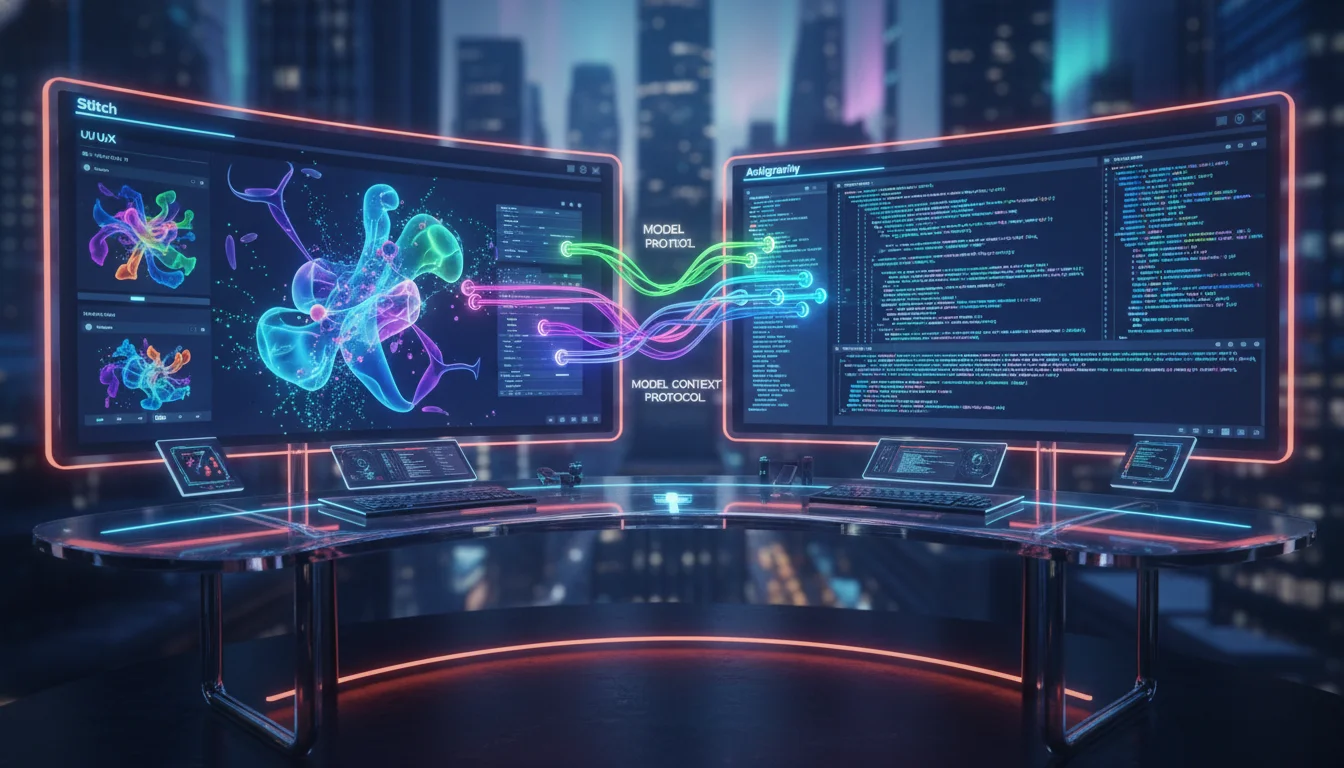
The connective tissue binding these two distinct platforms is the Model Context Protocol (MCP), an open standard that allows local AI agents to securely query external tools, databases, and design services in real-time. Historically, developers seeking to utilize generative AI were forced to engage in highly manual “vibe coding,” constantly exporting design tokens from tools like Figma and pasting them into the context windows of coding assistants. This disjointed workflow inevitably led to severe context drift; the underlying Large Language Models (LLMs) would routinely hallucinate padding parameters, mismatch color hex codes, and generate disparate user interfaces across multiple screens.
The synthesis of Stitch and Antigravity via MCP fundamentally resolves this fragmentation. It transforms visual design into programmable infrastructure. A user can now verbally articulate a software concept to Stitch, which synthesizes the intent into a mathematically rigid artifact known as “Design DNA”. Subsequently, specialized AI personas operating within the Antigravity IDE—acting as product managers, system architects, frontend developers, and quality assurance engineers—autonomously fetch this DNA, scaffold the repository, execute terminal commands, and deploy a production-ready application to cloud infrastructure.
This comprehensive analysis systematically deconstructs the architectural mechanics of this ecosystem. It evaluates the generative capabilities of the Stitch engine, the data routing efficiency of the Model Context Protocol, the strict governance hierarchies governing Antigravity’s multi-agent Mission Control, and the broader economic implications for the software engineering sector when benchmarked against competing 2026 methodologies such as Claude Code, Cursor, and v0.dev.
Google Stitch: Redefining the Generative Design Canvas
Google Stitch operates on a fundamentally different premise than traditional vector-based UI platforms. Rather than providing a blank canvas requiring manual manipulation of geometric primitives, Stitch is designed as a collaborative, generative partnership where the software translates semantic intent into high-fidelity, interactive prototypes.
The Modalities of Interaction and Vibe Design
The Stitch interface accommodates multiple input modalities, recognizing that creative intent is rarely confined to text. Users can upload raw whiteboard sketches, issue continuous voice commands, or provide traditional text prompts. The integration of a “Voice Picker” allows developers and designers to engage in a dynamic dialogue with the system. For instance, a user can vocally request the agent to “generate three distinct navigation menu options” or “re-render this dashboard utilizing an oceanic color palette”. The AI acts as an interactive sounding board, providing real-time critique and uncovering optimal layouts through iterative conversation.
Crucially, Stitch is not limited to generating static images. The platform features an integrated “Play” button that allows users to instantly experience the generated user journey. When a user prompts the system to create a multi-step checkout process, Stitch automatically maps out the logical progression of screens, stitching them together to form a navigable, interactive prototype. This rapid feedback loop allows stakeholders to validate complex application flows in minutes rather than weeks.
The Architecture of DESIGN.md
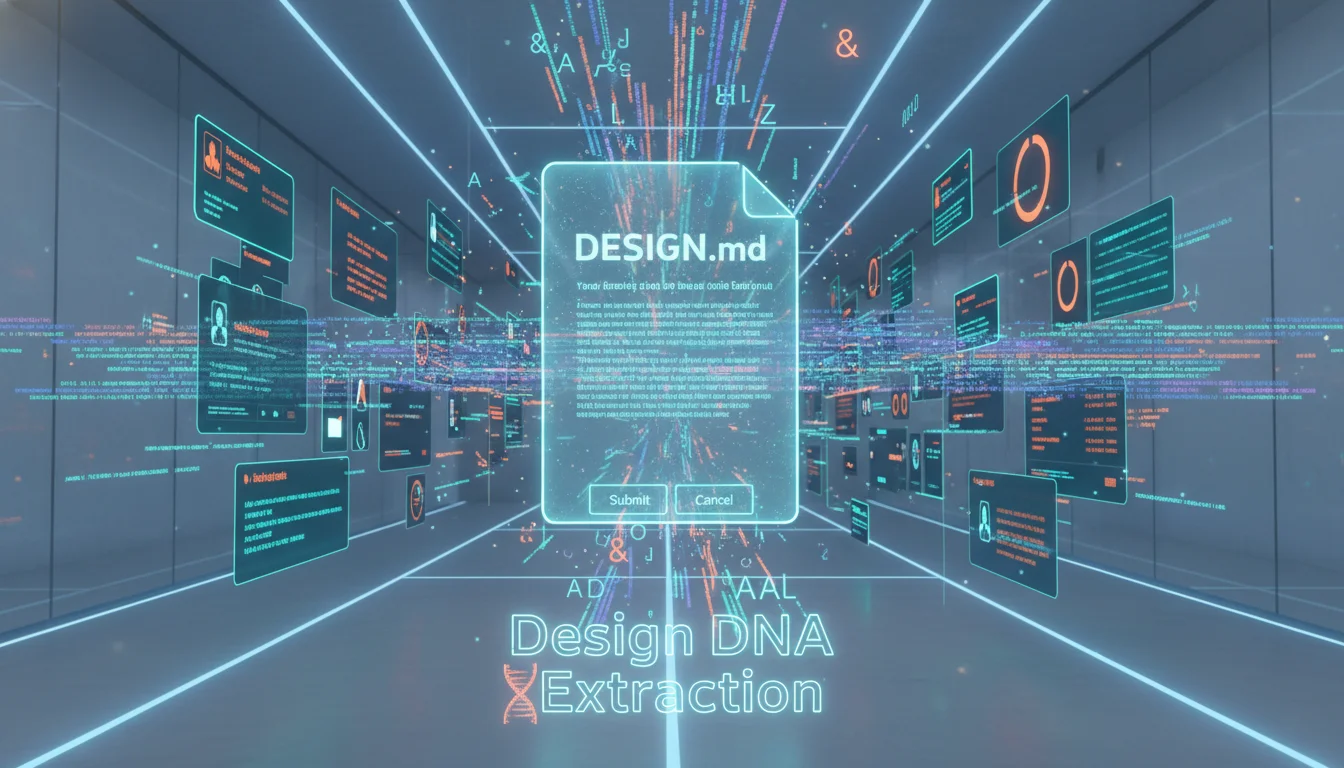
The true technical achievement of Stitch lies not merely in its visual output, but in its ability to synthesize aesthetic decisions into structured, machine-readable artifacts. The most critical of these artifacts is the DESIGN.md file. Stored persistently within the .stitch directory of a project, this plain markdown file captures a brand’s entire visual design system in natural, semantic language optimized for LLM consumption.
Every subsequent prompt dispatched to the Stitch generation engine is automatically paired with the contents of DESIGN.md before reaching the Gemini 2.5 Pro model. This architectural decision ensures that the output remains strictly consistent with established brand guidelines, eliminating the need for users to repeatedly specify hex codes or font weights in every prompt.
The structural composition of a standard DESIGN.md file generated by Stitch encompasses several fundamental categories, meticulously organized to provide absolute clarity to an interpreting coding agent:
| Architectural Category | Component Definitions | Strategic Purpose within the AI Workflow |
|---|---|---|
| Color Palette | Primary, secondary, and accent colors mapped to exact hex values. Semantic token definitions (e.g., success, warning, error, neutral). | Prevents agents from hallucinating disjointed color schemes and standardizes text hierarchy across all generated components. |
| Typography Settings | Font families, specific weights, sizes, line heights, and hierarchical DOM mappings (heading-1, body, caption). | Ensures font-rendering consistency and proportional readability across varying viewport sizes and operating systems. |
| Spacing & Layout | Spacing scales, underlying grid conventions, whitespace philosophy, padding, margins, and border-radius rules. | Enforces structural rhythm and predictable whitespace allocation, preventing claustrophobic or excessively sparse UI rendering. |
| Depth & Elevation | Shadow systems, z-index hierarchies, and surface interaction levels. | Dictates the accurate rendering of floating action buttons, modal overlays, and dropdown menus without clipping. |
| Component Patterns | Structured textual descriptions for buttons, input forms, navigation bars, and cards, including their hover and active variants. | Acts as a baseline heuristic library for repetitive elements, actively preventing the AI from generating duplicate, conflicting code. |
| Do’s and Don’ts | Explicit anti-patterns, design guardrails, and restricted aesthetic choices. | Constrains the model’s creative drift, ensuring strict compliance with overarching corporate brand safety guidelines. |
Extracting Design DNA for Multi-Page Consistency
While generating a visually stunning homepage is a solved problem in generative AI, maintaining visual continuity across a sprawling, multi-page application has remained a persistent challenge. If a user prompts a model to “build an analytics dashboard” and later requests “a user settings page,” isolated generation engines typically produce screens that look as though they belong to entirely different software products.
Stitch mitigates this fragmentation through a concept known as “Design DNA”. When utilizing the Stitch platform, the AI does not rely on transient memory. Instead, it employs a sophisticated context extraction methodology. Through the Stitch Model Context Protocol, developers gain access to an extract_design_context utility. Rather than forcing the AI to process thousands of lines of raw, unstructured HTML to deduce styling, this tool scans an existing high-fidelity screen and mathematically distills its core aesthetic metadata—specifically its Tailwind color palette, its exact typography weights, and its overarching structural DOM patterns.
Once this Design DNA is extracted, it serves as the foundational context for the generate_screen_from_text function. Consequently, when the system is tasked with generating the secondary settings page, it injects the extracted DNA directly into the prompt matrix. This mechanism ensures that the newly generated screen perfectly harmonizes with the original homepage, preserving visual identity and eliminating the risk of LLM hallucination during the scaling phase of application development.
Competitive Market Analysis: Generative UI Tooling
To fully comprehend the utility of Google Stitch, it must be evaluated within the context of the highly saturated 2026 generative UI market.
The landscape is segmented based on output fidelity, backend integration capabilities, and deployment architectures. The primary competitors in this space encompass Vercel’s v0.dev, Bolt.new, Lovable, UI Bakery, and various open-source forks like OpenBolt. Each platform serves a distinct engineering demographic.
| Generative Platform | Core Architectural Strength | Technical Limitations and Constraints | Optimal Target Demographic |
|---|---|---|---|
| Google Stitch | Pure visual exploration, semantic DESIGN.md synthesis, multi-page Design DNA extraction via MCP, entirely free via Google Labs. | Lacks native backend logic generation; relies on external IDEs (Antigravity) to wire complex databases. | Product designers and developers requiring early-stage conceptualization, holistic design systems, and visual cohesion. |
| v0.dev (Vercel) | Production-quality React component generation, seamless Vercel deployment ecosystem integration, mastery of Tailwind and ShadCN UI. | Devoid of backend or database generation capabilities; relies heavily on monochromatic aesthetics; utilizes a credit-based pricing model that drains rapidly on complex builds. | Frontend developers requiring the rapid, isolated scaffolding of highly specific UI components. |
| Bolt.new | Rapid full-stack prototyping, superior UI design cohesion requiring only single-prompt execution, highly transparent token-based pricing structure. | Limited to specific JavaScript ecosystems; struggles with bespoke enterprise architectural paradigms. | Developers necessitating rapid, cohesive full-stack MVPs with consistent color theming. |
| Lovable | Comprehensive full-stack generation with seamless Supabase backend integration, capable of generating functional business logic. | Less flexible for developers who prefer granular control over their specific tech stack or infrastructure. | Non-technical founders and builders prioritizing functional web applications over mere visual mockups. |
| UI Bakery | Enterprise-grade web applications, generation of internal tools and customer portals, direct integration with SQL, NoSQL, and REST APIs. | Steeper learning curve for simple aesthetic explorations; overkill for basic landing pages. | Enterprise environments requiring complex data binding, rigid workflows, and custom dashboarding. |
| OpenBolt / Open-Lovable | Cloud-based or local self-hosting, allows users to Bring Your Own Key (BYOK) to avoid proprietary platform markups. | Requires significant technical knowledge to maintain infrastructure; lacks the robust community support of commercial alternatives; heavily reliant on specific LLM models. | Budget-conscious developers and open-source advocates seeking to avoid vendor lock-in and token pricing. |
Google Stitch occupies a unique position in this matrix. It operates as the “designer’s brain,” prioritizing absolute aesthetic continuity and multi-page cohesion over instant backend wiring. By decoupling the generative design phase from the backend scaffolding phase, Stitch allows the resulting DESIGN.md and Design DNA to be ported into highly capable coding environments—most notably, the Antigravity IDE.
The Model Context Protocol (MCP) Architecture
The seamless transfer of conceptual intent from the Stitch design canvas to a local coding environment is facilitated entirely by the Model Context Protocol (MCP). The MCP represents a foundational shift in how artificial intelligence interacts with user data; it serves as a standardized, highly secure connection layer—frequently analogized as a “USB-C port for AI tools”—that permits local AI coding agents to interface directly with external software, cloud databases, and third-party APIs in real-time.
Eradicating Contextual Amnesia
Prior to the widespread adoption of MCP, developers were subjected to a highly inefficient workflow. To inform an AI about a specific design or database schema, the developer had to manually copy hex codes, layout metadata, or SQL schemas from external tools and paste them into the chat interface of the IDE. As project complexity increased, the AI’s context window would inevitably overflow, leading to contextual amnesia. The agent would begin hallucinating parameters, applying incorrect styling, and breaking the application’s visual continuity.
The MCP infrastructure eliminates this friction entirely. When an IDE is authenticated and connected to the Stitch MCP server, the resident AI agent is granted real-time, read-write access to the living design project. The agent is no longer constrained by the developer’s ability to accurately describe a button. Instead, the agent autonomously queries the Stitch server, retrieves the exact DESIGN.md parameters, and observes the layout metadata natively.
Integrating the Stitch MCP Server
The integration of the Stitch MCP server into a local IDE workflow is engineered to be a zero-configuration, cross-platform process, supporting Windows, macOS, and Linux. The developer navigates to their Google Stitch settings to provision a secure API key. Within the IDE—such as Claude Desktop or Google Antigravity—the developer modifies the core configuration file (e.g., claude_desktop_config.json or mcp_config.json), injecting the Stitch command and the requisite Google Cloud project environment variables.
Once the server is authenticated and active, the IDE’s AI agent gains access to a robust suite of programmatic tools exposed by the Stitch API. These endpoints transform the AI from a passive text generator into an active, system-aware orchestrator:
| MCP Endpoint Tool | Programmatic Functionality within the Agent Workflow |
|---|---|
| extract_design_context | Scans an existing, designated screen to extract core Design DNA (colors, typography, spacing, components). This data is cached to ensure visual consistency when generating subsequent screens. |
| apply_design_context | Commands the Stitch engine to generate a net-new UI screen by forcefully applying a previously extracted design context, thereby maintaining a pre-established corporate aesthetic. |
| compare_designs | Programmatically analyzes two distinct screens to identify structural differences, padding inconsistencies, and stylistic deviations, allowing the AI to automatically suggest harmonization refactors. |
| generate_screen_from_text | Accepts a natural language prompt, combined with extracted context parameters, to render a high-fidelity screen directly on the Stitch canvas. |
| fetch_screen_code / get_screen_code | Directly downloads the raw HTML, CSS, and frontend structure of the newly generated UI for immediate parsing and integration into the developer’s local repository. |
| fetch_screen_image | Downloads a high-resolution, Base64-encoded screenshot of the generated screen, utilized by IDEs with visual capabilities to perform automated “vibe checks” against local code execution. |
| Project Management Suite | A collection of commands (create_project, list_projects, list_screens, get_project, get_screen) that permit the AI to autonomously navigate, audit, and organize the user’s entire Stitch cloud workspace without manual intervention. |
The practical application of these endpoints is entirely opaque to the end-user. If a developer types the command, “Use Stitch to build a dark mode settings page matching my current dashboard,” the IDE agent executes a complex sequence. It invokes list_projects to locate the workspace, calls extract_design_context on the existing dashboard, utilizes generate_screen_from_text to create the new UI injected with the dark mode DNA, and finally executes fetch_screen_code to pull the underlying markup into the local codebase.
Google Antigravity: The Agent-First Environment
While the Model Context Protocol provides the necessary communication bridge to external services, the successful orchestration of multi-step, complex engineering logic requires a sophisticated command center. Google Antigravity, officially launched as an agentic development platform alongside the Gemini 3 rollout, represents a fundamental reimagining of the IDE architecture. Unlike legacy editors that merely feature a chatbot bolted onto a sidebar, Antigravity treats AI agents as first-class citizens capable of autonomous, systemic execution.
Mission Control and Multi-Agent Orchestration
Antigravity moves decisively beyond single-threaded LLM interactions by introducing the “Agent Manager” panel. This interface serves as a visual Mission Control, permitting developers to instantiate, monitor, and coordinate multiple autonomous agents operating in parallel across a massive codebase.
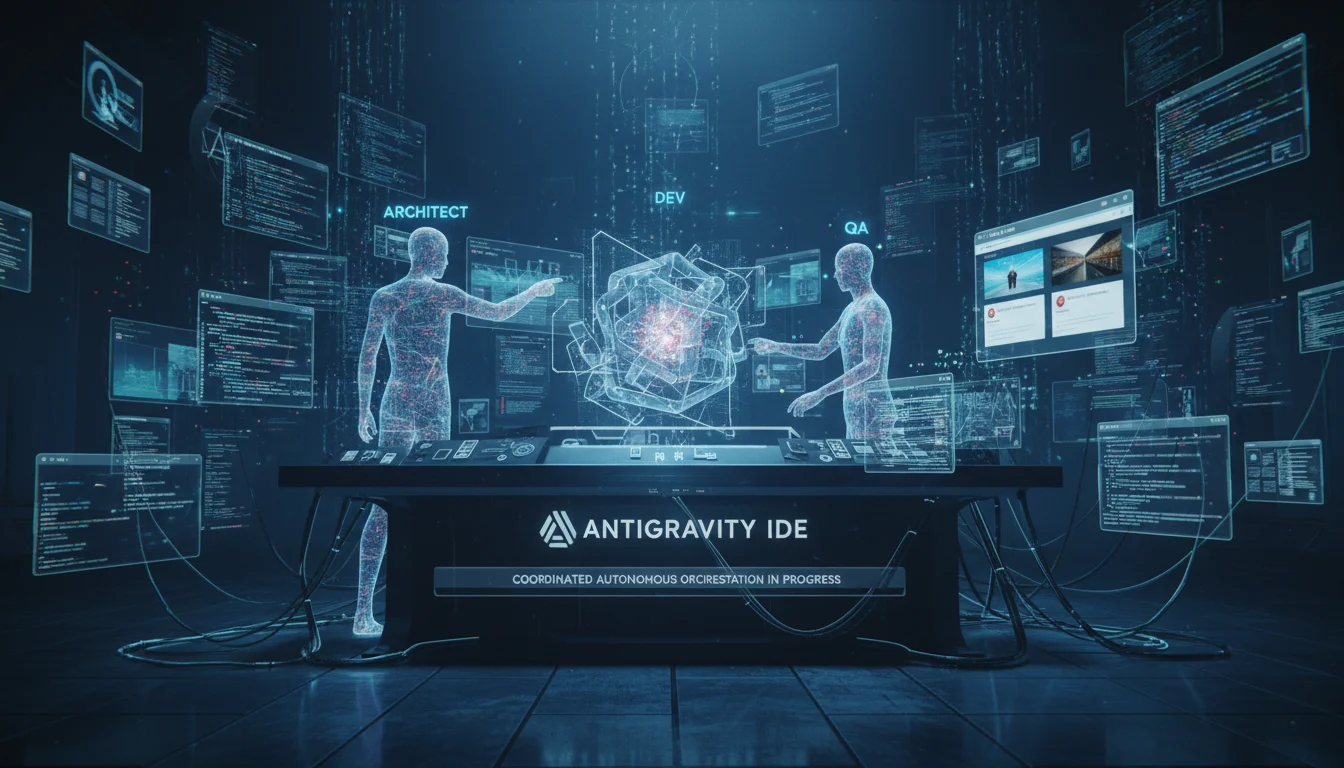
The platform acknowledges that different engineering tasks require different cognitive architectures. Consequently, the Agent Manager allows developers to seamlessly hot-swap between frontier models. A developer might assign the Gemini 3.1 Pro model to handle rapid, high-volume code generation; deploy Anthropic’s Claude 4.6 for deep, multi-file reasoning and complex architectural planning; and utilize GPT-O for specialized heuristic analysis.
Antigravity operates with two distinct cognitive modes: Fast mode and Planning mode. Fast mode is optimized for rapid inline edits and low-latency code completion, preserving token limits. Conversely, Planning mode initiates deep, multi-step research routines, authorizing the agent to extensively read the filesystem, map dependencies, and formulate comprehensive execution strategies before writing a single line of code.
Crucially, Antigravity agents are authorized to operate the IDE itself. They can execute native terminal commands, modify the filesystem, configure package managers (like npm or pip), and interact with Docker containers and Jupyter Notebooks. To accelerate repetitive workflows, the platform introduces “Turbo Mode” (/ turbo).
When a user includes this comment flag, it authorizes the AI to autonomously run terminal commands—such as dependency installations or server restarts—without prompting the human developer for manual confirmation at every step.
Furthermore, Antigravity features a built-in, native browser environment. This allows the AI to automatically run a local development server, visually inspect the rendered application, and perform an autonomous “Vibe Check.” By comparing the live DOM rendering against the high-resolution images fetched via the Stitch MCP server, the agent can self-correct layout discrepancies—such as identifying exact React 19 hydration error diffs—before ever presenting the final code to the user.
Hierarchical Governance: Rules and AGENTS.md
The inherent risk of autonomous multi-agent systems is chaotic execution. Without strict operational boundaries, highly capable models revert to their default training behaviors, which frequently conflict with a specific organization’s security protocols, Git conventions, or chosen tech stack. To mitigate this, Antigravity implements a rigorous, multi-tiered governance system governed by the Customizations panel.
The foundation of this governance relies on two specific configuration files: GEMINI.md and the newly established AGENTS.md standard. The IDE enforces a strict, unyielding precedence hierarchy to resolve conflicting instructions:
- System Rules (Immutable): Core, hardcoded directives authored by Google DeepMind. These establish baseline safety parameters, non-destructive defaults, and ethical guardrails that no user file can override.
- GEMINI.md (Highest User Priority): A project-level configuration file utilized strictly for Antigravity-specific behavioral overrides. If a rule in this file conflicts with any broader instruction, GEMINI.md takes absolute precedence.
- AGENTS.md (Cross-Tool Foundation): Introduced in Antigravity version 1.20.3, this plain markdown file serves as the universal project constitution. Crucially, this file is cross-compatible; it is read and respected not only by Antigravity but also by competing platforms like Cursor and Claude Code. This ensures that hybrid engineering teams utilizing different IDEs adhere to the exact same core standards.
- Workspace Supplements (.agent/rules/): Modular, highly specific rule files that are activated conditionally. These can be triggered Manually (via an @-mention), set to Always On, activated via Model Decision (where the LLM determines relevance based on natural language analysis), or triggered via Glob patterns (e.g., applying specific linting rules only to src/*/.ts files).
A mature, enterprise-grade AGENTS.md configuration acts as a comprehensive technical specification. It explicitly dictates the required tech stack (e.g., Next.js 15, React 19, Cloudflare Workers, Supabase). It enforces strict code quality limits, such as mandating that cyclomatic complexity remains under 10 per function and restricting file lengths to under 300 lines. It outlines non-negotiable testing parameters, requiring the utilization of Vitest and Playwright with a minimum of 80% coverage on all new code. Perhaps most critically, it defines severe security guardrails, explicitly instructing agents to never hardcode credentials, to store all secrets in .env.local, and to always prompt for human confirmation before executing any database write operations or destructive file deletions.
Because these rules are established in plain markdown, they are treated as production code. Development teams commit AGENTS.md to version control, subject it to pull request reviews, and sync it across the organization to ensure perfectly uniform AI behavior.
The Skills Framework (SKILL.md)
While the AGENTS.md hierarchy dictates how an AI agent should behave, the “Skills” framework dictates exactly what technical feats the agent is capable of executing. Antigravity abstracts complex, repetitive development tasks into a modular .md file system housed within the repository’s .agents/skills/ directory.
By early 2026, the community-driven Awesome Agent Skills library has cataloged thousands of cross-compatible skills. To ensure absolute reliability and facilitate “few-shot” learning for the agent, every skill directory adheres to a highly standardized blueprint:
- SKILL.md: Operates as “Mission Control” for the specific task, providing the primary instructions, context mapping, and the exact artifact handover rules the agent must follow.
- scripts/: Houses executable enforcers. These are underlying scripts that handle complex networking, API calls, and Abstract Syntax Tree (AST) validation tasks that the LLM cannot execute natively.
- resources/: A localized knowledge base containing specific style guides, documentation, and checklists required to complete the task.
- examples/: Provides the agent with “Gold Standard,” syntactically valid references used to train the model’s output formatting.
Antigravity optimizes token consumption and processing speed through a mechanism called “Progressive Disclosure”. When an agent boots, it performs an initial Discovery phase, scanning merely the titles and brief descriptions of all available skills. Only if a user’s prompt triggers relevance does the agent enter the Activation phase, reading the entire SKILL.md file into its active context window, before proceeding to Execution.
Because skill routing is reliant on LLM interpretation and is inherently non-deterministic, these modular structures are essential for stable debugging and testing.
The Stitch Skills Ecosystem
To maximize the efficacy of the Stitch MCP integration, Google Labs released an official, highly refined library of Agent Skills specifically engineered to orchestrate the design-to-code pipeline. Installed globally or locally via the npx skills add CLI command, these skills abstract away the immense prompt engineering required to perfectly translate UI into code.
The core components of the google-labs-code/stitch-skills repository include:
- stitch-loop: The crown jewel of the ecosystem. This skill teaches the agent to establish an iterative, continuous feedback loop. From a single user prompt, it can generate an entire multi-page website by systematically invoking the Stitch engine, generating screens, extracting the code, organizing the local filesystem, and running automated visual validations.
- react-components: Instructs the coding agent on the precise methodologies for converting raw, Stitch-generated HTML/CSS screens into highly modular React components. Crucially, it utilizes system-level networking and AST-based validation to ensure strict adherence to the project’s design tokens.
- design-md: Analyzes the active Stitch project via MCP and synthesizes the raw styling data into the foundational DESIGN.md file, documenting the system in natural, semantic language.
- enhance-prompt: Acts as an intelligent intermediary. It intercepts vague user intents (e.g., “make it pop”) and restructures them into highly specific, polished prompts injected with advanced UI/UX vocabulary and design system constraints, ensuring the Stitch engine produces optimal output.
- shadcn-ui: Provides the agent with expert guidance on discovering, installing, and customizing complex shadcn/ui components within a React application, ensuring alignment with best practices.
- remotion: An advanced utility that generates professional, programmatic walkthrough videos from Stitch project designs, utilizing smooth transitions and text overlays to present completed applications to stakeholders.
End-to-End Autonomous Workflows: The BMAD Implementation
The true transformational capability of the Antigravity and Stitch ecosystem is realized when rules, specialized skills, and MCP tools are intricately chained together through native Workflow automation. Workflows, housed within the .agent/workflows/ directory, are predefined sequences activated by custom slash commands in the IDE. They allow an individual developer to act as an executive orchestrator, commanding a complete AI software delivery pipeline.
A highly utilized, open-source configuration dominating the community in 2026 is the “BMad Method.” This template explicitly wires agentic Agile/Scrum roles into the Antigravity IDE via native slash commands, establishing a predictable, gated pipeline: PRD formulation, Architecture design, Implementation, QA gating, and Deployment.
Phase 1: Discovery and Specification (/pm)
The development cycle is initiated when a human user types a command such as /startcycle or /pm followed by a high-level concept (e.g., “Build a multi-tenant fitness tracking application”).
The Product Manager Agent (@pm) assumes control. Governed strictly by its persona defined in AGENTS.md, this agent is restricted from writing application code. Instead, its sole objective is requirement discovery. It drafts the initial Product Requirements Document (PRD) and frames the core user stories. To visualize these requirements, the PM agent invokes the stitch-design and enhance-prompt skills via the MCP bridge. It commands the Stitch engine to generate the initial wireframes and interactive user flows, presenting these visual artifacts to the human operator for validation.
Phase 2: Architecture and Design DNA (/architect)
Upon human approval of the PRD and initial visuals, the workflow shifts context to the Systems Architect Agent (@architect). This agent is responsible for shaping the technical blueprint.
It queries the Stitch MCP utilizing the extract_design_context endpoint. It mathematically maps the precise Tailwind color scales, typography weights, and structural DOM patterns from the generated visuals, writing this data into the repository’s DESIGN.md file to lock the visual identity. Concurrently, it drafts the necessary database schemas (e.g., Supabase Postgres structures), defines the API routing logic, and produces Architecture Decision Records (ADRs) to finalize the technical plan.
Phase 3: The Implementation and Vibe Check (/dev)
With the architecture locked, the Developer Agent (@dev) is activated. Utilizing the react-components and stitch-loop skills, this agent begins the heavy lifting of translating the Stitch prototypes into a functional React and Tailwind codebase. Because the agent constantly references the DESIGN.md and the AGENTS.md files, there is zero ambiguity regarding spacing utility classes, component modularity, or the designated tech stack (e.g., Next.js 15).
Leveraging Antigravity’s “Turbo Mode” (/ turbo), the Dev agent autonomously executes native terminal commands to install requisite NPM packages and scaffold directories without pausing for human permission. As it builds, it continuously utilizes the built-in IDE browser to perform programmatic “Vibe Checks,” pulling down high-resolution images via fetch_screen_image to compare the live DOM against the Stitch intent, rectifying any visual discrepancies or React hydration errors immediately.
Phase 4: Quality Assurance Gating (/qa)
Once the Developer agent signals completion, the QA Agent (@qa) takes over to enforce a strict quality gate. Operating under the parameters of the AGENTS.md testing requirements, this agent utilizes the terminal to initialize testing frameworks such as Vitest and Playwright. It aggressively audits the generated codebase, probing for cyclomatic complexity breaches, unhandled exceptions, and critical security flaws (such as inadvertently hardcoded API keys). If tests fail, the QA agent generates an error report and forces the workflow back to the Dev agent for immediate refactoring.
Phase 5: Production Deployment (@devops)
The final sequence is executed by a specialized DevOps Master (@devops) persona. To initiate deployment, this agent scans the finalized Technical_Specification.md and inspects the compiled workspace (app_build/) to automatically detect the final stack composition (e.g., Node.js vs. Python).
Relying on specific deployment skills such as deploy_app.md for local hosting or deploy_cloud_run.md for production environments, the agent interacts natively with the terminal. If utilizing Google Cloud, the agent executes gcloud run deploy –source., autonomously handling all CLI prompts, selecting default geographic regions, and configuring unauthenticated invocation rules. Ultimately, the DevOps agent outputs the live, functional production URL to the human operator, completing the cycle from prompt to deployment without manual coding.
Competitive Benchmarking in the 2026 IDE Landscape
The evolution of Antigravity has catalyzed intense competition within the AI coding tools sector. The market has fractured based on architectural philosophies: tools that seek to augment the individual developer, and tools that seek to replace the human developer with a managed artificial team.
Antigravity vs. Claude Code
The most pronounced ideological divide exists between Google Antigravity and Anthropic’s Claude Code.
Claude Code is a terminal-first architecture powered by Claude 3.7/4.6, operating as a deeply integrated command-line agent. As of early 2026, it is celebrated for its profound reasoning capabilities, achieving a remarkable 52.9% resolution rate on the stringent SWE-bench Full dataset. Because it operates entirely within the terminal, it integrates flawlessly into established, legacy IDE environments (like VS Code, IntelliJ, or Neovim) without disrupting existing developer habits. As General Availability (GA) software with highly documented behaviors and stable production workflows, it is heavily favored in highly regulated enterprise environments that demand compliance, SSO, SCIM, and audit logs.
Conversely, Antigravity is a fundamentally agent-first platform requiring developers to adopt an entirely new graphical interface. It provides unmatched visual orchestration, natively supporting Gemini, Claude, and GPT models simultaneously, while offering a built-in browser and the powerful Mission Control panel. However, its status as preview software presents risks. Community discourse in 2026 highlights stability concerns, with anecdotal reports indicating that unsupervised Antigravity agents have occasionally executed destructive commands on local drives.
The practical conclusion is clear: Claude Code is the superior choice for maintaining and refactoring massive, established enterprise codebases where reliability is paramount. Antigravity is the dominant choice for rapid, greenfield MVP construction, complex multi-agent orchestration, and seamless visual generation workflows. Furthermore, the economic barrier to entry differs; Antigravity offers an incredibly generous free tier (with weekly refreshed quotas and unlimited completions) compared to strict subscription models, though users remain wary of potential “bait-and-switch” pricing adjustments on premium tiers.
Evaluating Cursor, Windsurf, Kiro, and Codex
The broader AI IDE market features several other highly capable tools, each carving out specific niches:
- Cursor: AI-Supercharged Editor. A direct fork of VS Code, it maintains the largest community and extension ecosystem. It acts as an aggressive, highly project-aware copilot deeply embedded into the standard development workflow. Strategic Weakness: Lacks the true autonomous, parallel multi-agent orchestration found in Antigravity; heavily reliant on human-in-the-loop interaction.
- Kiro: Spec-Driven Development. Unique in its methodology, Kiro relies on executable specifications rather than natural language. It translates specs into rigid plans, orchestrating agents via event-driven automation hooks directly against the Git repository. Strategic Weakness: An incredibly rigid workflow that enforces a steep learning curve; developers must master the specification syntax to achieve results.
- Windsurf: Budget-Optimized Pipeline. Formerly known as Codeium, it offers the best price-to-feature ratio at roughly $15/month. It features an “Arena Mode” for blind LLM benchmarking, direct Devin integration, and advanced structural grep capabilities. Strategic Weakness: Future development roadmap remains precarious and uncertain following massive industry acquisitions (e.g., Cognition).
- OpenAI Codex: Cloud-Based Command Center. Bundled with ChatGPT Plus, it operates as a distinct desktop application command center, uniquely capable of running multiple agents in parallel across entirely different projects. Strategic Weakness: Disconnected from the granular, file-level intimacy of a dedicated IDE; functions more as a powerful external utility than a native development environment.
Macro-Economic Implications and Business Strategies
The frictionless synthesis of generative UI (Stitch) and autonomous coding (Antigravity) extends far beyond technical achievement; it is actively restructuring the micro-economics of the web development agency model.
The Commoditization of Frontend Engineering
Historically, translating a static design mockup into a highly performant component library was a highly valued, time-intensive engineering skill. The integration of react-components skills and MCP-driven Design DNA extraction fundamentally automates this translation layer. Because an AI agent can parse an Abstract Syntax Tree (AST) and output validated React code faster and with greater stylistic accuracy than a human developer, traditional frontend roles are being forced to evolve. The focus of engineering is pivoting rapidly away from CSS architecture and layout generation toward complex state management, data pipeline security, and API optimization.
The “Google Maps Strategy” and Democratized Web Agencies
The sheer velocity of the Antigravity pipeline has spawned entirely new micro-economies. Independent operators and non-technical entrepreneurs are leveraging a strategy colloquially termed the “Google Maps Strategy” to build highly profitable solo-agencies.
Operating on a “Zero-Prep” workflow, an operator utilizes Google Maps to prospect local, small businesses with severely outdated web presences. Utilizing the Stitch generation engine, the operator inputs the business’s existing data to instantly generate a modern, high-fidelity, mobile-first UI redesign. This design is then seamlessly passed through the MCP bridge to the Antigravity IDE, where the agentic pipeline autonomously builds and deploys the fully functional React website.
Because the entire process requires no manual coding and relies on entirely free or low-cost tools, the profit margins are staggering. Operators pitch the “Before vs. After” prototypes directly to business owners, closing deals ranging from $250 to $1,000+ per site, effectively creating a high-volume SaaS or white-label agency model with zero engineering overhead. This democratization allows single individuals to mirror the output capacity of a traditional, multi-disciplinary agency squad.
The Ascendancy of Contextual Governance
In an economic environment where the marginal cost of code generation approaches zero, the strategic value of contextual governance skyrockets.
The underlying Large Language Models (Gemini, Claude, GPT) are largely commoditized; they are available to everyone. The true proprietary intellectual property of a modern engineering team no longer lies in the code it writes, but in the parameters it defines.
A development agency’s competitive advantage in 2026 relies entirely on its .agent/rules/ directory, the robustness of its AGENTS.md constitution, and the sophisticated chaining of its .agent/workflows/. Teams that master the progressive disclosure of technical skills and the strict enforcement of rule hierarchies will successfully harness AI at massive scale. Conversely, teams that continue to rely on zero-shot, ad-hoc prompting will suffer from compounding technical debt, unmanageable context drift, and catastrophic deployment failures.
Final Architectural Synthesis
The convergence of Google Stitch and the Antigravity IDE, facilitated by the robust architecture of the Model Context Protocol, represents a masterclass in systemic AI integration. By successfully decoupling the highly generative, exploratory capabilities of UI design from the rigid, deep-reasoning requirements of software engineering—and subsequently bridging them through a secure, context-aware API—Google has effectively eliminated the manual translation bottlenecks that previously stunted AI-assisted development.
The introduction of specialized artifacts like the semantic DESIGN.md file and the extract_design_context utility permanently resolves the pervasive issue of generative fragmentation. It ensures that complex, multi-page applications adhere strictly to an overarching visual DNA, transforming aesthetic design into programmable, mathematically verifiable infrastructure. Furthermore, Antigravity’s implementation of hierarchical governance models—relying on the cross-platform AGENTS.md standard, executable SKILL.md frameworks, and automated slash-command workflows—proves that the future of software development relies not on smarter autocomplete utilities, but on the rigorous orchestration of autonomous multi-agent pipelines.
As these tools transition out of their preview phases and achieve enterprise-grade stability, they will necessitate a profound reevaluation of technical roles across the industry. The core competency of the future software engineer will irrevocably shift from mastering the syntax of code to mastering the architecture of artificial thought, acting as a high-level director managing complex, intelligent systems to autonomously manifest secure, beautiful software from raw human intent.