Advanced Search Engine Listing & Webmaster Tools 2026 Guide
The Macro-Architecture of Global Search and Discovery Ecosystems

The digital landscape of 2026 is defined by a highly fragmented yet technologically sophisticated search engine ecosystem. While global web traffic remains overwhelmingly dominated by a select group of platforms that shape how billions of individuals retrieve information, the underlying architecture governing how these platforms discover, crawl, and index content has undergone a profound transformation. Traditional passive crawling mechanisms are increasingly being supplemented, and in several ecosystems entirely superseded, by active, application programming interface (API)-driven push protocols designed for real-time data ingestion. Navigating this environment requires webmasters to move beyond monolithic optimization strategies and interface with multiple proprietary webmaster portals, utilize bespoke indexing APIs, and adhere to strict geopolitical localization parameters.
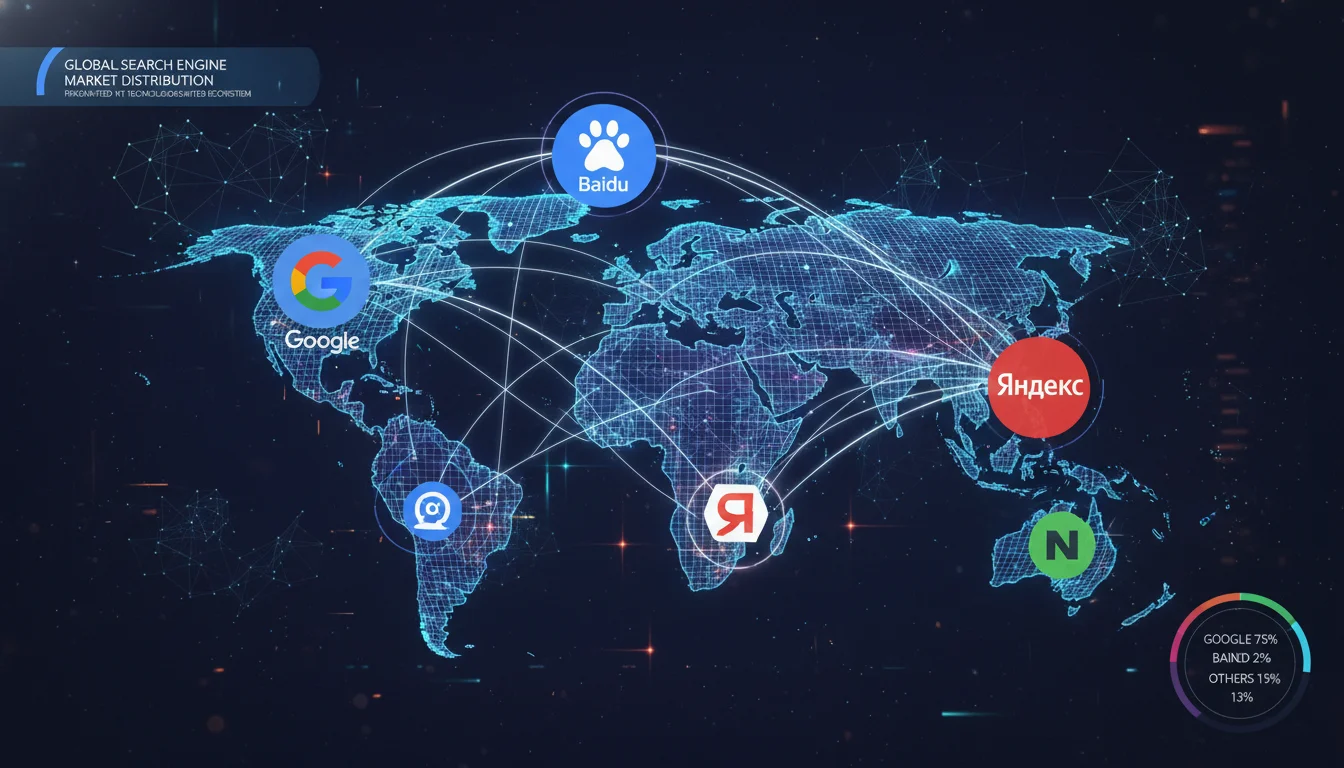
An exhaustive analysis of global web traffic reveals that Google continues to maintain a near-monopoly on aggregate global internet traffic, ranking as the most visited website worldwide with approximately 94.8 billion monthly visits. This dominance is geographically pervasive but not absolute. As of mid-2025, Google held an 86.66% market share in Germany, a metric that rises to over 96% when isolating mobile web searches. Similarly, Google commands an 89.5% market share in Canada and maintains unchallenged positions across the United States, the United Kingdom, India, Brazil, France, Italy, Spain, Australia, and Mexico. However, the broader composition of top digital platforms is rapidly evolving. The emergence of artificial intelligence (AI) interfaces, most notably ChatGPT, which has ascended into the top five most visited global websites with 5.5 billion monthly visits, has fundamentally altered the indexing paradigm. Modern AI-driven search models, large language models (LLMs), and zero-click search environments rely heavily on real-time data retrieval from traditional search indexes to generate contextual overviews.

Simultaneously, regional monopolies dictate the technical search engine optimization (SEO) strategies required for international market penetration. While Google’s global footprint is massive, its influence is significantly diminished or entirely absent in specific geopolitical spheres. In China, Baidu commands absolute dominance over the search market, processing billions of queries daily. In the Russian Federation and the broader Commonwealth of Independent States (CIS), Yandex reigns supreme. In South Korea, Naver operates as the primary gateway to the internet, functioning as a comprehensive digital ecosystem rather than a mere search bar. Furthermore, localized engines like Seznam in the Czech Republic continue to maintain critical market shares by leveraging highly specialized, language-specific algorithms that outperform global competitors in localized intent recognition.
| Geographic Region | Dominant Search Engine | Secondary Search Engines | Primary Market Characteristic |
|---|---|---|---|
| Global/United States | Google (94.8B visits/mo) | Bing, Yahoo!, DuckDuckGo | Algorithmic dominance, AI integration, strict manual indexing limits. |
| Mainland China | Baidu (54%+ share) | Sogou, 360 Search, SM.cn | Strict firewall regulations, ICP license requirements, mandatory Simplified Chinese. |
| Russian Federation | Yandex | Google, Mail.ru | Site Quality Index (IKS) crawling limits, strict URL parameter filtering. |
| South Korea | Naver | Google, Daum | Localized server preference, ignoring hreflang tags, mandatory Korean content. |
| Czech Republic | Seznam | Heavy reliance on local directories, low JavaScript rendering capacity, Slavic accent processing. | |
| Germany/Canada | Google (86%-89% share) | Bing, Yahoo!, Ecosia | Overwhelming Google mobile dominance (96%+), standard Western SEO protocols. |
The velocity of content creation and the demand for real-time information by AI interfaces have rendered passive crawling inefficient for time-sensitive data. This has precipitated an industry-wide shift toward “push” models. This report provides an exhaustive technical analysis of the global search engine landscape, detailing the specific protocols, architectural limitations, and strategic imperatives necessary for achieving comprehensive indexation across Google, Bing, Baidu, Yandex, Naver, Seznam, and emerging mobile-native platforms.
The Paradigm Shift: The IndexNow Protocol and Push-Based Indexation
Historically, search engine indexation relied on a “pull” model. Webmasters would deploy Extensible Markup Language sitemaps and wait for autonomous web crawlers to discover, schedule, and eventually crawl new or updated uniform resource locators (URLs) based on opaque, algorithmically determined crawl budgets. By 2026, the inefficiency of this model has driven the widespread adoption of push-based indexation architectures.
The most significant development in cross-engine indexation is the IndexNow protocol. Originally spearheaded by Microsoft Bing and Yandex in 2021, IndexNow has evolved into a free, open-source standard adopted by a growing alliance of search engines, including Seznam, Naver, and Yep. The protocol enables website owners to instantly notify participating search engines of content additions, modifications, or deletions, effectively bypassing crawler latency and reducing the infrastructural server overhead associated with blind site crawls.
A defining infrastructural feature of the IndexNow alliance is its reciprocal data-sharing mandate. Search engines participating in the protocol agree to automatically share submitted URLs with all other participating endpoints. To qualify as a participant, a search engine must maintain a noticeable market presence and contribute significantly to URL submission volumes. Consequently, a single API request from a webmaster to a designated endpoint propagates across multiple global search indexes simultaneously, creating a unified discovery web. The IndexNow partners authorize the downloading of transaction logs by matching the network address of the HTTP request source against predefined notifier IP addresses found in the meta.json file of the protocol partners, ensuring secure authentication across the network.
Implementing IndexNow requires strict cryptographic verification of host ownership to prevent index manipulation by unauthorized third parties. Webmasters must generate a cryptographic key that adheres to specific formatting requirements. The key must possess a minimum length of 8 characters and a maximum length of 128 characters. While the key traditionally consists of hexadecimal characters, the protocol specification permits the inclusion of lowercase letters, uppercase letters, numbers, and dashes. This key must be hosted as a UTF-8 encoded text file on the origin server to prove domain authority.
The protocol offers two distinct implementation paths for key hosting, each with specific scope implications. The first, and strongly recommended approach, is to host the key file directly at the domain root, formatted as key.txt. The text file must contain the exact key string. By placing the file at the root, the webmaster authorizes URL submissions for the entire domain hierarchy. The second option allows the key to be hosted within a specific subdirectory; however, this imposes strict scope limitations on the submission engine. If a webmaster hosts the key file at /catalog/key.txt, that specific key can only authorize URL submissions for URLs starting with the /catalog/ path. Submitting a URL from outside this directory, such as an image file located at /image/, will result in the request being rejected by the search engine endpoint. This secondary method requires specifying the key location in the submission payload using the keyLocation parameter.
Once authenticated, URL submissions can be executed via standard HTTP requests. For individual URL updates, a webmaster can issue a simple HTTP GET request to the search engine’s endpoint. The target URL must be URL-escaped, properly encoded, and strictly adhere to RFC-3986 formatting standards. For enterprise-level deployments managing high volumes of dynamic content, webmasters can utilize HTTP POST requests to submit up to 10,000 URLs in a single JSON-formatted payload. The payload structure requires defining the host, the verification key, the optional key location, and an array of URLs, which can mix both HTTP and HTTPS protocols if necessary.
The target server responds with specific HTTP status codes to indicate the transaction’s success or failure, providing crucial debugging information for automated systems.
| HTTP Status Code | Definition | Technical Implication for Webmasters |
|---|---|---|
| 200 OK | Success | The search engine has successfully received the URL submission. |
| 202 Accepted | Pending Validation | The URL was received, but cryptographic key validation is still pending in the background. |
| 400 Bad Request | Syntax Error | The JSON payload or GET request contains an invalid format. |
| 403 Forbidden | Authentication Failure | The key was not found on the server, or the file exists but the content does not match the submitted key. |
| 422 Unprocessable Entity | Scope Violation | The submitted URLs do not belong to the verified host, or the key does not match the schema constraints. |
| 429 Too Many Requests | Rate Limiting | The endpoint has detected potential spam or API abuse and is throttling the connection. |
Integrating IndexNow into existing web infrastructure is increasingly streamlined.
Many modern content management systems (CMS) and cloud delivery networks offer native support or plugins that trigger IndexNow APIs asynchronously upon content publication, entirely eliminating the gap between content creation and search engine discovery. Tools like Sight AI integrate IndexNow notifications directly into their content generation workflows, pushing AI-generated, SEO-optimized articles directly to endpoints like Bing and Yandex the moment they are published.

Google Search Console: Managing the Dominant Index
Domain Authority and Verification Workflows
Establishing authoritative control over a domain in GSC requires completing a strict verification workflow. Webmasters are presented with a fundamental architectural choice when initiating a new property: creating a Domain property or a URL Prefix property. A Domain property provides the most comprehensive coverage, tracking all subdomains (e.g., blog.example.com, shop.example.com) and all protocols (both HTTP and HTTPS) under a single unified dashboard. However, verifying a Domain property mandates DNS verification, requiring the webmaster to inject a specific TXT record into the domain registrar’s configuration pane.
Conversely, a URL Prefix property isolates tracking to one specific version of the site, requiring exact matches for protocols and subdomains (e.g., example.com is treated as a distinct entity from www.example.com). While more restricted in scope, URL Prefix properties offer diverse, highly accessible verification methods suitable for environments where DNS access is restricted. Verification can be achieved by uploading a Google-provided HTML file to the server’s root directory, injecting a specific tag into the homepage’s section, linking an existing Google Analytics tracking code (provided the user has edit access to the property), or utilizing a Google Tag Manager container snippet. Mismatches in URL Prefix setup—such as verifying the non-WWW version when the site resolves to the WWW version—frequently result in severe data reporting gaps.
XML Sitemap Architecture and Submission Constraints
Once domain authority is verified, the primary mechanism for guiding Googlebot’s initial discovery phase remains the XML sitemap. A sitemap provides Google with a machine-readable directory of publicly available page URLs, image metadata, and relationship structures. Google imposes strict limitations on sitemap file dimensions to ensure efficient parsing. A single sitemap file cannot exceed 50 megabytes in its uncompressed state, nor can it contain more than 50,000 URLs. Enterprise-scale websites exceeding these thresholds must programmatically break their URL lists into multiple sitemaps and nest them within a parent sitemap index file.
Sitemap files must be strictly UTF-8 encoded. Furthermore, the URLs referenced within the sitemap must be fully qualified, absolute URLs; Googlebot will attempt to crawl the exact string provided, and relative paths will result in syntax errors. While webmasters can physically host sitemap files anywhere on the verified server, a sitemap submitted through GSC typically only affects descendants of the parent directory. To circumvent this and utilize cross-submission techniques—such as hosting all sitemaps on a centralized subdomain like sitemaps.example.com—webmaster must ensure they have verified ownership of all covered domains in GSC and explicitly declare the sitemap location in the respective target domain’s robots.txt file (e.g., Sitemap: https://sitemaps.example.com/sitemap.xml). Submission is executed either directly through the GSC interface under the “Sitemaps” menu or by pinging the endpoint.
Manual Indexing Quotas and the Google Indexing API
For rapid updates outside of the standard, algorithmically scheduled sitemap crawl cycle, GSC provides the URL Inspection Tool. This interface allows webmasters to submit individual page URLs to request immediate crawling and indexation, serving as the modern equivalent of the deprecated “Fetch as Google” feature. This is typically deployed for newly published articles or highly critical page modifications.
However, Google operates this tool under severe, intentionally opaque rate limits. Empirical data from the global SEO community and Google Product Experts indicates a strict quota of approximately 10 to 20 manual URL submissions per account, per 24-hour period. Google intentionally restricts this quota to prevent the tool from being utilized for routine, automated website management. The official doctrine dictates that the vast majority of web pages should be discovered automatically through organic crawling and sitemap parsing; the URL Inspection Tool is reserved exclusively for emergency updates, critical structural changes, or troubleshooting isolated indexing failures.
To circumvent these strict manual limits, enterprise websites frequently look toward the Google Indexing API. Unlike the broadly applicable IndexNow protocol, the Google Indexing API is highly restrictive and developer-focused. As of 2026, Google formally supports the API only for two specific content archetypes: pages containing JobPosting schema markup (such as job listing boards) or pages featuring BroadcastEvent data embedded within a VideoObject (livestreaming and real-time video pages).
Deploying the Google Indexing API requires substantial backend engineering. Developers must create a project within the Google Cloud Console, generate OAuth credentials by provisioning a service account, and subsequently add that service account’s unique email address as an owner within the GSC property settings. Once authenticated, developers can push automated Python scripts or Node.js applications to submit POST requests containing the target URL and an update type directive (either URL_UPDATED or URL_DELETED). While officially restricted to events and jobs, technical SEOs frequently experiment with the API for broader content updates, noting its capacity to trigger extremely rapid global discovery, though doing so falls outside Google’s documented, sanctioned use cases and carries the risk of API key revocation if abused.
XML Sitemap: Routine content discovery and site architecture mapping. Max 50,000 URLs or 50MB per file; nestable in sitemap indexes. UTF-8 encoding, absolute URLs, GSC submission or robots.txt declaration.
URL Inspection Tool: Emergency updates, troubleshooting, priority single-page pushing. Approximately 10 to 20 URLs per 24-hour period per account. Verified GSC property, manual interface interaction.
Google Indexing API: Automated, real-time indexation for highly volatile data. High volume, but strictly limited to specific schema definitions. Google Cloud Project, Service Account setup, JobPosting/BroadcastEvent schema.
Technical SEO Best Practices for Googlebot in 2026
Optimizing for Google in 2026 extends far beyond sitemap submission and keyword density. As AI overviews and zero-click search experiences dominate the interface, technical SEO must ensure seamless crawlability. The underlying site architecture must maintain valid canonical tags to resolve duplication, ensure paginated series are logically linked (noting that while rel=”next” and rel=”prev” are no longer strict directives, they still inform user experience and architecture), and prevent aggressive URL parameter generation from exhausting the crawl budget.
Furthermore, as search engines increasingly behave as answering engines rather than mere directories, content must be structured to be easily retrieved, summarized, and cited by LLMs. This requires pristine, hierarchical HTML structuring (proper utilization of H1 through H6 tags), lightning-fast rendering to pass Core Web Vitals thresholds, and the elimination of orphaned pages through robust internal contextual linking, ensuring every critical page is reachable within three clicks from the homepage. The strategic focus has shifted from optimizing for page rankings to optimizing for brand salience, multimodal content discovery (video, images, text), and establishing verifiable authority across distributed digital ecosystems.
Microsoft Bing Webmaster Tools and the AI Search Nexus
While Google commands the raw volume of traditional search queries, Microsoft Bing has positioned itself as the foundational index for the generative AI era. ChatGPT Search relies on a combination of proprietary scraping mechanisms and Microsoft Bing’s live index to generate real-time responses and synthesize data. Consequently, technical optimization within Bing Webmaster Tools (BWT) is no longer an ancillary task but a mandatory requirement for brands seeking visibility within LLM environments.
Streamlined Onboarding and Domain Verification
Microsoft has engineered the BWT onboarding process to minimize friction for webmasters already embedded in the Google ecosystem. If a webmaster possesses a verified Google Search Console account, Bing permits a seamless, API-driven import of the site property. By granting BWT permission to access the GSC account, Bing automatically imports the verified domains, user role details, and associated XML sitemap configurations, bypassing the need for manual reverification.
For manual additions, Bing supports a diverse array of verification protocols.
Notably, Bing integrates the Domain Connect standard, allowing for DNS auto-verification. If the domain is hosted with a participating DNS provider, BWT can automatically detect the provider, log the user in, and inject the necessary CNAME or TXT records without manual copy-pasting. Alternative methods include standard HTML file uploads and meta tag implementations, mirroring Google’s secondary protocols. The system imposes a generous limit of 1,000 site additions per BWT account.
Massive Submission Limits and Sitemap Analytics
Bing strongly differentiates itself from Google through its highly permissive manual indexing limits. While Google artificially restricts manual pushes to roughly 10-20 URLs daily to discourage routine use, Bing embraces active pushing. By default, Bing provides a baseline allowance of up to 10,000 manual URL submissions per day for the vast majority of verified domains. This fundamentally alters the webmaster workflow, allowing for the rapid synchronization of massive e-commerce catalogs or news publisher archives without fear of quota exhaustion. For sites managing heavy editorial output, Bing offers a dedicated URL Submission API, distinct from IndexNow, allowing developers to automate this 10,000-URL daily allowance.
Sitemap submission in BWT supports standard XML formats, RSS feeds, and robots.txt declarations. However, to optimize network bandwidth and processing efficiency, Bing explicitly recommends utilizing gzip compression, submitting files as .xml.gz. The BWT interface provides deep analytics regarding sitemap health, flagging syntax errors, dead links, warnings, and tracking the total number of URLs discovered across all submitted maps. Furthermore, BWT includes robust diagnostic features, including a robots.txt tester, a Bingbot verification tool to identify spoofed traffic, and comprehensive backlink tracking modules.
Despite user requests, Microsoft maintains a conservative approach to its URL removal and blocking tools; if Bing’s algorithm predicts a URL is highly useful to searchers, it may override a webmaster’s manual request to hide it, forcing the webmaster to implement hard technical directives (like a 404 status code or an X-Robots-Tag: noindex header) to force removal.
The Chinese Search Hegemony: Penetrating Baidu and Sogou
The digital ecosystem operating behind the Great Firewall of China is entirely decoupled from Western search paradigms. Google is largely inaccessible and structurally irrelevant to domestic consumer traffic. Instead, Baidu stands as the undisputed hegemon of the Chinese search market, commanding an estimated 54% to 58% market share and processing upwards of 6 billion daily searches. Secondary players, such as Sogou, 360 Search, and mobile-specific engines like SM.cn, capture the remaining fragmented market. Penetrating this ecosystem requires not just technical translation of content, but strict adherence to localized infrastructural compliance laws.
Infrastructural Prerequisites and Algorithmic Bias
Baidu is engineered explicitly to serve the domestic Chinese market, and its algorithms exhibit profound biases toward local infrastructure. To rank competitively, a website must load exceptionally fast within China, which practically necessitates hosting on servers located within Mainland China. However, securing mainland hosting requires navigating Chinese digital bureaucracy. A business must obtain a Chinese business registration and subsequently apply for an ICP (Internet Content Provider) License issued by the Chinese Ministry of Industry and Information Technology. Sites lacking an ICP license or hosted on overseas servers face severe latency issues as data traverses the firewall, which Baidu’s algorithm actively penalizes, resulting in suppressed rankings. For international entities unable or unwilling to secure mainland hosting and an ICP license, deploying servers in neighboring jurisdictions, such as Hong Kong, serves as a common viable fallback strategy to mitigate latency while circumventing mainland registration requirements.
Furthermore, Baidu’s natural language processing capabilities are heavily focused on Simplified Chinese. The crawler struggles to accurately parse and contextualize non-Chinese scripts, and crucially, Baidu explicitly ignores hreflang tags commonly utilized in Western technical SEO to manage multi-regional architectures. Therefore, deploying automated translation plugins is wholly ineffective; native, culturally localized content is mandatory. Furthermore, unlike Google, which deprecated the influence of meta keyword tags over a decade ago, Baidu still heavily weighs traditional meta keywords in its ranking algorithms, necessitating exact-match keyword optimization in the HTML <head>. Baidu also places immense value on brand authority, offering a unique “Brand Terms Protection” feature within its webmaster portal, allowing verified brands to submit their official terms (e.g., “Apple’s Phone” or “Starbucks Shanghai”) to secure preferential snippet display and protect against competitor hijacking.
Baidu Search Resource Platform Onboarding
Managing indexing requires registration on the Baidu Search Resource Platform, the equivalent of Google Search Console. Due to the Internet Security Law of the People’s Republic of China enacted in June 2017, registering for a Baidu account requires real-name authentication, typically enforced via mandatory SMS verification to a Mainland China mobile phone number.
For overseas marketing teams lacking a Chinese number, workarounds involve utilizing international registration pages or authenticating via Baidu Pan (Baidu’s cloud storage service). An overseas user can register using their local country code, log into Baidu Pan specifying the “Overseas phone number” option, and immediately navigate to the account security page to bind an email address. Once the email is bound, the user can bypass the SMS requirement for future logins to the Webmaster Tools portal. However, the platform’s interface remains exclusively in Simplified Chinese, demanding local expertise or continuous reliance on translation software to navigate the myriad diagnostic menus.
Domain verification within the platform is executed via standard industry methods: downloading a verification file to the root directory, injecting an HTML meta tag (), or configuring a DNS CNAME record pointing to zz.baidu.com. Once verified, webmasters must explicitly configure their site’s industry category to assist Baidu in contextualizing the domain.
The Four Pillars of Baidu Link Submission
Baidu is notorious among the international SEO community for exceptionally slow crawling speeds, particularly regarding foreign-hosted sites. To combat crawler latency, the Search Resource Platform provides four distinct, highly technical mechanisms for link submission, heavily favoring active API pushes.
| Submission Method | Technical Mechanism | Efficacy and Use Case |
|---|---|---|
| Active Push (API Submission) | Programmatic POST requests sending URL payloads via cURL, PHP, or Python to a specific endpoint using a 16-character alphanumeric authentication token. | The fastest and most highly recommended method. Ensures real-time discovery and serves as a timestamped claim to protect original content against plagiarism. |
| Auto Push (JavaScript) | Injection of a specific, Baidu-provided asynchronous JavaScript snippet into the global <head> of the website templates. | Highly convenient for non-developers. Automatically sends URL link data back to Baidu’s indexers every time a user visits the page. |
| Sitemap Submission | Uploading standard XML or TXT sitemaps via the Webmaster interface. Sitemaps must reside in the root folder. | Highly restrictive. This is an invitation-only feature granted based on site quality. Files cannot exceed 10MB, and the URLs inside cannot contain Chinese characters. |
| Manual Submission | A standard graphical interface allowing webmasters to copy and paste strings of URLs. | Suitable only for one-off troubleshooting or minor site updates. |
Sogou Webmaster Tools Integration
Sogou, a vital secondary engine in the Chinese ecosystem, operates its own dedicated webmaster portal.
Registration requires standard email and password creation, which must adhere to strict complexity rules (6-16 characters, alphanumeric with symbols), followed by captcha verification and an email confirmation link.
Site addition and verification mirror Baidu, relying on file uploads to the root directory or HTML tag injection into the <head>.
A critical distinction is that Sogou enforces a strict 6-hour window to complete the technical verification after generating the code; failure to verify within this window necessitates restarting the process.
Utilizing Sogou Webmaster Tools alongside Baidu is a standard operating procedure for comprehensive Chinese market coverage, allowing webmasters to monitor indexing status and ensure backlink profiles align with Sogou’s specific algorithmic intents.
Yandex and the CIS Regional Search Architecture
Yandex remains the unshakeable leader in the Russian search market, with profound algorithmic influence and market share across the broader Commonwealth of Independent States (CIS). Yandex’s webmaster ecosystem is robust, technically dense, and crucially, offers comprehensive English localization, making it significantly more accessible to Western developers than its Chinese counterparts.
Verification and Crawl Quotas Governed by IKS
Domain verification within Yandex Webmaster is achieved through familiar protocols: HTML file upload to the root directory, adding a specific meta tag to the homepage, or configuring a TXT record in the domain’s DNS settings. Yandex provides native integrations for popular CMS platforms and website builders, such as Tilda, allowing for streamlined meta tag injection directly through the platform’s UI. For troubleshooting, Yandex provides a dedicated “Server response check” tool within the dashboard, allowing webmasters to simulate the Yandex indexing bot’s access to verify file placement and HTTP status codes before attempting formal verification.
Unlike Bing’s flat 10,000 URL limits or Google’s opaque, restrictive constraints, Yandex employs a dynamically scaling quota system for manual URL submissions, known as the “Reindex pages” tool. The daily submission limit is intrinsically tied to the site’s IKS (Site Quality Index) score. The IKS is a proprietary Yandex metric that evaluates the overall usefulness of a site to users, factoring in audience size, engagement, and domain authority.
Sites with a low IKS score (below 10) are heavily restricted, allowed to manually submit a maximum of only 30 pages per day to the reindex queue. Conversely, highly authoritative sites boasting an IKS score exceeding 1,000 unlock significantly higher thresholds, allowing webmasters to manually push upwards of 240 to over 500 URLs daily for repeated crawling. URLs successfully submitted to this queue are prioritized by the indexing bot, with status indicators showing “In queue,” typically resulting in a successful crawl within a three-day window. For sites requiring the submission of massive URL volumes that exceed their IKS-dictated limits, Yandex provides a secondary “Tags crawl” tool.
Technical Indexing Constraints and Directives
Yandex supports the submission of standard XML sitemaps and RSS feeds to map site architecture. However, the platform imposes exceptionally strict technical limitations on document indexing that webmasters must accommodate. Most notably, Yandex bots will outright refuse to index any document or HTML file whose size exceeds 10 megabytes. Furthermore, Yandex algorithms are highly sensitive to complex URL architectures. URLs featuring deeply nested directories, excessive lengths, or an abundance of CGI parameters are frequently de-prioritized or discarded from the index entirely.
To combat this URL parameter fatigue and conserve the assigned crawl budget, webmasters must heavily utilize the Clean-param directive within their domain’s robots.txt file. This specific Yandex directive explicitly instructs the bot which CGI parameters within a URL string (such as UTM tracking tags, affiliate codes, or dynamic session identifiers) do not alter the core content of the page and should therefore be ignored during the indexing process, preventing mass duplication in the Yandex index. Additionally, Yandex remains one of the few global search engines to maintain explicit documentation on indexing legacy Flash content, capable of indexing .swf files if a direct link exists or if they are embedded properly via object or embed tags.
South Korea’s Digital Gateway: Naver Search Advisor
South Korea boasts one of the highest smartphone penetration rates and the fastest average internet speeds globally. The primary gateway to this highly connected digital economy is not Google, but Naver. Operating more as a comprehensive, closed-loop web portal than a minimalist search engine, Naver delivers search results grouped into distinct vertical blocks, prioritizing its native properties such as Naver Blogs, Naver Cafes, and Knowledge iN Q&A forums alongside traditional Web Documents. To compete effectively in the organic Web Document space, brands must master the Naver Search Advisor (formerly Naver Webmaster Tools).
Geopolitical Localization and Language Isolation
Naver’s algorithmic infrastructure places extreme emphasis on local relevance and linguistic purity. Naver prioritizes websites hosted on servers physically located within South Korea, providing them with inherent latency advantages and ranking boosts. More critically, Naver’s crawler completely ignores hreflang attributes. Attempting to target Korean users by appending a /ko/ subdirectory to a global, English-primary website and relying on hreflang signaling is technically ineffective on Naver. To achieve visibility, content must be natively authored in Korean across the entire site architecture, spanning widgets, sidebars, footers, embedded image text, and core content.
Accessing Naver Search Advisor requires establishing a standard Naver user account. Site registration is initiated by entering the primary domain URL and completing an ownership verification process. Webmasters can prove ownership via a standard HTML file upload to the root directory or the injection of an HTML meta tag. Once verified, Naver begins monitoring the site’s compliance with global web standards, executing diagnostic crawls approximately every three hours to update the site’s overall crawling status and structural health metrics.
The Yeti Crawler: Overcoming Autonomous Discovery Limitations
Naver’s proprietary search robot, known as Yeti, has historic, documented limitations regarding autonomous deep-site discovery when compared to the highly aggressive Googlebot. Consequently, explicit architectural mapping is not just recommended; it is mandatory for visibility.
Webmasters must generate and submit an XML sitemap directly through the Naver Search Advisor interface. While Naver supports standard XML schemas and parses optional tags such as
For individual page discovery, Naver provides a “Request Page Collection” tool, serving as its manual indexation mechanism. Upon submitting a newly published URL via this tool, Yeti will attempt to crawl the specific page. The indexation cycle typically completes within a 24-hour window, after which the Search Advisor dashboard provides granular status reporting codes.
Naver Collection Status Code
Technical Meaning for Webmasters
- Request completed
- The manual URL submission has been received and is currently queued for processing.
- Collection success
- Yeti has successfully crawled and processed the page (though this does not guarantee ranking).
- Collection failure
- The requested webpage URL has already been crawled previously and contains no new data.
- Blocked collection
- Yeti is being actively blocked from accessing the URL by directives within the site’s robots.txt file.
- Connection failure
- The crawler encountered blocked access, IP filtering, or server-side rate limits preventing a connection.
- Server error
- A 5xx level server-side error occurred on the host during the crawl attempt.
Furthermore, Naver’s algorithmic interpretation of structured data requires specific attention. While Google supports a massive, sprawling library of schema markups, Naver’s support is significantly narrower.
Naver officially recognizes Microdata, RDFa, and JSON-LD formats, but strongly recommends JSON-LD. It restricts its rich snippet generation to a limited subset of schema types, primarily focusing on Organization, Person, JobPosting, BreadcrumbList, FAQ, and AggregateRating. Naver also integrates deeply with Open Graph (OG) tags to populate social snippets across its portal, making OG metadata optimization a critical element of technical setup to maximize click-through rates.
Specialized Ecosystems: Seznam, Petal Search, and Privacy-First Platforms
Beyond the major global and regional hegemons, a subset of highly specialized search engines dictates visibility in specific geographic niches or within closed hardware ecosystems.
Seznam: Localized Algorithms in the European Market
While global engines dominate the broader European continent, Seznam maintains a formidable and deeply entrenched presence in the Czech Republic. This is primarily due to its hyper-localized understanding of the Czech language, regional morphology, and domestic search intent.
Seznam operates its own Webmaster Tools interface, operating independently from Google. Registration and domain verification follow standard industry practices, but the platform operates with minimal manual intervention. Officially, Seznam does not require the manual submission of URLs for discovery, relying instead on its proprietary Seznambot to traverse the web autonomously. While Seznam Webmaster Tools supports XML sitemap submissions, empirical testing and community consensus suggest that Seznam does not prioritize sitemaps as heavily as Google or Naver for crawl prioritization; simply placing the sitemap at the root directory is often sufficient.
The Seznam ranking heuristic differs dramatically from Google. Seznambot possesses limited capability to render client-side JavaScript. Therefore, modern single-page applications (SPAs) relying heavily on frameworks like React or Angular without implementing dynamic rendering or Server-Side Rendering (SSR) will struggle to be indexed. It is imperative that crucial navigational links and core content are delivered via plain HTML.
Seznam algorithms exhibit a strong bias toward local relevance. While the historical myth that Seznam universally boosts .cz top-level domains has been debunked as merely correlative, the engine overwhelmingly prioritizes Czech-language content and local backlink profiles. Links from major Czech business directories (such as Firmy.cz or Najisto.cz) and high-authority domestic news portals carry significantly more weight than high-authority international backlinks. Content optimization must also carefully handle the Slavic alphabet. Special characters like č, š, and ž must be properly encoded within the text, but Seznam prefers that URLs strip these accents entirely (e.g., converting č to c) to ensure clean crawling and indexing.
Huawei Petal Search and the AppGallery Ecosystem
Following geopolitical trade restrictions that severed Huawei’s access to Google Mobile Services, the hardware manufacturer developed Petal Search. This engine serves as the default discovery portal for millions of Huawei devices globally, deeply integrated with the Huawei AppGallery and mobile ecosystem.
For webmasters, application developers, and e-commerce operators, interfacing with Petal Search occurs through the Petal Merchant Center (PMC) or the overarching Huawei Developer portal. Establishing a presence requires registering a verified Huawei Enterprise account, which involves submitting formal business license documentation or DUNS numbers for corporate identity verification. Domain verification is executed via familiar mechanisms: downloading an HTML file to the root directory, adding an HTML meta tag to the homepage (requiring administrator permissions), or associating DNS records with Petal Search.
For e-commerce entities, the PMC allows for the direct upload of product XML feeds, entirely bypassing the need for traditional web crawling to populate shopping search results. Petal Search emphasizes a multi-modal AI approach, supporting visual, voice, and text search. This necessitates rigorous image optimization and structured data markup to ensure content is successfully pulled into Petal’s personalized, widget-like “cards” that display shopping, travel, and local life data directly on the device homepage.
Brave Search and Telemetry-Based Indexing
Brave Search represents the rapidly growing privacy-first sector of the search market. Built upon a truly independent index rather than white-labeling Bing or Google, Brave fundamentally differs from its peers in its webmaster relations. Currently, Brave offers no official webmaster tools suite. There is no portal to verify domain ownership, no interface to submit XML sitemaps, and no mechanism to request the manual indexing or de-indexing of specific URLs.
Instead, Brave Search relies almost entirely on its Web Discovery Project (WDP). The WDP is a privacy-preserving telemetry system that allows Brave browser users to anonymously opt-in to share their browsing data. When a user with the WDP enabled navigates to a new or recently updated webpage, the browser securely pings the Brave Search index, effectively triggering the Brave crawler to fetch and index the page. Consequently, the only methods for a webmaster to accelerate indexing on Brave Search are to drive organic traffic from Brave browser users to the target URLs, or to ensure that the domain’s robots.txt explicitly references the XML sitemap (e.g., Sitemap: ), allowing Brave’s autonomous crawlers to parse the map during routine, unprompted discovery passes.
Strategic Imperatives for Global Indexation
The compounding data clearly indicates that a monolithic, Google-centric approach to technical SEO and indexation is entirely obsolete. A holistic global indexation strategy in 2026 requires the careful orchestration of multiple distinct protocols, APIs, and regional infrastructure compliance measures.
- First, webmasters must embrace API-driven push indexing as a baseline operational standard. The deployment of the IndexNow protocol is no longer optional for maintaining immediate visibility in modern search environments. By generating a cryptographic hex key and configuring CMS platforms to automate JSON POST requests upon content publication, organizations can secure near-instantaneous indexation across Bing, Yandex, Seznam, Naver, and Yep simultaneously. This mitigates reliance on crawl budgets and ensures time-sensitive content reaches the index immediately.
- Second, organizations must respect regional firewalls and geopolitical constraints. Attempting to rank in China or South Korea using Western web infrastructure will invariably fail. Organizations must commit to securing ICP licenses and mainland hosting for Baidu visibility. They must deploy native Korean content, abandoning reliance on hreflang tags, to satisfy Naver’s algorithms. Furthermore, they must utilize the specific Active Push (API) and Auto Push (JavaScript) tools mandated by Baidu to overcome its notorious crawler latency.
- Third, webmasters must strategically automate and monitor their manual submission quotas. Manual submission tools provided by Search Consoles are meant for triage, not primary strategy. Webmasters must respect Google’s tight 10-20 daily URL limits by ensuring flawless organic site architecture and XML sitemap hygiene, while simultaneously leveraging Bing’s massive 10,000 daily limit and Yandex’s dynamically scaling, IKS-dictated limits for bulk processing of large-scale updates.
- Finally, the ultimate goal of indexation has shifted from merely appearing on a results page to optimizing for AI retrieval. As Bing’s index powers LLMs like ChatGPT, and Google shifts toward AI Overviews, indexation alone is insufficient. The content must be structured logically, unburdened by heavy, non-renderable client-side JavaScript, and marked up with robust, validated Schema.org vocabularies. This ensures that once a search engine bot successfully crawls the page via a push protocol or sitemap discovery, the underlying artificial intelligence models can accurately parse, understand, summarize, and cite the data within conversational interfaces. Mastery of these diverse webmaster tools, regional constraints, and active ingestion protocols is the absolute foundational requirement for digital visibility and brand authority in the highly complex, multi-polar search market of 2026.