Unit 7.6
Supply Chain Management (SCM) and the Push vs. Pull Models
Learning Objectives
By the end of this session, you will be able to:
- ✅ Define Supply Chain Management (SCM) and its strategic importance.
- ✅ Identify and describe the five basic components of SCM.
- ✅ Differentiate between the push (make-to-stock) and pull (make-to-order) models.
- ✅ Provide real-world examples of companies that use each model.
What is Supply Chain Management?
Supply Chain Management (SCM) is the active and strategic coordination of all activities in the supply chain to gain a competitive advantage.
🎯 The Goal: Improve efficiency, reduce costs, and increase customer satisfaction.
SCM is a holistic discipline managing three key flows:
📦 Material Flow
Products, raw materials
📊 Information Flow
Orders, forecasts, status
💰 Financial Flow
Payments, credit
🌐 Visualizer: The Three SCM Flows
The 5 Components of SCM
A common framework breaks SCM into five core components:
- Plan: The strategy for managing resources.
- Source: Choosing suppliers and procuring goods.
- Make: Manufacturing and production.
- Deliver: Logistics and getting products to customers.
- Return: Handling reverse logistics for returns.
We will now look at each component in more detail.
Component 1: Plan 🗺️
This is the strategic foundation of the supply chain.
- Develop a strategy that balances demand and supply.
- Create metrics to monitor efficiency, cost, quality, and value.
- Focuses on long-term planning and infrastructure decisions.
⚡ Good planning ensures the entire supply chain is aligned with the company's business goals.
Components 2 & 3: Source & Make
Source 🤝
Identifying and working with suppliers.
- Select suppliers for materials & services.
- Negotiate pricing and contracts.
- Manage supplier relationships & schedule deliveries.
Make 🏭
The manufacturing and production phase.
- Schedule production activities.
- Transform raw materials into finished products.
- Includes testing, packaging, and release.
Components 4 & 5: Deliver & Return
Deliver (Logistics) 🚚
Getting the product to the customer.
- Manage customer orders.
- Coordinate a network of warehouses.
- Schedule shipments and invoice customers.
Return (Reverse Logistics) ↩️
Managing the flow of returned goods.
- Process customer returns (defective, excess).
- Manage refunds and repairs.
- Decide on restock, repair, or recycle.
🔗 Activity: Build the Supply Chain
SCM Models: Push vs. Pull
How does a company decide WHEN to make and move products?
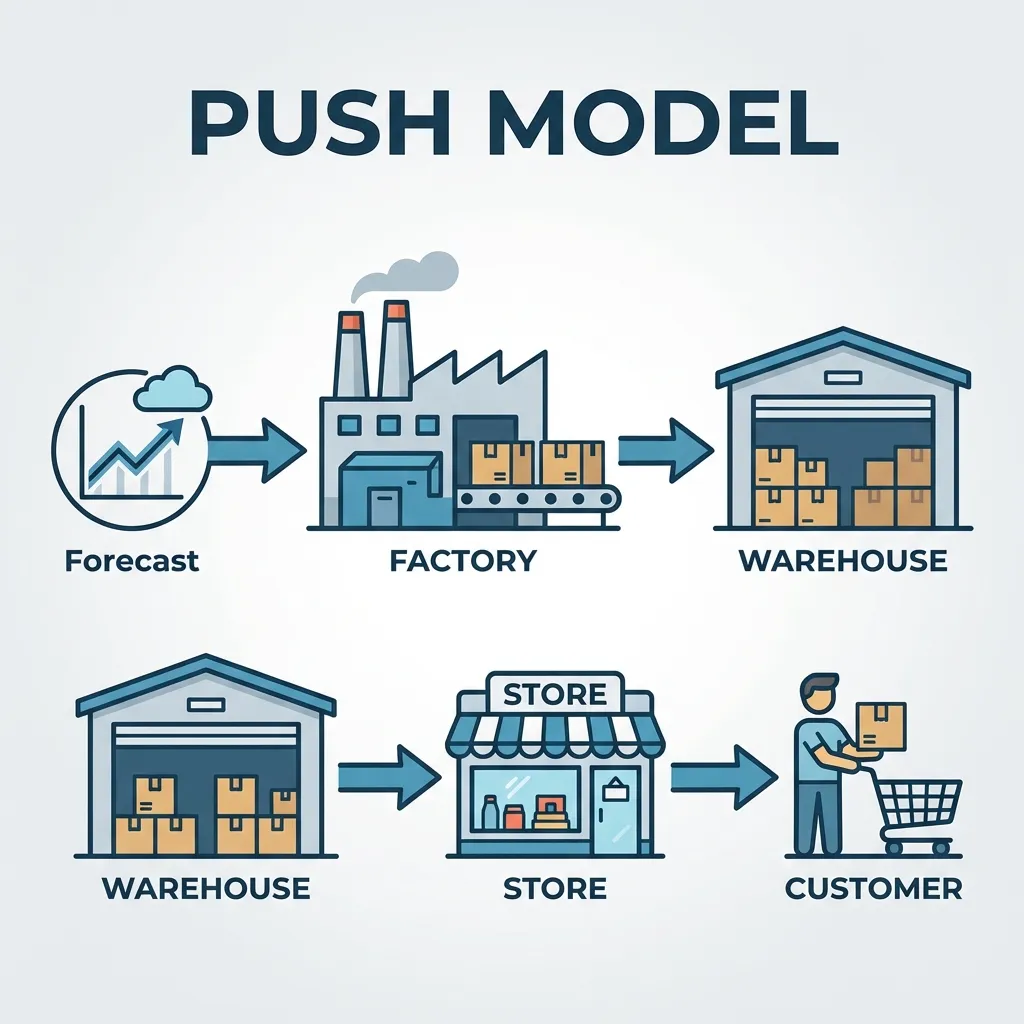
Push Model (Make-to-Stock)
Production is based on forecasts of future demand.
🔮
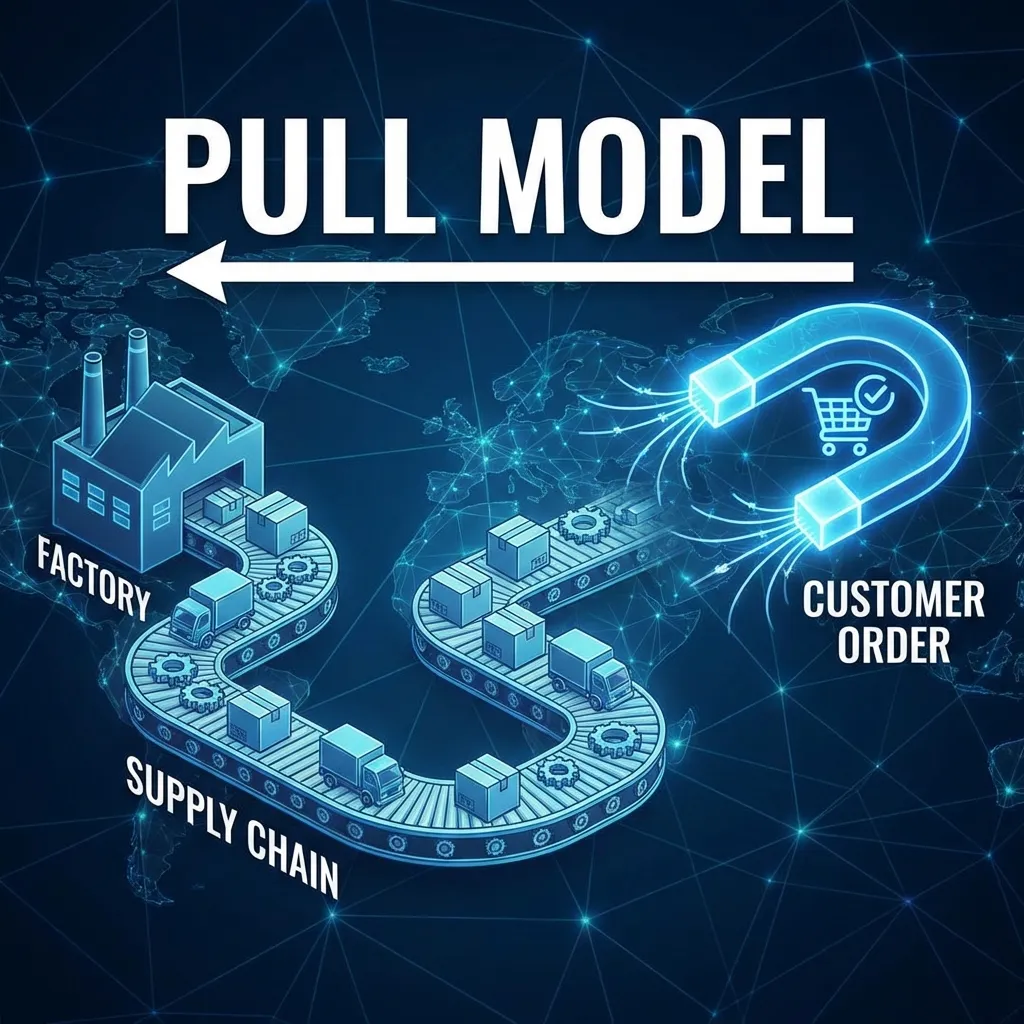
Pull Model (Make-to-Order)
Production begins only after a customer order is received.
🙋
🔍 The Push Model: Make-to-Stock
Companies produce goods in anticipation of demand and "push" them into the market.
- Advantage: Products are immediately available, leading to high customer satisfaction for common goods.
- Disadvantage: High risk of overstock (costly inventory) or stockouts (lost sales) if forecasts are inaccurate.
Example: Fast-Moving Consumer Goods (FMCG) like Wai Wai noodles or Coca-Cola. Production isn't tied to individual customer purchases.
🔍 The Pull Model: Make-to-Order
A customer order "pulls" the product through the manufacturing and delivery process.
- Advantage: Low inventory risk and high potential for product customization.
- Disadvantage: Customers must wait longer to receive their product. Not suitable for all goods.
Example: Dell computers. Each PC is assembled according to the specific components a customer selects online.
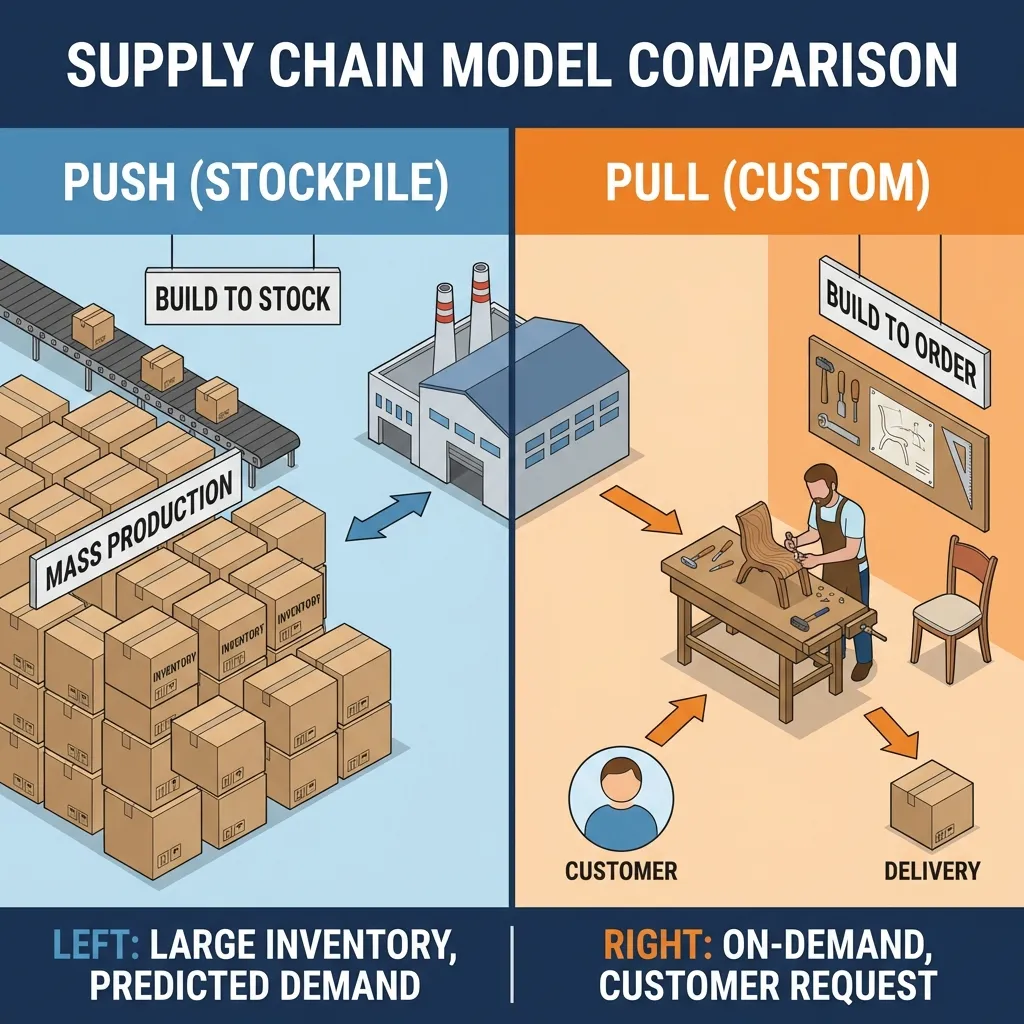
Push vs. Pull: At a Glance
Push Model ➡️
- Trigger: Forecast
- Focus: Resource allocation
- Inventory: High
- Customization: Low
- Customer Wait Time: Short
Pull Model ⬅️
- Trigger: Customer Order
- Focus: Responsiveness
- Inventory: Low
- Customization: High
- Customer Wait Time: Long
Many companies use a hybrid model, pushing core components and pulling final assembly.
🎯 Quiz: Push or Pull?
Application in Nepal 🇳🇵
Let's consider the local context.
Case Study: Daraz Nepal
Daraz operates on a complex hybrid model:
- Push Element: For popular items ("Fulfilled by Daraz"), they are pre-stocked in warehouses based on sales forecasts to ensure fast delivery in Kathmandu valley.
- Pull Element: For most third-party sellers, the order from a customer on Daraz.com.np "pulls" the product from the seller, who then packages and sends it to a Daraz hub for delivery.
This hybrid approach balances inventory costs with the need for quick delivery on high-demand products.
🛍️ Simulation: Daraz Order Tracker
Key Takeaways
- SCM is the strategic management of material, information, and financial flows.
- The five components are Plan, Source, Make, Deliver, and Return.
- The Push Model is proactive, based on forecasts, and risks inventory issues.
- The Pull Model is reactive, based on customer orders, and can lead to longer wait times.
- Effectively managing the supply chain is a critical source of competitive advantage.
Discussion Questions
- Is a push or a pull model more appropriate for a company that sells fresh, perishable food like dairy products? Why?
- What are the main challenges in managing the "Return" component of a supply chain for an e-commerce company?
- How can information technology (like BI tools or AI) help a company improve its demand forecasting in a push model?
Thank You!
Any questions?