Unit 4.2
A Guide to Wireless Technologies: From Bluetooth to 5G
Learning Objectives
By the end of this chapter, you will be able to:
- ✅ Categorize wireless technologies based on their effective range.
- ✅ Describe the common uses of short-range technologies like Bluetooth and NFC.
- ✅ Explain the role of Wi-Fi in creating Wireless Local Area Networks (WLANs).
- ✅ Understand the evolution and capabilities of wide-area cellular networks, including 5G.
Categorizing Wireless by Range 📊
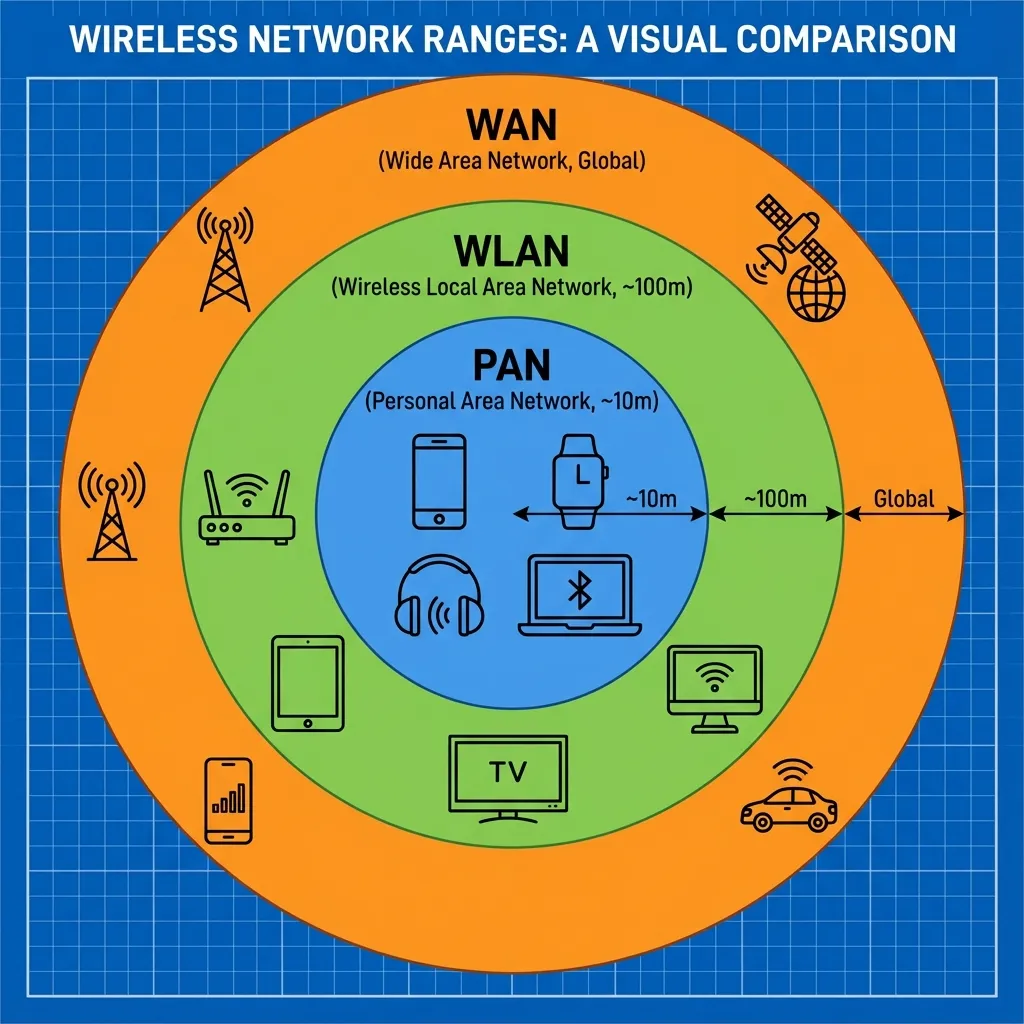
Wireless technologies use radio waves to connect devices. We classify them by their effective communication distance.
Short-Range
Personal Area Networks (PANs)
Range: A few meters
Examples: Bluetooth, NFC
Medium-Range
Wireless Local Area Networks (WLANs)
Range: A room, a building
Examples: Wi-Fi, Wi-Fi Direct
Wide-Area
Wide Area Networks (WANs)
Range: City, country, global
Examples: Cellular (4G/5G), Satellite
Interactive: Sort Wireless Technologies by Range
Click a technology chip to select it, then click the correct range category to place it.
Short-Range (PAN)
Medium-Range (WLAN)
Wide-Area (WAN)
1. Short-Range: Personal Area Networks (PANs)
Definition: Technologies designed to connect devices over a small area, typically within a single room or to a person.
Bluetooth
Low-power standard for connecting peripherals.
- Headphones, Keyboards
- Smartwatches, Fitness Trackers
Near Field Communication (NFC)
Extremely short-range (a few cm) for secure, simple communication.
- Contactless Payments
- Quick Device Pairing
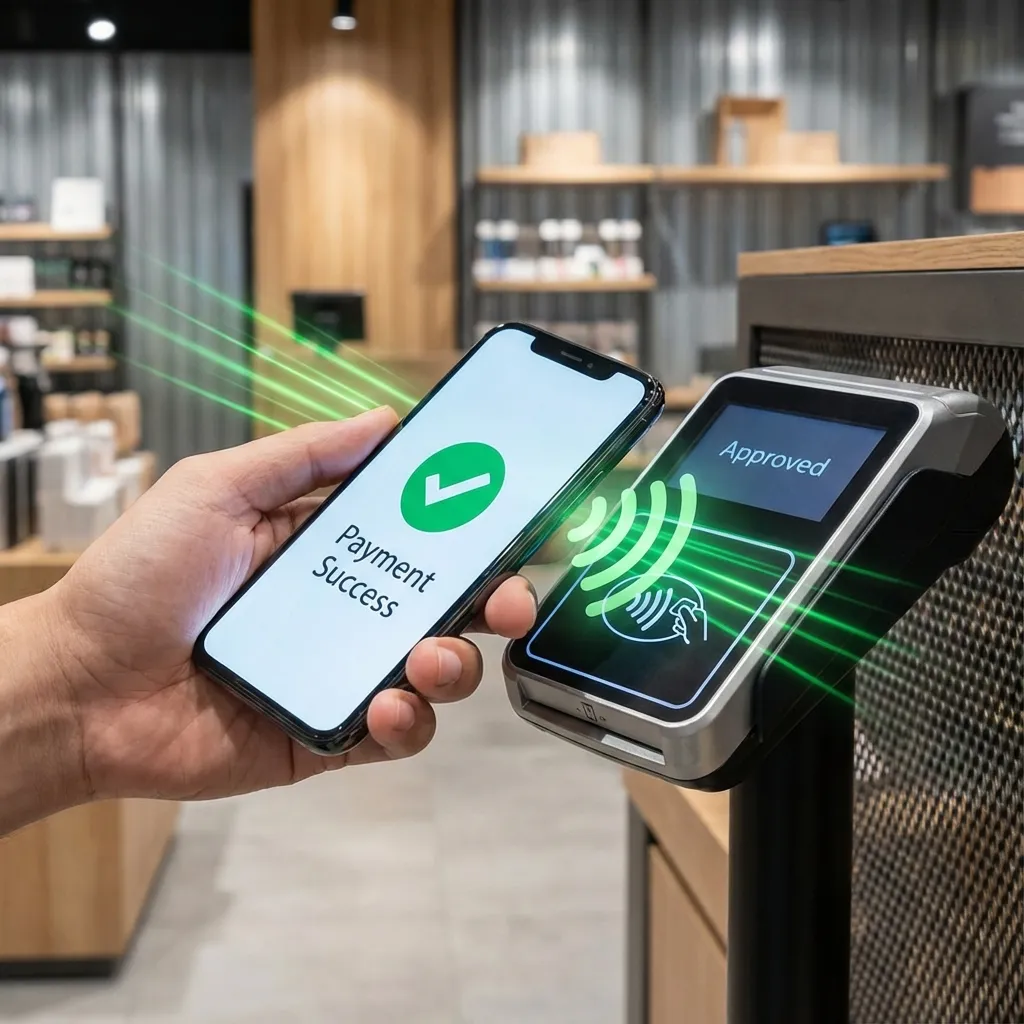
Focus: NFC for Contactless Payments
Key Use Case: Secure mobile payments.
How it works:
- Bring your phone or card within a few centimeters of the terminal.
- NFC creates a secure, temporary link.
- Payment information is exchanged instantly.
The extremely short range is a security feature—it prevents accidental or unauthorized transactions.
Interactive: NFC or Bluetooth?
For each scenario, pick the best wireless technology — then see why.
2. Medium-Range: Wireless LANs (WLANs)
Key Technology: Wi-Fi (Wireless Fidelity)
The most common technology for creating local networks in homes, offices, and public hotspots.
- Connects devices to the internet and each other via a wireless router.
- Based on IEEE 802.11 standards.
- Standards have evolved for higher speeds and better performance.
The Evolution of Wi-Fi ⚡
Each new standard brings improvements in speed, capacity, and efficiency.
802.11g- An early popular standard.802.11n(Wi-Fi 4) - Introduced multiple antennas for better speed/range.802.11ac(Wi-Fi 5) - Became the dominant standard with gigabit speeds.802.11ax(Wi-Fi 6/6E) - The current standard.
Why Wi-Fi 6 Matters: Higher speeds, lower latency, and dramatically better performance in crowded environments with many devices.
Interactive: Wi-Fi Standards Explorer
Click each card to reveal its speed, frequency band, and key improvement.
3. Wide-Area Wireless Networks
Definition: Networks providing wireless coverage over large geographical areas, like a city or country.
Cellular Networks
The backbone of mobile communication. Divides territory into "cells," each with a tower. Seamless handoffs as you move.
Satellite Communication
Provides connectivity to remote and rural areas where terrestrial infrastructure is unavailable. New LEO satellites are reducing latency.
The Evolution of Cellular: 1G to 5G
- 1G: Analog voice calls.
- 2G: Digital voice, SMS messaging.
- 3G: Basic mobile internet access.
- 4G (LTE): Fast mobile broadband, enabled quality video streaming.
- 5G: The current generation, a revolutionary leap forward.
Interactive: Match the Generation to Its Capability
Use the dropdowns to pair each cellular generation with its defining feature, then check your score.
Deep Dive: What Makes 5G a Game-Changer?
Massive Speed
Multi-gigabit speeds, allowing for near-instant downloads of large files.
Ultra-Low Latency
Minimal delay between sending and receiving signals. Critical for real-time applications like autonomous vehicles and remote surgery.
Massive Connectivity
Ability to connect a huge number of devices simultaneously. The key enabler for the Internet of Things (IoT).
Interactive: Classify 5G Use Cases
Click a use case to select it, then click the correct 5G pillar to place it there. Check your answers when done.
Massive Speed
Ultra-Low Latency
Massive Connectivity
Practical Application: Wireless in Nepal 🇳🇵
Digital Payments
While NFC tap-to-pay is growing, QR code payments (like Fonepay, eSewa) are extremely popular in Nepal, serving a similar function for contactless transactions.
Wi-Fi Hotspots
Wi-Fi is ubiquitous in urban centers like Kathmandu and Pokhara, powering cafes, hotels, and homes with internet from ISPs like WorldLink and Vianet.
The Road to 5G
Nepal Telecom (NTC) and Ncell are actively conducting 5G trials. The future rollout could transform industries like tourism, telemedicine, and smart city infrastructure.
Summary & Key Takeaways 🎯
- Wireless technologies are categorized by range: short, medium, and wide-area.
- Bluetooth & NFC dominate the short-range for personal devices and secure payments.
- Wi-Fi is the standard for medium-range Wireless Local Area Networks (WLANs) in homes and offices.
- Cellular networks provide wide-area mobile connectivity, with 5G offering massive improvements in speed, latency, and device capacity.
Discussion Questions 🔍
- Why would you use NFC instead of Bluetooth for a mobile payment, considering security and ease of use?
- What are the key business advantages of 5G technology over 4G? Think beyond faster movie downloads.
- Besides speed, what other factors (e.g., security, range, number of devices) would you consider when choosing a Wi-Fi router for a small business?
Thank You
Any questions?
Next Up: Unit 4.5 - The Internet of Things (IoT)