Unit 2.1
Unit 2 Intro: Organizational Strategy and Information Systems
Learning Objectives
By the end of this introductory lesson, you will be able to:
- ✅ Define the relationship between organizational strategy, business processes, and information systems.
- ✅ Identify the major business pressures that influence modern organizations.
- ✅ Explain how information systems can be leveraged to create a competitive advantage.
- ✅ Understand why aligning IT with business goals is critical for success.
The Core Triangle of Modern Business
Success in today's digital world depends on aligning three critical components:
🎯 Organizational Strategy
Where are we going?
⚙️ Business Processes
How do we get there?
💻 Information Systems
What tools power our journey?
This unit is about understanding how these three elements work together.
The Core Triangle of Modern Business
Success in today's digital world depends on aligning three critical components:
🎯 Organizational Strategy
Where are we going?
⚙️ Business Processes
How do we get there?
💻 Information Systems
What tools power our journey?
This unit is about understanding how these three elements work together.
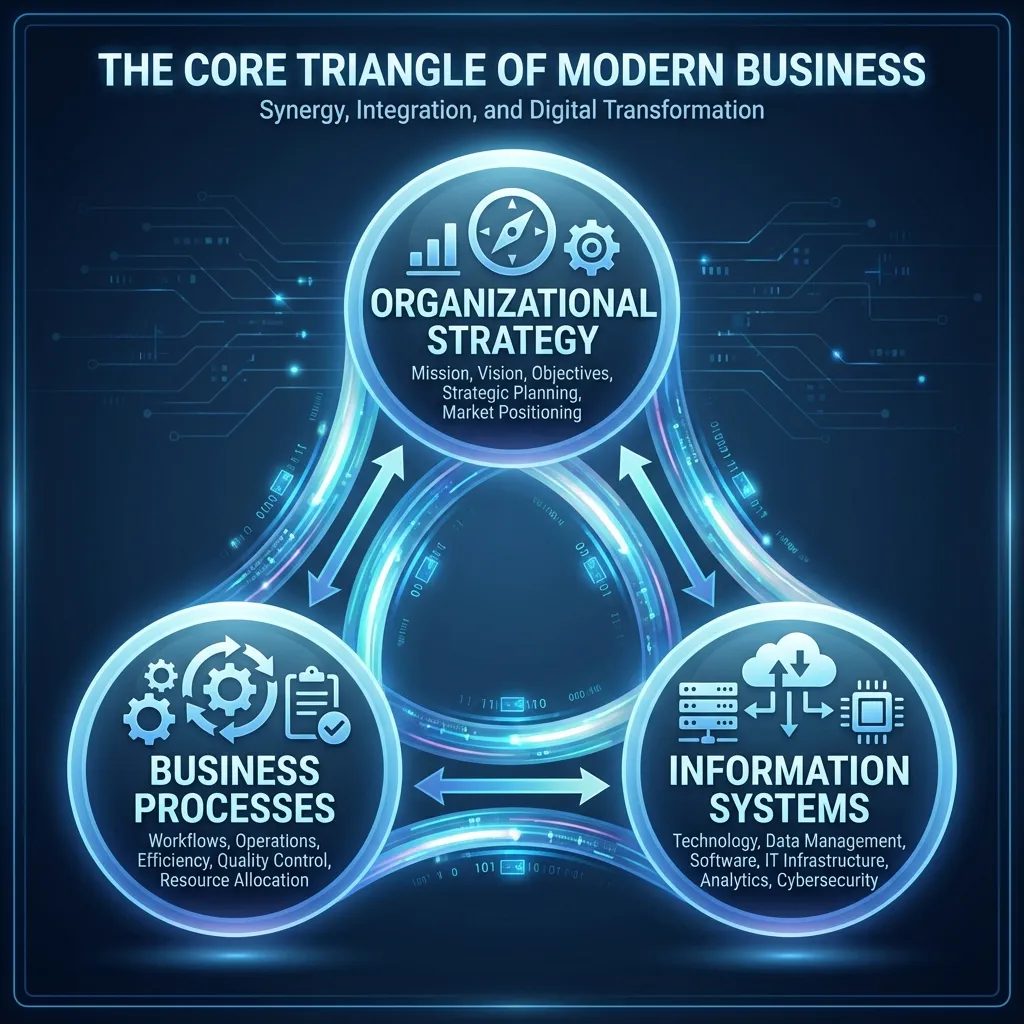
🔺 Interactive: Strategy→Process→IS Alignment
Strategy
Process
IS
What is Organizational Strategy?
Organizational Strategy is a high-level plan that identifies an organization's long-term goals and outlines the approach to achieving them in a competitive environment.
- It answers the question: "How will we compete?"
- Examples:
- Being the lowest-cost provider (e.g., a budget airline).
- Offering a premium, differentiated product (e.g., Apple).
- Focusing on a specific niche market (e.g., a luxury watchmaker).
What are Business Processes?
A Business Process is a collection of related, structured activities or tasks performed by people or equipment in which a specific sequence produces a service or product for a particular customer or customers.
Think of them as the "verbs" of a company—the actions that execute the strategy.
- Order Fulfillment Process
- New Employee Onboarding Process
- Customer Support Process
Connecting Strategy to Process
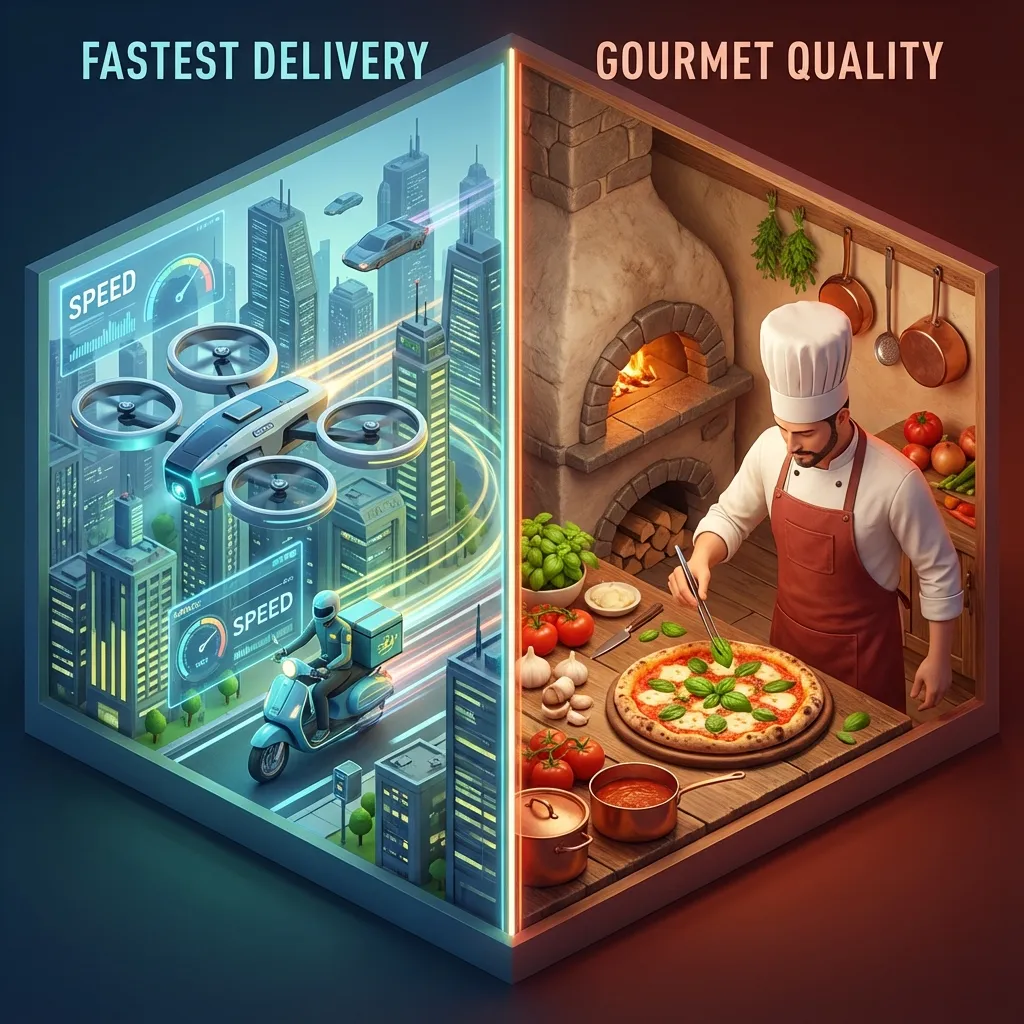
Your strategy determines your processes.
Strategy: Fastest Pizza Delivery
- Order-taking process must be instant.
- Kitchen process must be optimized for speed.
- Delivery routing process must be efficient.
Strategy: Highest Quality Gourmet Pizza
- Ingredient sourcing process is critical.
- Dough preparation process is slow and careful.
- Baking process uses specialized ovens.
🍕 Builder: Design Your Pizza Business IS
1. Choose Your Strategy
2. Pick the Best IS for Each Process
Enter Information Systems (IS) ⚡
Information Systems are the technology infrastructure and tools that support, automate, and enhance business processes.
Crucial Idea: IS is not just a support function. It's a strategic enabler that can fundamentally change how business processes are performed.
- From manual order-taking to an online ordering app.
- From paper-based accounting to an ERP system.
- From guessing delivery routes to using GPS-based optimization software.
The Constant Force: Business Pressures
No organization exists in a vacuum. They face constant pressures from their environment that force them to adapt.
📊 Market Pressures
Competition, changing workforce, powerful customers.
💻 Technology Pressures
Technological innovation, information overload.
🌍 Societal/Legal Pressures
Social responsibility, government regulations, ethical issues.

🌪️ Pressure Mapper: Identify Business Pressures
📊 Market
Pressures
💻 Technology
Pressures
🌍 Societal/Legal
Pressures
From Support to Strategic Advantage
How organizations view IT determines its impact.
Traditional View (IT as Support)
- Manages servers and networks.
- Fixes computer problems.
- Seen as a "cost center".
- Focus on operational efficiency.
Modern View (IT as Strategic Partner)
- Creates new products/services.
- Enables new business models.
- Seen as a "value driver".
- Focus on gaining competitive advantage.
💡 Toggle: IT as Cost Center vs. Value Driver
| IT Line Item | Expense View (Cost Center) | Strategic View (Value Driver) |
|---|---|---|
| Server Infrastructure | Rs 2.4M/yr — electricity, hardware refresh, cooling | 99.9% uptime → zero downtime for customers → trust & retention |
| IT Helpdesk (5 staff) | Rs 1.8M/yr salary — reactive problem-solving | Avg fix time 22 min → staff productivity up 18% → faster order processing |
| Software Licenses (ERP) | Rs 900K/yr — vendor fees, mandatory renewals | Real-time inventory → 35% less overstock → Rs 1.2M saved in warehouse costs |
| Cybersecurity Suite | Rs 600K/yr — "insurance no one sees" | Zero breaches → regulatory compliance → enterprise client contracts unlocked |
| Data Backup & DR | Rs 400K/yr — "just in case" storage costs | 4-hr recovery guarantee → SLA met → no penalty clauses activated |
🔍 Achieving Competitive Advantage
How do we win in the marketplace?
Competitive Advantage is any asset that provides an organization with an edge against its competitors in some measure such as cost, quality, or speed.
Information Systems are a primary way modern companies create a sustainable competitive advantage—one that is difficult for competitors to duplicate.
- Example: Amazon's massive logistics and recommendation systems.
- Example: Netflix's data analytics for content creation.
🏆 Nepal IS Advantage Builder
Practical Application: The Rise of Digital Wallets in Nepal
Case Study: eSewa / Khalti
- Strategy: Make financial transactions simple, accessible, and cashless for everyone in Nepal.
- Business Processes Re-engineered:
- Bill Payment (electricity, water, internet)
- Mobile Top-ups
- Fund Transfers
- Movie & Airline Ticketing
- IS as the Enabler: A robust mobile application and backend system that integrates with banks and service providers.
- Competitive Advantage: First-mover advantage, large user base, and a wide network of merchants, creating a powerful ecosystem that is hard to replicate.

Key Takeaways
- 🎯 Organizational strategy, business processes, and information systems are deeply interconnected. You cannot change one without affecting the others.
- 🌪️ Businesses must constantly respond to market, technology, and societal pressures to survive and thrive.
- ⚡ Information Systems have evolved from a simple support tool to a powerful strategic weapon for creating and sustaining a competitive advantage.
- 🔑 The goal is alignment: using technology to execute processes that achieve strategic goals, leading to true business transformation.
Thank You
Any questions?
Next Up: 2.2 - A Deeper Dive into Business Processes