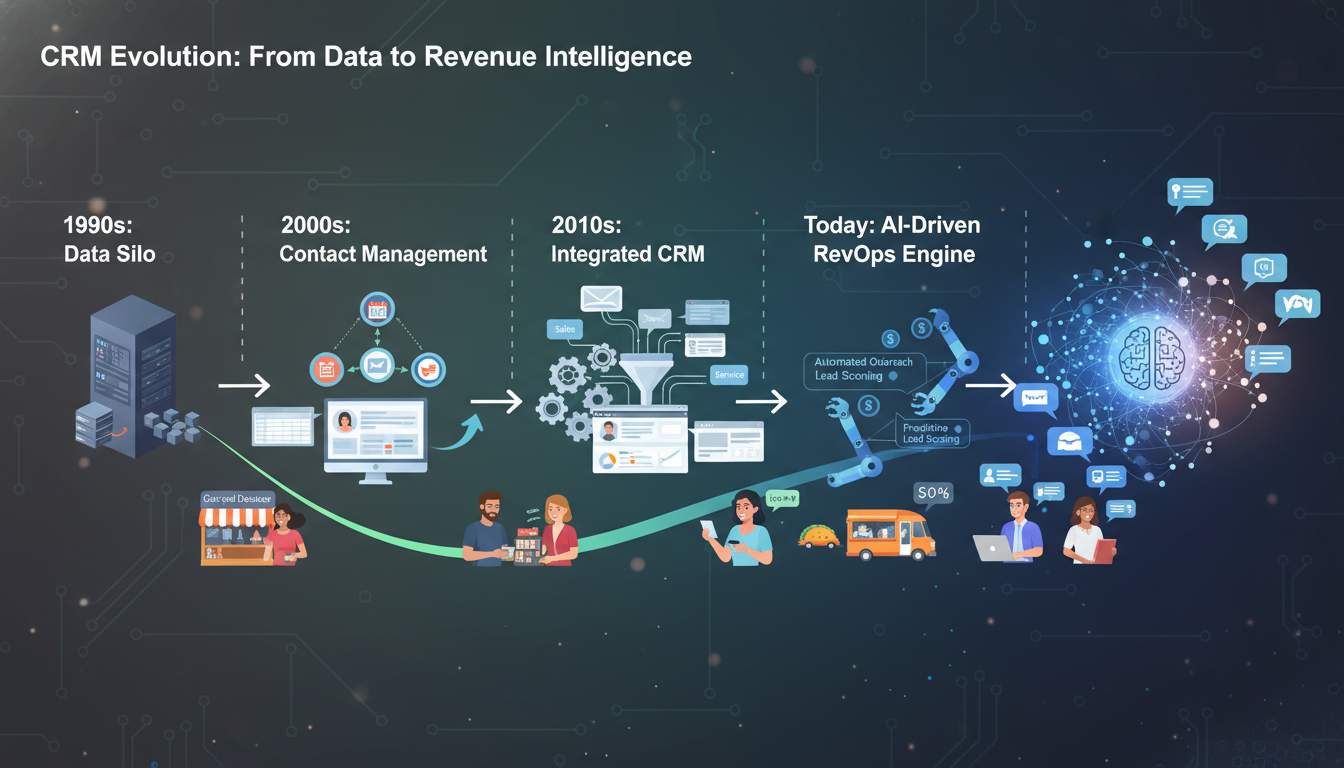
The customer relationship management (CRM) software ecosystem for small and medium-sized businesses (SMBs) has undergone a profound structural and philosophical transformation by 2026. What was historically utilized as a digitized repository for contact storage has definitively evolved into an artificial intelligence-driven revenue operations engine. The contemporary small business operating environment demands technological platforms that not only consolidate sales, marketing, and customer service but also provide actionable data analytics through deeply integrated automated workflows. The global CRM market, which reached a valuation of $73.40 billion in 2024, is currently expanding at a compound annual growth rate of 14.6%, reflecting the escalating reliance on these platforms as foundational business infrastructure.
The transition from localized spreadsheets and decentralized communication tools to unified, cloud-based CRM systems is no longer a luxury for small enterprises; it is a critical operational imperative. Empirical research indicates that organizations utilizing dedicated CRM systems achieve their sales targets 41% more frequently than those relying on fragmented data management strategies. Furthermore, approximately 45% of enterprises report direct, measurable increases in sales revenue immediately following a successful CRM implementation. However, the proliferation of over 800 available CRM applications creates a formidable paradox of choice for small business owners and regional technology procurement officers. Selecting the optimal software architecture requires navigating complex pricing structures, hidden scalability costs, varying degrees of implementation difficulty, and critical regional ecosystem compatibility.
This exhaustive report provides a peer-level, forensic analysis of the premier CRM platforms available for small businesses in 2026. It meticulously dissects the undisputed market leaders—HubSpot, Zoho CRM, Pipedrive, Freshsales, and Salesforce Starter—evaluating them through the rigorous lenses of total cost of ownership, user experience, artificial intelligence capabilities, and architectural flexibility. Additionally, the analysis deeply explores critical third-party integrations, such as advanced accounting software synchronization and the deployment of localized communication channels like WhatsApp. Special emphasis is placed on mapping the unique market dynamics of the Asia-Pacific region, with a highly specific focus on India and Nepal, addressing localized pricing, implementation partner networks, and regional tax compliance protocols.
The fundamental architecture of customer relationship management software has shifted drastically from passive data repositories to active, predictive business partners. The most proficient platforms operating in 2026 are characterized by their ability to intuitively process raw customer data into practical, immediately actionable insights. This evolution automates repetitive, low-value workflows, thereby easing the administrative burden on sales representatives and allowing them to focus entirely on relationship cultivation and deal closure. This monumental shift is primarily driven by the native integration of proprietary artificial intelligence models directly into the core CRM interface. Rather than merely offering standalone, rule-based chatbots, modern systems employ sophisticated AI to intelligently score inbound leads, draft highly personalized outreach emails based on historical communication patterns, dynamically route support tickets to the appropriate personnel, and uncover macro-level business trends that would otherwise remain hidden within complex datasets.
For small businesses, this technological democratization means that enterprise-grade automation and predictive analytics are now available at accessible, subscription-based price points. However, the operational definition of a “small business CRM” remains highly fragmented across different industries. A micro-enterprise or solo entrepreneur requiring a simple visual pipeline to track deals has vastly different software requirements than a rapidly scaling mid-market firm that demands multi-currency transaction support, advanced geographic territory management, and omnichannel marketing automation. Consequently, the software industry has segmented into distinct platforms specializing in specific operational philosophies. Some platforms champion an “all-in-one,” marketing-led approach designed to unify disparate departments, while others focus exclusively on accelerating the sales pipeline or providing highly customizable, modular ecosystems for complex technical requirements.
The ultimate success of any CRM deployment is intrinsically linked to sustained user adoption by the frontline sales and marketing teams. Industry data consistently indicates that overly complex platforms force high abandonment rates among small teams that lack dedicated, full-time IT administrators to manage the software. Therefore, an optimal small business CRM must carefully balance sophisticated underlying capabilities with an approachable, low-friction user interface. Organizations must conduct rigorous internal audits of their technical proficiency before committing to a platform, as selecting a system that exceeds the team’s operational maturity often leads to the phenomenon known as a “dusty CRM”—a costly software investment that no one in the organization actually utilizes.
Choosing the correct CRM requires a methodical evaluation framework that extends far beyond a simple comparison of feature lists. As of 2026, the evaluation criteria for small businesses center on pricing transparency, user experience, pipeline management efficacy, cloud accessibility, integration breadth, and the quality of ongoing customer support.
Total Cost of Ownership (TCO) is arguably the most critical metric for small businesses. While many platforms advertise highly attractive base rates or even permanent free tiers, the true cost of the software often scales aggressively as the business expands its headcount, increases its database size, or requires access to advanced automation features. Predictable pricing is essential to prevent software expenditures from consuming an outsized portion of the operational budget.
Ease of use directly correlates with implementation speed and return on investment. The interface must be intuitive, allowing sales representatives to log calls, update deal stages, and generate reports without requiring extensive, multi-week training regimens. Furthermore, the platform must offer just the right amount of customization. While enterprise platforms like Salesforce provide limitless customizability through complex coding, small businesses require systems that allow for custom data fields, tailored sales stages, and personalized dashboards without the need to hire external software developers.
Pipeline management remains the functional core of the sales CRM. The software must provide a clear, visual representation of where every prospective deal stands within the sales funnel, alerting users to stalled negotiations and automatically prompting the next required action. Finally, robust integration capabilities are non-negotiable. The CRM must serve as the central nervous system of the business, seamlessly connecting with email clients, calendar applications, accounting software, and specialized marketing tools to ensure a unified flow of data across the entire organization.
The following section provides a comprehensive forensic analysis of the five dominant CRM platforms occupying the small business market in 2026, detailing their pricing architectures, core strengths, inherent limitations, and ideal deployment scenarios.
HubSpot has unequivocally established itself as the dominant force for organizations that prioritize inbound marketing and unified revenue operations. The platform’s architecture is uniquely designed to act as a single source of truth, housing dedicated Marketing, Sales, Service, Operations, and Content Hubs under one cohesive, cloud-based digital roof. The primary competitive advantage of HubSpot is its meticulously designed user interface, which consistently ranks highest for ease of use and features the shallowest learning curve among major platforms, heavily verified by thousands of independent user reviews on platforms like G2. Reviewers overwhelmingly praise its ability to centralize all sales activities and automate routine tasks without requiring dedicated technical intervention.
HubSpot’s immense market penetration is largely driven by its highly strategic freemium model. The foundational Free CRM offers a remarkably generous tier accommodating up to one million contacts and providing access to core functionalities such as visual deal pipelines, live chat integrations, and basic email tracking capabilities. This allows startups to organize their rudimentary sales processes with zero initial capital expenditure. The Starter tier, averaging $15 per user per month, provides an affordable, logical bridge for growing teams by removing HubSpot branding restrictions and raising operational limits.
However, deeper financial analysis reveals a significant scalability cliff that small businesses must anticipate.
As a small enterprise grows and requires advanced features—such as omnichannel marketing automation, predictive lead scoring, custom object creation, or multi-currency revenue forecasting—the transition to the Professional and Enterprise tiers represents an exponential cost increase. The Professional Marketing tier begins at $890 per month, which heavily restricts the number of marketing contacts and requires a mandatory $3,000 onboarding fee. The Sales Hub Professional tier costs approximately $100 per user per month, jumping to $150 per user for the Enterprise edition. This pricing architecture dictates that while HubSpot is exceptional for unifying disparate teams, the financial implications of scaling can be severe for bootstrapped or cash-conscious enterprises.
To mitigate this friction for early-stage companies, HubSpot operates an aggressive, highly structured startup discount program. Eligible startups with under $2 million in external funding can secure up to a 90% discount on premium software in their first year, tapering to 50% in the second year and a permanent 25% discount thereafter. Recognizing the importance of emerging markets, an international bootstrapped program also exists specifically for companies incorporated in regions like Asia, Africa, and Latin America, providing vital, discounted access to premium tools for global entrepreneurs who lack traditional venture capital backing.
From a technological standpoint, HubSpot continues to lead in artificial intelligence deployment. In 2026, the platform utilizes its “Breeze” AI architecture, deploying specialized Customer Agents, Data Agents, and Prospecting Agents designed to automate data entry, interpret buyer intent, and execute workflows autonomously, significantly amplifying the output of small sales and marketing teams.
In stark contrast to HubSpot’s unified but premium-priced model, Zoho Corporation offers a highly modular, deeply customizable, and intensely budget-conscious alternative. Zoho CRM is engineered specifically for small to medium businesses that require extensive process customization and are willing to navigate a slightly steeper initial learning curve in exchange for unparalleled financial value. The platform is globally recognized for democratizing enterprise-level features, bringing advanced analytics and territory management down to SMB pricing tiers.
Zoho’s pricing architecture is structured to accommodate highly granular scaling, making it deeply attractive to organizations that wish to pay only for the precise functionality they require. The Standard edition costs a modest $14 per user per month, providing essential tools such as mass emails, custom modules, workflows, and detailed sales forecasting. The Professional tier, priced at $23 per user per month, introduces “Blueprint,” a highly lauded, powerful tool designed for scaling organizations to enforce strict, step-by-step sales processes and manage complex configure-price-quote (CPQ) requirements. The Enterprise tier, available for $40 per user per month, unlocks comprehensive artificial intelligence capabilities through “Zia,” Zoho’s proprietary AI engine. Zia performs highly advanced functions such as automated anomaly detection, predictive sales forecasting, conversational data querying, and recommending the statistically optimal times to contact individual prospects.
A unique, foundational strategic advantage of Zoho is its broader software ecosystem. Zoho CRM natively integrates with over 50 internal applications built by the same vendor, spanning comprehensive accounting (Zoho Books), advanced project management (Zoho Projects), helpdesk ticketing (Zoho Desk), and robust email marketing (Zoho Campaigns). This allows a small business to run its entire operational stack on a single vendor’s architecture, drastically reducing the need for costly third-party middleware and eliminating the data silos that typically plague growing companies.
However, this extensive functionality inherently introduces complexity. Independent reviews and usability analyses frequently cite that Zoho’s interface can feel somewhat cluttered and dated compared to its modern competitors, and that initial implementation requires significantly more technical effort and configuration. Furthermore, users occasionally report frustrations regarding the speed and consistency of Zoho’s customer support when dealing with highly complex, technical integration issues.
To specifically address the needs of micro-enterprises and solo entrepreneurs transitioning away from simple spreadsheets, Zoho introduced Bigin. Priced at a highly accessible $9 per user per month, Bigin intentionally strips away the complexities and vast feature sets of the flagship CRM, focusing entirely on a streamlined, pipeline-centric experience. Bigin frequently wins editorial awards for its approachability, serving as an ideal, low-friction entry point for businesses that require basic organizational structure without the burden of feature bloat.
For small businesses where the primary organizational objective is purely accelerating the sales process and closing deals, Pipedrive emerges as a highly specialized, dominant solution. Conceived and built by sales professionals, Pipedrive utilizes an innovative “activity-based selling” methodology. Rather than focusing merely on stagnant data entry, the system continually prompts representatives with the next logical action required to advance a deal, ensuring that opportunities do not stagnate or expire within the pipeline.
The platform is universally lauded for its highly visual, drag-and-drop interface that makes complex pipeline management instantly comprehensible for users of all technical backgrounds. Pipedrive intentionally avoids the feature bloat associated with marketing-heavy suites or enterprise-resource-planning (ERP) adjacent systems, focusing its engineering resources relentlessly on intuitive deal tracking, two-way email synchronization, and rigorous activity scheduling.
Pricing for Pipedrive is highly transparent, scalable, and competitive. The foundational Lite plan begins at $14 per user per month, offering core pipeline management, basic AI-powered report creation, and integration access to over 500 third-party applications. The Growth plan at $39 per user per month introduces full email synchronization and basic automated nurturing sequences, while the highly popular Premium plan at $59 per user per month introduces sophisticated lead routing, custom scoring models, and AI-powered multi-email drafting tools. A critical architectural distinction is that Pipedrive charges for certain lead generation add-ons per company rather than per user. For instance, the LeadBooster add-on (starting at $32.50) provides chat functionality, web forms, and chatbot capabilities across the entire organization, allowing businesses to control auxiliary costs effectively as their headcount expands.
While highly effective for dedicated outbound sales teams, Pipedrive’s specialized nature inherently acts as a double-edged sword. It fundamentally lacks native, deep-tier marketing automation, sophisticated customer support ticketing, and complex ERP functionalities. Small businesses looking for a unified, cross-departmental platform will find themselves relying heavily on third-party integrations and middleware to achieve complete organizational alignment, which can introduce secondary costs and data management complexities.
Freshsales, part of the broader Freshworks technology suite, occupies a strategic, highly competitive middle ground between the extreme simplicity of Pipedrive and the comprehensive, enterprise-adjacent feature sets of HubSpot and Zoho. It is highly regarded by industry analysts as a robust, capable solution for growing mid-sized businesses that demand technical sophistication but actively wish to avoid the steep pricing cliffs associated with legacy enterprise platforms.
The defining architecture of Freshsales in 2026 is built intrinsically around “Freddy AI,” a native artificial intelligence engine that acts as an omnipresent co-pilot for sales representatives. Freddy AI is embedded deeply within the user workflow, offering sophisticated contact scoring, predictive revenue forecasting based on historical win patterns, and advanced generative text capabilities allowing users to effortlessly rephrase, expand, and enhance email text directly within the CRM’s composer. The platform also sharply distinguishes itself from competitors by including built-in telephony and live chat natively within its core interface, eliminating the immediate need for small businesses to procure external, specialized communication software.
Freshsales offers a highly capable Free plan designed for up to three users, which remarkably includes visual sales pipelines, email templates, and built-in communication tools, making it highly attractive for micro-startups. The paid tiers are aggressively priced to capture market share, with the Growth plan starting at $9 per user per month (offering AI-driven contact scoring and custom sales activities) and the Pro plan at $39 per user per month, which introduces advanced capabilities such as multiple sales pipelines, territory management, and complex workflow automations.
User sentiment and feedback for Freshsales consistently highlight a highly positive experience with its intuitive user interface, comprehensive email tracking, and ease of onboarding. However, a recurring and notable criticism involves the platform’s native reporting engine.
Users frequently note that customizing reports to fit highly specific, niche business needs can be challenging without advanced technical skills, and that complex data filtering can occasionally cause system lag or interface glitches during high-volume activity. Despite these reporting limitations, the platform’s exceptional cost-to-feature ratio makes it a formidable, highly logical competitor in the small business sector.
Salesforce is universally recognized as the undisputed enterprise standard for customer relationship management, historically deemed far too complex, rigid, and expensive for the agile needs of small businesses. To aggressively capture the expanding SMB market, the company introduced the Salesforce Starter Suite. Priced at a highly competitive $25 per user per month, this iteration is specifically engineered to consolidate essential sales, customer service, and marketing tools into a single, simplified interface.
The Starter Suite offers a highly guided, frictionless onboarding experience, intentionally stripping away the labyrinthine customization menus, complex metadata rules, and overwhelming administrative requirements of the flagship Sales Cloud. It provides built-in sales flows, simplified case management for customer support, and dynamic email marketing capabilities capped at 2,000 sends per month. Furthermore, it integrates native e-commerce and payment capabilities, allowing small businesses to quickly build branded storefronts and dispatch secure payment links directly from within the CRM environment.
The strategic intent behind the Starter Suite is to offer small businesses a gateway into the broader Salesforce ecosystem. The primary, undeniable advantage is the foundational architecture; a small business that begins on the Starter Suite can seamlessly upgrade to the Pro Suite ($100 per user per month) or the full Enterprise editions without undergoing a massive, risky data migration process as the company scales its operations. Conversely, the Starter Suite imposes rigid limitations to prevent cannibalizing Salesforce’s higher tiers. It entirely lacks access to the vaunted AppExchange for third-party integrations, heavily restricts advanced workflow automation, and omits complex sales quoting (CPQ) functionalities. For small businesses that do not realistically anticipate graduating to enterprise-level complexity within three to five years, investing in the Salesforce Starter Suite may ultimately prove more restrictive and isolating than adopting a platform natively and exclusively built for the SMB scale.
Beyond the primary market leaders, the 2026 landscape features several highly capable platforms tailored for highly specific operational requirements:
CRM Platform
Target SMB Demographic
Base Paid Tier (Monthly/Annual)
Primary Technological Strength
Primary Architectural Limitation
HubSpot
Scaling, marketing-led SMBs
~$15 / user (Starter)
Unmatched UI, Inbound marketing, AI agents
Exponential scaling costs, per-contact limits
Zoho CRM
Value-driven, process-oriented
$14 / user (Standard)
Extreme customizability, massive internal ecosystem
Steeper learning curve, UI complexity
Pipedrive
Pure sales/outbound teams
$14 / user (Lite)
Intuitive visual pipeline, activity-based selling
Lacks deep native marketing/support tools
Freshsales
Mid-market, value-seeking teams
$9 / user (Growth)
Built-in telephony/chat, robust Freddy AI
Advanced reporting constraints, UI lag
Salesforce
SMBs planning massive enterprise scale
$25 / user (Starter Suite)
Seamless upgrade path to Enterprise SFA
No AppExchange access, strict feature limits
A CRM system cannot and should not operate in a technological vacuum. Its true efficacy is directly proportional to its ability to seamlessly synchronize with the broader technological stack of the enterprise. For small businesses operating in 2026, the synchronization of front-office sales data with back-office financial reality is a critical operational hurdle that must be overcome to maintain accurate revenue reporting.
Small businesses in Western markets predominantly rely on specialized, cloud-based accounting software such as QuickBooks, Xero, and FreshBooks. Integrating these financial systems with the CRM completely eliminates dual data entry, drastically reduces human error in invoice generation, and provides frontline sales teams with real-time, actionable visibility into customer credit limits, payment histories, and outstanding balances. Platforms like HubSpot, Pipedrive, and Freshsales offer robust, native connectors for global accounting platforms. For instance, Freshsales integrates intimately with QuickBooks to automate the transition from a “closed-won” deal stage directly into a generated, legally compliant invoice.
However, in massive, rapidly digitizing emerging markets like India and Nepal, Tally (specifically TallyPrime and Tally.ERP 9) is the ubiquitous, undisputed standard for financial management and tax compliance. Native integration between Western-built global CRMs and Tally requires highly specialized middleware to function correctly. Integrations built by companies like ApiX-Drive and Commercient serve as the vital technological bridge, capturing data from online web forms or CRM deal stages and pushing them directly into Tally ledgers. This ensures precision in closing balances, effort-free quotation-to-invoice transitions, and harmonious item master control. Advanced middleware solutions manage the bidirectional flow of data, ensuring that sales representatives working in HubSpot or Salesforce can view Tally inventory levels in real-time before committing to a client order.
Zoho CRM holds a distinct, overwhelming regional advantage in this specific domain. Not only does Zoho offer its own highly capable, localized accounting software—Zoho Books—which acts as a modern, cloud-based alternative to Tally, but it also provides a dedicated, native Zoho Inventory-Tally connector. This native ecosystem linkage allows for the seamless, error-free migration of master data, sales transactions, and multi-currency operations without relying on complex, third-party API configurations or expensive middleware subscriptions, greatly simplifying the technological overhead for Asian MSMEs (Micro, Small, and Medium Enterprises).
In North American and European markets, email remains the primary, accepted conduit for B2B sales outreach and customer communication.
However, in regions such as Latin America, Africa, and crucially, Asia, WhatsApp has completely superseded email as the de facto communication protocol for both B2C and B2B interactions. An MSME attempting to operate a CRM that cannot natively capture, log, and automate WhatsApp conversations is fundamentally compromised in these markets, actively losing leads and revenue to communication friction.
Modern businesses require systems where inbound WhatsApp inquiries instantly create new contact records, assign leads to the appropriate sales representative via round-robin routing, track follow-ups automatically, and trigger automated nurturing sequences. The global CRM market has aggressively responded by developing deep, varied integrations with the WhatsApp Business API.
CRM Platform
WhatsApp Integration Status
Setup Complexity
Automation & AI Capabilities
Clientify
Native Integration
Plug & Play
Deep AI integration tailored for conversational sales
Salesforce
Native (via Service Cloud)
Complex
Advanced routing, comprehensive AI handling
HubSpot
Native Integration
Easy to Moderate
Supported via workflows, limited native conversational AI
Zoho CRM
Native Integration
Moderate (Requires configuration)
Limited AI within the WhatsApp module
Pipedrive
Native Integration
Plug & Play
Highly dependent on third-party connector capabilities
Implementing WhatsApp effectively via a CRM allows organizations to maintain a crucial “unified inbox,” ensuring that all customer dialogue is securely tied to the central CRM contact record rather than being dangerously siloed on an individual sales representative’s personal mobile device. For micro-enterprises operating on basic or free CRM tiers that do not support native API connections, relying on robust third-party connectors like Zapier or Make (formerly Integromat) provides a highly cost-effective method to bridge the WhatsApp Business application with their CRM until their revenue can justify upgrading to premium software tiers. Furthermore, specialized regional conversational marketing platforms, such as KwikEngage, Chatarmin, and Wati, have emerged to provide deep, e-commerce-focused WhatsApp automation for SMBs that require greater conversational agility than traditional CRMs offer natively.
The geographic location of a small business significantly influences its optimal CRM selection, heavily dictated by currency constraints, localized support hours, taxation compliance, and the availability of certified partner networks. In 2026, the South Asian market, particularly nations like India and Nepal, demonstrates a rapid, exponential acceleration in cloud CRM adoption, fueled by dramatically improving internet infrastructure across cities like Kathmandu, Pokhara, and Biratnagar, alongside a national mandate for digital transformation.
Software as a Service (SaaS) pricing typically denominated in United States Dollars (USD) creates substantial financial volatility for enterprises operating in emerging markets due to constantly fluctuating exchange rates. For example, the exchange rate between the Indian Rupee (INR) and the Nepalese Rupee (NPR) remains relatively pegged (historically hovering around 1.6 NPR to 1 INR), but both fluctuate significantly against the USD, making fixed software budgeting exceptionally difficult. Vendors that offer localized pricing and billing directly in local currencies immediately gain significant market share. Zoho CRM is highly aggressive and successful in this area, offering fully customized pricing tiers for the Indian subcontinent that often fall well below the converted USD equivalent of western competitors. HubSpot users frequently seek to transition their accounts from USD to INR to capitalize on this localization, though navigating these account transitions can occasionally require direct support intervention.
Furthermore, the availability of technical support operating within the Asia-Pacific (APAC) timezone is a critical differentiator for businesses that cannot afford 24-hour operational delays. HubSpot mitigates this by operating robust regional headquarters in Singapore, Sydney, and Tokyo to ensure overlapping, localized support hours for its APAC clientele. Freshworks, leveraging its strong foundational Indian heritage, maintains an extensive and dominant APAC footprint. It utilizes its Singapore regional office, established specifically to cater deeply to ASEAN nations, alongside its massive operational base in India to provide localized, 24/7 dedicated professional services and immediate technical remediation.
In developing markets like Nepal, the complex transition from manual spreadsheets to a fully automated CRM is rarely executed completely in-house. Businesses rely heavily on the expertise of local system integrators and technology consulting firms to bridge the knowledge gap and ensure successful deployment. The capital city, Kathmandu, hosts a rapidly growing, sophisticated directory of certified CRM implementation partners. Firms such as Cynoteck Technology Solutions, MetaDesign Solutions, Digital Consulting Ventures, and Infinite IT Solutions provide highly specialized services ranging from complex Salesforce architecture design to custom HubSpot API developments and deep Zoho CRM process mapping. Engaging these local partners is absolutely crucial for aligning the global CRM architecture with regional operational realities, such as implementing multi-language support, ensuring offline mobile capabilities for field representatives navigating difficult terrain, and configuring GST-ready invoicing modules.
Furthermore, strict regulatory compliance regarding digital taxation is paramount. Software utilized by regional businesses must integrate seamlessly with Global Tax Compliance engines—such as Stripe Tax or Sphere—or possess the built-in, native capabilities to handle Goods and Services Tax (GST), Value Added Tax (VAT), and Tax Deducted at Source (TDS) reporting requirements. Accounting-centric CRMs or those tightly integrated with localized ERPs (such as Zoho Books or regional solutions like Fraxinus Books and HostBooks Accounting) ensure that the generation of sales orders and e-invoices complies automatically with rigorous regional government mandates without requiring manual tax calculations.
Additionally, the unique pressures of the Nepalese market have catalyzed the rise of highly capable, hyper-localized CRM and scheduling software. Platforms like moCal offer an integrated, 7-in-1 suite tailored specifically for local professionals and agencies, bypassing the complexity of international tools. Similarly, regional solutions like Kumari Job CRM are emerging to provide smart, localized lead management tools expressly designed for domestic businesses that find international enterprise software either functionally too rigid, lacking in local nuance, or simply economically prohibitive.

The financial acquisition of a software license represents merely a fraction of the overall CRM journey. The implementation phase is the critical juncture where the theoretical value of the system is either fully realized or permanently lost. Industry analysis suggests that a poorly managed implementation results directly in a “dusty CRM”—a system characterized by low data integrity, massive user resistance, and eventual, total abandonment. For a standard small business with under 50 employees, a comprehensive CRM implementation timeline averages approximately three months, segmented sequentially into three distinct, non-negotiable phases.
The initial phase involves rigorous, unsparing internal auditing. Organizations must meticulously map their existing sales processes, defining the exact origin of inbound leads, the specific, sequential steps required to close a deal, and the key personnel involved at each customer touchpoint. This process clarity dictates the precise technical requirements of the platform. The evaluation process includes soliciting vendor demonstrations, analyzing security compliances (e.g., SOC 2, GDPR, ISO 27001), and ensuring strict alignment with long-term budgetary constraints. Engaging end-users (the frontline sales representatives) early during this phase is vital to ensure the chosen interface aligns with their technological proficiency and daily workflow realities.
This represents the most technically perilous phase of the entire project. Organizations must map historical data—which is often chaotically scattered across legacy systems, individual email inboxes, and disparate spreadsheets—into the precise, structured fields of the new CRM architecture. Clean, lossless data migration is the absolute bedrock of long-term system integrity. Simultaneously, the platform must be customized to mirror the business. This involves defining specific deal stages, automating repetitive administrative tasks via complex workflow rules, and establishing strict access permissions based on user roles and hierarchies. The deployment of native AI tools occurs here; configuring advanced algorithms to accurately analyze historical win patterns or establish functional lead scoring matrices requires careful, nuanced calibration based on pristine historical data.
The technical launch of the software must be accompanied by comprehensive, empathetic organizational change management.
It is highly recommended to roll out the system during a slower operational period to minimize business disruption. Training should never be a monolithic event; it must be conducted in small, role-specific cohorts rather than broad, generic seminars. The true, final metric of implementation success is not the system going live, but the permanent behavioral shift of the sales team transitioning entirely into the CRM ecosystem. Gamification strategies, which are integrated deeply into platforms like Zoho CRM and Pipedrive, can aggressively accelerate this adoption by fostering healthy team competition and actively rewarding high-fidelity data entry and consistent system utilization.
The determination of the single “best” CRM for a small business in 2026 cannot be achieved through a monolithic, universal ranking; the optimal choice is entirely contingent upon an organization’s unique structural DNA, its geographic operational location, and its specific growth trajectory over the next five years. The comprehensive analysis demonstrates that the market has matured significantly, shifting away from generic databases to offer highly specialized, AI-augmented solutions designed for distinct business models.
For organizations where aggressive inbound marketing lead generation is the primary growth engine, and minimizing software friction for non-technical users is paramount, HubSpot remains the premier, undisputed choice. Its incredibly intuitive design guarantees high user adoption rates, though organizational leadership must meticulously model the steep financial scaling costs associated with its premium tiers to avoid future budgetary crises.
Conversely, for process-oriented businesses seeking to construct a comprehensive, fully integrated digital operating system on a strict budget, Zoho CRM provides an unmatched technological ecosystem. Its unique ability to natively link CRM, accounting software, and advanced AI analytics makes it an exceptionally powerful, albeit more complex and technically demanding, alternative.
Sales-dominated environments that view software strictly as a focused tool to accelerate deal velocity and streamline representative activity should undoubtedly prioritize Pipedrive. Its visual, activity-based architecture eliminates cognitive load for sales representatives, ensuring maximum daily efficiency without the distraction of marketing features they will never utilize. Meanwhile, Freshsales offers a highly compelling, optimal hybrid solution, integrating cutting-edge AI assistance, robust automation, and built-in telephony at highly aggressive price points, making it a highly attractive option for scaling mid-market entities seeking high value.
Finally, regional operational requirements must heavily influence, and often dictate, software procurement. For businesses operating in the vibrant markets of the Asia-Pacific, particularly within India and Nepal, ensuring that the chosen CRM offers native WhatsApp API integrations, synchronizes flawlessly with localized accounting tools like Tally, accommodates local currency pricing, and provides accessible, culturally aligned regional support is strictly non-negotiable. Technology leaders and business owners are advised to look far beyond baseline feature sets and marketing collateral, prioritizing platforms that demonstrate deep architectural flexibility and an acute understanding of local economic realities. Aligning the software intimately with both the strategic macro-vision of the enterprise and the daily, micro-realities of the end-user will guarantee that the CRM acts not as a static, expensive ledger, but as a dynamic, intelligent catalyst for sustained revenue growth and operational excellence.